





























Which Camassia to choose and how to pair it in the garden?
All the criteria for selecting Quamash
Contents
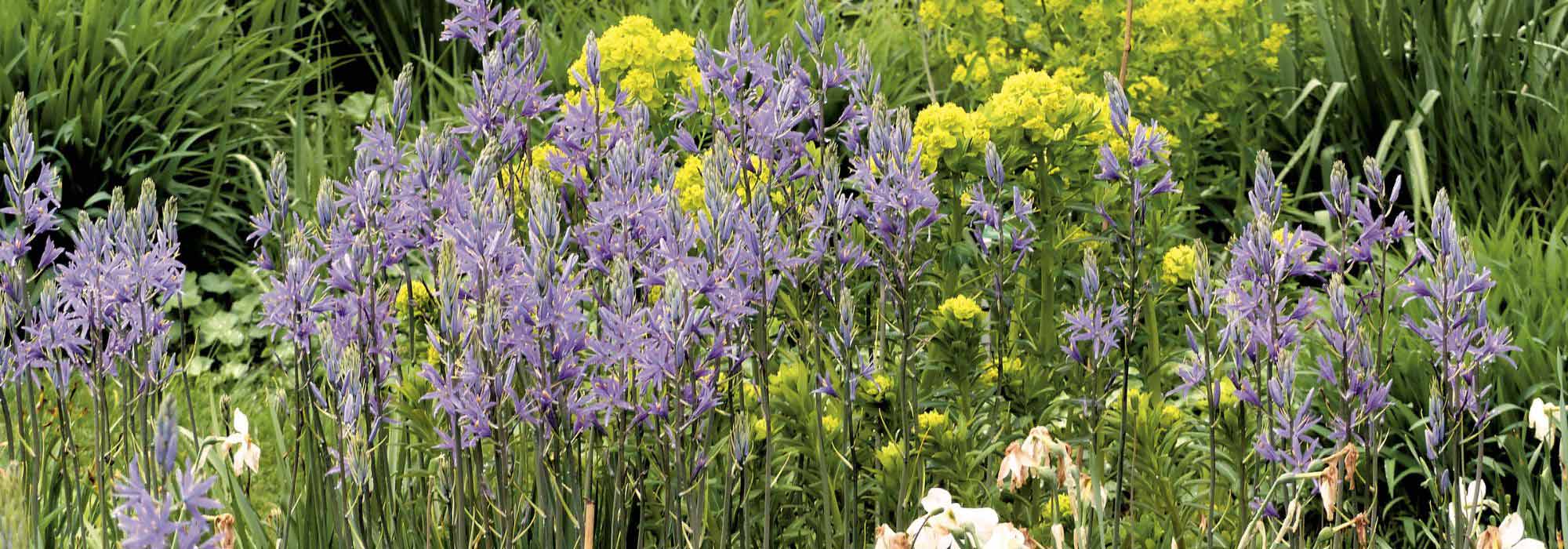
Camassia (or Quamash) is a bulbous perennial that is gaining popularity. It’s no surprise considering its ease of cultivation, its tendency to naturalise, its low maintenance, and of course, its beauty. With long green or variegated foliage depending on the species and varieties, long and sturdy flower spikes rise elegantly between April and June depending on the cultivars. Organised in spikes at the top of these stems, the star-shaped flowers display shades from white to deep blue, including various hues of mauve and violet.
Preferring cool soils during the growing season but well-drained in winter, the Camassia thrives in non-scorching sun or partial shade, in all types of soil, even quite clayey ones. This accommodating perennial exhibits a naturalness and spontaneity that is welcome in the garden. How do you choose between the different varieties available? What criteria should you consider based on your desires and tastes? Discover the characteristics and differences you can take into account when planting them in the garden or in pots.

According to their size
Camassia are compact perennials, typically ranging from 35 cm to 90 cm in height, and can grow even taller under favourable conditions. They can therefore be welcomed in all gardens, even small ones. You can select a particular species or variety based on its dimensions.
- Among the shortest varieties, you will mainly find Camassia quamash, reaching 60 cm in height with a spread of 40 cm, and the smallest of all, Camassia quamash ‘Orion’, which does not exceed 35 cm. In between, Camassia quamash ‘Blue Melody’ reaches about 45 cm. Flowering in shades of deep blue to mauve, there is always a place for them in a border.
- If you are looking for Camassia to plant in the background of a border, consider varieties like Camassia ‘Zwanenburg Wisteria Blue’, which has a lovely silhouette reaching around 70 cm, with a width of half that. Slightly taller, Camassia leichtlinii ‘Sacajawea’ (75 cm) or ‘Caerula’ (80 cm), as well as Camassia cusickii are also good options.
- While not giants, and although the difference is only a few centimetres, some varieties display a well-defined and substantial silhouette, such as Camassia leichtlinii ‘Blanc’ or ‘Semiplena’, which easily reach 90 cm, or even a bit more under optimal growing conditions. In their natural state, these perennials can sometimes reach nearly 1.30 m, but such heights are rarely achieved when cultivated in gardens.
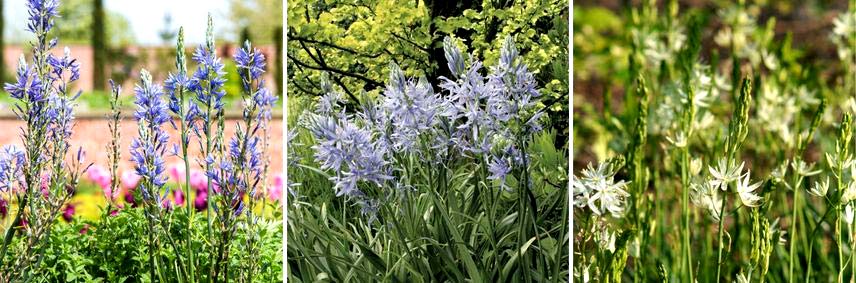
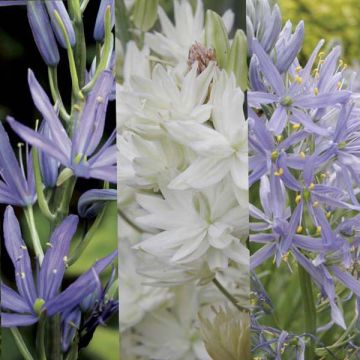
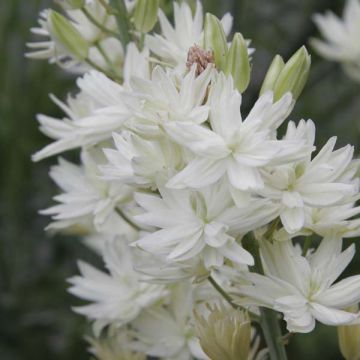
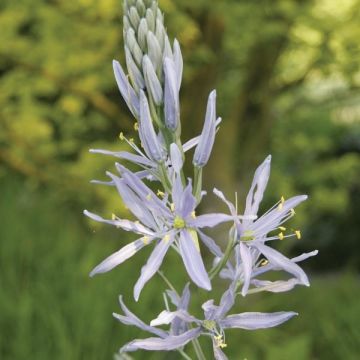
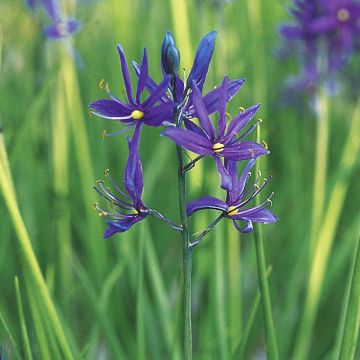
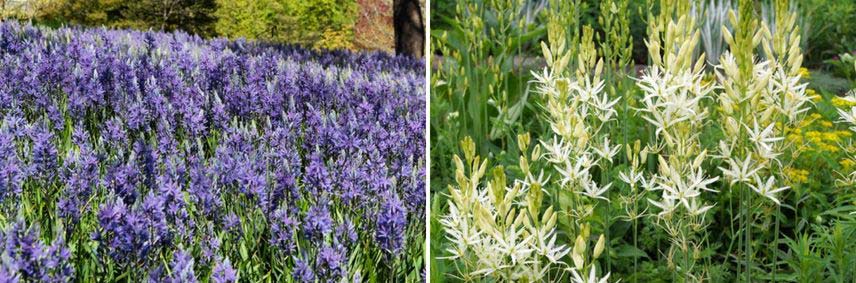
Camassia quamash, Camassia ‘Zwanenburg Wisteria Blue’ and Camassia leichtlinii ‘Blanc’
According to their flowering period
Camassia are spring-flowering perennials. By choosing different species, you can enjoy their corollas from April to June.
For early spring corollas, look to Camassia leichtlinii ‘Caerula’. From April, it brightens the garden with its light blue to violet hues. Most other species and cultivars follow suit between May and June, and for the latest, Camassia leichtlinii ‘Semiplena’ wraps up their flowering season at the very end of spring.
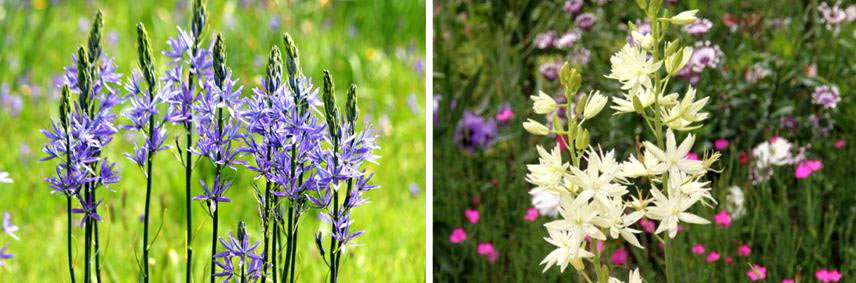
Camassia leichtlinii ‘Caerulea’ and Camassia leichtlinii ‘Semiplena’
Discover other Camassia
View all →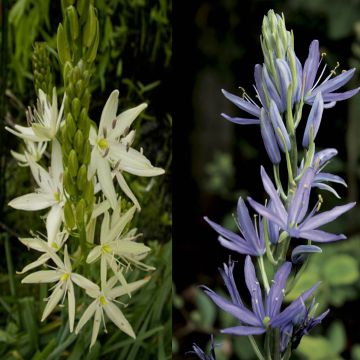
Available in 0 sizes
Available in 0 sizes
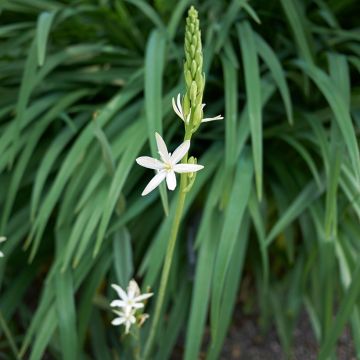
Available in 2 sizes
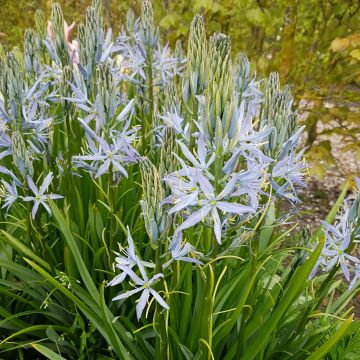
Available in 1 sizes
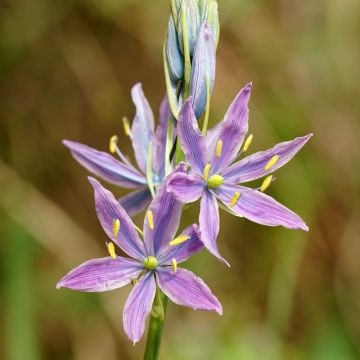
Available in 1 sizes
Available in 2 sizes
Available in 3 sizes
Available in 1 sizes
Available in 3 sizes
Available in 1 sizes
According to the colour of the foliage
Camassia develop in clumps with an upright and graceful habit, formed of deciduous leaves that are longer than wide, lance-shaped, with dimensions ranging from 30 cm to 80 cm for the largest varieties. During the summer, the foliage dries, yellows, and then disappears, as the plant enters dormancy. The leaves are predominantly green with varying blueish hues, but cultivars are equally attractive for the beauty of their variegated shades. For instance, the leaves of Camassia leichtlinii ‘Sacajawea’ are elegantly edged with a fine cream margin, adding depth and dimension. This is also true for Camassia quamash ‘Blue Melody’, whose mauve flowers emerge from leaves marginate with light yellow, creating a stunning effect.
Camassia leichtlinii ‘Sacajawea’ and Camassia quamash ‘Blue Melody’
According to the duplication of flowers
The duplication of a flower describes how the petals are arranged. Thus, we distinguish between “single flowers,” which have only one rank of petals, and, in contrast, more or less double (or “full”) flowers, where several ranks of petals are superimposed around the corolla. It is worth noting that single flowers reveal the stamens of the flower much more, which can be yellow or white in this perennial.
- In most Camassia, the flowers are single. The petals, numbering six, form a star 5 to 7 cm in size with almost perfect shapes. The flower stems are erect and emerge well from the foliage. They bear on their upper part spikes of countless corollas, contributing to the beauty of this plant. Their simple and delicate appearance adds a very natural touch to the garden.
- However, there are varieties with double flowers, such as Camassia ‘Semiplena’, whose stems are adorned with a multitude of small corollas in a very bright cream white. Exuberant, it is also one of the last to bloom.
According to the colour of the flowers
Camassia are not among those eye-catching plants with garish or aggressive colours. Everything about them is gentle. The choice of colours is not very wide, but there are beautiful shades available for the gardener.
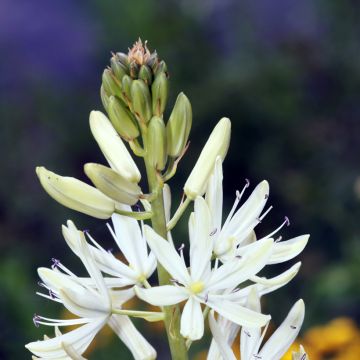
- If you are looking for white, which is easy to pair with all colours and useful for linking or softening them, opt for Camassia leichtlinii ‘Blanc’, ‘Sacajawea’ or ‘Semiplena’, which have more or less ivory and cream tones.
- For shades ranging from soft blue, azure blue to light mauve, Camassia ‘Zwanenburg Wisteria Blue’ or Camassia cusickii offer stunning shades.
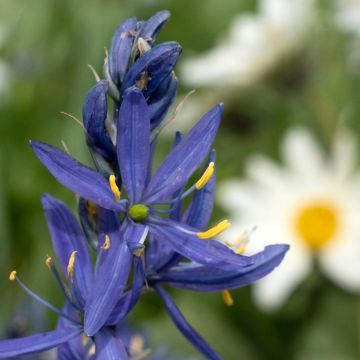
- To add depth to a display, deep blues and mauves are unmatched. Camassia quamash (bright blue), ‘Orion’ (intense mauve) and ‘Blue Melody’ (bluish mauve) are perfect if that is the effect you are looking for.
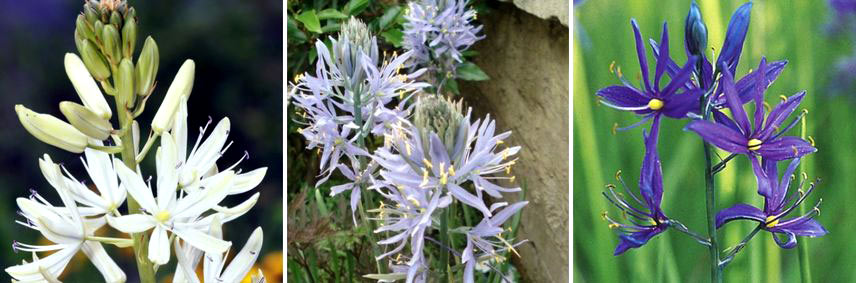
Camassia leichtlinii ‘Blanc’, Camassia ‘Zwanenburg Wisteria Blue’ and Camassia quamash ‘Orion’
According to their use
- The smallest Camassia, such as ‘Orion’ or ‘Blue Melody’ make beautiful border plants, with their blue highlighting the shapes of a flowerbed. Pair them with perennials in similar shades that maintain a lovely presence throughout the season. Caucasian forget-me-nots, hardy geraniums, small phlox, or lungworts make good companions. Small bulbs with early flowering such as crocuses can set the colour theme even before the official start of spring.
- In a sunny flowerbed, the larger varieties, such as Camassia ‘Zwanenburg Wisteria Blue’ or Camassia leichtlinii ’Sacajawea’ create beautiful verticals among roses, herbaceous peonies, or spring-flowering spireas. Also plant bulbs with round inflorescences to create interest through shape contrasts, with ornamental alliums that bloom at the same time. Complete with fritillaries, daffodils, and tulips, while being careful not to overdo the colours, as this may lead to an unsatisfactory result. Stick to simple combinations, such as mauve and orange or blue and yellow, to which you can of course add neutral notes of white.
- A stunning combination for a sunny flowerbed can also consist of Camassia cusickii, ‘West Country Masterpiece’ lupins (violet speckled with orange), Verbascum ‘Southern Charm’ (adds a touch of old rose to apricot), ‘Blue Barlow’ columbines (with beautiful very double blue flowers) and Geum ‘Prinses Juliana’ (to enhance the complementary colour already initiated by the lupin flowers).
- At the edge or in a semi-shaded area, place your Camassia in front of or beneath the branches of shrubs with stunning purple foliage such as those offered by a Japanese maple ‘Peve Dave’, a Judas tree ‘Forest Pansy’, a smoke tree ‘Royal Purple’ or a Physocarpus opulifolius ‘Summer Wine’. Complete with the beautiful foliage of hostas, Hakonechloa (a low, flexible grass) and ferns with bold graphics, not forgetting the incredible diversity of shades that can be utilised with heucheras.
- Camassia look very natural in a flower meadow-inspired area. Accompanied by loosestrifes, bee balms, echinaceas, angelicas, angel’s fishing rods and Veronicastrum, they create a colourful tapestry from spring to autumn. Clumps of ornamental grasses complete the picture with lightness and extend interest very late in the season.
- Don’t hesitate to plant your Camassia in pots! They bring a pleasant and welcome rustic touch to the heart of spring. Choose a pot large enough to mix them with other perennials that will take over once their flowering is over, such as oxalis, heucheras, carex, or Inca lilies for example. Of course, some spring-flowering bulbs planted in the lower layers extend the ornamental interest of your composition.
For further reading...
- Discover our range of Camassias in our online nursery.
- 7 ideal perennial plants for borders!
- Flower beds: vary and mix the shapes!
- Which plants to choose for a romantic balcony?
- Subscribe!
- Contents
Comments