





























10 primroses to grow in pots
for a flowering balcony in spring
Contents
Easy to care for and resilient, primroses are wonderful in pots. From spring onwards, they add colour to window boxes, containers, and pots on our balconies and terraces. With various forms, they pair well with many other spring flowers such as bulbs, forget-me-nots, daisies, or silver baskets. Let your imagination run wild and create stunning floral displays featuring primroses. To assist you, here is our selection of the most compact primroses, making them the most suitable for pot cultivation.

The double primrose 'Belarina Pink Champagne', for a romantic touch
The double primrose ‘Belarina Pink Champagne’ is perfect for creating romantic pots. It produces, from January to April, very double, fragrant flowers in soft shades of powder pink and cream. Their tones and romantic appearance stand out well against the rich green of the broad crinkled leaves arranged in a rosette.
This double-flowered primrose, derived from Primula vulgaris or garden primrose, is one of the plants once cherished in English gardens. Standing at 15 cm tall, it fits well, for example, in a lawn dotted with violets and forget-me-nots.
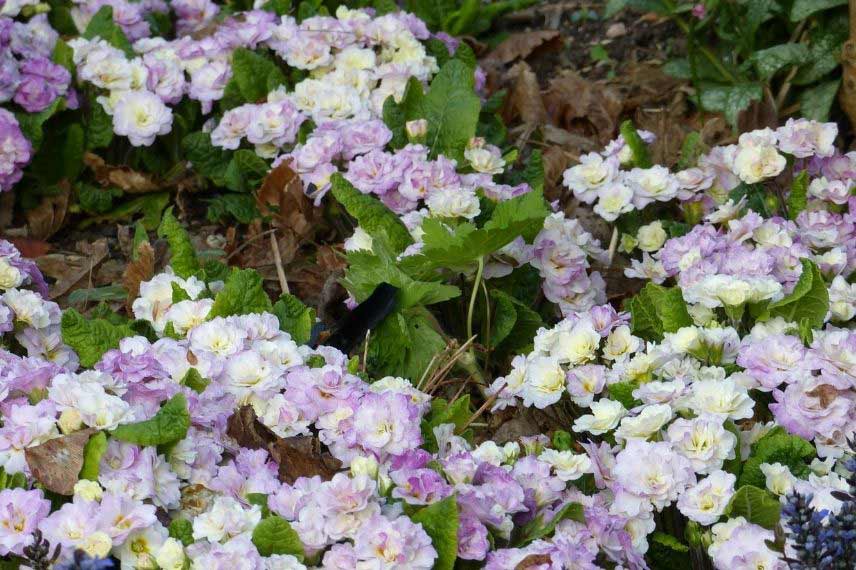
Double primrose ‘Belarina Pink Champagne’
The primrose 'Perle d'Alsace', vibrant colours for spring
We all know the garden primrose, also known as Primula vulgaris or Primula acaulis. Recognisable by its collar of green, crinkled leaves, it bears large solitary flowers in often vibrant colours that catch the eye. The ‘Perle d’Alsace’ primrose is one of the most popular varieties of garden primrose. This biennial produces giant flowers measuring 6 cm in diameter, in a wide range of attractive colours. It flowers from March to May, and if you take care to remove the faded flowers, they will renew themselves. In short, it is both a classic and a true delight!
At maturity, the ‘Perle d’Alsace’ primrose reaches a height of 15 cm. It is easy to grow in pots or containers in a rich, cool, and well-draining substrate such as geranium compost. From February to March, you can feed it with fertiliser once or twice a week to further encourage flowering. It has semi-evergreen foliage and pairs well with other spring flowers. Place it in partial shade or even in the shade.
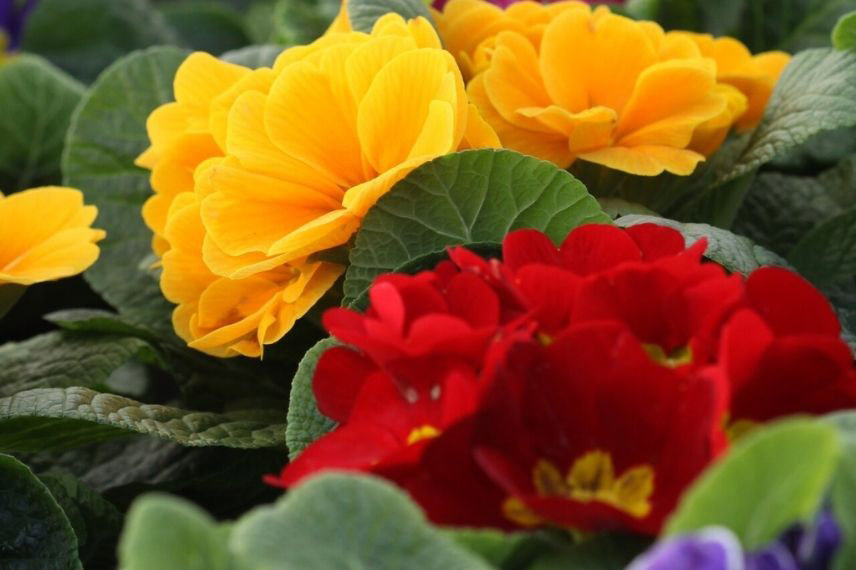
‘Perle d’Alsace’ primrose
Discover other Primula - Primroses
View all →
Available in 1 sizes
Available in 0 sizes
Available in 2 sizes
Available in 1 sizes
Available in 1 sizes
Available in 1 sizes
Available in 1 sizes
Available in 2 sizes
Available in 1 sizes
Available in 1 sizes
The hybrid primrose 'Dark Rosaleen', featuring stunning bicolour flowers.
Measuring 15 cm tall at ripeness, the hybrid primrose ‘Dark Rosaleen’ is also a small plant that is easy to grow in pots. Remarkable, it produces small bicoloured flowers striped in dark pink and pale pink, contrasting with a golden centre. The crinkled foliage displays a bronze, even purplish colour and is semi-evergreen.
The hybrid primrose ‘Dark Rosaleen’ flowers from March to May. The flowers are grouped in small clusters on a short purplish peduncle. Highly decorative, with its bicoloured tones and slightly undulating petals, this perennial pairs well in pots with snowdrops, daffodils, grape hyacinths, hyacinths, and forget-me-nots.
Read also
Primroses: 7 ideas for garden companionsPrimula 'Prom Lilac', the delicacy of mauve
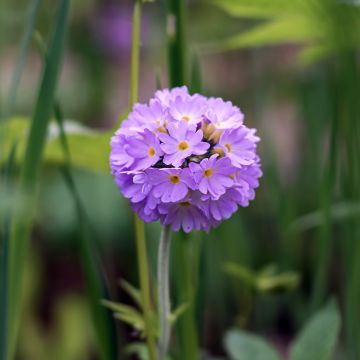
The ‘Prom Lilac’ primrose exudes natural charm. From March to May, it bears spheres of small mauve flowers perched on floral stems, evoking the beauty of wildflowers. The flowers of light lilac colour are adorned with a yellow eye at the centre, enhancing their hue. This primrose is part of Primula denticula and originates from a perennial primrose found in the Himalayas.
It reaches an average height of 22 cm and bears elongated, dentate, deciduous leaves. The ‘Prom Lilac’ primrose can be paired with tulips, astilbes, and hostas. It makes an excellent cut flower to insert into your bouquets. However, be cautious of primin, one of its constituents that can cause allergies. Like other primroses, it prefers rich, cool substrates and a shady location.
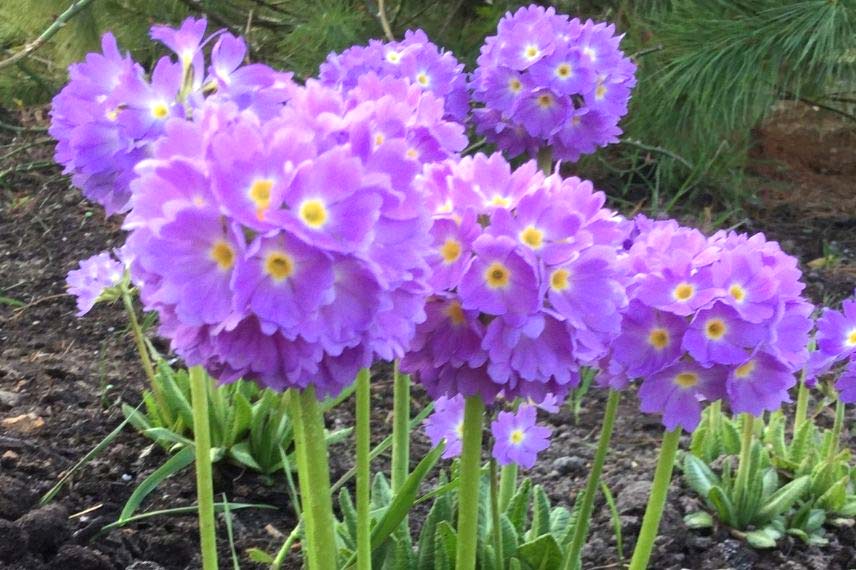
‘Prom Lilac’ primrose
The Bear's Ear Primrose 'Plums & Custard', a charming little primrose
The bear’s ear primrose ‘Plums & Custard’ or Primula auricula is a small, vigorous perennial that reaches a height of 13 cm. From April to June, umbels of 5 to 10 bicoloured purple and white flowers with a yellow centre appear above a bed of velvety, evergreen foliage.
Hardy and perennial, the bear’s ear primrose ‘Plums & Custard’ is native to the Alps. It has been cultivated since the 16th century and underwent numerous hybridizations in the 19th century, resulting in a wide range of colours. This charming little primrose emits a light sweet fragrance.
The hybrid primrose Primula 'Guinevere', for its uniqueness
Standing at 10 cm, the hybrid primrose Primula ‘Guinevere’ is one of the smallest primroses. Thanks to its petite size, it is well-suited for pot cultivation. Its foliage takes on an original hue, starting as purple, then bronze, and finally dark green. Semi-evergreen, it contrasts beautifully with the small bright light pink flowers with a yellow centre, which bloom from May to June.
Hardy and robust, the hybrid primrose Primula ‘Guinevere’ was created in 1930 from a cross-breeding of juliae primroses, a very small species native to the Caucasus. It pairs well with hostas and peonies.
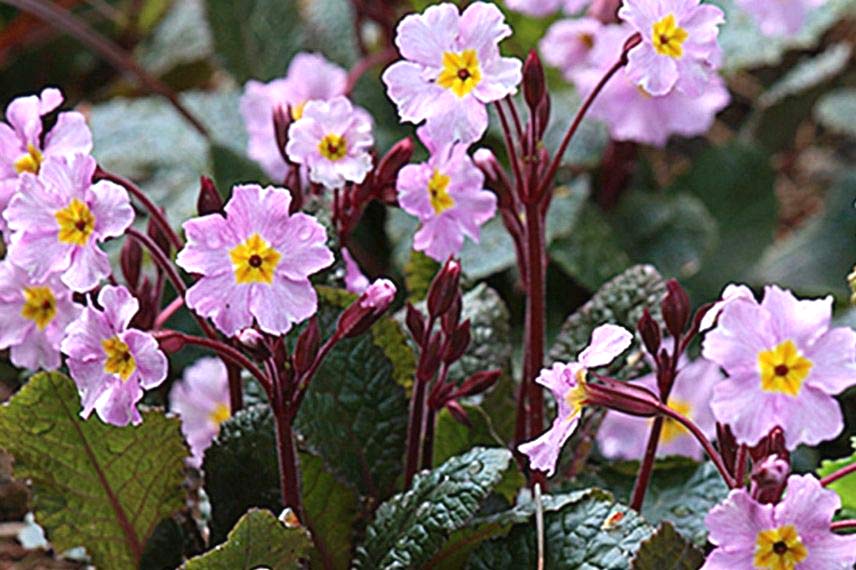
hybrid primrose Primula ‘Guinevere’
Primula elatior 'Gold Lace Red', for a unique graphic effect
The primrose or Primula elatior ‘Gold Lace Red’ offers, during its flowering period, between April and June, a unique contrasting effect that makes it very graphic. Related to the wood primroses, also known as cowslips, the tall primrose ‘Gold Lace Red’ produces collars of flowers with rounded carmine red petals edged in white and adorned with a yellow centre. The flowers are slightly fragrant and highlighted by elongated, dark green evergreen foliage.
Perennial and hardy, Primula elatior ‘Gold Lace Red’ looks stunning in a pot or container. Pair it with heucheras with purple or golden foliage, anemones, and pansies, and place the pot in partial shade.
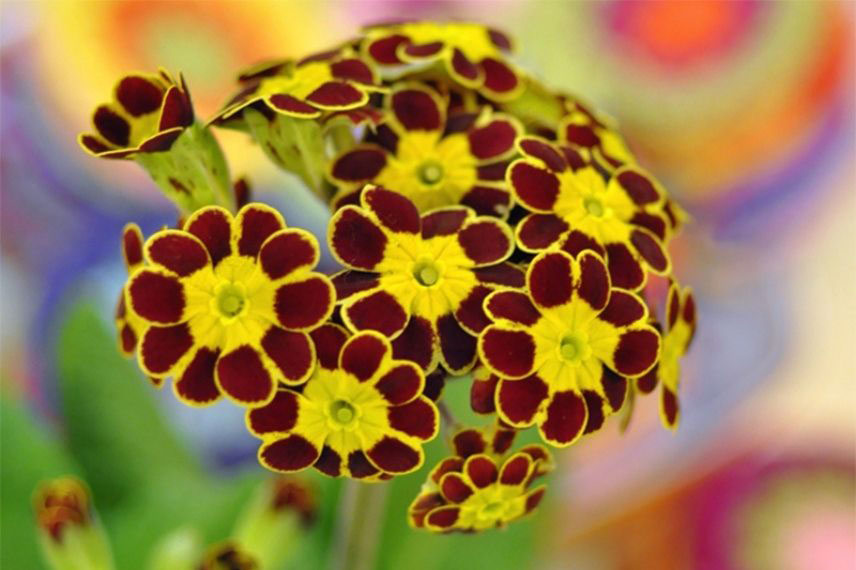
Tall primrose ‘Gold Lace Red’
The hybrid primrose 'Oak Leaf Yellow Picotee' for early flowering
The hybrid primrose ‘Oak Leaf Yellow Picotee’ boasts numerous qualities. It blooms early, starting from February and its flowering lasts until May. It features small lobed leaves resembling those of oak and offers flowers with slender yellow petals adorned with a red edge. Its semi-evergreen foliage displays a light green colour.
With its vibrant colours, the hybrid primrose ‘Oak Leaf Yellow Picotee’ is highly decorative in a planter or pot on a balcony. Reaching a height of 15 cm at ripeness, it can be paired with cyclamen, anemones blanda, as well as hellebores.
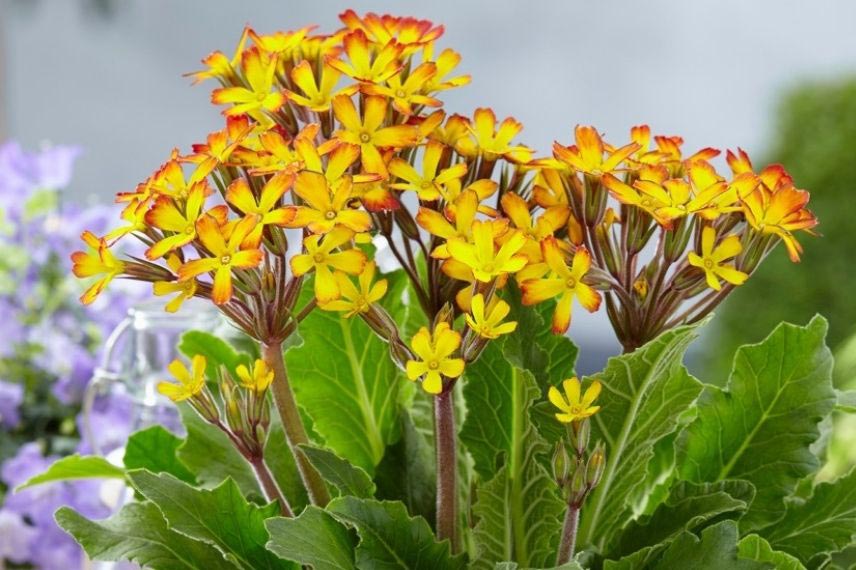
Hybrid primrose ‘Oak Leaf Yellow Picotee’
The primrose Primula acaulis 'Lipstick', cheerful colours from January.
The primrose Primula acaulis ‘Lipstick’ is also an early small primrose, as it blooms from January. On a collar of crinkled, bright green leaves, delightful flowers open in a light pink with a bright yellow centre and last until March. The combination of the two colours is striking and adds a cheerful touch to containers.
These are biennial plants that reach a height of 15 cm and have evergreen foliage. In a pot or container, plant them for example at the base of tulips or alongside violets.
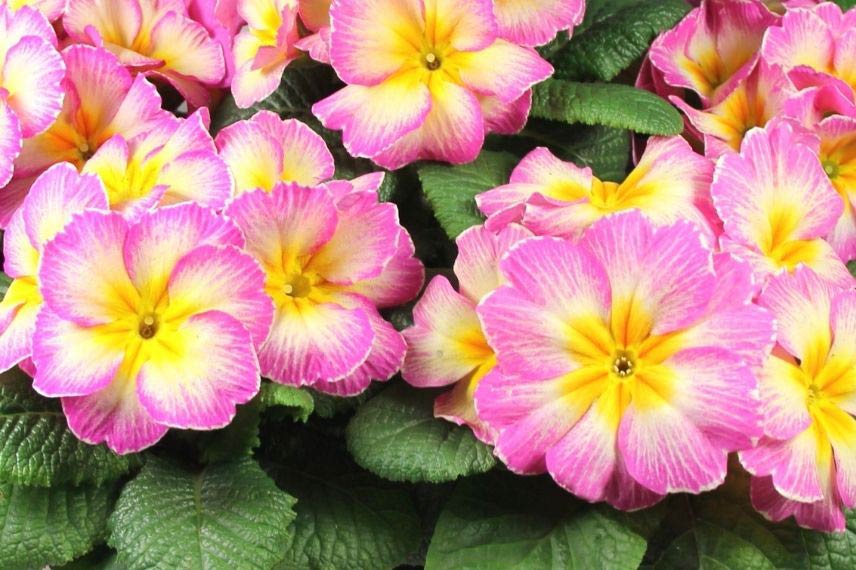
Primula acaulis ‘Lipstick’
Primula 'Everlast F1', a bright garden primrose
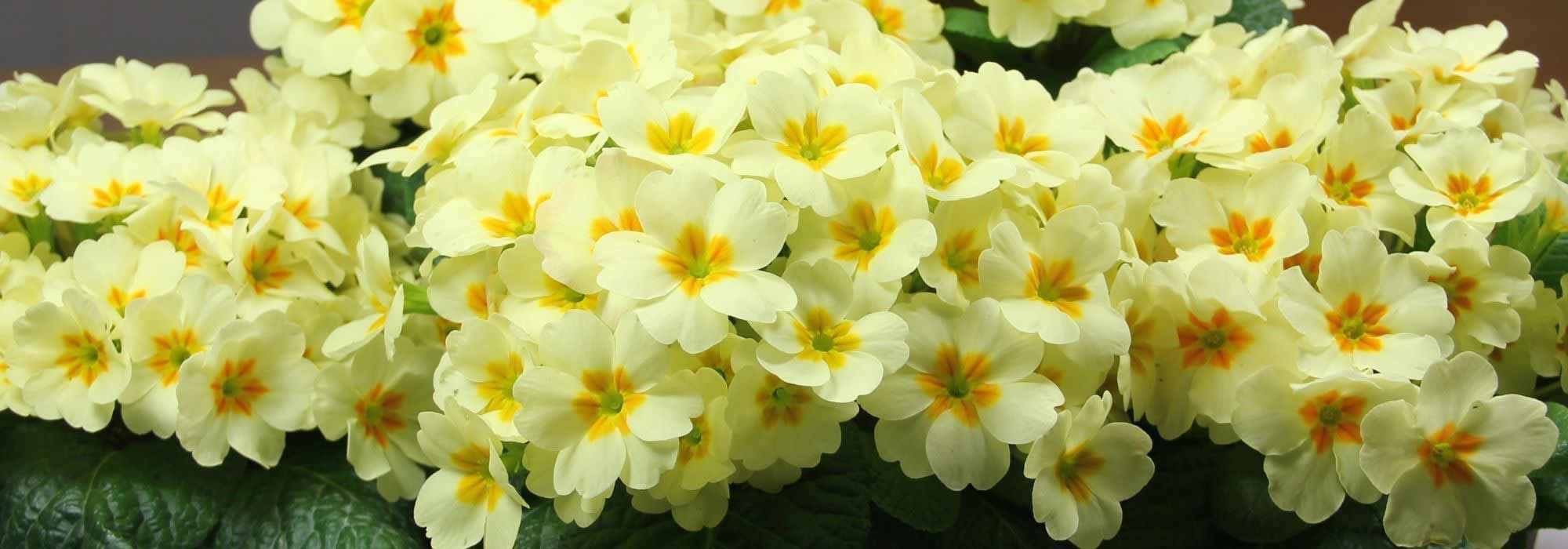
With its pale yellow flowers and dark green, crinkled evergreen foliage, Primula ‘Everlast F1’ creates soft and bright floral displays. It offers a compact and generous ball-shaped flowering, as it blooms from January to March, and then in December.
Hardy and perennial, it is a hybrid primrose that has been awarded by Fleuroselect for its ornamental qualities and vigour. For a beautiful contrast, pair it with forget-me-nots, muscari, blue pansies, and white tulips.
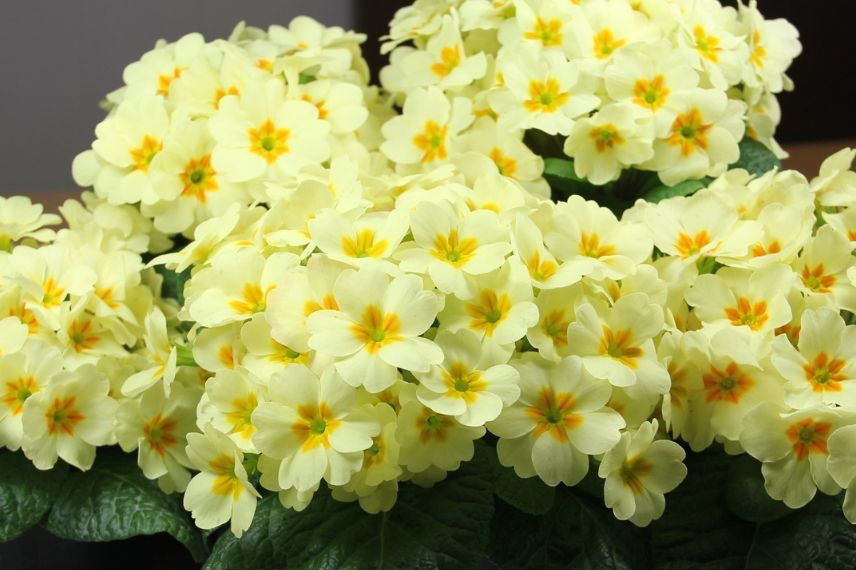
Primula ‘Everlast F1’
For further reading
- If you want to learn more about primroses, check out our comprehensive guide on their cultivation and discover our complete collection of primroses.
- To avoid any failures, we recommend planting appropriately; feel free to adopt our Plantfit web application!
- Subscribe!
- Contents
Comments