





























6 great pairing ideas with Japanese quince
Our ideas and inspirations to showcase it
Contents
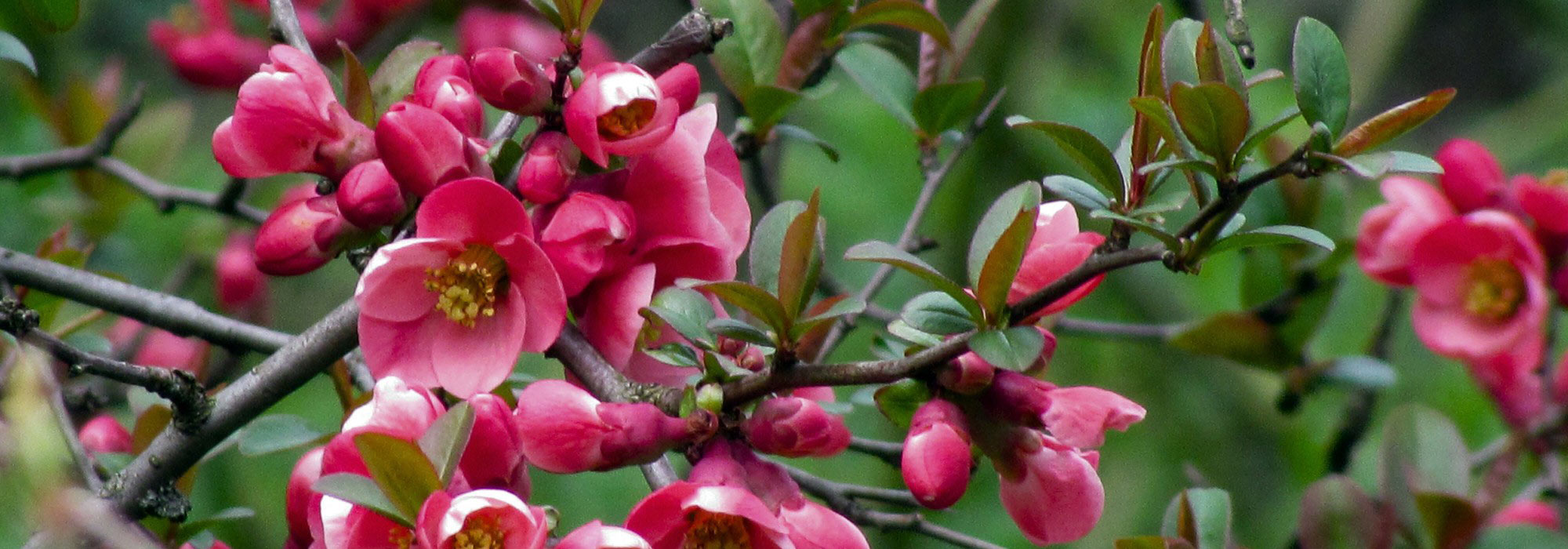
The Japanese quince, or Chaenomeles is a handsome deciduous shrub prized for its early flowering, at the very end of winter, which appears on the bare twigs. The flowers, brilliant, pink, coral, orange, red or white depending on the variety, bloom before the foliage, waking the garden still sleepy from the cold. This profusion of flowers gives way in autumn to small edible fruits, as decorative as they are delicious in jams. Robust and perfectly hardy to -20°C, the Japanese quince grows in full sun as well as in partial shade, in any good garden soil. With its natural flowering and its twisted, sometimes thorny habit, it stands out in natural gardens, cottage gardens or more contemporary ones, to which it brings gaiety and graphic appeal. Compact and versatile, it is equally suitable for a border or for a defensive or flowering hedge. It offers numerous companion planting possibilities in the garden. Discover how and with which plants to pair the Japanese quince!
To learn everything about this superb shrub, discover our plant profile Japanese quince: planting, pruning and care.

In a spring border
From the end of winter, it’s easy to brighten spring scenes with Japanese quince! They are part of those flowering shrubs that announce the return of warmer days. They find their place within a natural garden, in a bright border, surrounded by spring bulbs that bloom at the same time. From the end of winter, the garden will wake up to their flowering, offering a superb colourful display! Their bare twigs, enhanced by small vibrant flowers, pink, red or white, will echo the early-flowering bulbs. In the garden, you can plant them prominently within a border carpeted with a joyful carpet of bulbs such as the crocus, the hyacinths, the tulips or the narcissi.
Under a Japanese quince or Chaenomeles speciosa ‘Toyo-Nishiki’, bearing on its spiny, leafless branches delicate flowers uniting pink, red and white, install pretty botanical tulips such as Tulipa clusiana ‘Lady Jane’ in soft pink and whites, the Muscari ‘Pink Sunrise’ with opaline pink clusters and a charming Narcissus ‘Rosy Cloud’ with silky petals, pale pink, peach and white. The Muscari armeniacum ‘Valerie Finnis’ with its pale blue hues will provide the contrast. A few spring perennials, such as the Anemone nemorosa, the Hellebores, Primula denticulata offering globular flower heads violet, pink or white, and Pulmonarias will join this spring ballet with very soft colours. Also consider mixing your border with late-flowering groundcovers, such as hardy geraniums and Heucheras in grey and purple tones. In the background of the border, don’t hesitate to plant Japanese cherries (for example, ‘Accolade’), which, too, are early to bloom with a profusion of soft pink or white blossoms.
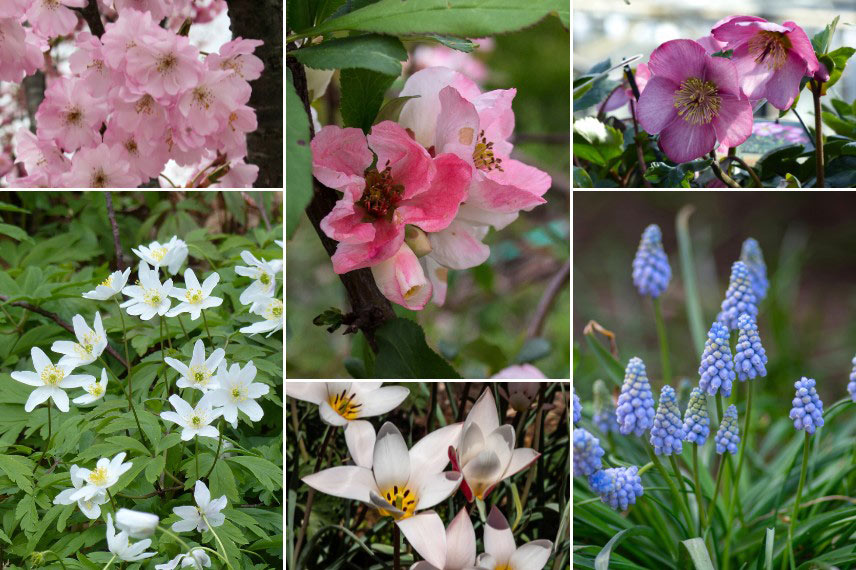
Prunus ‘Accolade’, Chaenomeles speciosa ‘Toyo-Nishiki’ (photo: F. D. Richards), Hellebore ‘Madame Lemonnier’, Anemone nemorosa ‘Lychette’, Tulipa clusiana ‘Lady Jane’, Muscari armeniacum ‘Valerie Finnis’
In a flowering hedge
As they bloom early from March, Japanese quince trees stand out, just like Forsythias and Abeliophyllum, in a cottage hedge. The flowering of a Japanese quince is fairly short-lived, but by pairing early-flowering shrubs with others that are later, you can easily enjoy a flowering hedge almost all year round. The Chaenomeles speciosa ‘Nivalis’, a white-flowered quince, is perfect for integrating a bright hedge. It can be paired with numerous shrubs with decorative foliage or spring-flowering or summer-flowering varieties. It looks wonderful with shrubs as easy to grow as itself, such as the Prunus triloba, or the currantsflowering, which also have very early spring flowering. The Spiraeathunbergii, the Weigelas, Deutzia, Enkiantus campanulatus, Forsythias or Kolkwitzia will take over from its flowering, itself followed by that of lilacs and buddlejas through to summer. Consider incorporating a few evergreen foliage shrubs such as the Chinese Loropetalum, or the photinias with handsome colourful foliage, which will both thicken this screen and maintain rhythm in your hedge, even in winter.
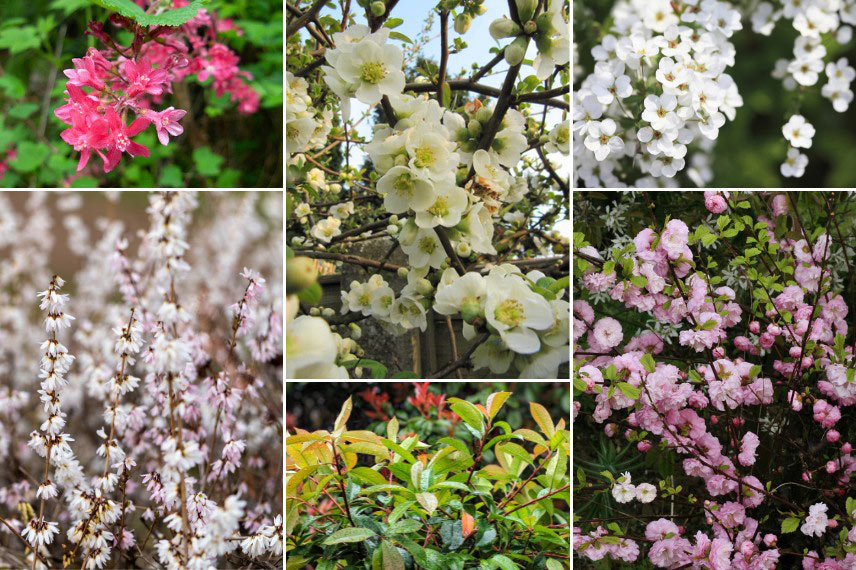
Ribes sanguineum, Chaenomeles speciosa ‘Nivalis’ (photo : Leonora Enking), Spiraea thunbergii, Abeliophyllum distichum, Photinia (photo : Steve Rainwater) and Prunus triloba ‘Multiplex’
In a windbreak hedge.
With their branches, usually thorny, and their rather untidy silhouette, Japanese quince shrubs, sometimes also referred to as “Japanese quinces”, are perfect for completing a defensive hedge and even a fruit hedge. We can pair them with gorgeous Japanese roses, the holly, the Berberis thunbergii, some pyracanthas or other ornamental fruit shrubs whose berries will echo the colourful, decorative and highly fragrant fruits of the Japanese quince and will feed the birds through the winter. They will also make good companions for hawthorn and other edible-fruiting shrubs such as sea buckthorn, which bear pretty bright orange berries with a delicious tangy flavour.
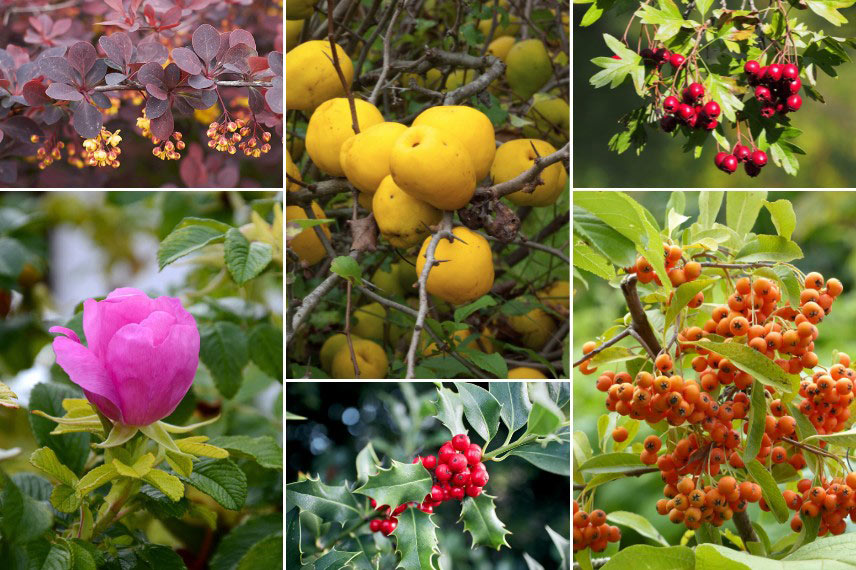
Berberis thunbergii ‘Atropurpurea’, Chaenomeles japonica, Crataegus monogyna (photo: Agnieszka Kwiecień), Rosa rugosa (photo: Andrea Wilhelm), Ilex aquifolium and Pyracantha ‘Golden Charmer’
Read also
How to choose a Japanese quince?In a Japanese-inspired scene.
If your garden offers an ideal environment for acidophilous plants, with slightly acidic soil and partial shade, you can easily envisage a Japanese-inspired scene around a Japanese quince. In addition, its twisted branches are very decorative in austere Ikebana-style displays. With its delicate pink flowers on still-bare branches and its low habit, Chaenomeles speciosa ‘Pink Lady’ is a perfect fit for Japanese-style gardens. Surround it with ferns, of Ophiopogons, of Acer palmatum, of Hakonechloa macra ‘Aureola’, of bamboos, and the flowering of a few azaleas. You can add small plants with soft and rounded shapes: niwaki pines (cloud-pruned) or a Picea glauca ‘Alberta Globe’ with a compact, rounded habit.
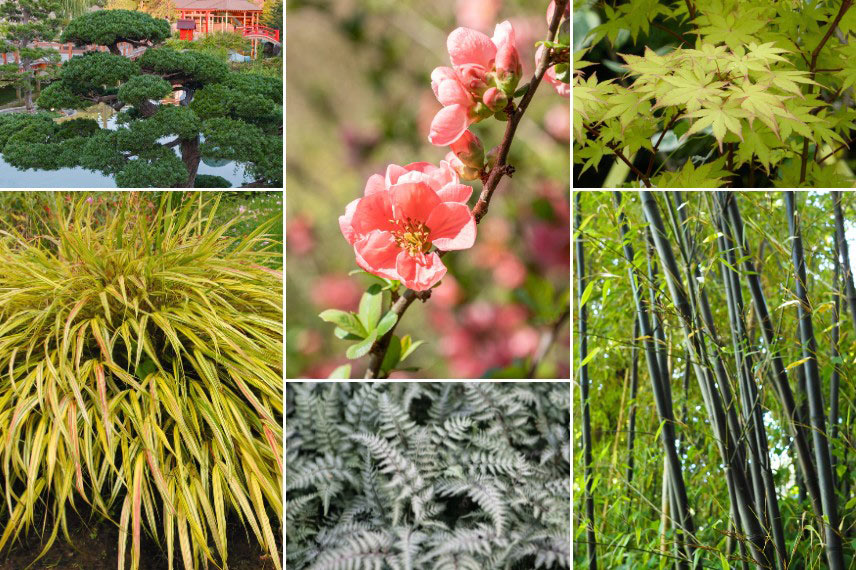
Cloud-pruned pine, Chaenomeles superba ‘Pink Lady’, Acer palmatum ‘Summer Gold’, Hakonechloa macra ‘Aureola’, Athyrium niponicum ‘Pewter Lace’, Phyllostachys nigra
Potted, bonsai
Some small Chaenomeles forms are interesting to work as bonsai. For this, choose a pretty form of quince with a compact habit, such as Chaenomeles japonica ‘Sargentii’ which forms a dense shrub not exceeding 1 m in height at ripeness. The ‘Sargentii’ variety, with its unusual silhouette, makes a good bonsai subject or simply for container planting. Its leaves can be miniaturised, but its single flowers in a beautiful salmon-orange will retain their normal size! To fill out its base, the Sedum spathulifolium ‘Cape Blanco’, a silver-leaved stonecrop, will provide a nice texture and colour contrast.
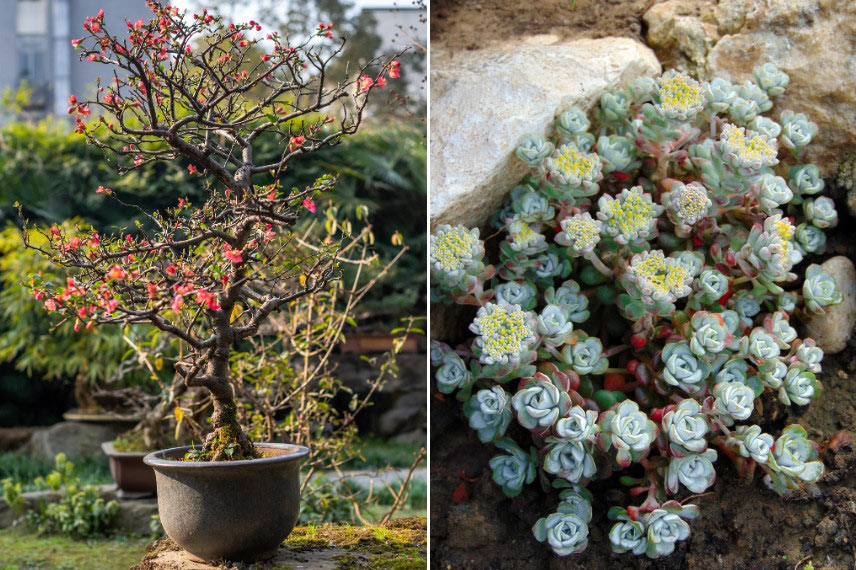 Japanese quince trained as bonsai, Sedum spathulifolium ‘Cape Blanco'</caption]
Espaliered against a wall.
You can espalier Japanese quinces against a wall near the house to curb somewhat their natural tendency to tangle. However, avoid espaliering the spiny varieties; their spines can prove formidable. A Japanese quince ‘Scarlet Storm’ will provide a graceful, graphic green backdrop trained against a sun-drenched wall near the house to make the most of its fragrance. On its bare shoots, as winter ends, numerous small double camellia-like flowers bloom, in a bright, fiery red, like countless tiny incandescent suns. With a modest growth habit (about 1 to 1.2 m tall) and thornless, this variety will herald the start of spring. Plant it alongside fragrant shrubs such as Lonicera fragrantissima, the winter honeysuckle with very fragrant white flowering that precedes it or winter jasmine; they will enchant every time you pass by.
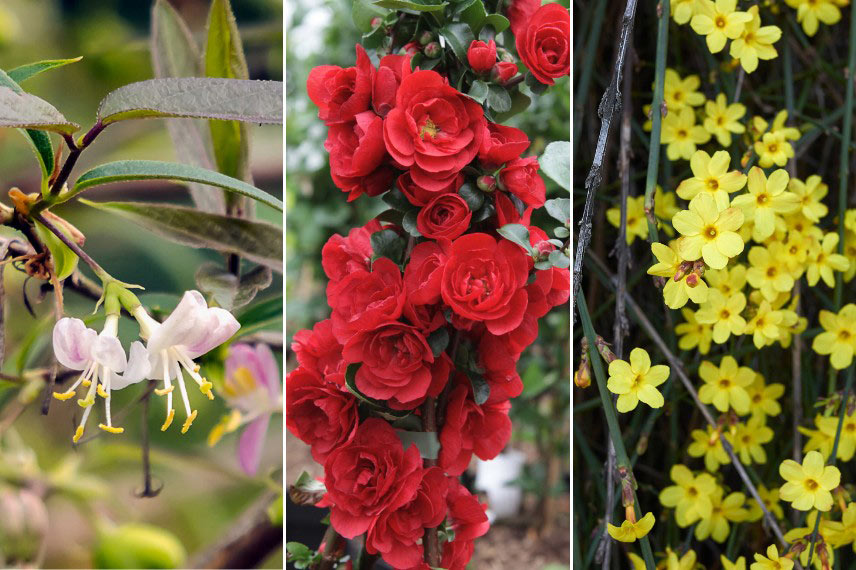
Lonicera fragrantissima, Chaenomeles ‘Scarlet Storm’, Jasminum nudiflorum
- Subscribe!
- Contents
Comments