



8 Carex for shade
Our selection to brighten up the shaded corners of the garden!
Contents
Carex, also known as sedges, are ornamental grasses belonging to the family of papyrus and include no less than 1,500 species worldwide. They thrive in various conditions, particularly in shaded areas. If you have a garden with less sunny spots or wish to add texture and colour to a shaded corner, Carex are your ideal allies. In this guide, discover 8 varieties of Carex perfectly suited for shade, along with some ideas for an artfully coloured garden…

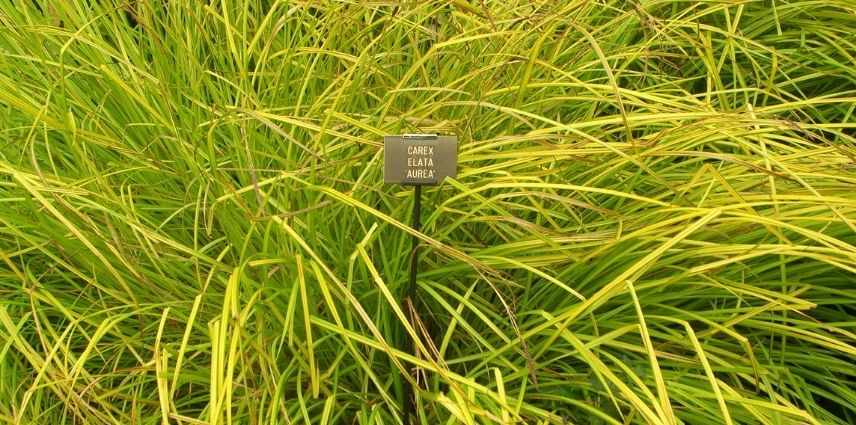
The golden hue of Carex Elata ‘Aurea’
Also known as Golden Sedge, Carex Elata ‘Aurea’ is a particular variety appreciated for its elegant and attractive leaves, which are a bright golden yellow, adding a splash of vibrant colour to gardens and landscapes. Its leaves are long, narrow, and trailing, forming dense, tousled clumps that can reach about 40 to 60 centimetres in height. In summer, this plant produces slender, elongated spikes of golden-brown colour, which add an extra dimension to its aesthetic appeal.
This variety of sedge prefers cool to moist soils, even slightly boggy, and generally thrives in sunny to partially shaded areas. It is often used as groundcover in pond edges, water gardens, and wet borders. Easy to maintain, Carex elata ‘Aurea’ is a hardy plant that can thrive in temperate climates. Once well established, it requires little attention, but it can be pruned in early spring to encourage new growth.
Highlight its beautiful colour by planting nearby a few Iris sibirica ‘Blue King’ with their purple flowers and/or a few Camassia leichtlinii ‘Caerulea’ with a more subtle violet, not forgetting a few Astrantia major ‘Rosensinfonie’ offering beautiful shades of pink.
Read also
Carex: planting, dividing and careThe refreshing blue of Carex flacca ‘Blue Zinger’
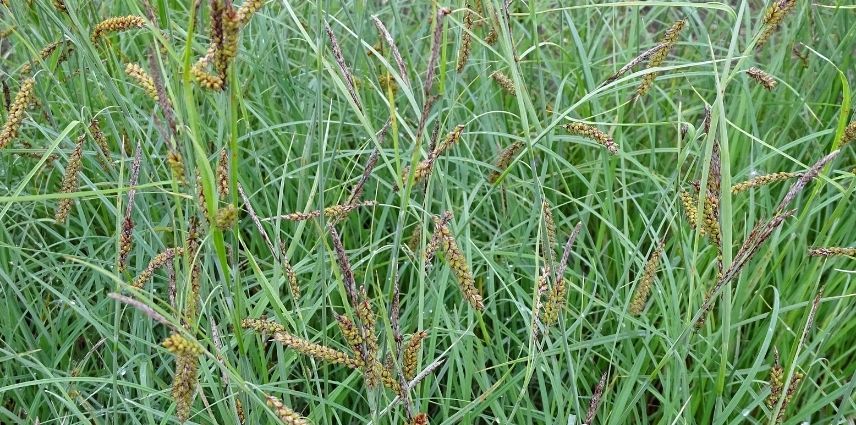
The Carex Flacca ‘Blue Zinger’, commonly known as blue sedge, is a variety distinguished by its remarkable foliage in a unique blue-grey hue that adds a subtle and soothing touch of colour to gardens. Its leaves are fine, narrow, and arching, forming dense and elegant clumps. They typically measure between 30 and 50 centimetres in height, creating a compact and tidy appearance. The bluish colour of its leaves is particularly attractive and can vary in intensity depending on growth conditions and lighting.
This variety of sedge thrives in well-drained soils and tolerates semi-shaded or shaded areas very well. It is quite adaptable and can withstand some drought once well established, although it generally prefers slightly moist soils.
The Carex flacca ‘Blue Zinger’ is a hardy and low-maintenance plant. It is often used as groundcover to cover small areas or as a border element in flower beds.
With its evergreen foliage, both fine and flexible, in a refreshing blue, the Carex Flacca ‘Blue Zinger’ can be paired with a Japanese Andromeda, this dwarf heather soil shrub, which adorns itself with pink in spring and a Euonymus fortunei ‘Emerald’n Gold’ with lovely variegated bright green and gold foliage. It can also be combined with the Caucasian Speedwell and its white spike flowers.
The emerald green marginated with white of Carex Morrowii ‘Ice Dance’
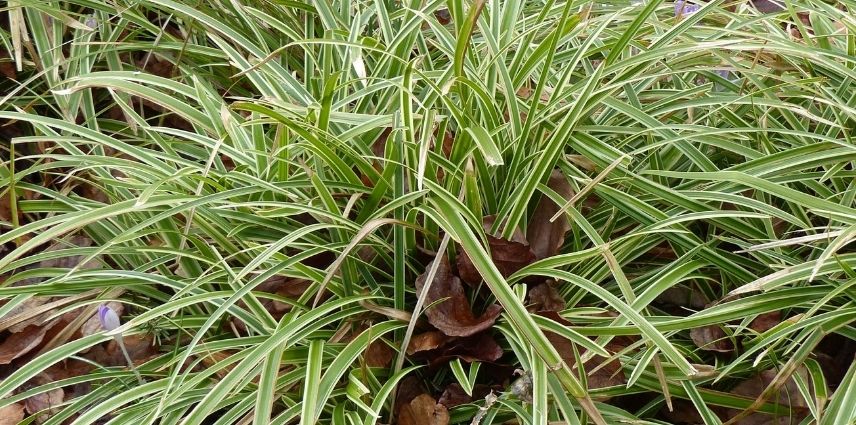
Forming a bristly, trailing clump, the Carex Morrowii ‘Ice Dance’ brightens and covers the soil in shaded areas of the garden with its dark green foliage striped with fine white edges, creating a striking contrast effect. These leaves are narrow, arching, and typically measure 20 to 30 centimetres in height, forming dense, compact clumps.
This variety of sedge tolerates a range of growth conditions but generally prefers well-drained, moist soils, as well as shaded to partially shaded areas. This makes it an ideal option for gardens under trees or in areas with limited sunlight. ‘Ice Dance’ is a hardy and low-maintenance plant. It is often used as groundcover, to stabilise slopes, or to add a decorative touch around borders and paths. It gradually spreads, forming a dense and attractive carpet.
With its bold green edged in white, you can plant it alongside a wide variety of colours, such as different heucheras. To play with heights, feel free to introduce red-stemmed dogwoods!
Read also
Carex: 5 Pairing IdeasThe green and white variegation of Carex Ornithopoda ‘Variegata’
The Carex ornithopoda ‘Variegata’ is a variety of perennial sedge particularly valued for its variegated foliage that offers a unique visual appeal! The leaves are green with an irregular border of cream, yellow, or white, creating a variegated pattern along the leaves. These colour variations add a touch of brightness and contrast to the plant, making it very attractive. This variety of sedge generally prefers well-drained, moist soils, as well as sunny to partially shaded areas. It can tolerate some drought once well established, but it typically thrives better in areas where the soil remains slightly moist.
Easy to maintain, hardy, and low-maintenance, the Carex ornithopoda ‘Variegata’ is commonly used as groundcover or at the edge of borders to add a splash of colour in shaded gardens. Arched and graceful, it pairs perfectly with Rudbeckia ‘Rustic Dwarfs’ with their brown and yellow blooms featuring a ‘chocolate’ centre, as well as Persicaria microcephala ‘Red Dragon’ with its striking brown-purple leaves and white spike flowers.
The green foliage marginate with silver of Carex Conica ‘Snowline’
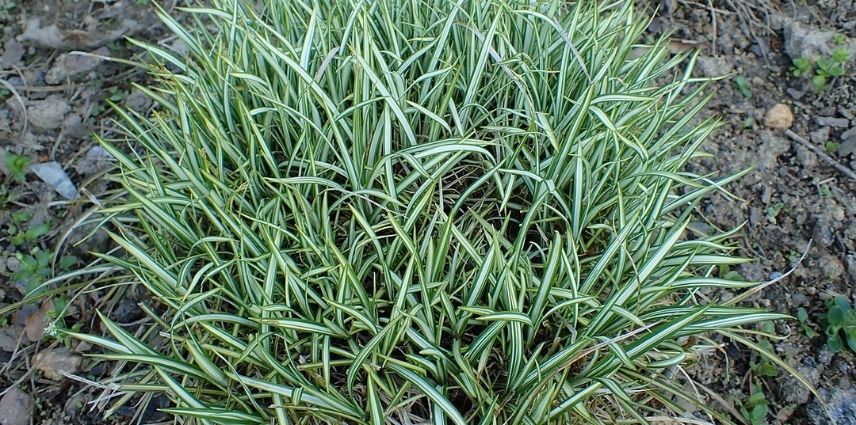
Dwarf variety of sedge, the Carex Conica ‘Snowline’ features leaves with a stunning silver hue, striped with green, creating a striking contrast, not to mention a beautiful white flowering in summer. The leaves of ‘Snowline’ are narrow, ribbon-like, and form dense, rounded clumps that can reach heights of 20 to 30 centimetres. The white edge on the leaves adds a touch of brightness and draws the eye, providing additional aesthetic interest to the plant.
This variety of sedge prefers well-drained, moist soils, and thrives in partially shaded areas. It is quite adaptable and can tolerate slightly moist soil conditions, making it an ideal option for areas near water points or in gardens with adequate drainage. Easy to maintain and disease-resistant, it is often used as groundcover, to fill spaces between other plants, or to create defined borders along paths. Its compactness also makes it an excellent choice for window boxes and small containers.
Behind it, bring a bit of height (90 cm tall) and colour to your flowerbed with some varieties of kniphofia suitable for partial shade, such as the golden yellow of Kniphofia ‘Dorset Sentry’ or the orange of kniphofia ‘Alcazar’. And for a touch of purple with a flower always in spikes, try the salvia nemorosa ‘Caradonna’.
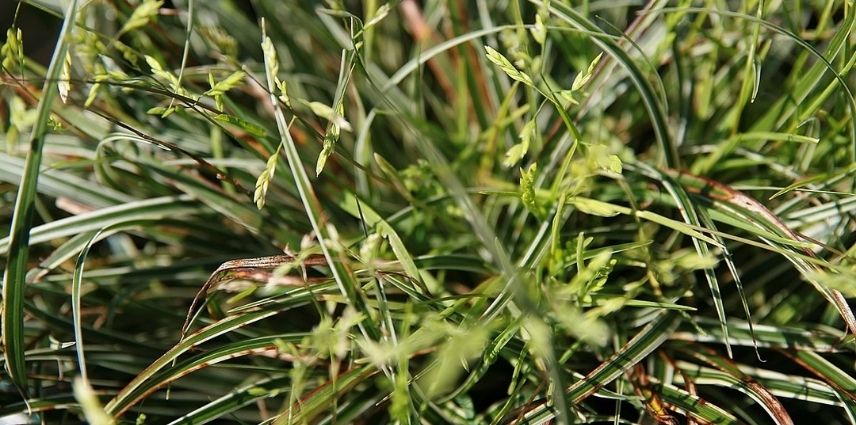
The bright light green of Carex Muskingumensis
Offering vigorous and abundant clumps, the Carex Muskingumensis, or the marsh sedge, displays green, linear leaves, typically measuring 30 to 60 centimetres in height. They are slightly arching and form dense, attractive clumps. Its vertical silhouette and slender leaves add texture and visual interest to gardens and landscapes.
This variety of sedge prefers moist to waterlogged soils and generally grows in shaded to partially shaded areas. It is often found in marshy areas, along riverbanks, and in low-lying areas where the soil remains wet for much of the year. It is frequently used to stabilise banks and wet soils, as well as to filter water in water gardens and artificial marshes.
Its light green foliage, both flexible and fine, pairs beautifully with the lovely pink of the meadow pinks, beautifully complemented by the intense magenta pink of the ‘Ballade’ Tulips and the violet blue of the Geraniums ‘Blue Sunrise’. This variety of sedge also pairs well with astilbes: choose from the white of the ‘Washington’ variety, the carmine red of Astilbe Arendsii ‘Spinell’, the lilac pink of Astilbe Arendsii ‘Cattleya’, or the chocolate of Astilbe Chocolate ‘Shogun’.
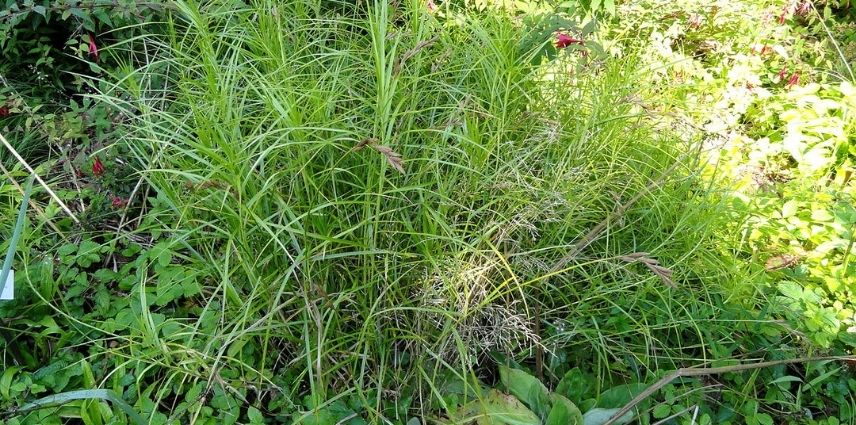
The arching stems of Carex pendula
The Carex Pendula, also known as the pendulous sedge, is a variety of perennial valued for its long arching stems that bear pendulous spikes, giving it an elegant and graceful appearance.
Its leaves are green, broad, and long, typically measuring between 30 and 90 centimetres in length. Evergreen throughout winter, they are dark green on the top and light bluish-green underneath, forming lush and attractive clumps. In summer, long, fine spikes of dark brownish-black appear.
This variety of sedge prefers cool to moist soils and . It is often found along the banks of streams, ponds, and wooded areas. Carex pendula is a hardy and low-maintenance plant, frequently used to create vertical accents in gardens, along water edges, or in semi-shaded areas, thanks to its elegant silhouette and pendulous spikes.
It is possible to pair the Carex Pendula with a selection of Foxgloves suitable for shade in various colours (white, yellow, orange, purple…), as well as Bergenias in vibrant pink! Finally, this variety can be accompanied by some golden sedges to enhance the overall effect.
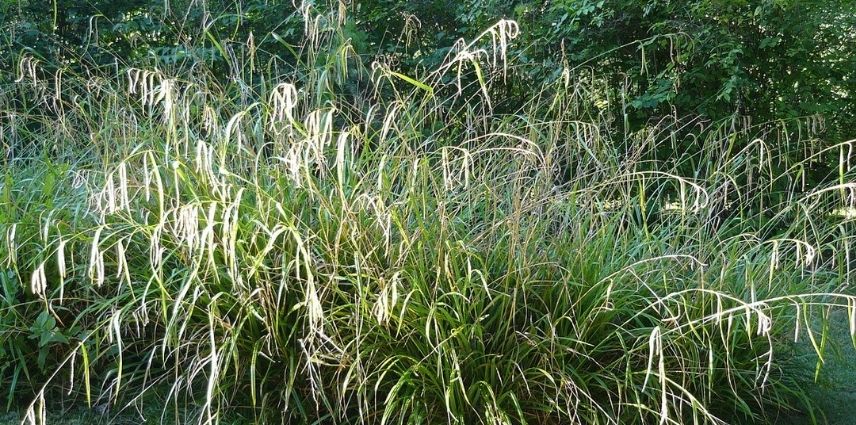
The soft green of Carex grayi
Also known as “Club Sedge”, the Carex Grayi stands in a tuft that is as round as it is compact, with a lovely soft green colour. Its leaves are green, linear, and typically measure between 30 and 60 centimetres. They are arching and form dense, lush tufts, creating a tousled foliage effect. This sedge prefers cool to moist soils and generally thrives in shaded to partially shaded areas. It is often found in wet forests, along streams, and in other areas where the soil remains relatively moist. Its hardy appearance and ability to flourish in cool soil conditions make it a popular choice for natural gardens and woodland landscaping.
For a flowerbed full of colour, it pairs perfectly with Artemisia ludoviciana ‘Silver Queen’ with its silvery grey foliage and white flowers, the pink spikes of Fountain Grass, the light green of fennel, not to mention the soft green of Miscanthus, the fluffy white of Stipa pulcherrima and the small purple flowers of Buenos Aires Verbena. Note that these plantings should receive more sunlight than Carex Grayi.
- Subscribe!
- Contents
Comments