





























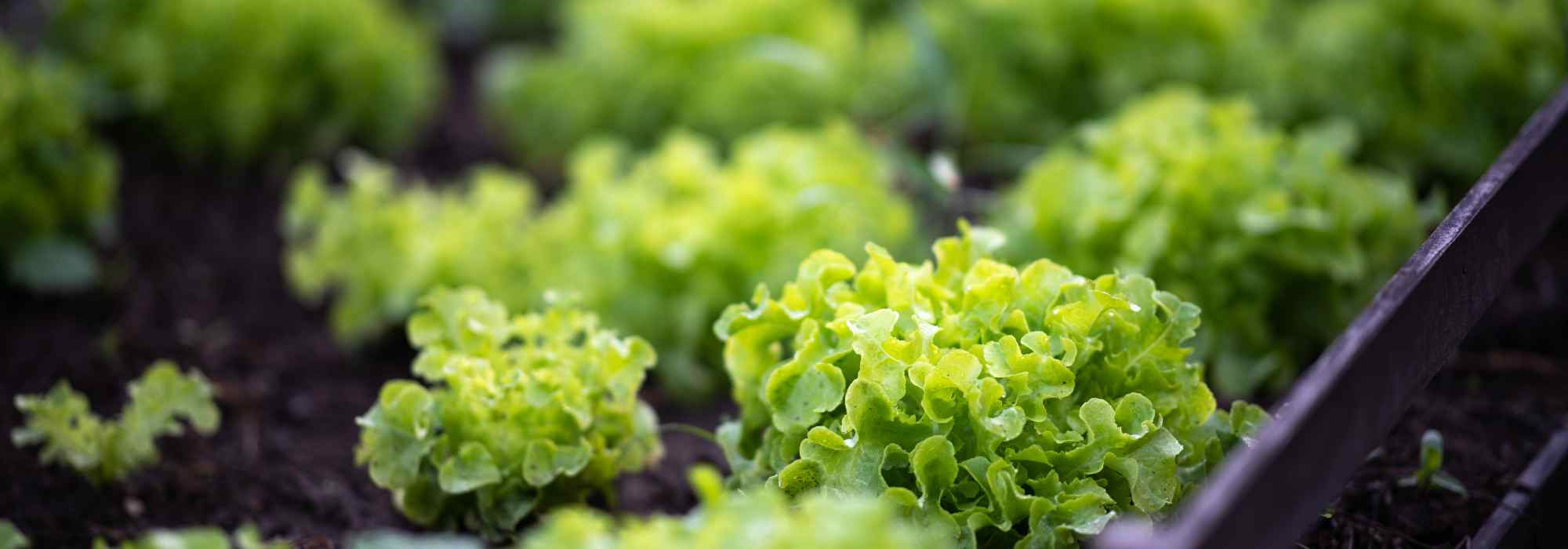
When it comes to salads, you're spoilt for choice!
Overview of different types of salad: varieties, flavours and textures
Contents
At first glance, nothing could be simpler than a salad! Yet this leafy vegetable from the Asteraceae family, the most consumed in France, is much more complex than it seems. Indeed, behind these few leaves lies the astonishing diversity of the families and types of salads. And, on the plate, everyone can discover flavours, textures and colours to brighten their meal in a healthy and balanced way.
Relatively easy to grow, lettuce also comes in a multitude of varieties. Nearly 2,000 varieties distributed worldwide. That said, choosing can be a real dilemma. They are grown for their colour, for their size, for growth, for flavour… but also with regard to the season, their heat resistance, the soil available. In short, it’s hard to navigate all this lettuce!
Let’s take stock together of the different types of lettuce, with their taste and cultivation characteristics.

The lettuce family, the most commonly eaten salads
Let’s begin our inventory of the different lettuces with the lettuce (Lactuca sativa). Regarded as the ancestor of salad greens, lettuce was already eaten by the Egyptians, around 4500 BCE. It is believed to originate from the Near East and Western Asia. It has, throughout the centuries, been greatly improved through hybridisation and cross-breeding. It is said to derive its name from the Latin lacta, meaning milk — simply because the wild form of our lettuce had long stalks that, when cut, exuded a pale juice, known for its soporific qualities.
Today, there are nearly 200 varieties of lettuce, whose leaves range from crunch to tender to melt-in-the-mouth, from smooth to crinkled, and come in green, red, or slightly pale.
Here are the different types of lettuces :
- The pommehead lettuce (la laitue pommée): also known as butterhead lettuce, it forms a round head, sometimes slightly flattened, made up of smooth and very tender leaves. The leaves of this lettuce display a green colour, varying from light to dark, sometimes washed with red or almost entirely red. If we were to name a few, we could highlight the ‘Merveille des quatre saisons’, the ‘Grosse Blonde Paresseuse’, the ‘Reine de Mai’ to sow from February to July, the early ‘Gotte jaune’ (to sow from January to April) or the winter-pommes like the ‘Bourguignonne’ or the ‘Merveille d’Hiver’
- The Batavia lettuce: this lettuce offers crisp but tender, crinkled leaves that are heavily veined, with edges that are scalloped. Their head is slightly more elongated than that of pommehead lettuces. Among the best, we note ‘Rouge Grenobloise’, the ‘Blonde de Paris’, the aptly named Kinemontepas, the hardy ‘Reine des Glaces’ or the ‘Pierre Bénite’ with blonde leaves.
- The romaine lettuce is a lettuce with very crisp leaves, featuring a thick central vein. We like the ‘Chicon du Père Vendi’, the ‘Romaine d’Hiver’ (sowing from August to September) and the ‘Verte Grasse’ (sowing from March to June).
- The grasse lettuce: this lettuce produces very thick, crinkled leaves. It grows especially well in the south thanks to its resistance to heat. Distinguishing the essential ‘Sucrine’, the ‘Craquerelle du Midi’ or the ‘Rougette de Montpellier’.
- The cut-and-come-again lettuce: this is a leaf lettuce with no head from which leaves are harvested as needed. Of course, it’s hard to overlook the ‘Oak Leaf’ but other varieties such as the ‘Lollo Rossa’ with red-tinged leaves, the ‘Salad Bowl’ in green and red, are well worth noting.
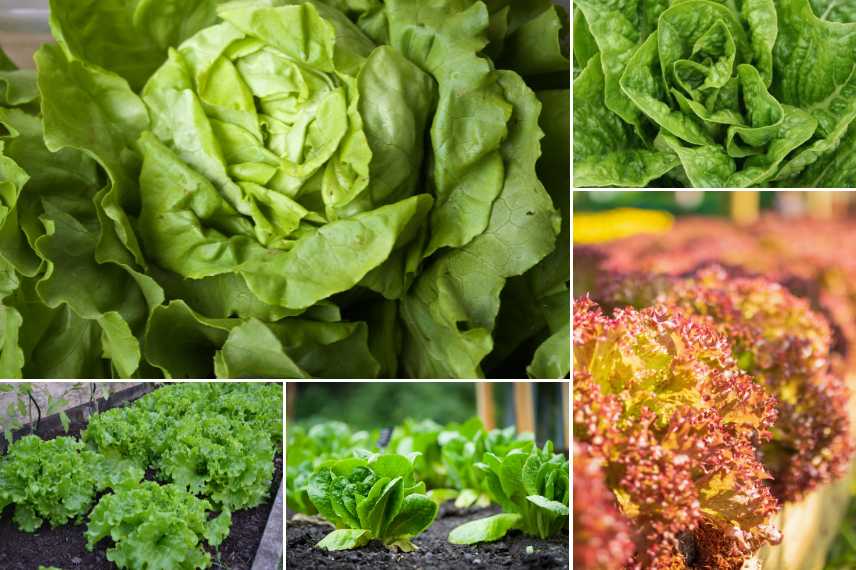
The different types of lettuces: butterheads, Batavias, romaine, grasses and cut-and-come-again
And for everything you need to know about lettuce:
The chicory family, a great diversity of salads
The second major group of salads, chicories (Cichorium), comprises cultivated varieties and others known as wild, with leaves bearing a certain bitterness. The genus Cichorium is divided into two species: Cichorium endivia and Cichorium intybus. And that’s where things get a little more complicated! Indeed, Cichorium endivia includes escarole and curly chicory, but not endives which belong to genus Cichorium intybus. In this latter category, there are also wilder chicories. But let’s keep it simple…
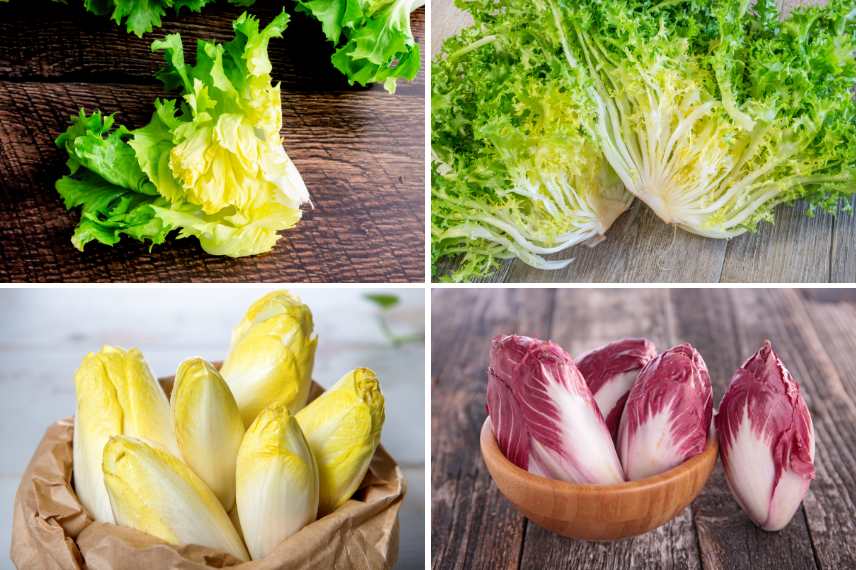
The chicory salads: escarole, curly chicory, endive and wild chicory
– Escarole : this is a salad with a very wide and loose rosette made up of leaves with wavy edges that naturally blanch. The ‘Géante Maraîchère’ is sown from May to August, just like the ‘Grosse Bouclée’. We could also name the ‘Cornet d’Anjou’ and the ‘Cornet de Bordeaux’, both very frost-hardy
– Curly chicory : this salad offers a very dense and tight rosette of crinkled and very crunchy leaves. The ‘Frisée fine de Louviers’ is early, while the ‘Frisée de Ruffec’ is sown from May to August. As for the ‘Très Fine Maraîchère’, it’s perfect for a summer harvest
– Endive : this is Witloof chicory which must be forced to obtain pale yellow, plump shoots. The roots are dug up in October or November, then they are placed in a box filled with soil, potting compost and sand, in darkness at a temperature between 12 and 15 °C
– Wild chicories : these are salads with an upright habit that include some cultivars such as the ‘Barbe de Capucin’ with bitter, cut leaves, the ‘Pain de Sucre’ with tightly packed leaves forming a very dense head, or Italian chicories with heads that are well red (‘Rouge de Vérone’ and ‘Rouge de Trévise’)
For further reading:
– Chicory: sowing, cultivation and harvest
– How to grow chicory successfully and blanch it
– How to sow endives or chicons?
Beautiful Italian salads
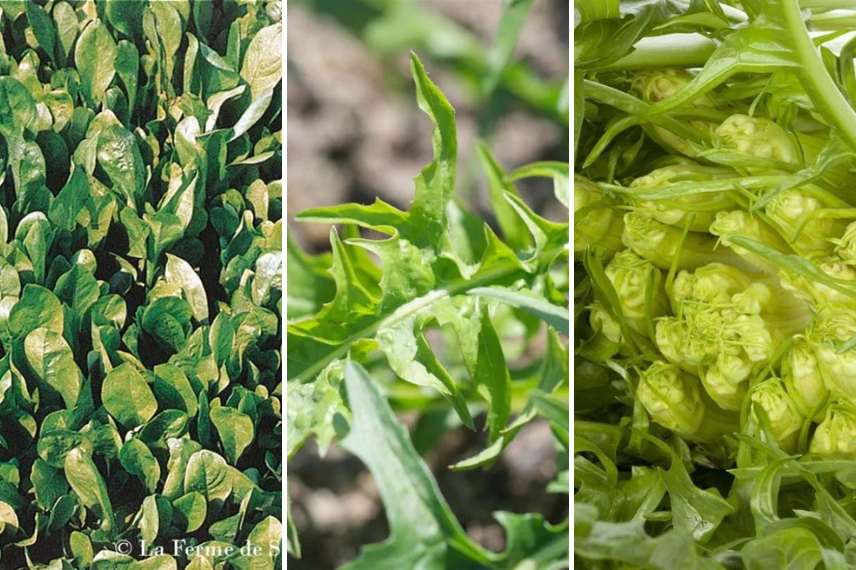
Biondissima Da Trieste (©La Ferme de Sainte-Marthe), the chicory Catalogna Punterella di Galatina and the Catalogna Punterella di Galatina
In addition to Verona Red and Treviso Red, Italy also offers other chicory varieties to discover. Thus, Grumolo Verde, an old variety, produces round and broad leaves. It is sown from April to June for a harvest from June to August. Biondissima Da Trieste is a lettuce with broad, entire and round leaves. The Catalogna di Chioggia chicory offers leaves similar to those of a dandelion, and the Catalogna Punterella di Galatina chicory stands out for its pointed head and its flowering shoots resembling asparagus, harvested in September–October.
Read also
15 salads for summerOther unconventional salads to add a touch of originality to your plate
We can’t serve our salad without mentioning other varieties with flavours that are instantly recognisable:
- rocket and its leaves with a pungent and peppery flavour. You can sow wild rocket or cultivated rocket.
- lamb’s lettuce: it’s the winter salad par excellence with spoon-shaped, bright green leaves. Here again there are varieties with large seeds that are sown from August to October–November, and varieties with small seeds to harvest throughout the winter.
- watercress which distinguishes itself by three varieties: Algerian watercress, fountain watercress and garden watercress. All carry a pungent and peppery flavour.
- purslane: it is an herbaceous plant with very crisp leaves and a mild flavour.
- plantain ‘Deer Horn’: it is a vegetable plant with narrow leaves bearing a salty note and forming a spreading rosette.
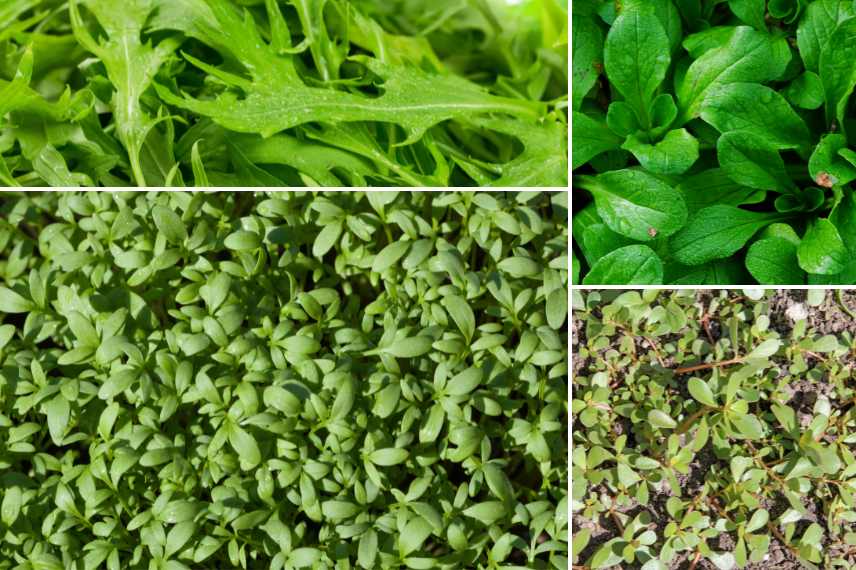
Rocket, lamb’s lettuce, watercress and purslane are salads that deserve a place in the vegetable garden
For more information:
- Subscribe!
- Contents
Comments