





























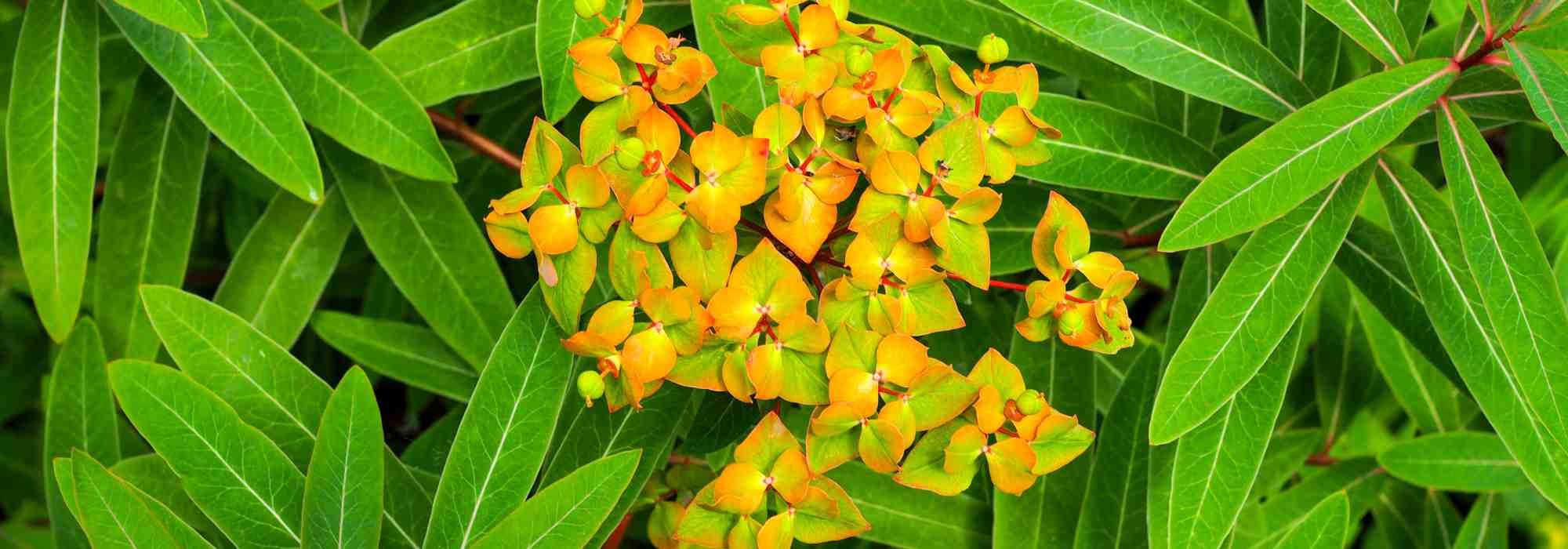
Beautiful plants all year round!
or almost...
Contents
There are plants that delight gardeners like us for many months, as they prove interesting across several seasons: through their flowering and then their foliage, but also their picturesque habit, colourful wood, or sometimes their berries or fruits. These are plants we cannot do without for their successive attractions and long-lasting effect. Perennials or bushes, climbing plants or trees, they are must-haves for the garden, in other words, essential plants to incorporate into our borders or pots. By combining them, we can dress the garden throughout the four seasons.
Let’s quickly discover these essential plants, beautiful all year round… Or almost!
→ Also check out our tips in Designing a Four-Season Garden

Evergreens
They are, by definition, the structural plants in the garden, as they retain their foliage in all seasons. It goes without saying that they should be integrated into the garden for their volumetric and colourful effect throughout the year. Some even reward us with a magical flowering, sometimes ephemeral, but often quite prolonged.
Here are a few remarkable examples, some of which are semi-evergreen depending on the climate:
- Conifers (with their multiple habits allowing for much creativity), the bamboos, graphic, and the eucalyptus
- The beautiful shrubs: Strawberry tree, Magnolia grandiflora, Mahonia, Abelia, Rhododendrons and azaleas, Camellias, evergreen Ceanothus, Loropetalum, Teucrium, evergreen Berberis, Pyracantha, Cotoneaster, and in mild climates Grevillea, oleander, Callistemons…
- Climbers: Hydrangea seemani, Trachelospermum, Holboellia, Clematis armandii and Fremontodendron
- Perennials: Euphorbias, hardy geraniums that are evergreen, Iris and Bermudiana, Epimediums, Ivy, Penstemon and wormwoods (semi-evergreen)
- The exotic plants: Phormium, Cordylines and palms, Yucca and agaves, Euphorbia mellifera, Opuntia… among others
- Not to forget the marcescent plants that bring a tawny hue in mid-winter: beech and hornbeam, chestnut
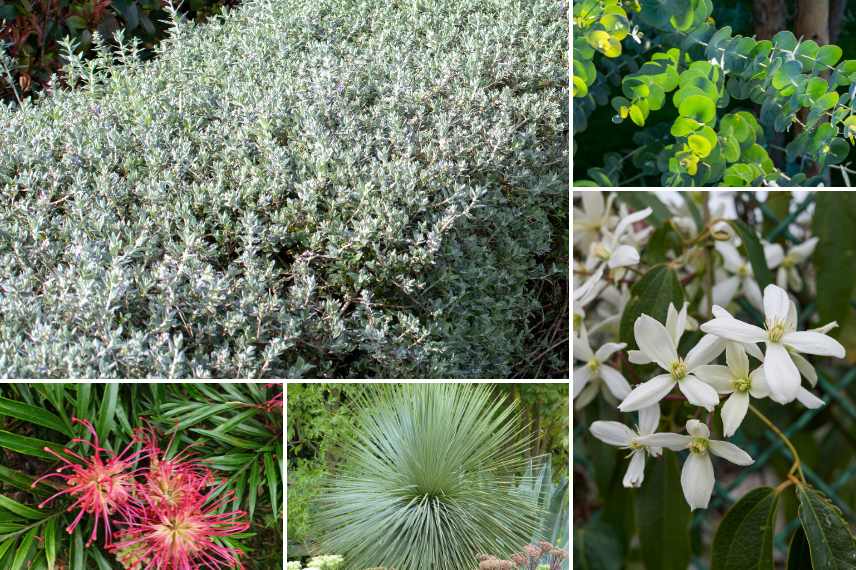
Teucrium fruticans, Eucalyptus gunii, Grevillea, Yucca rostrata and Clematis armandii
Read also
6 Beautiful Trees All Year RoundThe champions of long-lasting flowering
Enduring, they bloom for a long time, often in summer, but also in winter or spring:
- Long-flowering shrubs: Hydrangeas, Abelia, Oleander, Buddleia, Callistemon, Escallonia, Fuchsia magellanica, bush Veronicas, tree mallow (Hibiscus syriacus) and Alcalthaea, Lavatera ‘Barnsley’…
- Shrubs: Bush sages, Cinquefoils, Perovskias, heathers including Daboecia cantabrica (flowering from June to frost) and Erica x darleyensis, bush Veronicas…
- Perennials: Hellebores, Valerian, Gaura, Persicarias, Anthemis, Geranium ‘Rozanne’, Alstroemeria, Buenos Aires Verbena, Anaphalis triplinervis, Anisodontea, Fuchsias, Dahlias, Osteospermums…
- Climbers: Jasmines, Honeysuckles, Plumbago and Trumpet vines…
- Annuals: Ipomoeas, sweet peas, nasturtiums…
→ Also read: climbing plants: the longest flowering, hardy geraniums with long flowering, perennials for shady areas with long flowering periods, 7 sun perennials with long flowering
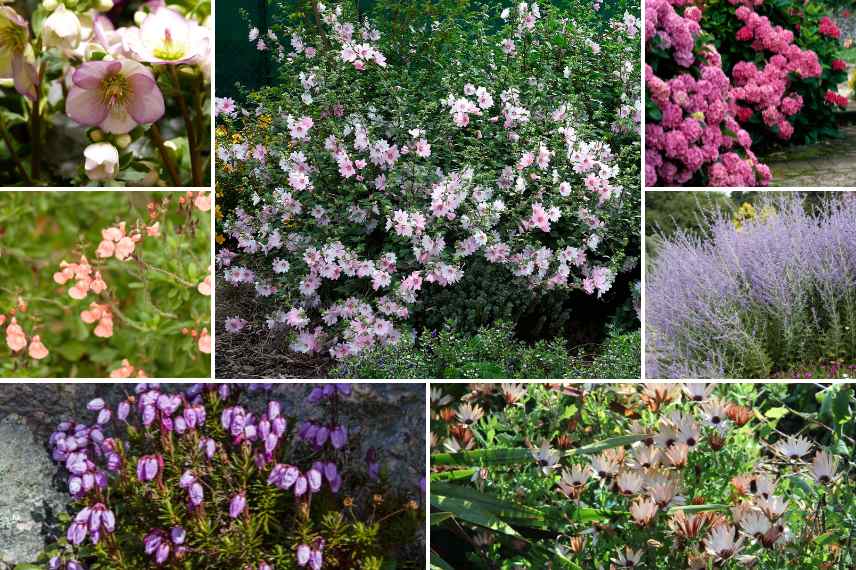
Helleborus ‘Ice’n Roses’, Lavatera ‘Barnsley’, Hydrangea macrophylla, Salvia macrophylla ‘Ribambelle’, Perovskia atriciplifolia, Daboecia cantabrica and Osteospermum
Plants that remain attractive after their flowering
There are a myriad of beautiful plants, once their flowers have faded: because their finely cut or slender foliage remains of interest, because their greyish or contrasting colours provide a spectacle, or those that always look stunning, as their flowers gracefully fade, evolving into beautiful cinnamon hues, sometimes adopting paper-like, almost translucent textures…
It is always worthwhile to have these plants within a border to prolong the enjoyment in the garden!
⇒ Which ones? : Hydrangeas, which then surprise with their faded shades, violet mixed with green, or straw yellow, all the grasses, the large Sedums, the Lunaria, astilbes, Alliums, Solidagos, and Asclepias…
→ Discover also decorative dried flowers in winter, and admire the stunning photos of flowers in winter in our article Seedheads
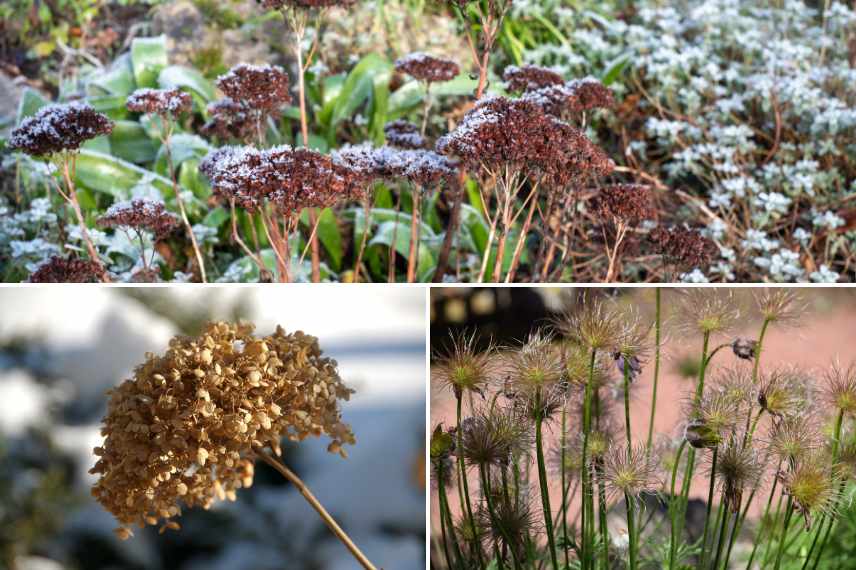
Sedums, Hydrangea arborescens, and Pulsatilla
Flowers that turn into ornamental fruits
With these plants, the lifespan and vibrancy of the garden are extended thanks to the particularly ornamental fruits or berries that emerge from their flowers, remaining for varying lengths of time on the plant in autumn or winter. Scarlet, orange, yellow, or bluish, the fruiting bodies bring colour to the garden in autumn or winter.
⇒ Which ones? : the ornamental crab apples, the Amelanchier, the persimmon or kaki with large fruits like oranges, the Viburnum nudum, Viburnum opulus ‘Xanthocarpum’, the sea buckthorns, the firethorn (Pyracantha) and the Cotoneasters, the mountain ashes, the curious Poncirus trifoliata, etc.
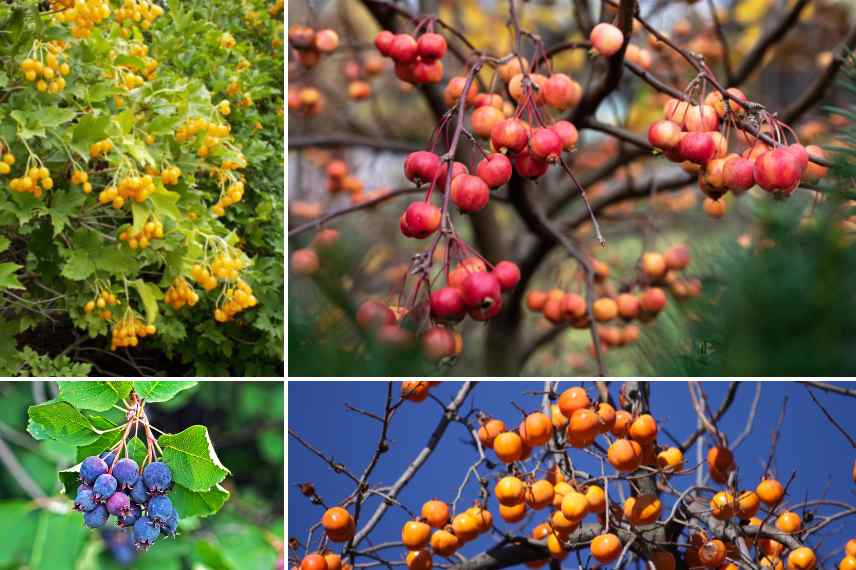
Viburnum opulus ‘Xanthocarpum’, Malus ‘Evereste’, Amelanchier alnifolia ‘Saskatoon Berry’, and persimmon
Trees and bushes 3 in 1: true stars of the gardens
Even more striking, some plants—often deciduous—have three displays that follow one another… Among them, many bushes are noteworthy for their ability to change their foliage in autumn, showcasing fruits or revealing a dreamlike bark and silhouette in winter, extending the enchantment in the garden. Beautiful plants in flowers, leaves, and fruits… or completely bare, here is a non-exhaustive selection of winning trios:
-
The winning trio: flowering + foliage + fruiting
⇒ Which ones? : Arbutus unedo, Amelanchier, Stewartia, Clerodendron, blueberries, Berberis thunbergii and its varieties, Cornus mas and Cornus kousa, Berberis darwinii, Berberis ottawensis, Hippophae rhamnoides, Hypericum inodorum, Nandina domestica, Viburnum nudum and Viburnum Plicatum ‘Pink Beauty’, Viburnum dilatatum ‘Sealing Wax’, Chionanthus virginicus (snow tree), Koelreuteria, not to mention the wild roses (Rosa canina) and others Rosa glauca that offer beautiful hips in winter if not pruned after August.
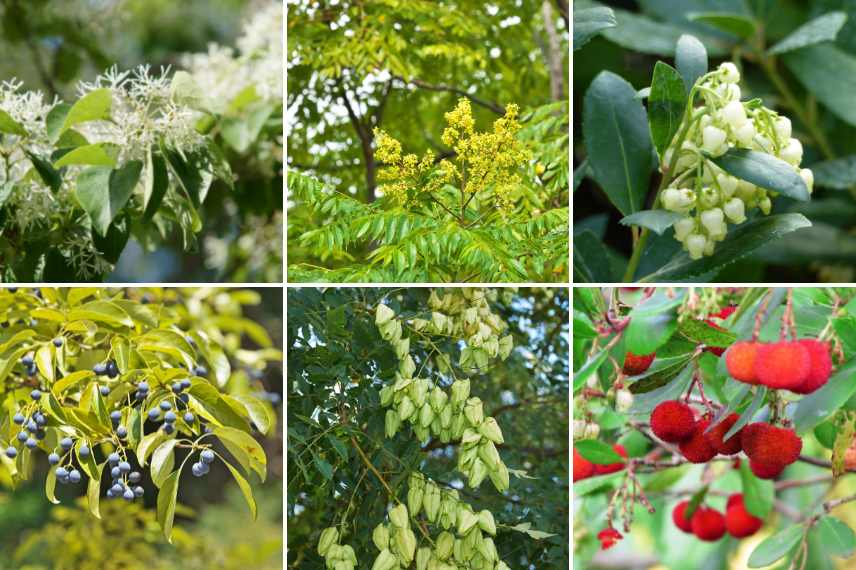 Chionanthus virginicus, Koelreuteria, Arbutus unedo: flowers and fruits
-
The winning trio: spring foliage + flowering + autumn foliage
⇒ Which ones? : Enkianthus campanulatus, Lagerstroemia indica or crape myrtle, Cercis canadensis ‘Forest Pansy’, Aesculus pavia ‘Koehnei’, some spiraeas including Spirea japonica ‘Goldflame’, Snowball viburnum (Viburnum opulus), Cornus kousa, Berberis thunbergii ‘Admiration’, Sumacs, Amelanchier, Cotinus coggygria, Koelreuteria (Pride of India), Prunus serrulata, some Physocarpus like ‘Diabolo’, Chionanthus virginicus, Heptacodion, Stewartia pseudocamellia, Sorbaria sorbifolia, Clethra barbinervis, Itea virginica…
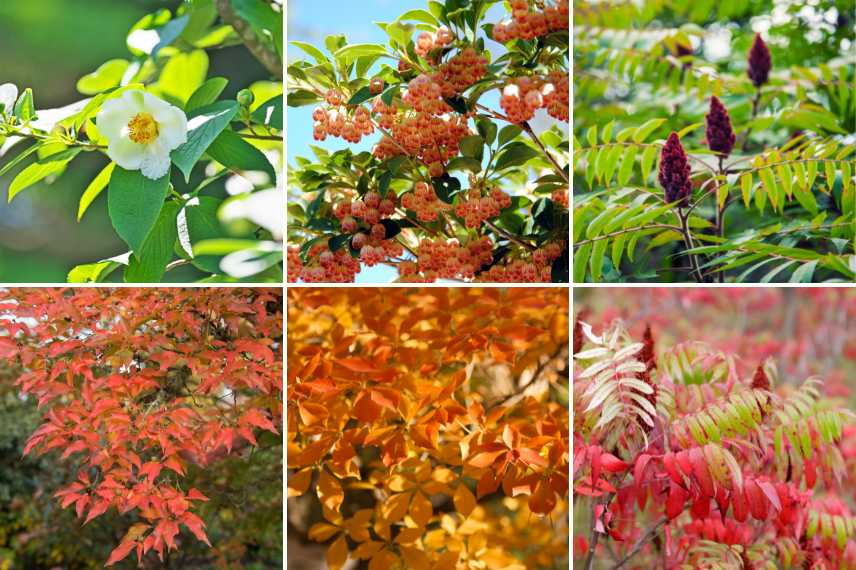 Stewartia pseudocamellia, Enkianthus campanulatus and Sumac: flowering and autumn foliage
-
The winning trio: foliage + flowering/wood + silhouette
⇒ Which ones? : Edgeworthia, Lagerstroemia, Poncirus trifoliata, Salix alba ‘Chermesina’, some twisted shrubs like the twisted hazel, Japanese maples, Heptacodion, and of course the decorative wood dogwoods.
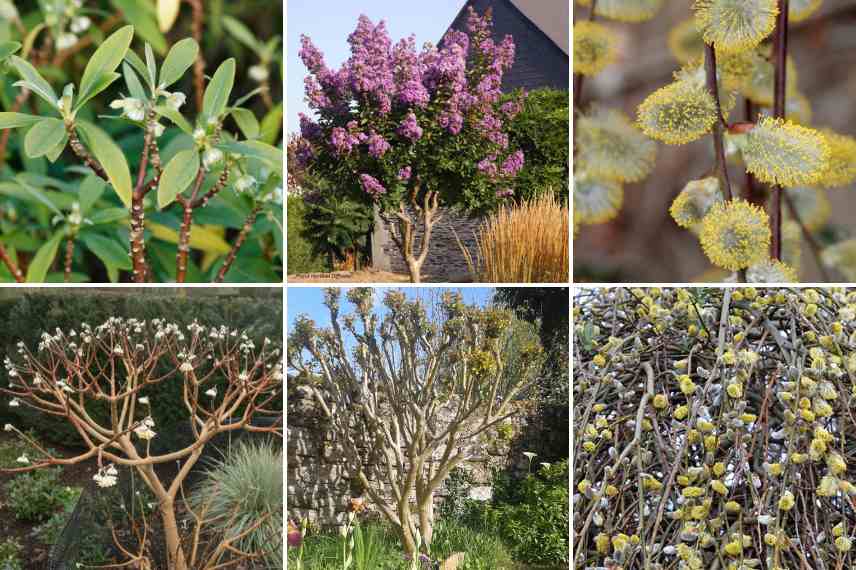 Edgeworthia chrysanta, Lagerstroemia indica and Salix caprea ‘Kilmarnock’
-
The winning trio: foliage + flowering + bark
⇒ Which ones? : Lagerstroemia, Stewartia, Arbutus unedo, Cornus alba and its numerous cultivars, Tibetan cherry (Prunus serrula), Clethra barbinervis, Heptacodium miconioides. The maples with decorative bark and Japanese maples (‘Sangokaku’, ‘Orange Dream’) although not flowering like ornamental shrubs, remain good subjects to plant for their long-lasting interest in the garden.
→ Read also: the most beautiful barks and the most colourful decorative dogwoods
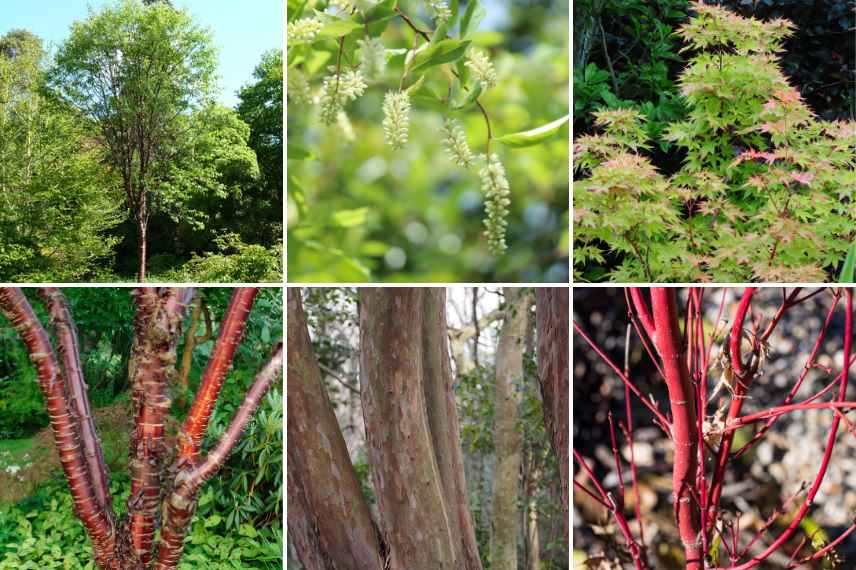 Prunus serrula (© Wendy Cutler), Clethra barbinervis and Acer palmatum ‘Sangokaku’
Foliage that remains colourful in autumn
Also rely on all the trees or bushes that retain their foliage for a long time; they still decorate the garden late into autumn, until the real heavy frosts of winter. These are deciduous species that often bud late in spring and mostly take on stunning autumn hues of yellow, orange, or red.
⇒ Which ones? : Crataegus x lavallei (a beautiful hawthorn with white flowers and orange fruits), Chitalpa tashkentensis (with beautifully exotic flowers), the Montpellier maple (Acer monspessulanum) with lovely trilobed leaves turning red-orange before falling, not to mention the wisteria, hazels, and Hydrangea quercifolia, which are also stunning in autumn, and finally the majestic Ginkgo biloba that adorns itself in bright yellow.
Don’t forget the grasses: evergreen ones like Carex, Stipa, Muhlenbergia, or fescues, but also deciduous grasses that look beautiful for nearly 8 months of the year (Miscanthus, Panicum, Calamagrostis, Andropogon…), bringing both volume and lightness.
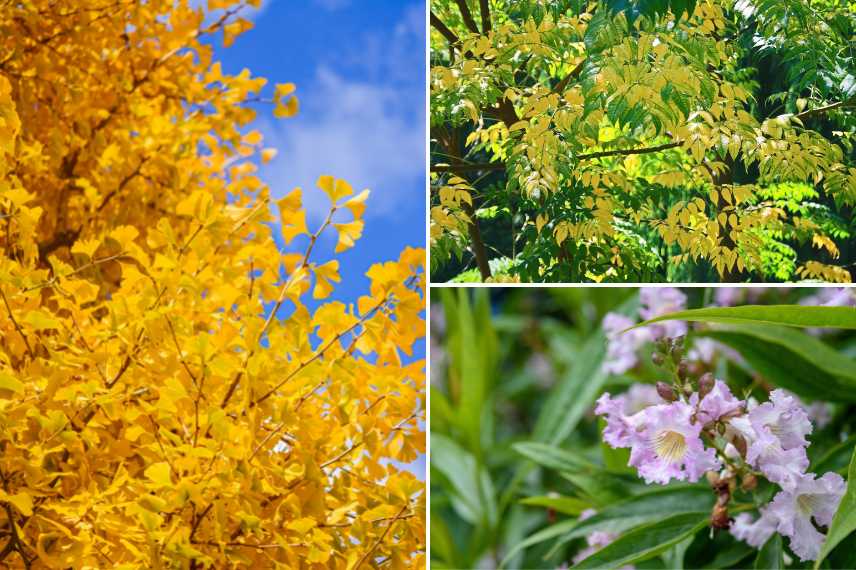
Ginkgo biloba, Wisteria, and Chitalpa
→ Read also: 6 trees that produce their foliage late; autumn-coloured hydrangeas
Repeat flowering
Provided that you properly maintain your perennials and prune them after the first flowering, some will “repeat flower”, meaning they bloom a second time in summer or early autumn. Even though the second flowering is less spectacular than the first, it is still very enjoyable! This is the case for wisteria and many repeat flowering roses, as well as alchemilla, nepeta, penstemon, and agastache, Mexican orange blossom (Choisya) cultivars, and certain hybrids: ‘Encore’® series azaleas. Rosemary can bloom two or three times a year depending on the region.
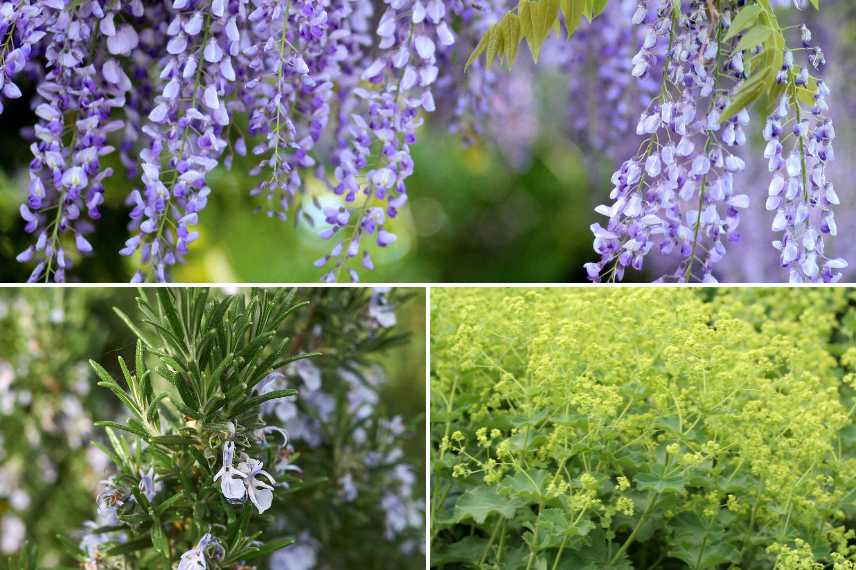
Wisteria, rosemary, and alchemilla
Perennials with evolving foliage
Let’s not forget the foliage, which is much more enduring in the garden than flowering. In addition to evergreen plants, deciduous or semi-evergreen perennials with attractive foliage from spring to autumn, as their hues change with the seasons, are also gems in the borders:
⇒ Which ones? : Mukdenia rossii, Libertia peregrinans, Epimedium x versicolor ‘Sulphureum‘, Darmera peltata, some Bergenias like ‘Bressingham Ruby’ or ‘Dark Margin’, some Carex like Carex testacea ‘Prairie Fire’, etc.
- Subscribe!
- Contents
Comments