





























Harvesting and Storing Apples and Pears
Our tips for making the most of your fruit all winter long
Contents
Apples and pears are among those autumn fruits that we love, whether enjoyed raw or cooked, whole or prepared. Their trees, growing in most regions of France, are some of the most common in orchards.
Some varieties of apples and pears also have the advantage of being able to be stored for long months, inviting enjoyment throughout winter. A few simple steps at the time of harvest and good storage conditions will ensure perfect preservation of your fruits.
From picking to storage, here are our tips for successfully harvesting and preserving apples or pears.
When to harvest apples and pears?
The harvest period for apples and pears generally starts in mid-August and continues until November-December. However, the timing of the harvest mainly depends on the variety of the fruits, the regions involved, and the climatic conditions. One essential requirement: the fruits, even the latest varieties, must be harvested before the first frosts.
Early apples and pears, also known as summer apples and pears, are harvested between mid-August and September. Later fruits will be harvested in autumn, between October and early December.
To know if it’s time to harvest, here are some indicators:
- healthy fruits start to fall spontaneously to the ground;
- the fruits have a nice colour, the seeds inside are a rich dark brown or black, and the flesh is white-yellowish;
- when you take a fruit from the tree in your hand, the peduncle detaches easily and effortlessly with just a slight twist (about a quarter turn); if not, the fruit is not yet ripe.
Not all fruits on the same apple or pear tree will necessarily be ripe at the same time: feel free to stagger the harvest over several days.
It’s worth noting that both apples and pears are climacteric fruits: they have the unique ability to continue ripening even after being picked, thanks to their own production of ethene. Therefore, it is possible, and even recommended, especially for certain varieties of pears, to harvest fruits that are not fully ripe for storage (about 1 to 2 weeks before full ripeness).
Read also
Apple tree: planting, pruning and careHow to harvest apples and pears?
Harvesting your fruits correctly is particularly important: it is indeed a careful picking that will determine the proper storage of apples and pears.
Harvest on dry days. Fruits should not be wet or damp to ensure good storage and limit the risk of mould.
Harvesting from trained or dwarf apple and pear trees poses no particular difficulty, as the fruits are almost at eye level or within reach. For larger varieties, however, you will need a ladder or a telescopic fruit picker.
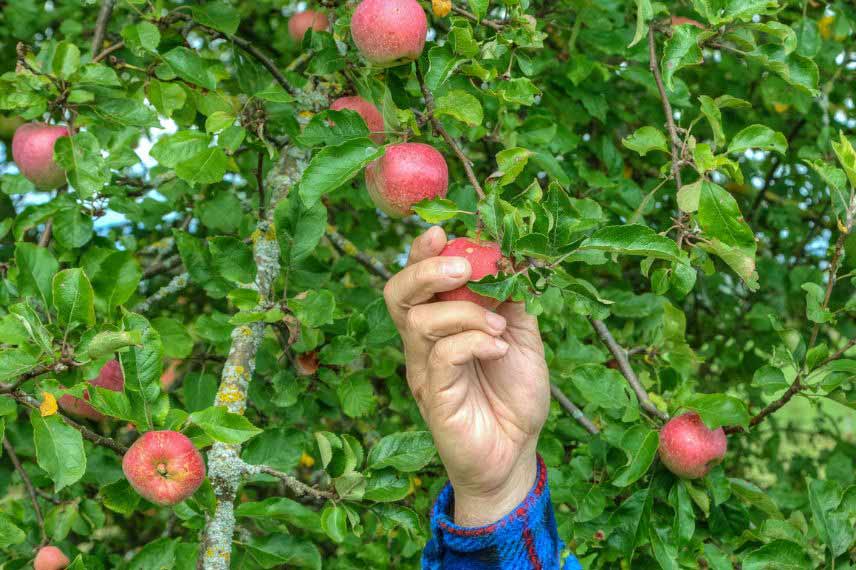
As mentioned earlier, the picking is simple: gently hold the fruit in your hand and give it a slight twist to detach the stem. To avoid damaging the fruits, especially the rather delicate pears, always proceed with care. Avoid knocking them against each other and lay them flat in a crate or basket, taking care not to stack them too high.
Next, leave your apples or pears flat for a few days in a place sheltered from heat and humidity. Ideally, the fruits should not touch each other to avoid contamination in case of disease. This resting period will help reveal the healthy specimens. Conversely, it will allow you to eliminate those that are rotten, have injuries, spots, or other signs of weakness that will hinder proper storage.
Keep only the intact fruits, which should be well dried. Consume or cook quickly any fragile fruits or those that have fallen to the ground.
Discover other Apple trees
View all →
Available in 1 sizes
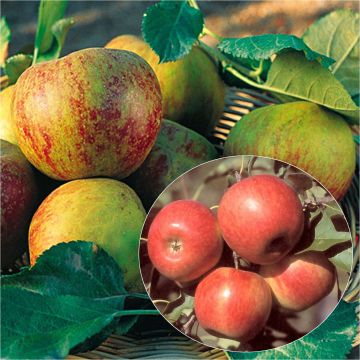
Available in 0 sizes
Available in 0 sizes
Available in 0 sizes
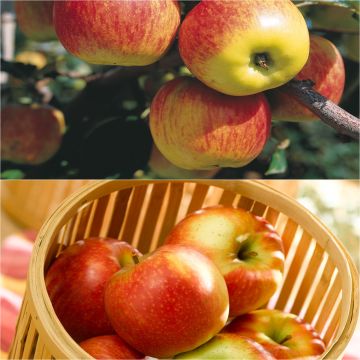
Available in 0 sizes
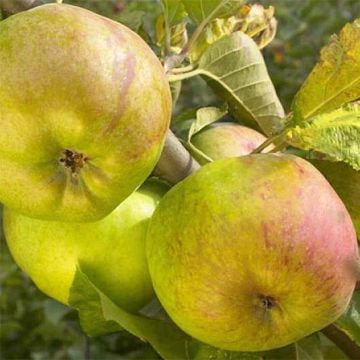
Available in 4 sizes
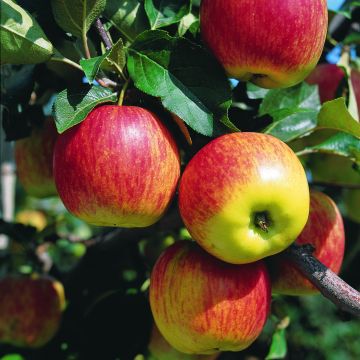
Available in 1 sizes
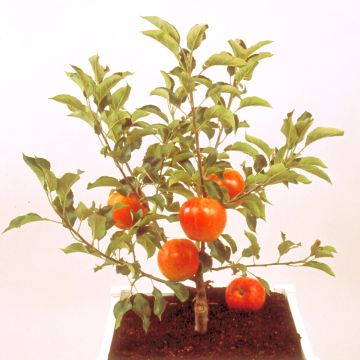
Available in 2 sizes
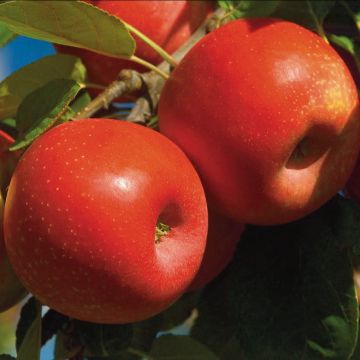
Available in 2 sizes
Available in 3 sizes
How to store apples and pears?
Long-term Storage Varieties
Pears and apples are renowned for their long storage capabilities, but this largely depends on the specific variety.
Summer apples and pears do not store well, lasting only about a month. It is the autumn cultivars or late varieties that offer long-storing fruits. Among them, we can mention:
- the ‘Conference’ pear tree (harvest from October to November);
- the ‘Doyenné du Comice’ pear tree (harvest from September to October);
- the ‘Comtesse de Paris’ pear tree (harvest from September to October);
- the ‘Doyenné d’hiver’ or ‘Bergamote de Pentecôte’ pear tree, with large fruits that can be stored until April (harvest from November to December), just like ‘Bergamote Esperen’;
- the ‘Granny Smith’ apple tree, one of the most widely grown in France (harvest in November);
- the ‘Golden Delicious’ apple tree, whose fruits can be stored until February (harvest from September to October);
- the ‘Belle de Boskoop’ apple tree, whose fruits can be stored until March (harvest from October to November);
- the ‘Choupette’ apple tree (harvest in October);
- the ‘Ariane’ apple tree, whose apples can be stored for nearly 7 months (harvest from September to October);
- the ‘Reine des Reinettes’ apple tree, whose fruits can be stored until March (harvest from September to October);
- the ‘Châtaignier’ apple trees and ‘Calville Rouge d’Hiver’, old late varieties whose fruits can be stored until March-April (harvest from November to December);
- the ‘Fuji’ apple tree, the most widely grown variety in Japan, whose apples can be stored for nearly 8 months (harvest from October to November).
However, there are many other varieties that store well, to be chosen according to your geographical area and climatic conditions.
Additionally, discover our articles:
Storing Whole Apples and Pears
Some precautions should be taken to ensure good storage of your apples and pears.
Store them in a place that is:
- dry, with a humidity level not too high, ideally between 65 and 80% (too much humidity encourages the development of mould and diseases, while excessive dryness hastens wilting);
- ventilated, allowing the ethene gas naturally produced by the fruits to escape, preventing premature ripening;
- protected from light, or even dark;
- cool, at a temperature of about 8 to 12 °C (the higher the temperature, the shorter the storage time);
- definitely frost-free.
Cellars, attics, garages, or pantries are often the preferred places for fruit storage.
Store your fruits flat on clean crates or shelves, ideally previously disinfected to prevent the transmission of pathogenous agents. Place them with the peduncle down for apples, and the stem up for pears. Spread them out in a single layer, avoiding contact between the fruits if possible.
To further optimise storage time, some gardeners recommend wrapping the fruits in newspaper. For pears, it is also sometimes advised to dip their peduncle in wax. This limits natural evaporation and thus delays ripening.
Remember to regularly inspect your fruits throughout the storage period. Immediately remove any apples or pears showing signs of wilting or mould to prevent contamination of their neighbours.
Under good storage conditions, your apples and pears can last between 3 to 5 months, generally throughout winter, and sometimes even until the end of spring.
Some Preservation Methods for Your Fruits
Fruits that are not intended for storage or that are not healthy enough to be stored whole can be transformed. They can thus be consumed for many months.
Several transformation methods are possible:
- dried fruit, which preserves flavours and nutritional qualities, ensuring storage for 6 to 12 months (see our article “How to Make Dried Apples?”);
- freezing cooked and chopped fruits, which can be stored for 12 months;
- canning in sterilised jars (fruits in syrup, compote, jam, jelly, etc.), for storage over several years;
- transforming into juice or liqueurs, which also keep for several years before opening.
- Subscribe!
- Contents

Comments