





























Pairing ideas with Daphne
Ideas for Flowering and Fragrant Combinations for Your Wood Garden
Contents
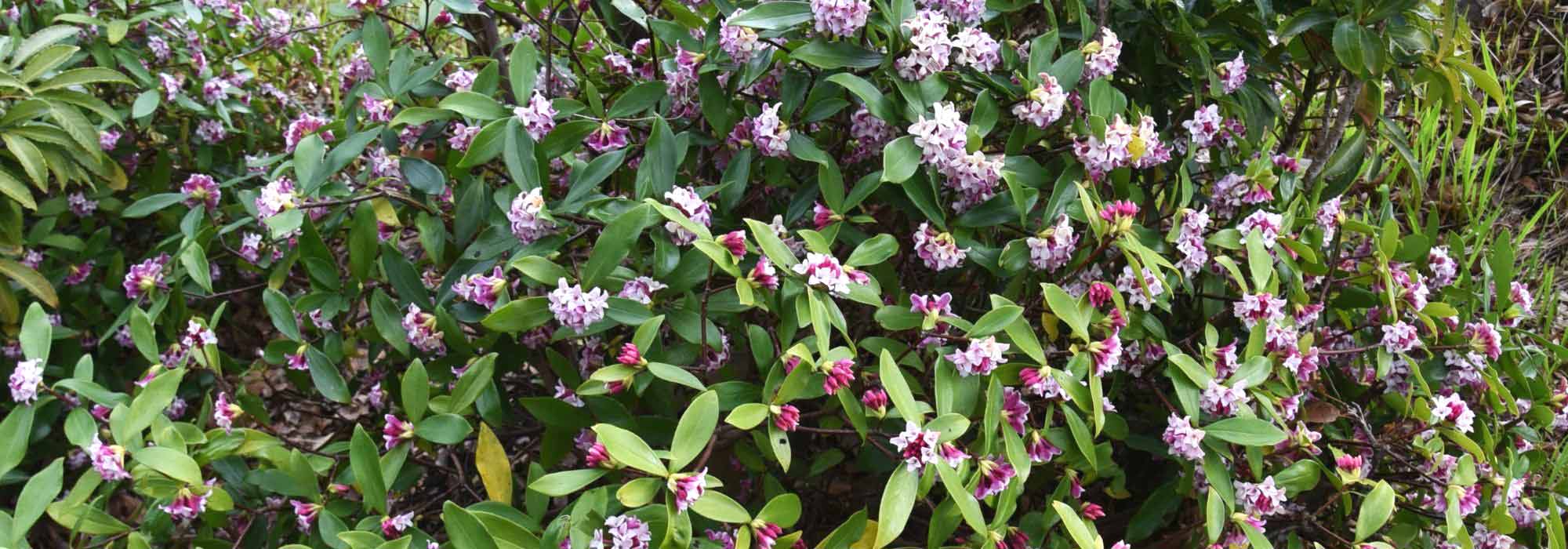
The Daphnes, also known as Sweet Wood or Pretty Wood, are delightful bushes whose sweet and intense fragrance has made their reputation. Emanating from white to pink flowers, it can be detected from several metres around the bush, a pleasure that is all the more enjoyable as many species bloom in the heart of winter, while others flower in successive waves until autumn. The foliage, deciduous to more or less evergreen depending on the climate, is thick and leathery, and some varieties also feature striking variegation that is particularly attractive.
While many prefer a partially shaded exposure and filtered light, it is also possible to place some in non-burning sunlight, as long as the soil remains cool but well-drained, since stagnant moisture is indeed the primary cause of the demise of this bush, which is known to be somewhat temperamental and short-lived. Neutral to acidic soils are preferred for most species, but there are also Daphnes that thrive in calcareous soils, allowing every gardener to incorporate them into their garden, or even on a terrace, as pot cultivation poses no issues.
Use it in your landscaping and create beautiful floral and fragrant compositions, here are some examples for inspiration.

In a flowering woodland
Daphne odora ‘Marianni Rogbret’ is a stunning bush, with evergreen, elongated, glossy leaves that are heavily marginate with yellow, giving it extraordinary brightness, welcome in the less sunny areas of the garden, such as those found in light woodland settings. The buds, a vibrant pink, bloom into small pale pink flowers from January in the milder regions. The fragrance of this rounded bush is a pure delight and fills the garden with its scent for metres around in the heart of winter.
To accompany it, surround its base with decorative-leaved perennials such as those offered by Heucheras, which provide both a contrast in leaf shape and an incredible richness of colours, not to mention their lovely spring flowering. Blooming between winter and spring depending on the variety, Bergenia features broad, rounded, evergreen leaves, with purplish hues that also enchant in winter. To ensure Daphne isn’t the only bush, plant nearby a Mahonia ‘Soft Caress’ with soft foliage… like a caress, and echo its delicacy with some ferns. Dryopteris erythrosora is a drought-resistant evergreen species, and its spring foliage, coppery orange, is particularly ornamental. To complete the look, fill the empty spaces with Hakonechloa. Their foliage dies back in winter, but they bring unmatched grace in season. A few early-flowering bulbs (crocuses, tulips, daffodils…) and you’ll be transported to a woodland atmosphere to admire without interruption!
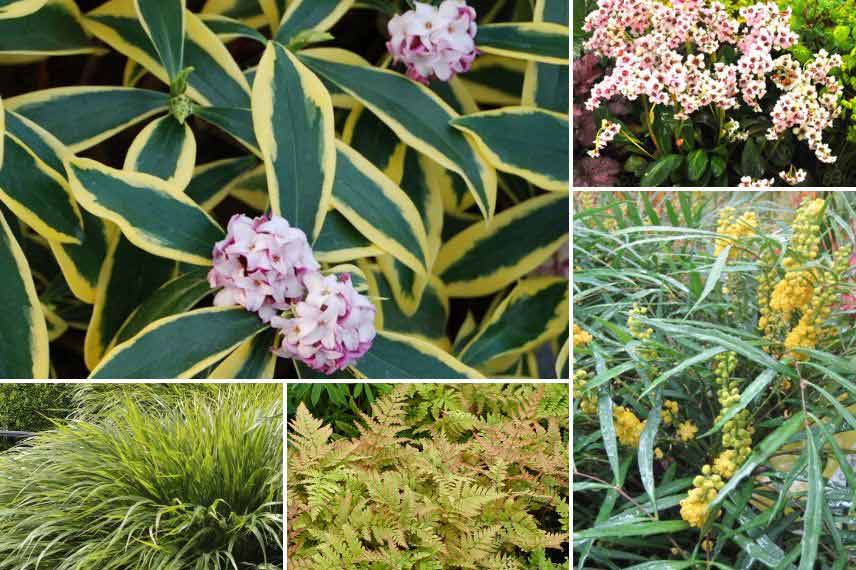
Daphne odora ‘Marianni Rogbret’, Bergenia ‘Dragonfly Angel Kiss’, Mahonia ‘Soft Caress’, Dryopteris erythrosora and Hakonechloa macra
Read also
Daphne: planting, growing and careIn a sunny border
Among the Daphnes, some tolerate growing in sunnier situations, as long as they are not scorched and the soil remains sufficiently cool during the season. This is the case for Daphne ‘Eternal Fragrance’, a bush with a globose habit whose delicately fragrant, pale pink flowering renews from spring to late autumn in successive waves.
Plant it in front of a Serviceberry, which rewards you with beautiful flowering, tasty fruits, and lovely autumn colours, itself positioned not far from a Himalayan Birch with a surprisingly white trunk. Also consider a Witch Hazel like Hamamelis ‘Jelena’, whose fragrant winter flowers blend coppery orange, yellow, and red, shades that are echoed in its foliage later in the season. Highlight the vertical spikes of large Foxgloves and Persicarias, the trumpet-shaped corollas of some Daylilies, the star-shaped flowers of autumn Asters, all linked by a carpet of hardy geraniums with long flowering like ‘Dreamland’ (soft pink flowers) or ‘Rozanne’ (blue), unless you prefer to focus on varieties with colourful foliage. In that case, Geranium ‘Bob’s Blunder’ (brown foliage with silver highlights and light pink flowers), ‘Espresso’ (chocolate foliage and lilac flowers) or ‘Blue Sunrise’ (golden foliage and late purple-blue flowering) are options to consider.
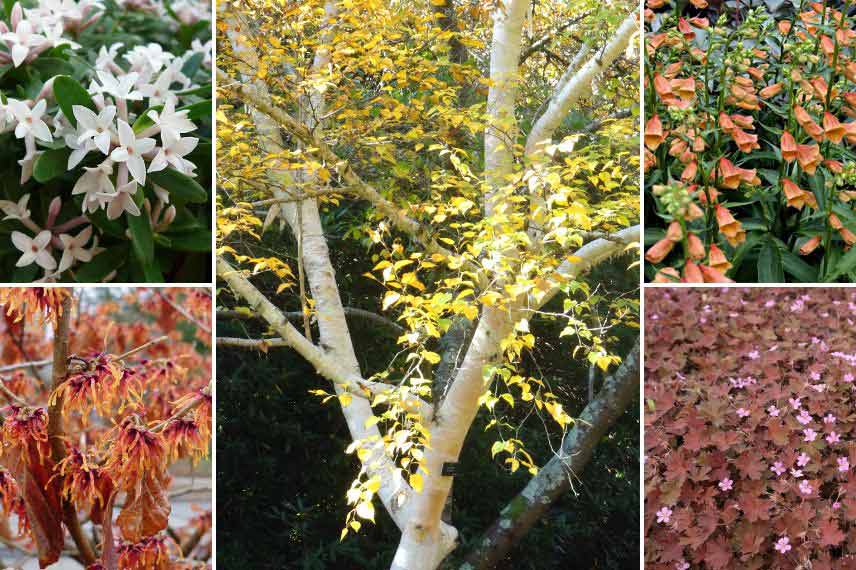
Daphne ‘Eternal Fragrance’, Hamamelis ‘Jelena’, Betula utilis ‘Jacquemontii’, Digitalis hybrid ‘Goldcrest’ and Geranium ‘Bob’s Blunder’
Discover other Daphne
View all →
Available in 0 sizes
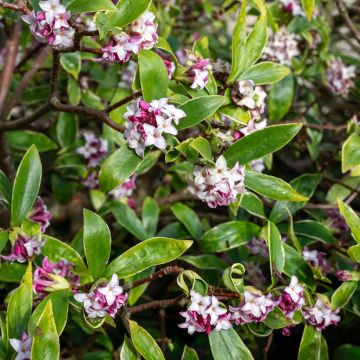
Available in 3 sizes
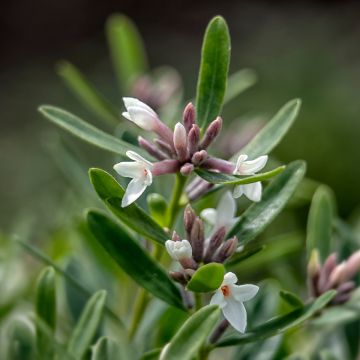
Available in 2 sizes
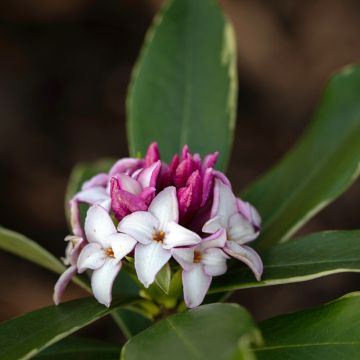
Available in 2 sizes
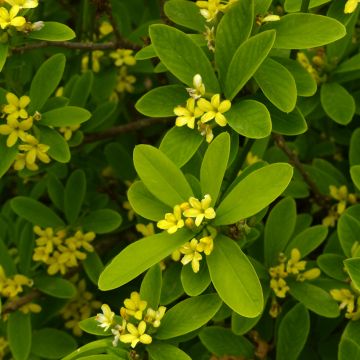
Available in 2 sizes
Available in 1 sizes
Available in 1 sizes
Available in 1 sizes
Available in 1 sizes
Available in 1 sizes
In a fragrant bed in chalky soil
If many Daphnes prefer soils that are neutral or acidic, some can, however, adapt to more alkaline conditions. This is the case for Daphne laureola ‘Philippi’, which thrives in calcareous soils. A lover of partial shade, its dark green, bluish-tinged evergreen foliage serves as a backdrop for an original flowering, featuring yellow-green corollas with a pleasant honey-like fragrance.
Pair it with shrubs that, like it, enjoy dappled light and well-drained soils. Among those with the largest dimensions, to be placed in the background, a weeping Cytisus such as Laburnum alpinum ‘Pendulum’ (2m) brightens spring with its clusters of yellow, fragrant flowers. A bit taller (5m) and more upright, Laburnum watereri ‘Vossii’ forms a lovely screen and can provide the shade that shelters your Daphne. Valued for their fragrant clusters in spring, Lilacs can also form small trees, like Syringa ‘Madame Lemoine’, a tried-and-true variety with pure white double flowers. Unique in its kind, a Buddleja ‘Sungold’ produces yellow ball-shaped inflorescences that take over in late summer and autumn. To enliven the whole, choose perennials with blue, mauve, or violet flowers, including Agastache ‘Globetrotter’, whose inflorescences rise above aromatic foliage, Geranium ‘Hocus Pocus’ with its beautiful lavender flowers that stand out against deeply cut purple foliage, or Meadow Sage ‘Madeline’, which offers a bicolour blue and white flowering.
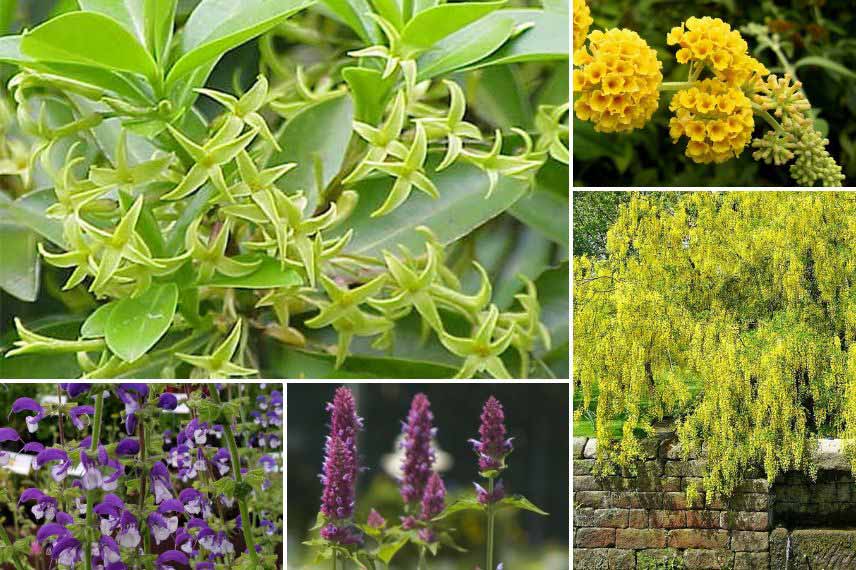
Daphne laureola ‘Philippi’, Buddleja ‘Sungold’, Laburnum alpinum ‘Pendulum’, Agastache ‘Globetrotter’ and Salvia pratensis ‘Madeline’
Read also
Daphne: how to care for it?To edge a border in partial shade
Some Daphnes, such as Daphne cneorum, do not exceed 30 cm in height but adopt a creeping habit that can cover 1.5 m, making it an ideal plant for the foreground to create a beautiful evergreen carpet adorned with pink flowers that have a sweet fragrance. It can thus be used to highlight taller plants that emerge from this colourful carpet. Preferring basic soil, pair it with shrubs that are not affected by a higher pH.
Leycesteria formosa ‘Purple Rain’ blooms in dark purplish-red tones and then produces decorative berries that delight birds. Representing a good option to replace a Japanese maple, the Beech ‘Mercedes’ is a dwarf variety that does not exceed 2 m. Its finely cut foliage, which turns coppery yellow in autumn, colours winter with a lovely brown before giving way to new leaves. A Samarian Elm with golden foliage adds a touch of brightness from spring to autumn. Still rare in cultivation, it is, however, a very accommodating small tree with aromatic foliage that changes tones. Contrast it with a dark-leaved shrub like Weigela ‘Alexandra’ (or the dwarf variety ‘Minor Black’ if space is limited), whose intense purple is enhanced in late spring by tubular pink flowers. A few clumps of Hellebores brighten winter, followed by the pink spikes of a Woodland Sage ‘Caradonna Pink’, succeeded in turn by the endless flowering of a Kalimeris incisa, culminating in the display of autumn Asters. One or more evergreen ferns like Polystichum polyblepharum with graphic foliage can complete the scene.
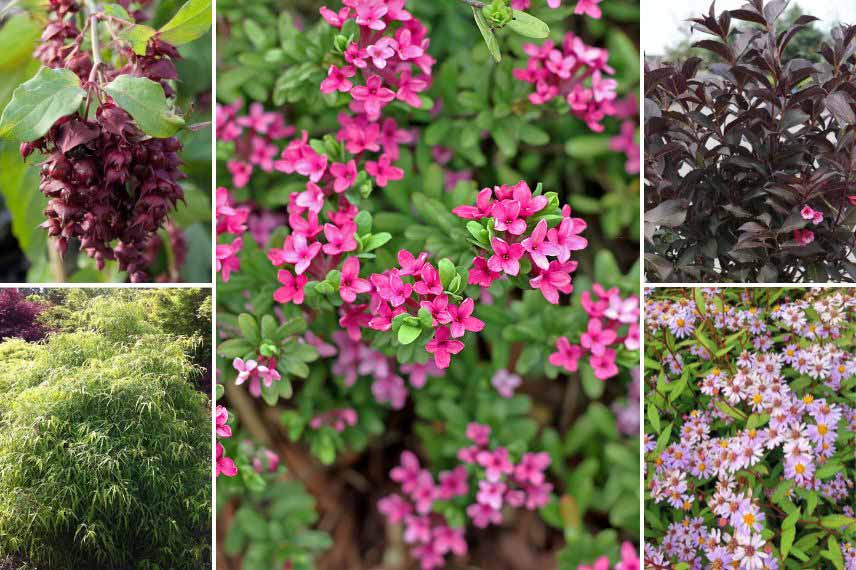
Leycesteria formosa ‘Purple Rain’, Fagus sylvatica ‘Mercedes’, Daphne cneorum, Weigela florida ‘Alexandra’ and Kalimeris incisa
In a cool rockery
A poorly drained soil is the number one enemy of Daphnes, so their planting in rockeries is highly recommended. In partial shade, Daphne burkwoodii ‘Somerset’ offers you green foliage, deciduous to evergreen depending on the severity of winter, and a very fragrant pink flowering around May. Pair it with small conifers with colourful foliage such as ‘Sungold’ Cypress (golden), ‘Blue Moon’ Cypress (blue) or Sitka Spruce (blue-green to silver-blue). Add colour here and there with Columbines, Astrantias, and Erigerons that guarantee beautiful blooms over a long period. Many ferns thrive particularly well in a rockery, such as Wall Rue or Cyrtomium falcatum. Also appreciated for their large decorative foliage and flowering, Hostas form beautiful and generous clumps. The crinkled blue leaves of Hosta ‘Drinking Gourd’ can thus be paired with the distinctly golden leaves of a variety like ‘Sunny Halcyon’ for a play of colours that dresses the base of your beautiful wood. As groundcover, Sagina subulata spreads into a low, mossy carpet full of freshness, while Ajuga reptans ‘Purple Torch’ grows quickly while flowering at the same time as the Daphne, creating a purple carpet that enhances its neighbour.
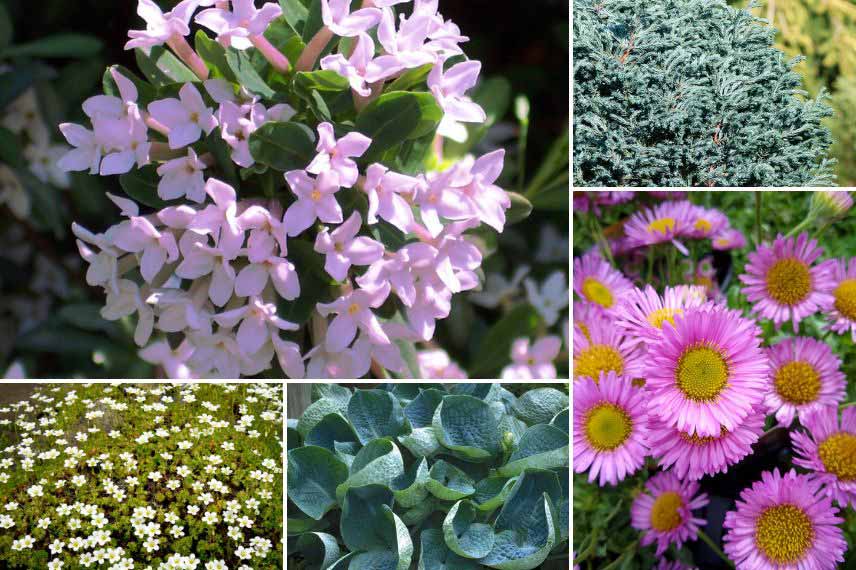
Daphne burkwoodii ‘Somerset’, Chamaecyparis pisifera ‘Blue Moon’, Erigeron glaucus ‘Sea Breeze’, Hosta abiqua ‘Drinking Gourd’ and Sagina subulata
In a pot on a terrace
Some gardens cannot provide the necessary conditions for the thriving of Daphnes, especially if the soil is heavy and poorly drained. On the other hand, many plant lovers only have a terrace or balcony to indulge their passion. In both cases, pot cultivation allows you to enjoy the beauty and fragrance of these sometimes delicate bushes. To scent your outdoor space for an extended period, why not plant different species in large, beautiful round pots: Daphne odora ‘Aureomarginata’ for fragrances from mid-winter, Daphne ‘Sweet Amethyst’ for spring, and Daphne ‘Pink Fragrance’ for a renewed flowering until autumn.
In other containers, install slightly taller bushes that can serve as a backdrop and provide shade if needed: Non-running bamboos, ‘Kojo no mai’ flowering cherry, Physocarpus, ‘Snowmound’ Spiraea, Laurel-tin… the choices are vast. A few Heucheras and Hostas in lower containers to form a skirt of decorative foliage, along with bulbs to mark the seasons, and you are off on a botanical journey at your fingertips… and nose!
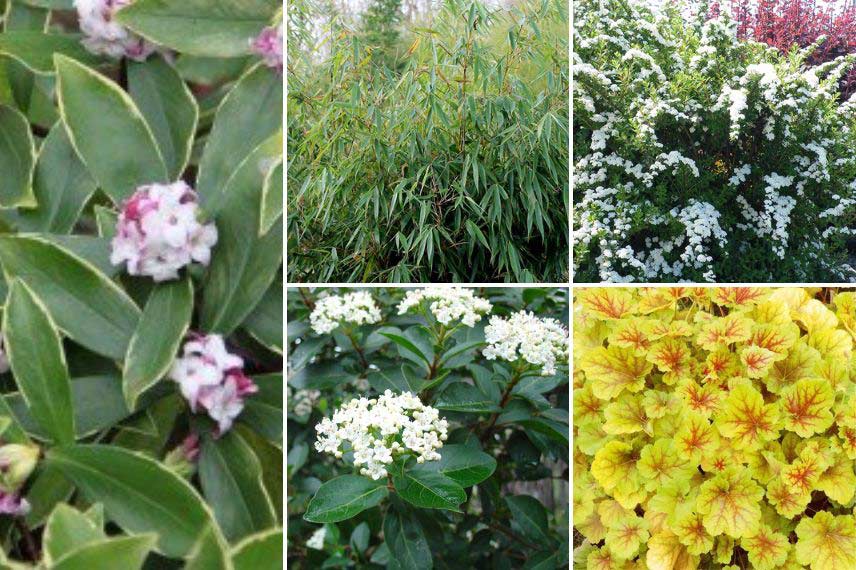
Daphne odora ‘Aureomarginata’, Fargesia robusta ‘Formidable’, Spiraea nipponica ‘Snowmound’, Viburnum tinus and Heuchera ‘Happy Flames’
- Subscribe!
- Contents
Comments