


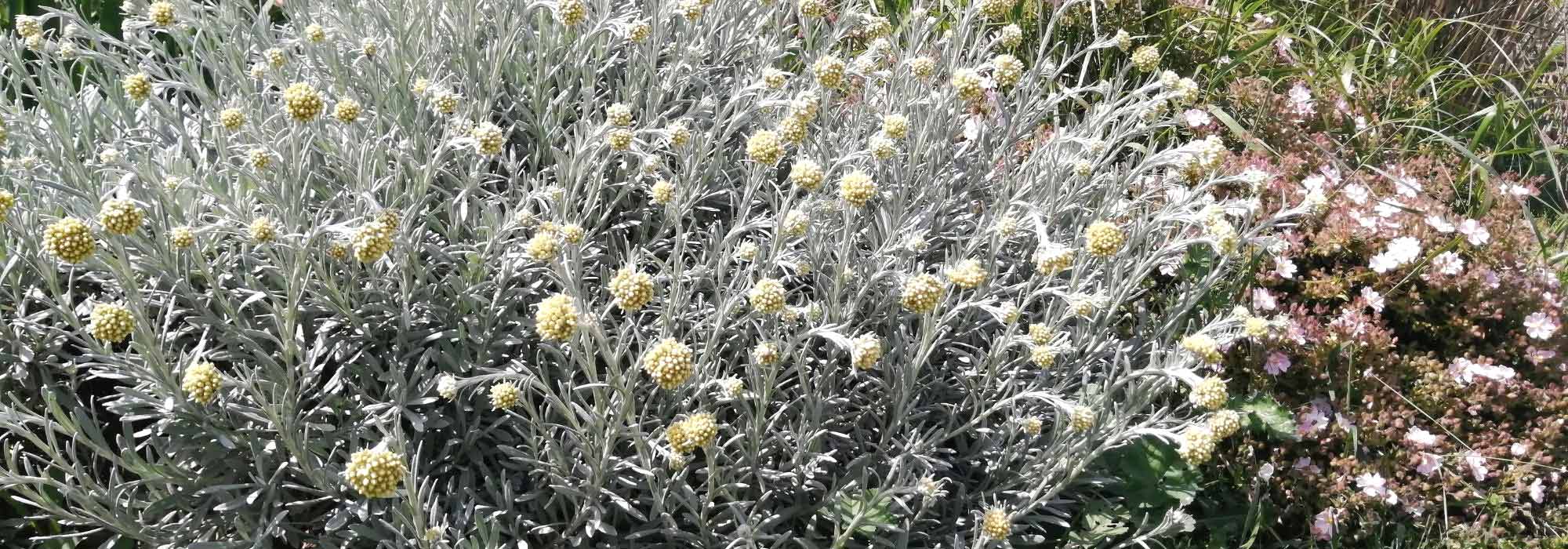
How to pair Helichrysum?
Ideas and inspirations for in-ground or potted plants
Contents
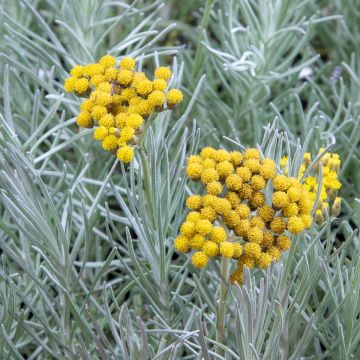
The Helichrysum has several nicknames: “Everlasting” refers to the longevity of its flowers, while “Curry plant” highlights the spicy fragrance emitted by its leaves.
This aromatic perennial from the Mediterranean offers a bright flowering in golden yellow pom-poms in summer, as well as decorative silver-grey evergreen foliage throughout the year. There are also a few annual varieties, the everlasting bracts (Helichrysum bracteatum), producing scaly and colourful flowers.
The Helichrysum thrives in sunny, even dry conditions and well-drained, even poor soils. Undemanding and of small stature, it fits in anywhere, whether in the garden, vegetable patch, or in containers.
Discover our 6 pairing ideas to inspire you and easily adopt the Helichrysum.

In a dry garden with an exotic inspiration
Italian Strawflower withstands heat and drought without flinching. It can therefore perfectly complement exotic and arid zone plants. This type of garden is not solely reserved for southern regions, as some exotic plants exhibit good hardiness. However, it will necessarily require a well-sunny exposure.
For an exotic-inspired garden, mix cacti, succulents, Agavaceae, and palms. Each family brings its own plant texture and silhouette, allowing them to harmonise beautifully.
For cacti, opt for the highly regarded Opuntia or prickly pear. Their summer flowering, often yellow, will wonderfully accompany that of our Helichrysum. Some varieties are quite hardy and will tolerate temperatures down to -10 to -15 °C, just like it. In mild climates not dropping below -4 °C, consider the candle cactus Cereus forbesii ‘Spiralis’, with its nocturnal flowering and astonishing corkscrew silhouette.
Yuccas, cordylines, and agaves will provide structure with their pointed foliage. Also consider Phormium or New Zealand flax, with its beautiful colourful clumps reminiscent of grasses.
For succulents, incorporate the fleshy foliage of thyrse-flowering kalanchoe or Echeveria ‘Perle Von Nürnberg’, whose very light silver-blue rosettes will pair beautifully with our Helichrysum (hardiness -4 °C). More hardy (down to -7 °C), the bright silver-white leaves of Senecio ‘Angel Wings’ will also create a lovely harmony. Don’t forget the undemanding and hardy houseleeks.
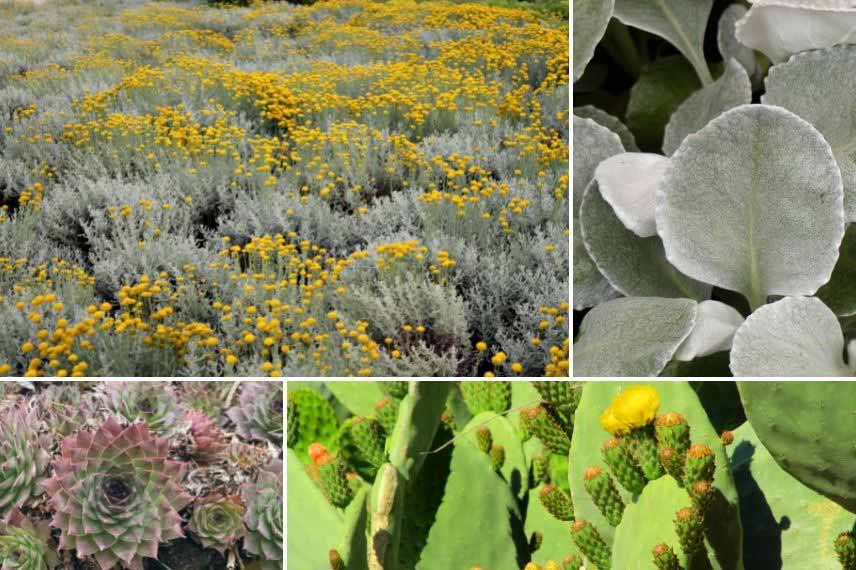
Helichrysum Italicum, Senecio ‘Angel Wings’, Echeveria ‘Perle Von Nürnberg’ and Opuntia
To add height and structure, finally include the essential palms: Phoenix, Chamaerops or Trachycarpus.
For more inspiration for an exotic garden, we recommend Gwenaëlle’s article: “Designing a Dry Exotic Garden.”
In a sunny and colourful rockery
The small silhouette of Helichrysum italicum, reaching no more than 50 cm in height, integrates very well into dry, sunny rockeries.
The sedums will be ideal companions, with their summer flowering extending into autumn, which will complement that of our curry plant. Opt for the varieties with a carpet habit and, from the wide range of colours they offer, choose white or warm yellow-orange shades. For example, consider Oregon stonecrop, the variegated stonecrop with its bright foliage, the white stonecrop with its changing foliage, or even pachyclados stonecrop with its starry white flowers. For a more original touch, also discover the incredible ‘Chocolate Cherry’ sedum, with its dark purple hues.
Essential candidates for rockeries, saxifrages will also be ideal plants. These small cushions will undoubtedly bring light and colour. Turn to Saxifraga x urbium, Saxifraga arendsii ‘Peter Pan’, or Saxifraga cotyledon ‘Southside Seedling’, which, with their flowering including a hint of yellow, will pair well with our Helichrysum. Preferring cooler soils, these perennials can easily be placed in partial shade.
Also add hardy geraniums, a Greek St John’s wort ‘Hypericum olympicum’, and perennial potentillas. In regions where winters do not drop below about -6°C, try the graphic leaves of mangaves. In colours similar to those of the everlasting, an Tanacetum haradjanii will fit in well.
For a rockery with long-lasting flowering almost in all seasons, add a small winter heather such as Erica carnea ‘December Red’ or Erica x darleyensis ‘Silberschmelze’. Also consider small bulbs of Iris reticulata, which will come to life at the end of the cold season with their delicate, colourful flowers. In spring, it will be small spurge that will take over.
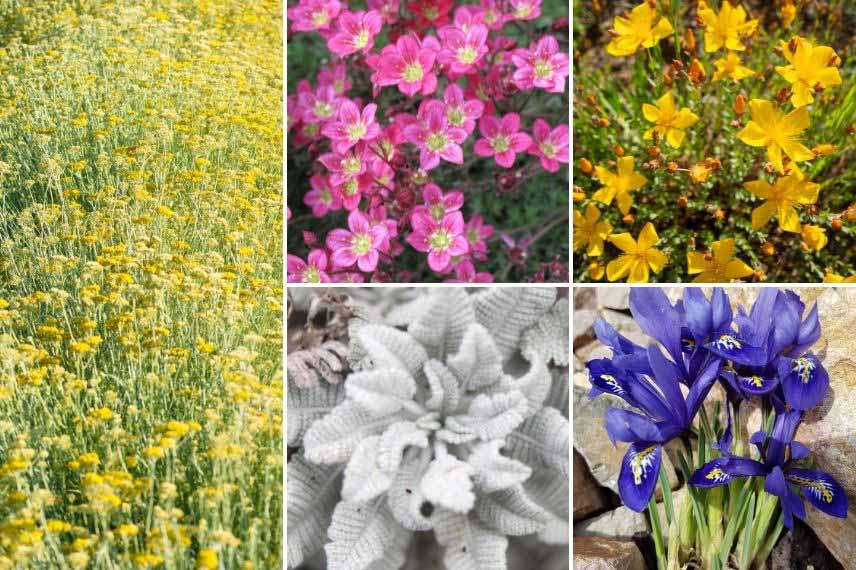
Helichrysum italicum, Saxifraga arendsii ‘Peter Pan’, Hypericum olympicum, Tanacetum haradjanii, and Iris reticulata
Discover other Helichrysum
View all →
Available in 2 sizes
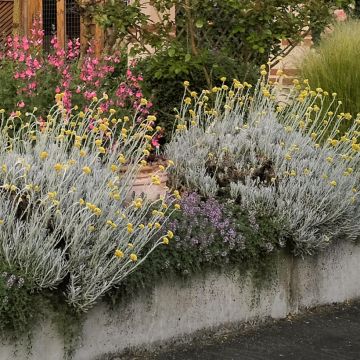
Available in 1 sizes
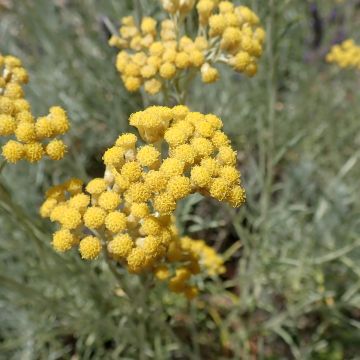
Available in 2 sizes
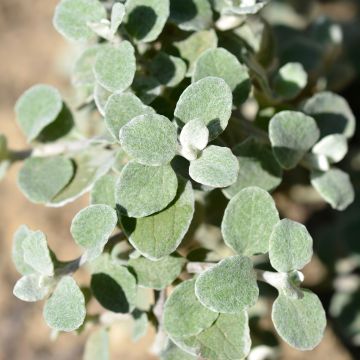
Available in 2 sizes
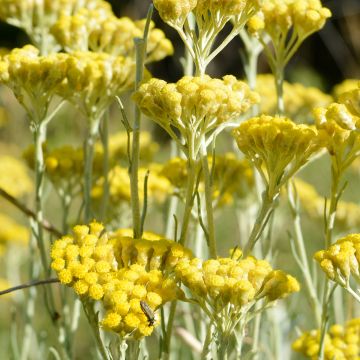
Available in 1 sizes
Available in 1 sizes
Available in 1 sizes
Available in 1 sizes
Available in 2 sizes
Available in 2 sizes
In an aromatic square with the feel of a medicinal garden
TheHelichrysum can easily be integrated into the vegetable garden. Its aromatic foliage can be used to flavour dishes in the kitchen, and the plant is also valued for its medicinal properties.
So don’t hesitate to use it to create a lovely herb corner, or even a small medicinal garden. You’ll combine the useful with the pleasant!
Pair the curry plant with other typical Mediterranean plants that share the same growing requirements. The lavenders with silver-grey foliage will be ideal, and their blue-violet flowering will beautifully complement the yellow colour of the everlasting flowers.
The small aromatic bushes of rosemaries and savouries will make good companions. A silver santolina with its grey foliage will also fit in well. Among the must-haves, thyme varieties with bright foliage, such as golden lemon thyme, variegated lemon thyme, or ‘Bertram Anderson’ lemon thyme are great choices. Oregano will add a lovely pink touch during flowering, while the tansy will provide volume with its fern-like leaves.
Don’t forget the common sage, with its fragrant green-grey foliage. For a more colourful touch, discover the purple sage or the beautifully variegated variety ‘Tricolor’.
Enjoy the magnificent and abundant crumpled flowering of cistus: choose a Corbières cistus, a Portuguese cistus, or a purple cistus to bring colour and freshness.
To complete this scene, add a common hyssop, yarrow, a great wormwood, and Greek mountain tea.
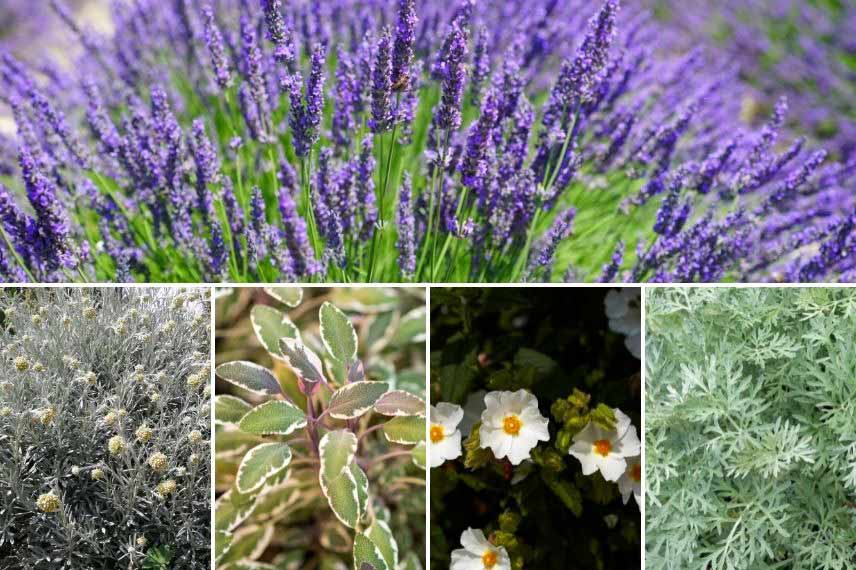
Lavender, Helichrysum, Salvia officinalis ‘Tricolor’, Cistus corbariensis, and Artemisia absinthium
Read also
How to prune Helichrysum?In a Mediterranean-inspired shrub hedge
Our curry plant will integrate very well into a bushy hedge, for example in a seaside garden exposed to drought and sea spray. It will be placed in the foreground and will be perfect for dressing the bases of larger bushes. Our perennial will mingle with groundcover plants or those with a small stature, such as perennial statice, sea kale, perennial ice plant, or Phlox subulata.
In the second plan, install a small chaste tree like Vitex agnus-castus ‘Blue Puffball’ with its lovely lavender-blue spikes in summer. Add a myrtle, such as Myrtus ugni ‘Flambeau’ with its charming variegated yellow and cream foliage.
In the background, the most imposing bushes will be placed: a eucalyptus with blue-silver foliage like ‘Baby Blue’, a sea buckthorn or a ceanothus, whose blue-violet or white flowering will pair very well with its companions. For a brighter touch, consider the Callistemon, with its original and vibrant bottlebrush flowers or the must-have oleander.
Finally, a strawberry tree will brighten up winter with its decorative and edible fruits.
To liven everything up, add some flowers, such as the Canary statice, with its beautiful purple and white inflorescences or some agapanthus.
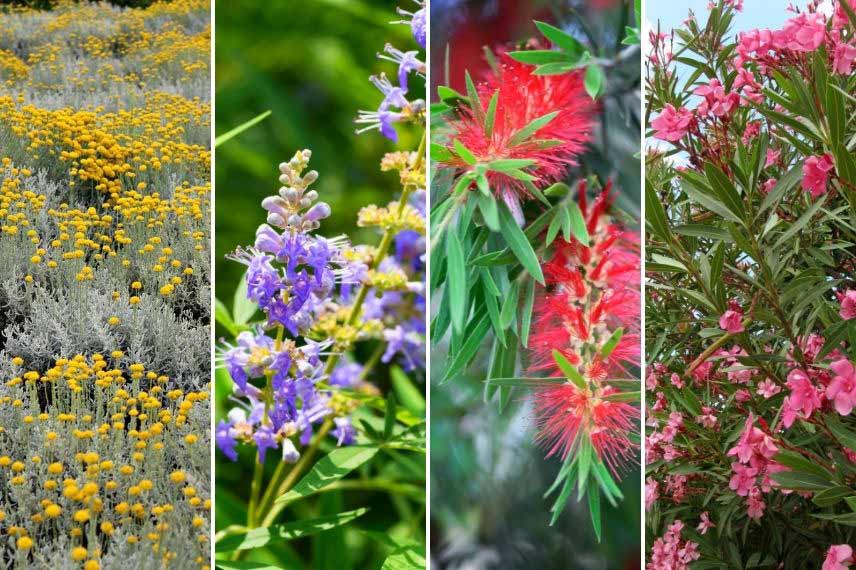
Helichrysum italicum, Vitex agnus-castus ‘Blue Puffball’, Callistemon viminalis, Nerium oleander
In a flowering pot
The small silhouette of the Italian Everlasting allows it to be easily grown in containers, window boxes, pots, or hanging baskets.
Pair it with vibrant zinnias (Maryland zinnia ‘Zahara Starlight Rose’, ‘Zahara Double Fire’, or ‘Double White’), which will complement its summer flowering. Install Pelargonium, which offers a wide range of colours to satisfy all tastes. For example, try Pelargonium ‘Prince Of Orange’, which not only provides fragrant blooms but also produces mauve flowers veined with purple that will harmonise beautifully with the sunny colour of our Helichrysum. The bright and colourful flowering of helianthemums will also add a natural and rustic touch.
For lightness, add small pot grasses, such as Pennisetum alopecuroides ‘Little Bunny’ with its lovely silky spikelets.
Also consider silver dust cineraria, which, with its almost white velvety foliage, highlights all its companions.
For a sunny pot in yellow tones, add coreopsis, heleniums, Osteospermum ‘Summersmile Double Golden Yellow’, or ‘Voltage Yellow’.
Also try complementary blue blooms, such as with Caryopteris ‘Petit Bleu’, small nepetas, and Spanish lawn (Globularia punctata or Globularia trichosantha).
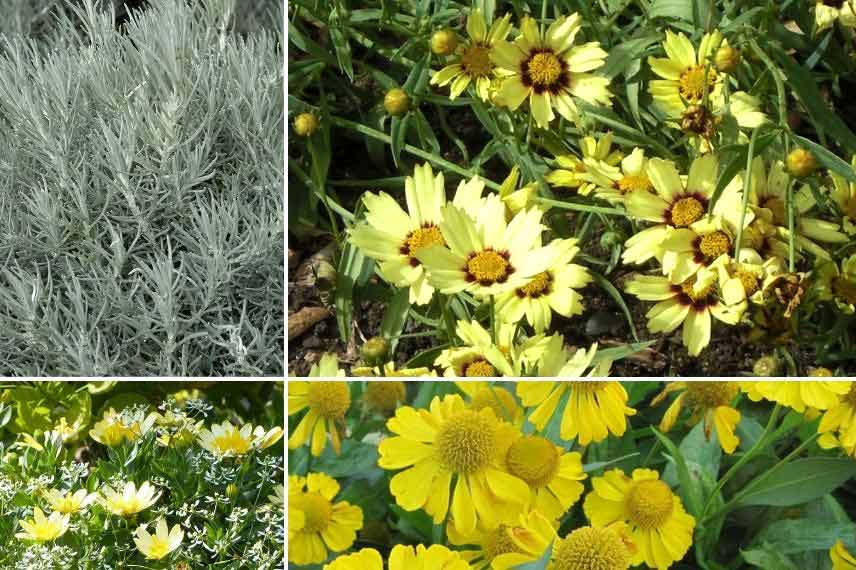
Helichrysum italicum, Coreopsis ‘Redshift’, Osteospermum Summersmile ‘Double Golden Yellow’ and Helenium ‘Tijuana Brass’
In mixed borders with bracteate immortelles
Annual immortelles will be perfect for slightly wild borders. They add a lovely rustic touch, and their dried flowers last a long time without fading or losing their colour.
Opt for a mixed flowerbed inspired by English gardens, offering beautiful diversity. In terms of colour, you can choose complementary shades, blending yellow and blue-violet flowering plants. White-flowering plants will highlight the other multicoloured blooms and add lightness. A yellow-orange colour scheme will bring a lot of cheerfulness, accented by purple notes.
The goal is to combine different foliage textures, with either voluminous or lighter silhouettes, and simple flowers, whether in spikes or pom-poms, etc.
For a vibrant and floriferous border in summer, combine immortelle flowers with daisy-like flowers, such as echinaceas, gaillardes, bidens, or anthémis.
To vary the flower shapes, consider dwarf dianthus, small amaranth flowering in fox-tail form, agastache, small Kniphofia (‘Banana Popsicle’, ‘Orange Vanilla Popsicle’) and the stunning Eucomis.
Also consider dwarf roses or groundcover roses: the ‘Sans Contraintes Rose du Soleil’ forms a true white groundcover with a yellow centre, the sunny ‘Lemon Fizz’, or the bright ‘Weg der Sinne’.
Add the silver-reflective foliage of alchemilla, the grey downy foliage of wormwood, or Cerastium bierbesteinii.
A few grasses will complete this scene for a touch of lightness, such as Stipa pennata or fescue grasses.
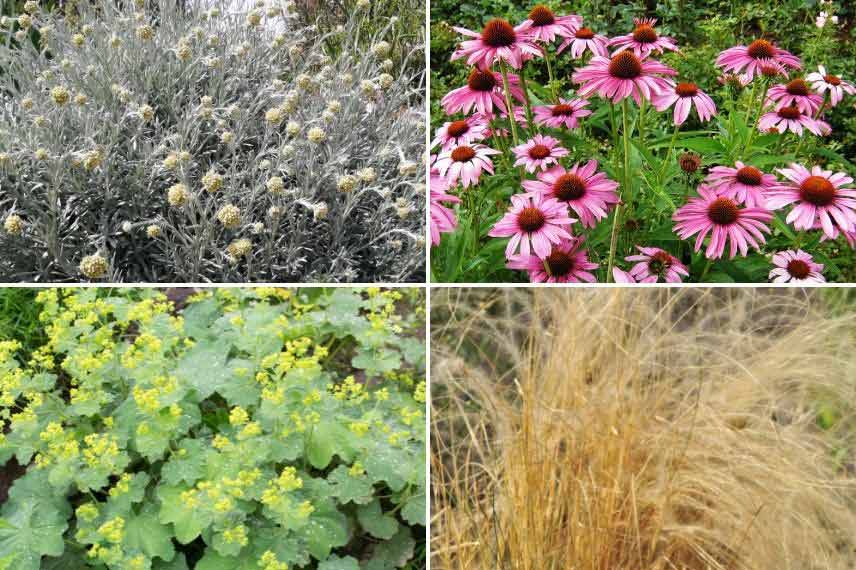
Helichrysum orientale, Echinacea, Alchemilla mollis and Stipa pennata
- Subscribe!
- Contents
![[helichryse_immortelle] Helichrysum italicum - Everlasting association](https://en.promessedefleurs.eu/blogwp/wp-content/uploads/2022/04/Comment-associer-lHelichrysum-.jpg "[plant_association plant=\"Helichrysum\"]Associate Helichrysum with other plants that enjoy similar growing conditions, such as Lavender, Rosemary, and Thyme. These companions will thrive together and create a beautiful and harmonious garden setting.")
Comments