


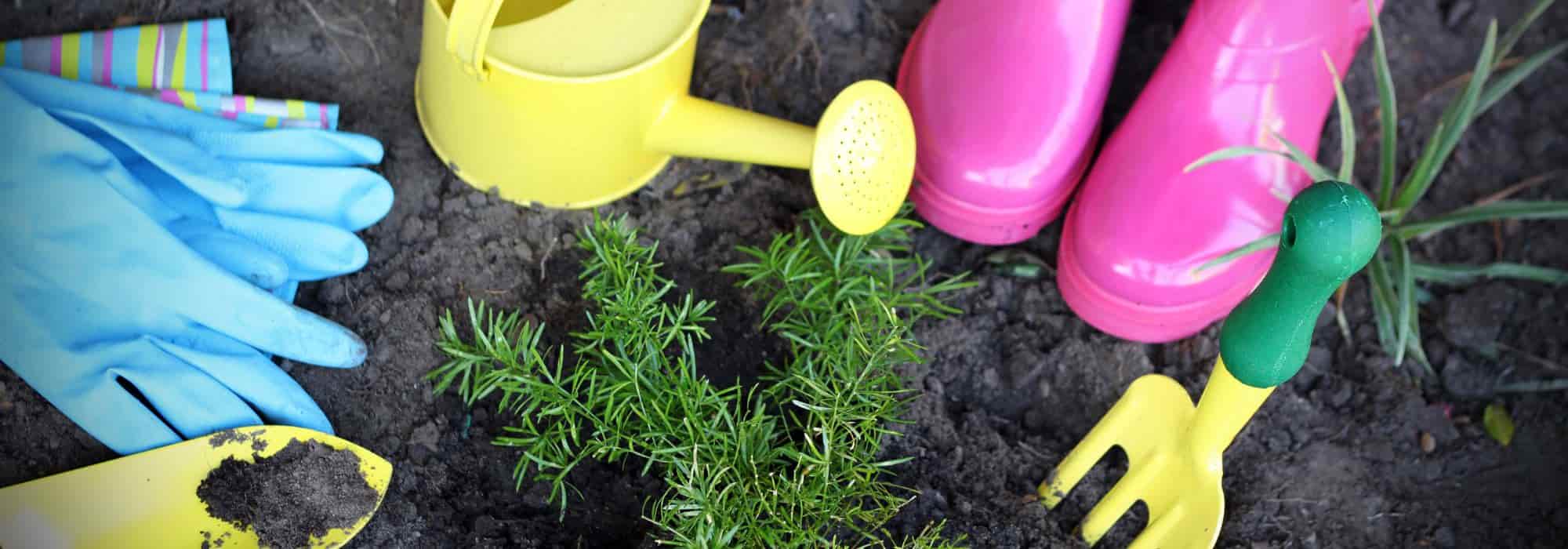
Introduce your children to gardening with age-appropriate, playful tools!
Our selection for family gardening
Contents
Gardening is a wonderful activity to share with children. By introducing them to gardening, you teach them to appreciate plants, to recognise insects, and even to understand how fruits and vegetables grow. This can also be an opportunity to share special moments and to encourage their curiosity in the garden. With tools well-suited to their little hands, your young gardeners will be able to take an active part while having fun. Here is a guide to choosing the right gardening tools for your children.

Choosing tools designed for small hands
Before letting your children play at being little gardeners, safety is essential. The tools you choose must be perfectly suited to their size, strength and age:
- For children under 4 years : we’ll favour plastic, one-handed tools (bucket, dibber, cultivator, etc).
- From 4 to 10 years : you can already introduce them to gardening tools made from aluminium or steel, mimicking grown-up ones, but always sized for them.
- After 10 years of age and depending on the child’s size: you can start lending them our “real tools”, while supervising and explaining the correct techniques.
But tools that are well designed to prevent injuries:
- Non-toxic and durable materials: check that the tools are made from materials safe for children (prefer tools manufactured in the European Union to avoid toxic materials), such as reinforced plastic (much sturdier) or lightweight aluminium.
- Rounded edges and no sharp parts: nothing beats this for preventing small accidents.
- Ergonomic and lightweight handles: to help them handle without getting tired.
And of course, safe gardening also depends on supervision (so that a spade does not become a knight’s sword, for example…). Don’t hesitate to demonstrate the correct techniques so that your children learn to garden with confidence.
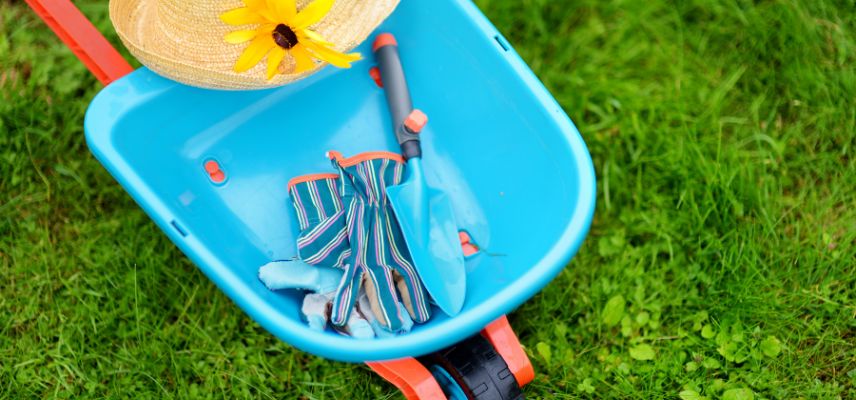
Basic tools: essentials for the budding gardener
To start with, here are some simple, yet basic tools, perfect for getting children actively involved.
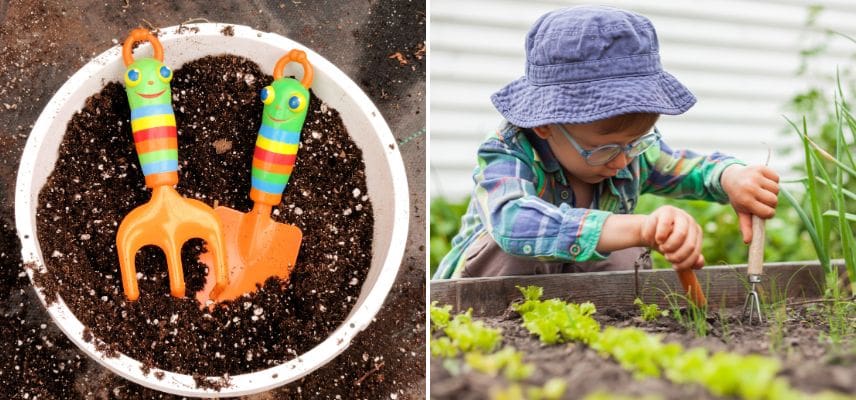
The garden fork and the transplanting trowel
The transplanting trowel is undoubtedly one of the first tools for our young gardeners, and also their favourite! The transplanting trowel (or simply trowel) is useful for digging holes and planting seedlings or young shoots. With it, children could even make small holes all over the lawn if you’re not careful.
The garden fork is perfect for scratching the soil and uprooting (or pretending to uproot) small unwanted weeds.
Choose models with a short, lightweight handle, easy for children to grip. For younger children, prefer those made of plastic. In addition, colourful models or those illustrated with amusing designs are always a hit!
The indispensable watering can
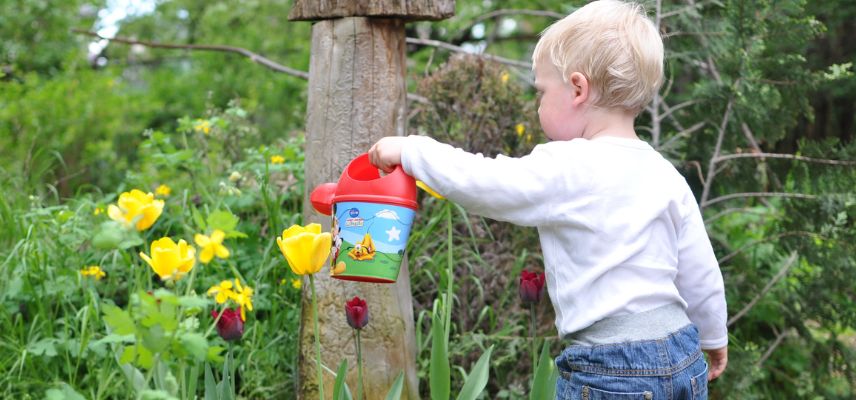
Children love watering, especially the younger ones, but the large garden watering can is often too heavy! Offer them a small-capacity watering can, about 0.5 to 1 litre, that they can fill and handle easily. Some models shaped like animals or in bright colours make watering even more fun. Then show children the importance of watering the plants so that they grow and stay healthy. For the older ones, we can even go further by teaching them to water sparingly—neither too little nor too much.
The bucket
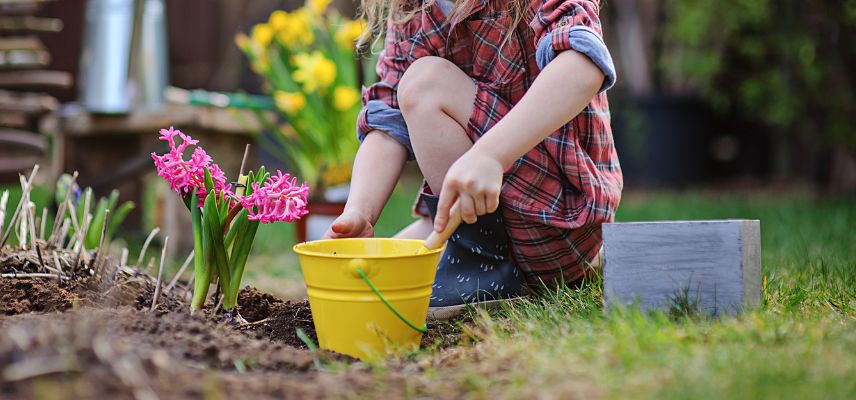
To carry soil, water, plants, harvests or even create an improvised collection of snails, daisies, pebbles or herb soup (a nod to parents of young children), the bucket is an essential tool for our young gardeners. Choose a lightweight model suited to their size, with a sturdy and ergonomic handle. Colourful buckets or those with fun patterns, often associated with beach play, are particularly popular.
The mini spade and the mini rake
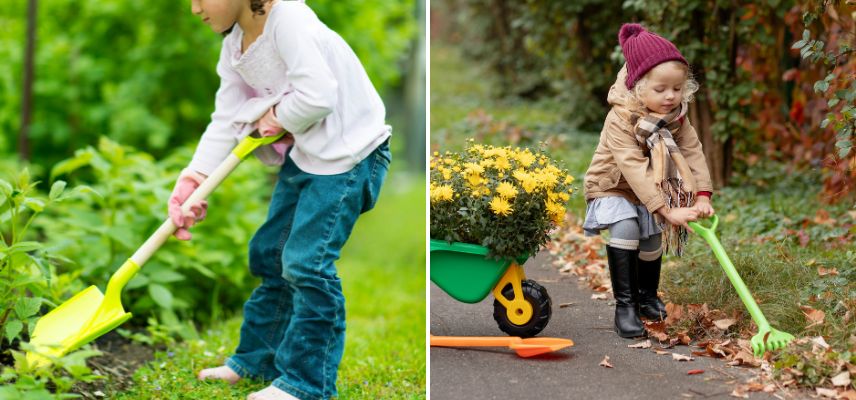
From age four, the mini spade is ideal for digging holes and planting flowers. The mini rake, on the other hand, helps to aerate the soil, remove small dead leaves and create lines in the soil (also all over if you’re not paying attention). Choose ergonomic models, with the handle length suited to their size. For younger children: again, opt for rounded ends and plastic (which will help prevent bumps, especially in a family with several children). From around six to eight years, you can opt for metal and a wooden, sturdier handle. With these tools, they’ll quickly learn the right techniques while enjoying gardening.
And many more
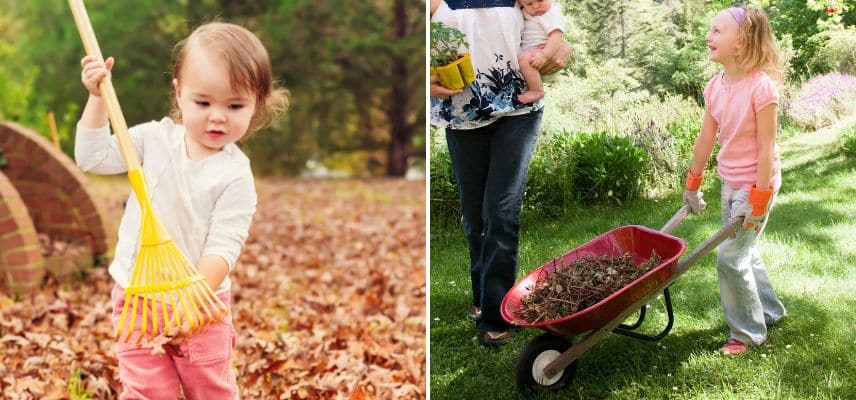
Often from the age of six, there are many other tools sized for children: hoe, lawn rake, spade, cultivator… and even a small wheelbarrow!Discover our range of gardening tools for children.
Fun and educational gardening kits
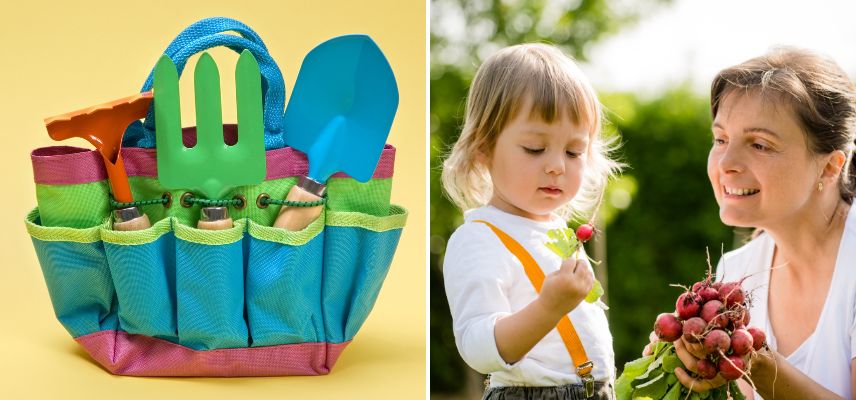
Please note that there are also ready-to-use gardening kits to introduce children to gardening. They are usually found in some toy stores and garden centres. Most contain basic tools (often a hand cultivator and a dibber), pots or a seed tray and seeds that are easy to grow.
You can also assemble your own kit, by purchasing pots or a mini greenhouse for sowing. For the seeds, opt for fast-growing plants: 21-day radishes, sunflowers, nasturtium, beans, cherry tomatoes, etc. Take the opportunity to show them the differences between seeds (sizes, shapes, colours, etc.).
Gardening gloves and clothing for safe pottering in the garden.
Gloves to protect little hands
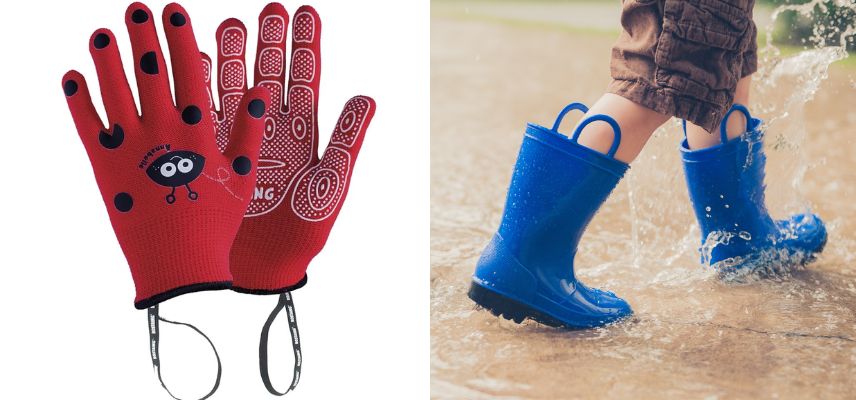
For safe gardening (and getting a little dirty in moderation), nothing beats soft, durable gloves, specially designed for children! The gloves will prevent small scratches and make the experience more enjoyable. Opt for coloured gloves or with fun patterns, such as the ladybird gloves from Rostaing (tested and approved) which are stretchy, thin, breathable, with a palm bearing a PVC-grip print. They are available in several sizes and can be found in most garden centres and on our site.
Boots: keeping little feet dry while gardening
Gardening boots protect little feet from mud, damp and small stones, allowing young gardeners to roam anywhere in the garden without worrying about getting dirty or wet. Whether after a shower or to explore a recently watered area!
Suitable clothing
Don’t forget to kit your child out in suitable clothing, whether it’s old clothes (that they can get dirty without any trouble), to the gardening combination (there are even waterproof versions for splashing in muddy puddles!). And why not a small gardening apron or a hat to protect them from the sun? These accessories are not essential, but they will give them the look of proper little bucolic gardeners.
Accessories for wildlife observation and discovery
Who says gardens are only for planting and work? It is also a place for contemplation… and a spot of leisure! There, hidden in blades of grass or in the shrubs, thousands of tiny creatures can be observed by your children. And we know: children will love observing the insects and the small animals that live in the garden. By offering them a few simple accessories, you will encourage them to discover this biodiversity.
Magnifying glasses, binoculars and observation kits
Magnifying glasses allow children to observe insects and plants up close. They will thus be able to watch ladybirds, bees or leaves from every angle. Some observation kits even include small jars with ventilation grills to observe insects without harming them, perfect for sparking curiosity and teaching respect for nature. And binoculars let children observe birds nesting in trees more clearly.

Insect hotels and bird boxes
Installing an insect hotel or a bird box is a way to raise children’s awareness of biodiversity. By seeing the insects and birds settle in, you can teach them the importance of ecosystems and the role of every little creature in the garden. It’s also an excellent way to teach them patience, by allowing them to see life organise itself around these refugia.
To learn more, read our articles: Make an insect hotel, How to make a bird box from flower pots? and DIY: bird feeders.
- Subscribe!
- Contents
Comments