


7 golden-leaved trees
to illuminate the garden
Contents
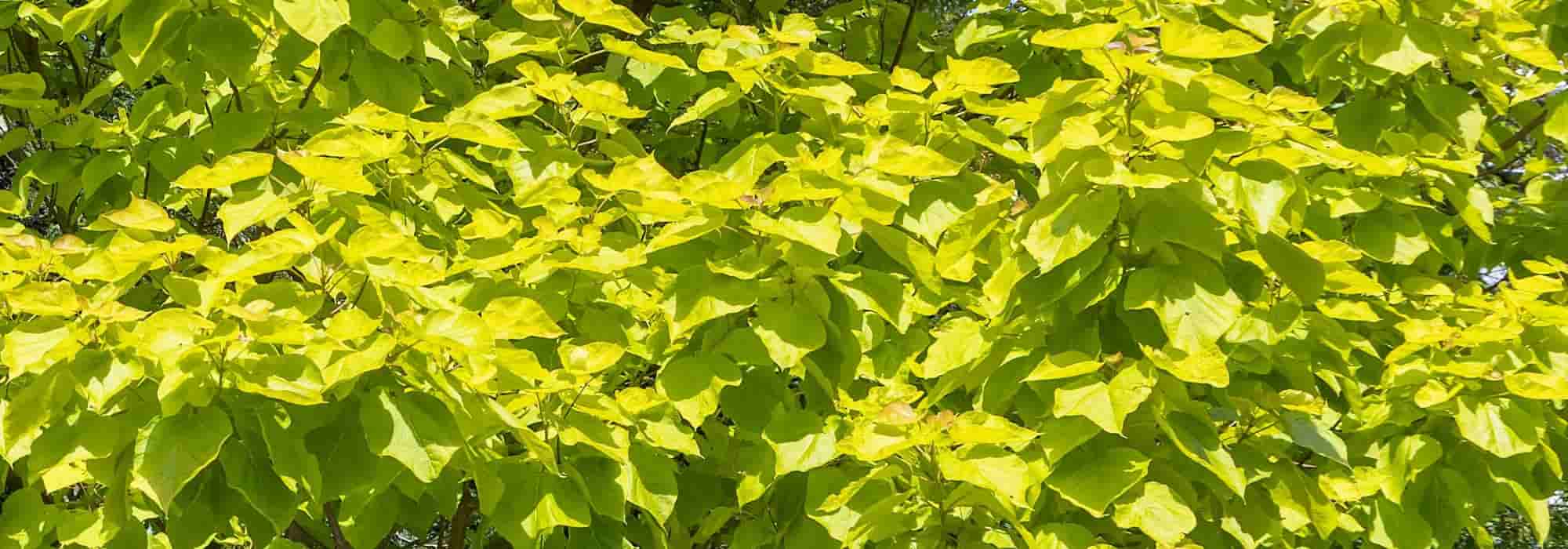
Trees with golden-yellow foliage bring a brilliant light, drawing the eye, like a sunlit touch in the garden. Their leaves, in golden tones, chartreuse green for some, add warmth and contrast with the medium to dark green, where present in our gardens. Discover our selection of 7 trees with golden foliage to brighten your outdoor space.

Golden Colchian Maple - Acer cappadocicum 'Aureum'
Golden Colchian Maple(Acer cappadocicum ‘Aureum’) stands out for its bright yellow foliage, edged with red in spring, which then shifts to soft green leaning towards yellow in summer. In autumn, the leaves take on a golden-yellow hue before falling. Its spring flowering is very discreet, in similar shades. We also admire this tree for its rounded habit and large palmate leaves, typical of maples. It can reach up to 15 metres in height with a 6–10 metre spread.
This maple prefers ordinary, neutral to calcareous soil, as long as it remains slightly moist. It even tolerates heavy, clay soils. Partial shade to full sun suits it perfectly. Hardy, it tolerates frosts down to -20°C once well established.
In the garden, it is perfect as a specimen to catch the eye. It can also add a splash of colour in a large shrub border, alongside flowering shrubs such as Hibiscus ‘French Cabaret Purple’ or a viburnum.
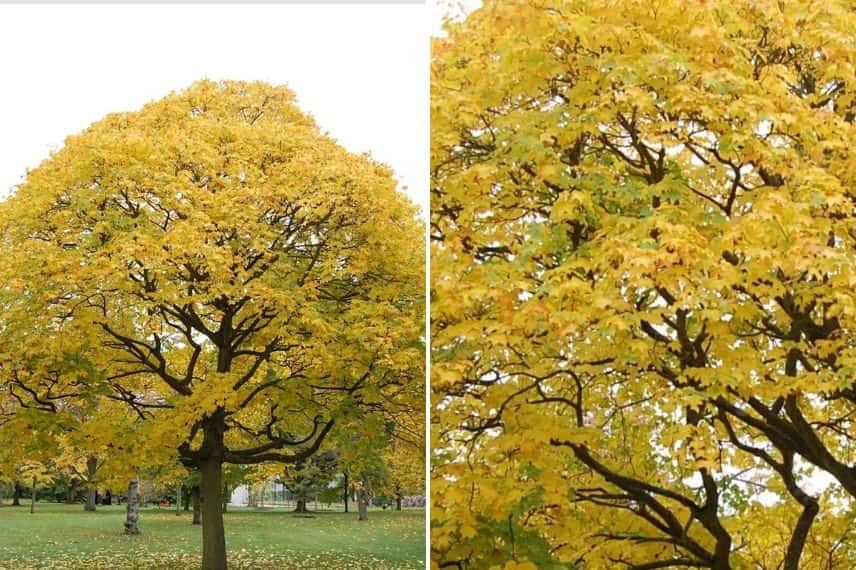
Acer cappadocicum ‘Aureum’
Golden Robinia - Robinia pseudoacacia 'Frisia'
If you are looking for a tree that combines golden foliage and a beautiful flowering, then the golden robinia could be the one for you! This variety ‘Frisia’ is distinguished by its slender, golden-yellow foliage, offering light shade in the garden. Its deciduous leaves, golden-yellow, develop into bright green-yellow in summer, then orange in autumn. In spring, clusters of white, pendulous and highly scented flowers appear.
But that’s not its only asset! It is very easy to grow in any soil type, even poor soil and in full sun. Once well established, this false acacia will withstand temporary drought without flinching, but beware of strong winds that can snap its branches. Note that these branches are somewhat thorny. Fast-growing, the Robinia ‘Frisia’ can reach up to 8 metres in height and 4–5 metres in width, thus with a rather columnar form. As it ages, its trunk becomes more and more striated.
Perfect as a solitary specimen plant, the golden robinia also suits forming a large hedge where it will bring brightness, for example alongside a Sophora or a purple hazel.
Note: If the flowers of this Robinia are edible, the rest of the plant is highly toxic.
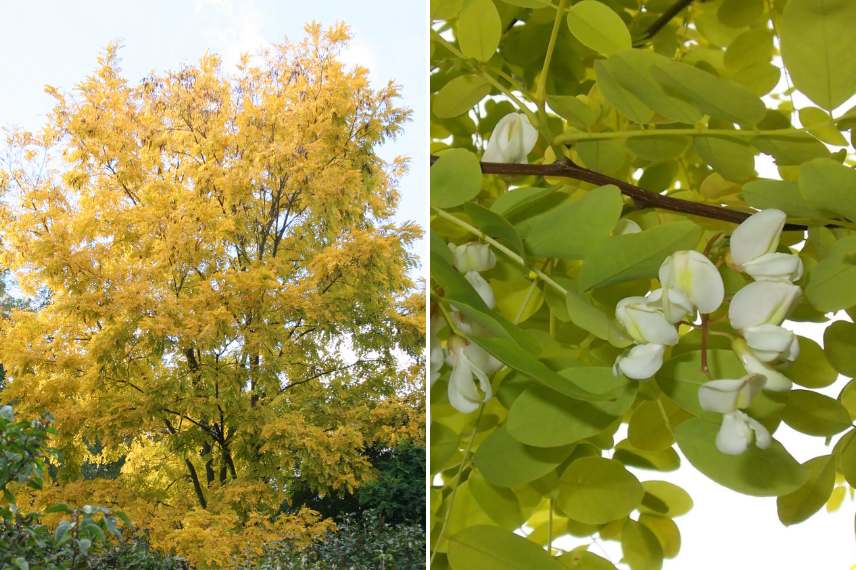
Robinia pseudoacacia ‘Frisia’
Golden American red oak - Quercus rubra 'Aurea'
Here is an American red oak, but with golden foliage! The Quercus rubra ‘Aurea’ stands out for its pretty deeply cut foliage, in golden yellow colour in spring, which evolves to green-yellow in summer. In autumn, the leaves blaze with red and blazing orange, before falling to the ground. It also has good resistance to cold, down to -23°C, once well established in the garden. It flowers very discreetly in spring.
Slow-growing and smaller than its cousin Quercus rubra, the variety ‘Aurea’ can nevertheless reach 15 metres in height, and 10 metres in width. It adapts to a wide range of soils, neutral to acidic, even clay, cool, provided they are well drained. It loves full sun.
Perfect as a specimen tree in a large garden, Quercus rubra ‘Aurea’ also pairs with other small shrubs, such as a Camellia, a Chinese Azalea or a Hydrangea for their flowering.
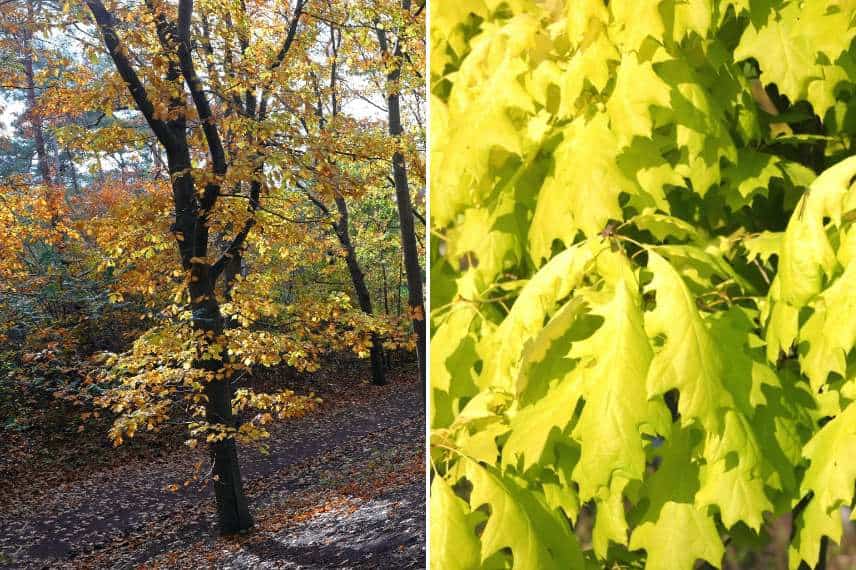
Quercus rubra ‘Aurea’
Golden honey locust - Gleditsia triacanthos 'Sunburst'
The Gleditsia triacanthos ‘Sunburst’, or more simply the Golden Honeylocust, is a thornless variety, offering glossy, bright yellow foliage in spring, then lime-green in summer. In autumn, the leaves take on gold and copper tones, before shedding its leaves for winter. These pinnate leaves create a light, airy texture, giving the garden a light shade. It flowers very discreetly in summer.
This fast-growing Honeylocust can reach 10–12 metres in height and 6–8 metres in width. Tolerant of a wide range of soils, it prefers a sunny position and it is hardy to −15°C. It particularly enjoys the heat of Mediterranean regions.
Ideal as a solitary specimen, it will provide a light shade in the garden, without hindering other plants from growing. It can also be planted in a mixed hedge to bring brightness, alongside a lilac or a Philadelphus.
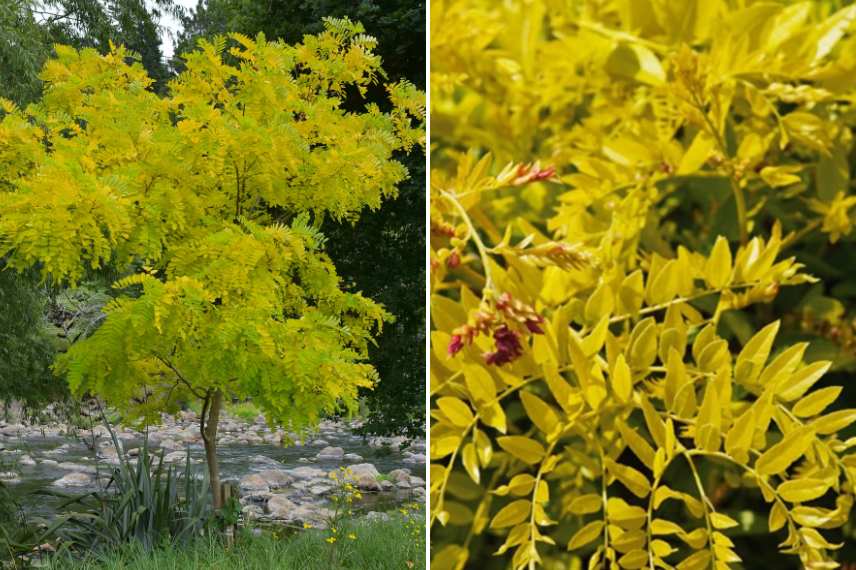
Gleditsia triacanthos ‘Sunburst’
American sweetgum 'Naree' - Liquidambar styraciflua 'Naree'
The Liquidambar ‘Naree’ offers magnificent palmate foliage, in a golden-yellow very bright in spring, evolving to chartreuse green in summer. Deciduous, the leaves dress in a palette of yellow, orange and red in autumn. This tree is also prized for its trunk with striate bark. A discreet flowering appears in early spring, giving way to fruits in the shape of bristly balls.
At maturity, it can reach 10–15 metres tall and 5–8 metres wide. Its habit is rather pyramidal. This Liquidambar likes acidic or neutral soils, remaining slightly damp, but not overly waterlogged. It enjoys full sun and is hardy to -23°C.
This American sweetgum is stunning as a standalone specimen to best admire its foliage. Nevertheless, it can be paired with other trees with golden or red-tinged autumn foliage, such as a Ginkgo biloba or a Japanese maple.
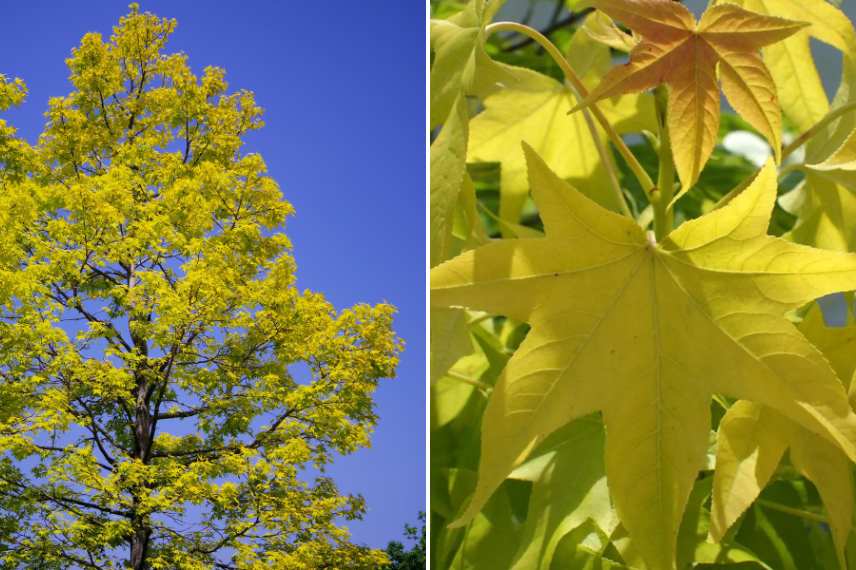
Liquidambar styraciflua ‘Naree’
Golden catalpa - Catalpa bignonioides 'Aurea'
The Catalpa bignonioides ‘Aurea’, also known as the golden catalpa, offers coppery-purple young leaves at bud burst period, quickly turning golden-yellow, then pale green in summer and finally gold in autumn. These large deciduous leaves have an elongated heart shape. In May, white flowers with purple throats appear, adding a touch of elegance to the garden.
This catalpa takes a spreading habit, like a parasol, capable of reaching 7 metres tall by 8 metres wide. It thus provides dense shade in the garden. ‘Aurea’ enjoys full sun and partial shade in the garden. This tree is not fussy; it tolerates all soil types, moist and well-drained, but does not tolerate prolonged drought or strong winds. Once well established, it is hardy to -20°C.
The golden catalpa is perfect as a specimen tree. Its dense shade and tendency to demand a lot of water leave little room for other plants, unless they have low water requirements. Outside its crown, you can plant summer-flowering perennials such as phlox or echinacea for a colourful and dynamic garden.
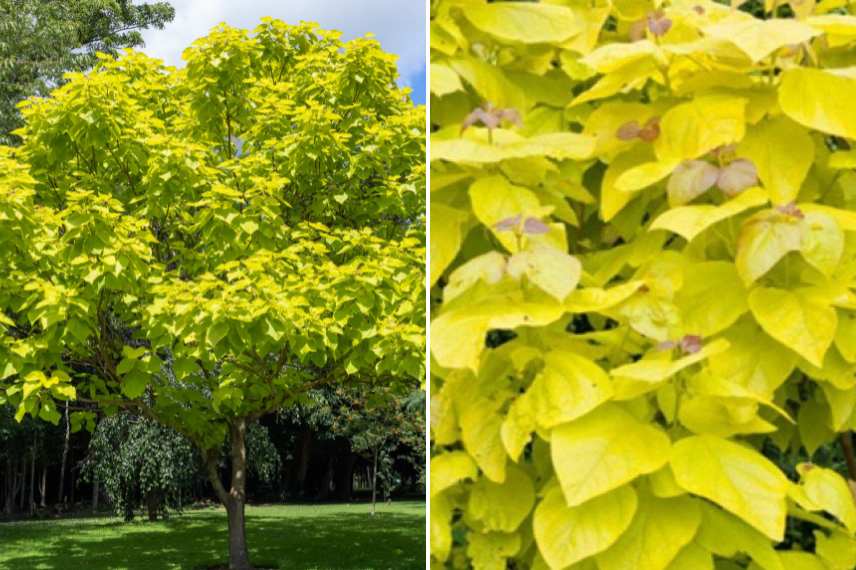
Catalpa bignonioides ‘Aurea’
Chinese dawn redwood 'Gold Rush' - Metasequoia glyptostroboides 'Gold Rush'
Also known as water fir, the Chinese Dawn Redwood ‘Gold Rush’ is a large conifer with foliage that is finely dissected, deciduous, golden in spring and soft green in summer. In autumn, it takes on warm, rusty-orange tones. In winter, it displays a reddish-brown, cracked trunk. This cultivar, smaller and slower-growing than other Metasequoia, will reach 10 to 15 metres in height with a 5-metre spread.
Metasequoia glyptostroboides ‘Gold Rush’ prefers cool to moist soils, rich, neutral to slightly acidic. It enjoys a sunny aspect and is hardy to -23°C.
This handsome tree can be planted as a specimen in the middle of the lawn, ideally in a contemporary garden or beside a water feature. It will also sit well in a bright grove, alongside Japanese maples, ferns and Hostas to echo its Asian origins.
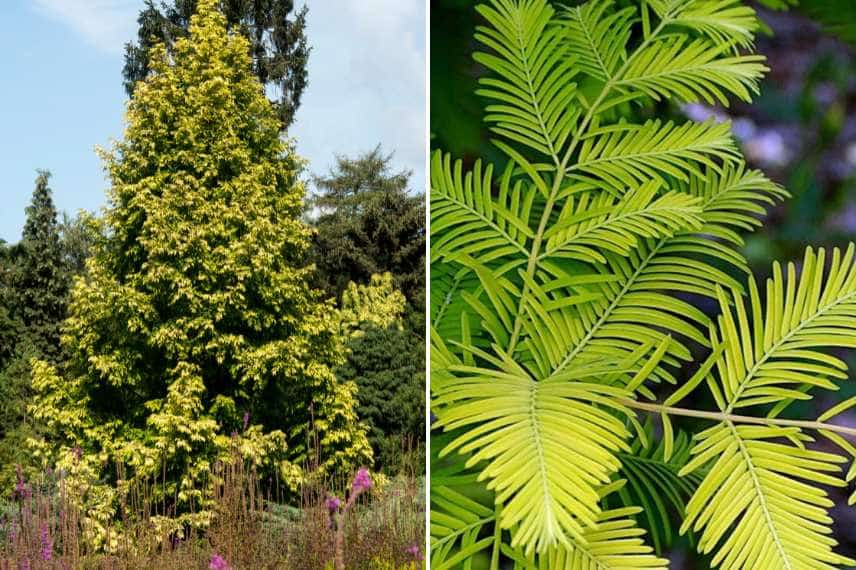
Metasequoia glyptostroboides ‘Gold Rush’
- Subscribe!
- Contents
Comments