





























Being self-sufficient in salads all year round
Our tips and advice to spread the harvests
Contents
The vegetable garden often goes hand in hand with harvest in spring and summer, especially for salads that we enjoy with every dressing during the beautiful season. However, it is not difficult to grow and harvest salads all year round in the garden, both in summer and winter. Discover our tips for spreading your harvests, choosing the right varieties according to the seasons to become self-sufficient in salads all year round.

Choosing the right varieties according to the seasons
To enjoy salads all year round, the first essential step is to choose varieties suited to the season. Indeed, some salads prefer winter, while others thrive in spring or summer! Additionally, it’s important to note that salads are generally sown in the season preceding their harvest period (sometimes even two seasons in advance!). For example, summer salads are sown in spring, and so on. You must therefore anticipate your sowing.
Winter salads
Some salad varieties are not deterred by the winter cold. These winter salads are often hardier and can withstand lower temperatures. They are also crunchier and have a more pronounced flavour than their summer counterparts. Depending on the variety, they are generally sown in summer and early autumn, from July to October, for a winter harvest.
Here are some types of salads you can grow during this cold season:
- Lamb’s lettuce (Valerianella locusta), also known as corn salad or doucette, is the quintessential winter salad, with a soft texture and nutty flavour. Choose small-seed varieties, which are slower to bolt than those with large seeds, such as ‘Verte de Cambrai’, ‘Verte d’Étampes’, or ‘Ronde maraîchère’. Sow from September to October for a harvest from December to March.
- Winter purslane or Claytonia is an annual plant that produces small fleshy leaves with a taste reminiscent of watercress. Very cold-resistant, it can withstand temperatures down to -20°C. Sow from September to October for an early winter harvest.
- Chicories dislike heat and thrive in cool temperatures! There are many varieties, such as escarole, frisée, ‘Cornet de Bordeaux’, ‘Wallonne’, ‘Rouge de Trévise’, or ‘Pain de sucre’. Sow in summer until early autumn for a winter harvest.
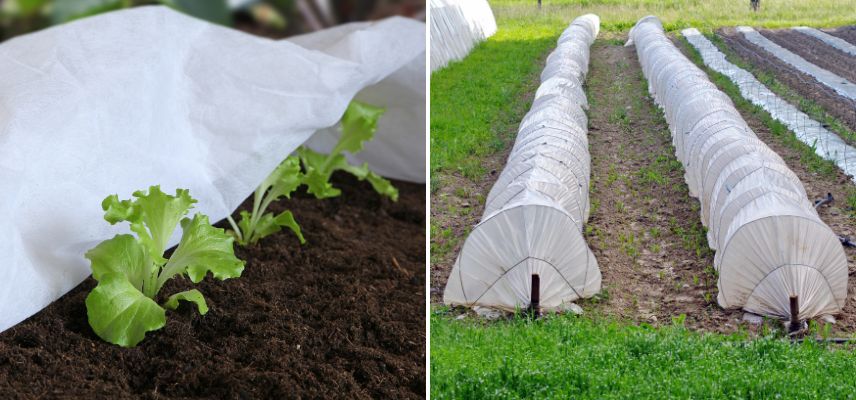
- Winter lettuces, such as ‘Brune d’hiver’ or ‘Balmoral’, withstand winter cold well. However, in most regions, they prefer to be sheltered under a winter cover or in a cold greenhouse to protect their tender leaves.
- Winter spinach is particularly hardy. For example, ‘Géant d’Hiver’ is sown from August to October, then harvested leaf by leaf as needed, from October to January.
- With its slight peppery and nutty taste, rocket is sown from September to October for a winter harvest, like ‘Astra’.
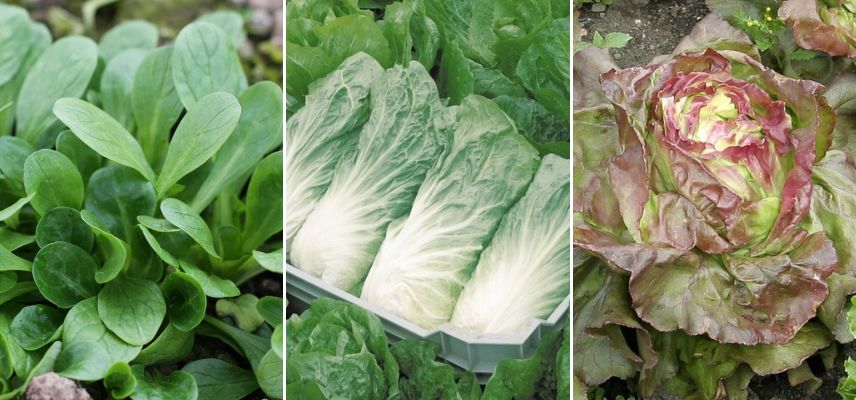 Lamb’s lettuce, chicory ‘Pain de Sucre’, and lettuce ‘Brune d’hiver’
Spring salads
Continuing with our logic, spring salads are sown (you may have guessed it) in winter under cover or in a warm environment (see paragraph 4). Planting can also be done at the very beginning of spring in open ground. Choose varieties that are fairly cold-resistant in case of late frosts. Spring salads generally have a rapid growth rate, which is beneficial when aiming for a harvest in a few weeks. However, they tend to bolt quickly in the event of hot summer weather. Their flavour is often mild and refreshing, making them a perfect addition to spring meals. In fact, there is often an abundance of varieties to choose from in this season! Here are some salad ideas you can grow in spring:
- Head lettuces offer tightly packed heads of leaves, with a soft and crunchy texture. There are many varieties, including ‘Appia’, ‘du Bon Jardinier’, ‘Reine des Glaces’, ‘Reine de Mai’, and ‘Saint Antoine’.
- Rocket, with its peppery flavour, is an excellent salad to grow during this period. It grows quickly and can be sown as soon as the soil is workable around March-April.
- Cutting lettuces particularly enjoy this season. The most interesting ones are ‘Lollo Rossa’ and ‘Lollo Bionda‘ or even ‘Salad Bowl‘ for their tolerance to frost and brief heat spells.
- Spinach can be sown very early in spring, even before the last frost. They are cold-resistant and have a mild, slightly sweet taste.
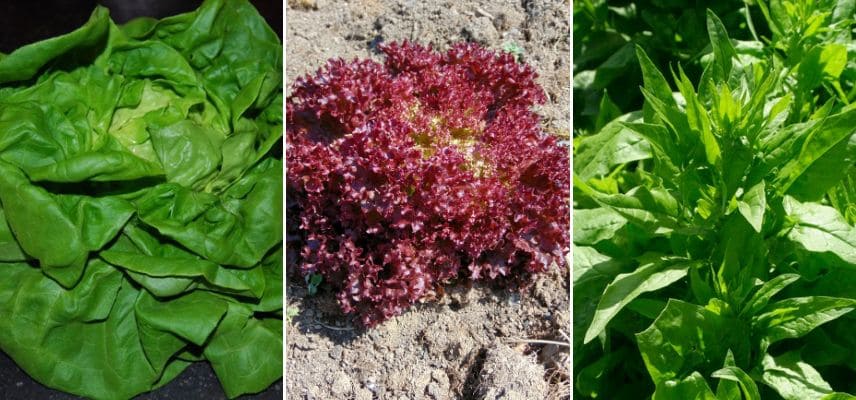 Lettuce ‘Reine de Mai’, Lettuce ‘Lollo Rossa’, and winter spinach
Summer Salads
As you may have understood, summer salads are sown in spring. However, you will need to choose varieties that are resistant to heat, bolting, and drought. Here are some salads to prioritise:
- In the family of head lettuces, we find the famous ‘Grosse blonde paresseuse’, ‘du Bon Jardinier’, ‘sucrine’, ‘Gotte jaune d’or’, and ‘Rigoletto’.
- Among the Batavias, you will find ‘‘Rouge Grenobloise’‘, ‘‘Pierre-Bénite’‘, ‘‘Reine des Glaces’‘, or ‘‘Blonde de Paris’‘.
- On the Romaine side, sow ‘Craquerelle du midi‘, ‘‘Verte grasse’‘, or ‘Chicon des Charentes‘.
- Rocket can also be harvested in summer, but beware of drought! It will need to be watered abundantly.
- Spinach is another excellent option for summer cultivation. Choose heat-resistant varieties like ‘Emilia’, ‘Apollo’, or ‘Malabar’.
- Purslanes, due to their good drought resistance, can be interesting to grow in hot regions.
⇒ Find more ideas in our article: 15 salads for summer.
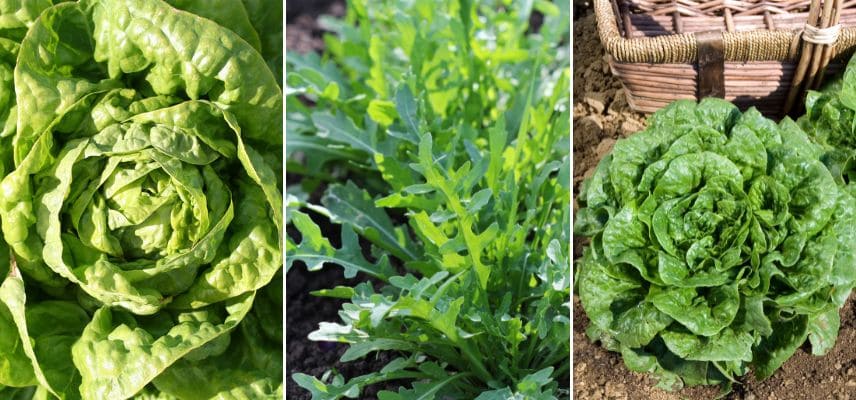 Lettuce ‘Grosse blonde paresseuse’, rocket, and Romaine ‘Craquerelle du midi’
Autumn salads
For autumn, it is preferable to choose salads that can tolerate the cold and grow well despite the shortening days. Seeds are generally sown towards the end of spring and in summer. Here are some interesting varieties to plant:
- From July to the end of September, it’s time to sow lamb’s lettuce for an autumn harvest. Choose fast-growing varieties, such as ‘Grosse Graine’ or ‘à Grosse Graine de Hollande’.
- Chicories are known for their cold resistance and are perfectly suited for autumn cultivation, provided they are sown in late spring or summer.
- Lettuce can also be included, but preferably in a greenhouse or under a winter cover to protect their tender leaves. For example, you can plant ‘Blonde Maraîchère‘, Batavia ‘Rouge Grenobloise’‘, ‘Gloire du Dauphiné’, ‘Appia’, and the essential ‘Reine des Glaces’.
- Autumn also heralds the return of rocket to the plates! Choose a fast-growing variety, such as ‘Pronto’ or wild rocket ‘Sylvetta’, which should be sown in September.
- Short-day spinach varieties, such as ‘Géant d’Hiver’ and ‘Apollo’, are perfect for an autumn harvest.
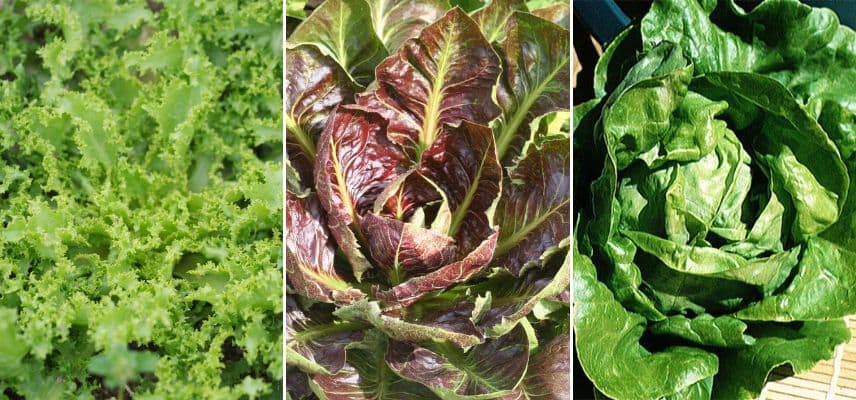 Frisée chicory ‘Wallonne’, wild chicory ‘Rouge De Trévise’, and lettuce ‘Appia’
Salads for (almost) all seasons
Some exceptional varieties have been selected for their good tolerance to both cold and drought, allowing them to avoid bolting quickly. They can thus be grown in almost all seasons, but winter cultivation under glass is highly recommended. Also, keep in mind that a salad often grows for one to two seasons before typically bolting in the next.
- Lettuce ‘Merveille des 4 saisons’: As its name suggests, this lettuce variety can be grown all year round. It is particularly cold-resistant and can withstand summer heat.
- Cutting lettuce ‘Red Salad Bowl’ with red leaves and its green-leaved sister ‘Salad Bowl verte’ can also be harvested all year round, just like the variety ‘Querido’.
- The ‘Rougette Cardinale’, a compact and tasty lettuce with bright red leaves, resists bolting well. It is sown from February to October for a harvest after six weeks.
- Rocket can be sown almost all year round, starting from late March, under cover and frost-free until July. Avoid sowing during hot summer weather, then you can resume in September-October for a winter harvest.
- The cultivation of spinach adapts to all seasons, but it is particularly successful in spring and autumn. Late autumn sowings offer a winter harvest in mild regions or under cover. Although spinach tends to bolt in summer, long-day varieties like ‘Matador’ and ‘Junius’ can overcome this seasonal challenge.
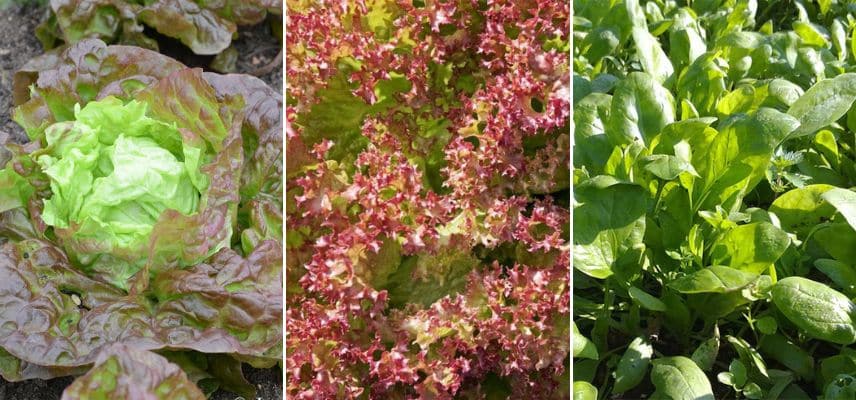 Lettuce ‘Merveille des quatre saisons’, cutting lettuce ‘Red Salad Bowl’, and spinach
Read also
Growing lettuce in potsCutting salads for a second harvest
Did you know that most salads, particularly cutting salads, regrow after harvesting? So when you harvest your salads, only take the leaves you need for cooking. Do not pull up the roots. The leaves typically regrow two or even three times under good growing conditions.
Another advantage: they can be grown almost all year round, usually from April to September outdoors in the garden and from October to March under cover or indoors (see paragraph 4). They also take up less space in the vegetable garden than a round-headed lettuce. And, with more space, you can grow more salad!
Among the most popular and recognised varieties of salads, there is a wide range of lettuces such as the ‘Blonde Oak Leaf’ cutting lettuce and the ‘Salad Bowl‘ which comes in red or green. Not to mention the mescluns and the famous ‘Lollo Rossa’ cutting lettuce and ‘Lollo Bionda‘.
⇒ Find our tips in our article: “Cutting Salads: Many Advantages”
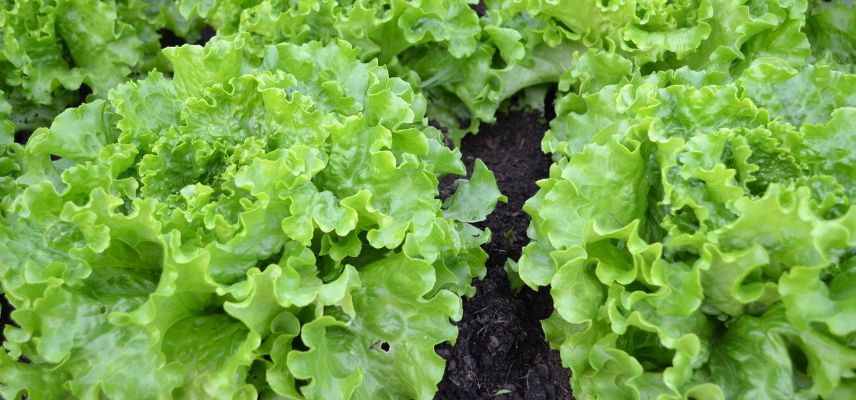
Increase the frequency of sowing
To enjoy salads all year round, another tip is to sow a little less, but more often! Ideally, make new sowings every 3 to 4 weeks to ensure continuity in your harvests of salads in the vegetable garden.
Also remember that the growth of your salads will be much slower in autumn and winter, so don’t hesitate to double the number of sowings during these two periods.
Read also
Lettuces to harvest in autumn and winterSow indoors in winter for spring salads
During the coldest months, often in December, January, and February depending on the regions, winter weather prevents your seeds from germinating in open ground, and even in a cold greenhouse. But to have young plants of lettuce in winter and a harvest in early spring, you need to sow your lettuce seeds in a warm place, either in the house or in a room where the temperature ranges between 10 and 20°C.
1- Fill a seed tray, a small container, a planter, or pots with seed compost.
2- Sow lettuce seeds spaced a few centimetres apart.
3- Cover with 0.5 cm of compost and water gently with a spray bottle or a watering can with a fine rose. Preferably use rainwater, as it is less chalky and richer for your young shoots than tap water. The soil should remain slightly moist but not waterlogged.
4- Place your seedlings near a window to prevent them from becoming leggy (growing too tall) due to lack of light.
5- When your young lettuce plants are between 3 and 4 cm tall, you can place them in a cold greenhouse or under a forcing cover.
6- Division or planting in open ground will take place when the plants are sufficiently developed, with at least 4 true leaves. Plant them 30 cm apart and under cover depending on your climate and the outside temperatures.
Note: In other months, you can sow in a greenhouse or in open ground from April to October depending on the regions.
⇒ Find our tips in our advice sheet: growing lettuce under cover
- Subscribe!
- Contents

Comments