






























Dracaena: seasonal care
Caring for your indoor Dracaena
Contents
Of tropical origin, Dracaena, also known as the dragon tree, acclimatises perfectly to our cosy interiors. This houseplant in the Asparagaceae family is also highly valued for its decorative foliage, which differs from one species or variety of Dracaena to another, its tolerance of varying light conditions, and its relative ease of maintenance. Not to mention its distinctly exotic, on-trend appeal. But like any houseplant, Dracaena requires only minimal care, tailored to the seasons. Indeed, to keep your dragon tree healthy, it is essential to adapt its care to the time of year.
Discover how to carry out Dracaena care indoors through the four seasons, including its watering, fertilising, and repotting…
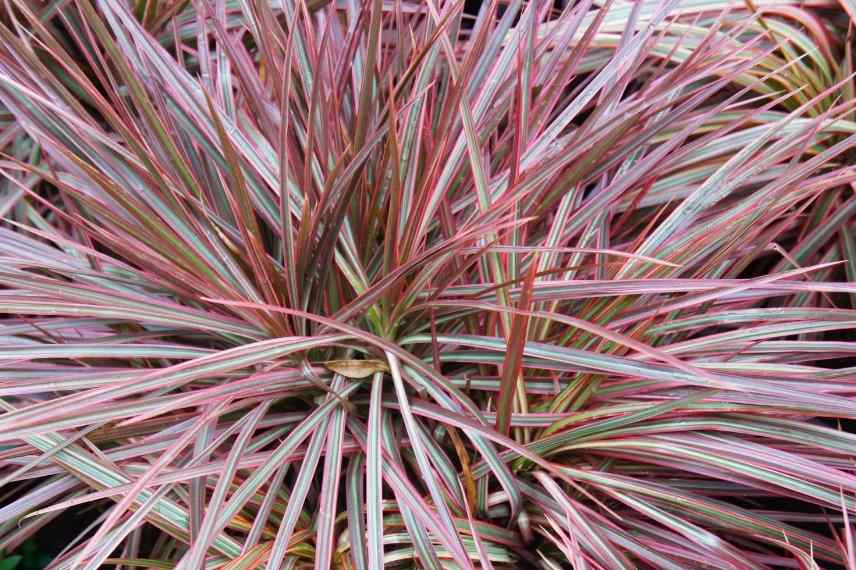
Dracaena ‘Tricolor’

Spring, a time of renewal
For garden plants, as with indoor plants, spring is a season of renewal. Light increases gradually, temperatures rise gently, and plants come out of their winter dormancy. It’s the best time to encourage growth and prepare the Dracaena for the growing season. Spring is indeed a period of active growth.
- Watering : it is time to resume more regular watering, but without excess, a source of root rot. Indeed, you should wait until the substrate dries at the surface before watering. In spring, a weekly watering is generally sufficient. It is important never to leave standing water in the saucer or the drip tray. Watering with soft water (rainwater, demineralised water or tap water left to stand for a few hours) is preferable. Likewise, use water at room temperature.
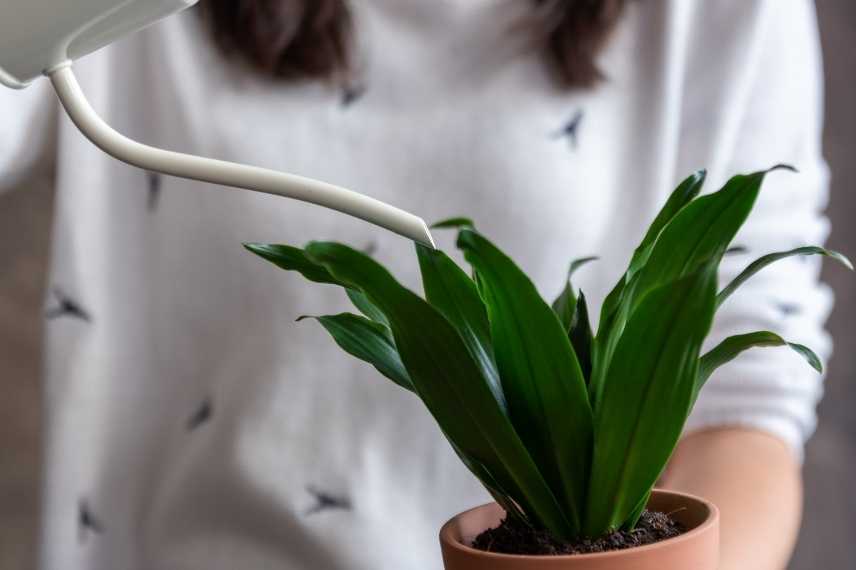
In spring, weekly watering is ideal
- Repotting : although it has relatively slow growth for an indoor plant, the repotting of the Dracaena should be regular, roughly every 2 to 3 years. Early spring is the ideal season. This repotting allows providing a pot slightly larger for the dragon tree, but above all to refresh the potting medium. It is, of course, important to choose a perforated pot, lay a layer of clay balls at the bottom and then fill the pot with substrate. For the Dracaena’s potting mix, opt for a blend made of 70% indoor plant potting mix (70 %) added to sand or the perlite. Between two repottings, top-dressing provides nutrients.
Pascale tells you more in the tutorial: Repotting a Dracaena: when and how? - Fertilisation : spring is also the right time to resume nutrient inputs, paused during winter. It is necessary to use a balanced liquid fertiliser for green plants, once a month.
- Light and exposure : you can take advantage of the increasing light to move your Dracaena towards a window. But it must not be exposed to direct sunlight to avoid leaf scorch. It is also important to ventilate the room, without draughts.
- Pruning : if the Dracaena has a few dead or damaged leaves, they should be removed. A proper pruning may be feasible for some Dracaena species that can become tall (essential for the maintenance of the dragon tree, Dracaena marginata, Dracaena fragans). They shed their lower leaves and reveal a bare trunk. It suffices to prune the main stem above a node to allow the dragon tree to densify. Be sure to use sharp, sterilised secateurs. Do not discard the cut stem, which can be propagated in water or seed-starting compost.
- Pest monitoring : spring often marks the return of pests such as scale insects, red spider mites, and aphids. Especially if cultural conditions are not optimal. It is time to thoroughly clean the leaves to aid photosynthesis, but also watch for the slightest sign of attack. And act quickly!
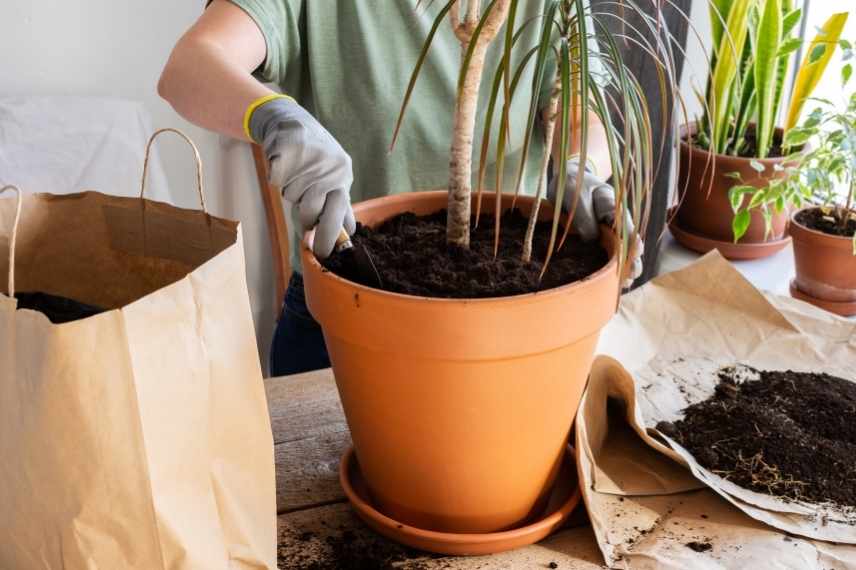
In spring, repotting helps renew the substrate and provide nutrients
In summer, beautiful growth for Dracaena
Heat, drought, direct sun, bright light… for an indoor plant such as Dracaena, summer is a season of hazards. Yet it is also a time of vigorous growth. The key is to provide the right care.
- Watering : water regularly to prevent the substrate from drying out for too long. A watering once a week is usually sufficient, unless indoor or outdoor temperatures are very high. In that case, increase the watering and ensure that water does not stagnate in the saucer or in the cache-pot. Water should be rainwater or filtered water. You can also use tap water, but never when it is too cold.
- Humidity and ventilation : if the ambient air is too dry due to fans or air conditioning, don’t hesitate to mist the leaves with rainwater. It is also important to ensure good air circulation by opening the room daily.
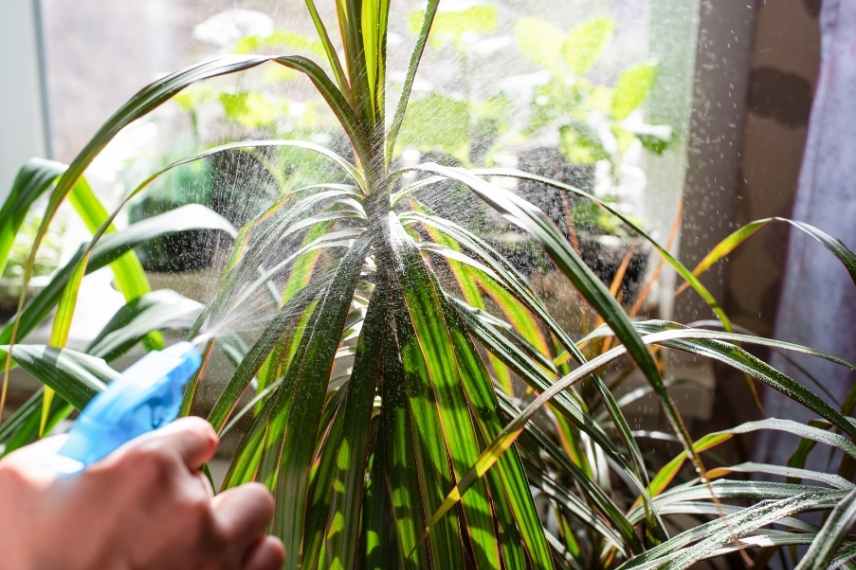
In summer, if ambient air is too dry due to fans or air conditioning, don’t hesitate to mist the leaves
- Light and exposure : Dracaena should be provided with bright indirect light, placing it near a window. But you must absolutely protect it from direct sun. During the warm season, you can also place the Dracaena outdoors, in the garden, on a balcony or a terrace, provided it is in the shade.
- Fertilising : fertiliser should be applied monthly. Be careful not to over-fertilise: too many nutrients combined with heat and bright light can burn the leaves and the roots.
- Protection against stress : in case of high heat, do not leave your Dracaena in darkness all day. Take advantage of the relative cool of the morning to move it outside, in the shade. Watch for signs of stress such as brown or yellow edges on your Dracaena leaves or leaves that dry out, and adjust shading and watering accordingly.
Autumn, a period of transition for Dracaena
Autumn marks the transition to the cold season. Light, like temperatures, is gradually decreasing. Dracaena’s growth slows. It is therefore necessary to help it through the winter in good conditions.
- Watering: start by gradually reducing watering, without letting the growing medium dry out. A watering every 10 to 15 days is more than enough. Standing water in the saucer or cachepot should always be avoided.
- Light and exposure: If light levels fall, adjust the positioning and bring Dracaena nearer a south- or east-facing window, equipped with a sheer curtain.
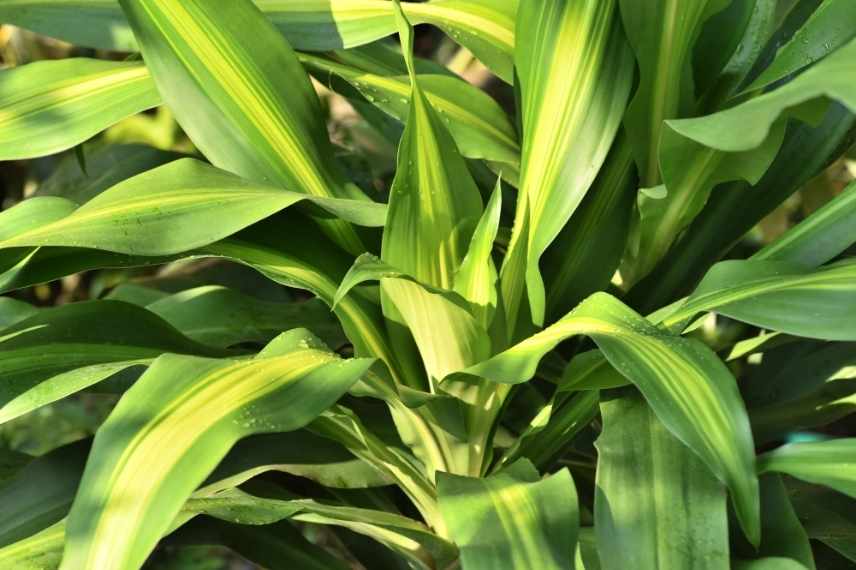
Dracaena fragrans
- Fertilisation: we also begin to reduce fertiliser applications, stopping them in October.
- Disease and parasite prevention: it is essential to check for signs of disease, because in autumn, with rising ambient humidity and falling temperatures, certain parasites or fungi find the environment favourable.
- Temperature: if your Dracaena is still outside, bring it indoors. It is essential to keep it away from drafts caused by poorly insulated windows and open doors. Likewise, do not place the Dracaena near a heat source such as a radiator or a fireplace. Aim to keep it at around 20 °C.
How to overwinter a Dracaena?
Winter is a period of dormancy for many tropical plants, including Dracaena. The days are shorter, temperatures and light decline, and growth slows. This is the time to provide gentler care, to avoid stress, to guard against excesses, and to prepare for a restart in spring.
- Watering : water the Dracaena moderately and reduce watering to allow the substrate to dry out. A watering every two to three weeks is sufficient, in small quantities. More than in spring or summer, it is recommended to use water that is not cold, ideally at room temperature or lukewarm to avoid thermal shocks. And again, remember never to let water stagnate.
- Light and position : Place the Dracaena in a well-lit position, but avoid direct sunlight. Even in winter, direct rays can be treacherous! It should also be kept away from sources of cold and drafts, but also away from direct heat sources. Ideally, during its winter dormancy, a Dracaena should be kept at a temperature above 15°C and up to 20°C.
- Humidity : Indoor air can become too dry in winter due to heating. If this is the case, you can lightly mist the foliage with water at room temperature, or place your Dracaena on a humidity tray of moistened clay pebbles.
- Fertilisation : Dracaena grows slowly in winter, it does not require fertilisation. Therefore, stop fertiliser applications until the beginning of spring, in March.
- Subscribe!
- Contents
Comments