





























How to grow fescue in pots?
Tips for planting and care
Contents
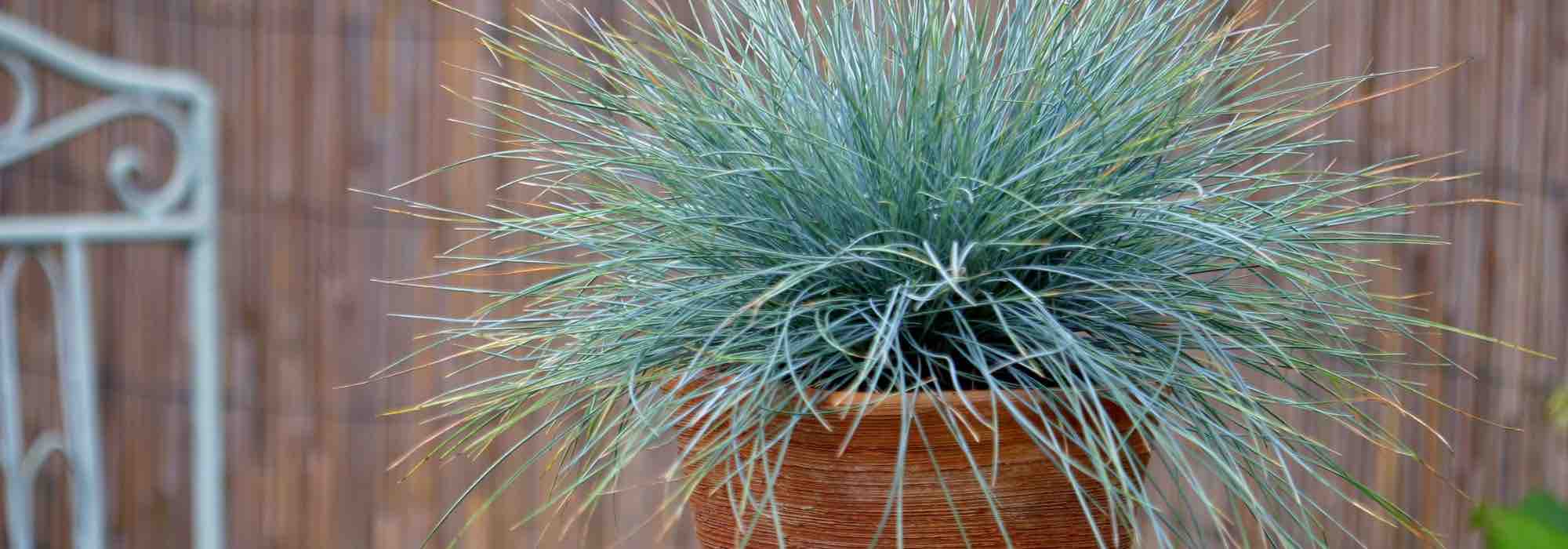
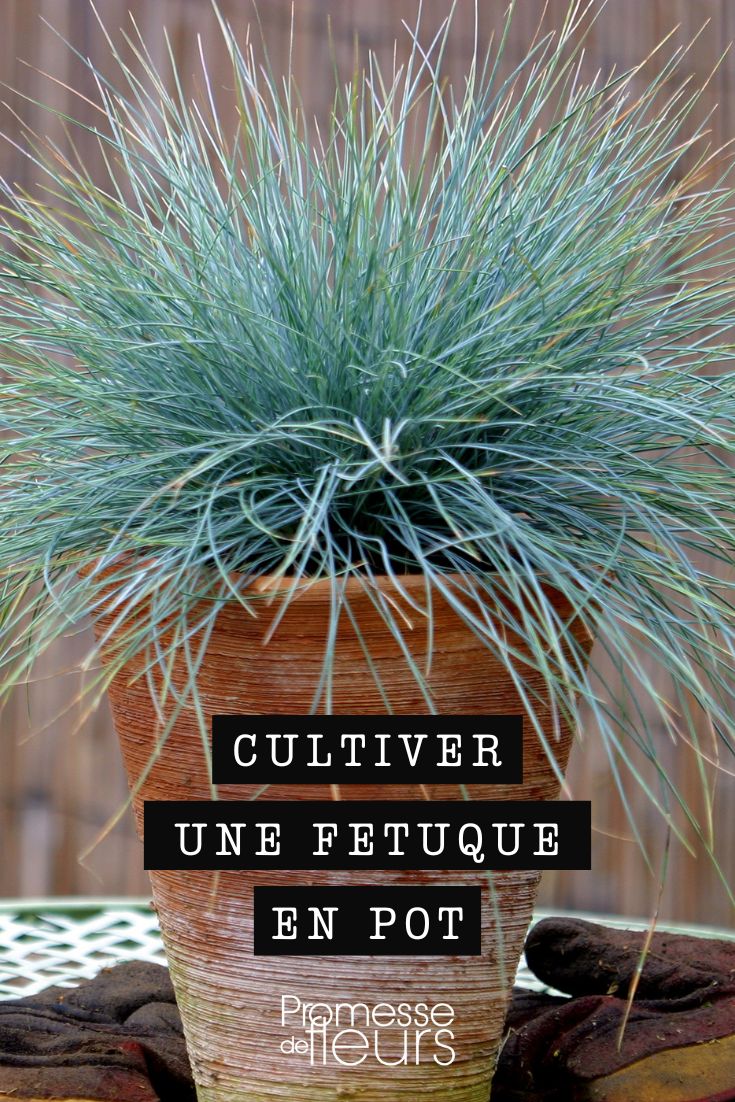
Fescue or Festuca is a small, hardy grass that is easy to grow and distinctive. Its fine, slender leaves are green, blue or blue-grey. They are upright and evergreen and form a graphic, spherical clump, prized by enthusiasts of contemporary gardens. It reaches a height ranging from 10 cm to 1 metre tall, depending on the species. In spring, flowering spikes appear amid the tuft of wispy leaves. The inflorescences consist of fine blond spikes, straw-yellow or blue, with silver or violet tinges.
This plant, suited to dry gardens and soils, also tolerates drought as well as rocky soils and sea spray. Hardy to at least -15°C, it can be grown in almost all regions of France. This easy-to-maintain plant also grows perfectly in a pot.
Discover our tips for growing fescue in a pot on your balcony or terrace.

Which varieties to grow in pots?
Blue fescue varieties available for pot culture:
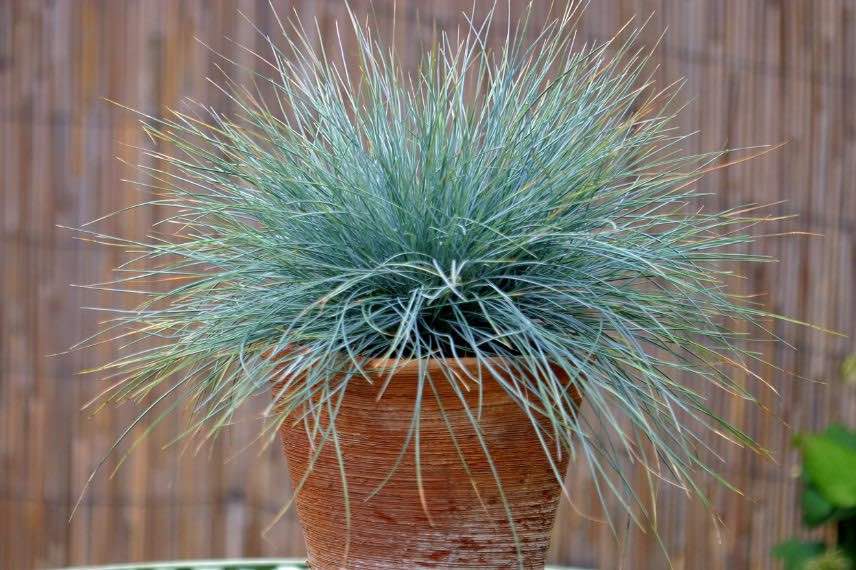
– Blue fescue or Festuca glauca: This compact grass, reaching about 25 cm in height, forms a dense tuft of fine, elegant leaves with a silver-blue hue. Flowers appear in June and July. Hardy to -18°C.
– Blue fescue ‘Elijah Blue’ – Festuca glauca: This variety grows a little taller, up to 30 cm. Its leaves have a striking steel-blue sheen.
– ‘Intense blue’ blue fescue: Also growing up to 30 cm tall, it forms a tuft of slender leaves with a superb metallic blue that remains for most of the year and fades to gold tones. Hardy to -18°C.
– Valais blue fescue – Festuca valesiaca ‘Glaucantha’: Forms a 20 cm high, rounded lawn-like tuft. Foliage is grey-green to silver-blue. Flower stems appear from May to July and take violet tints. Hardy beyond -15°C.
– Gautier’s fescue – Festuca gautieri: A small grass of 15 cm with leaves ranging from light green to emerald. Flowers in May and June. Hardy to -15°C.
– Golden Toupee fescue: Reaches 20 cm at maturity and produces blue leaves that turn golden yellow. Hardy to -18°C.
– Sunrise fescue: A Polish variety notable for very decorative orange-copper flower spikes. Flowers from July to September. Foliage is green-tinged blue, then bronze in autumn. Can reach 70 cm tall and 25 cm wide.
– Amethyst blue fescue or Festuca amethystina: A 40 cm-tall grass at maturity. It bears fine blue-green leaves and, in May and June, light spikes with violet reflections. Hardy to at least -15°C.
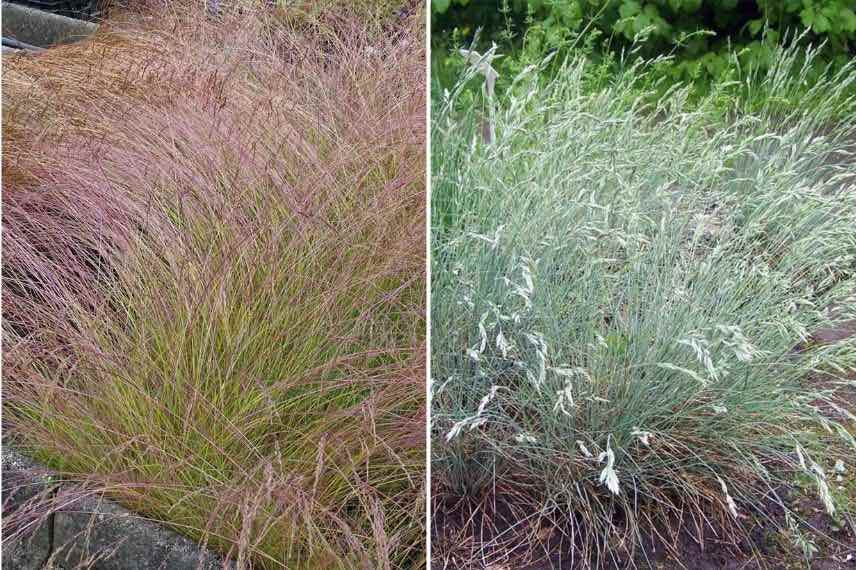
Festuca amethystina and Festuca glauca
When is the best time to plant fescue in a pot, and what light exposure should it have?
The best time to pot up fescue is in spring or early autumn. This gives the roots a good chance to establish themselves before the extreme temperatures of summer or winter.
Fescue prefers a sunny exposure. It loves full sun, which allows it to develop its beautiful silvery or bluish foliage, depending on the variety. Ensure it receives at least 6 hours of sun per day. It can tolerate light shade, but it will be less compact and colourful.
Hardy down to -15°C, fescue can be grown in almost all regions of France.
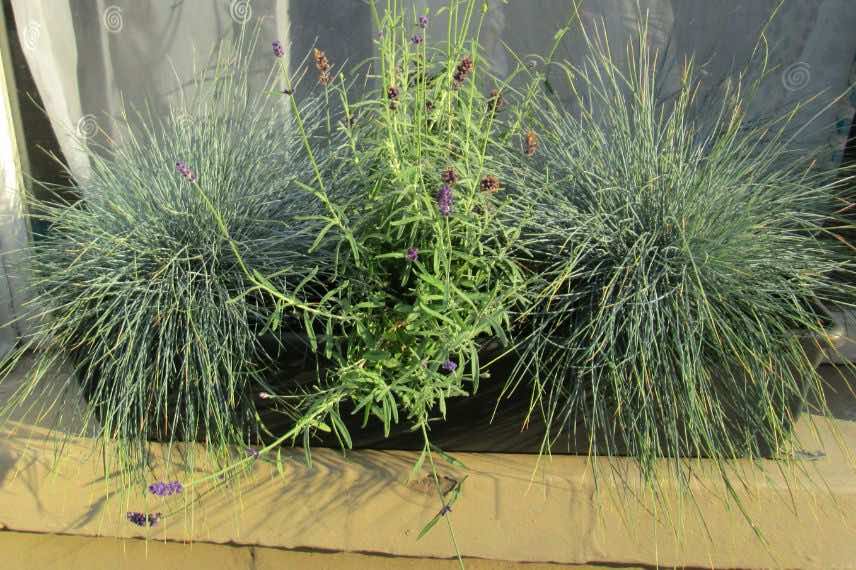
Plant fescue in full sun
How to plant fescue in a pot?
What type of pot?
You can choose a pot you like or that matches the atmosphere of your balcony. Terracotta pots are an excellent option as they allow good root aeration and promote effective drainage. However, they dry out more quickly, so you’ll need to monitor the watering. Plastic pots retain moisture better and are light, which can be convenient if you need to move the pot. It is crucial that the pot has drainage holes to prevent water from accumulating at the bottom, which could cause root rot. You can also add a layer of gravel or clay pellets at the bottom of the pot to improve drainage.
The fescue does not have a very deep root system, so a pot of around 20 to 30 cm in depth is sufficient. A larger pot (at least 30 cm in diameter) is ideal, as the fescue grows in tufts and needs space to spread.
What substrate?
Use a substrate that provides excellent drainage for the roots to prevent rot.
You can mix garden soil with sand or gravel. The fescue prefers a soil with a neutral to slightly alkaline pH, between 6.5 and 7.5. You can add a little horticultural lime if your soil is too acidic.
Or plant it in a mix of universal potting compost with coarse sand or the perlite. (about 1/3 sand or perlite for 2/3 potting compost)
You can also use a potting compost for Mediterranean plants, often formulated to provide good drainage while being light.
The planting
- Take a pot with drainage holes at the bottom and lay a layer of gravel or clay pellets at the bottom of the pot to ensure good drainage.
- Cover with the substrate.
- Place the fescue in the centre of the pot and cover with the other half of the substrate
- Firmly press the soil to expel any air pockets and ensure good contact between the soil and the roots
- Water the planting and place it in full sun.
Care
Watering and fertilising
Water the potted fescue regularly, allowing the soil to dry between waterings.
Fescue does not need fertiliser.
Pruning
In late February, put on gloves and remove the dry parts of the plant by hand.
To revive a dried-out fescue due to age, you can cut it back to the base before winter to encourage better leaf regrowth.
Division
After 3–4 years of cultivation, divide the clump of your fescue, which will give it a new lease of life. The division is performed in spring.
Here’s how to proceed:
- Take the fescue from the soil and cut the clump into 2 or 3 pieces using a knife or a spade.
- Plant the pieces in separate pots and water them thoroughly.
- Then ensure regular watering for a few months, giving the plant time to re-establish itself.
Diseases
Fescue is not very susceptible to diseases and pests.
For more information, read our comprehensive guide on the planting and maintenance of fescue as well as on the cultivation of potted plants.
- Subscribe!
- Contents
Comments