





























How to pair Hebe?
Ideas and inspirations for planting in the ground or in pots for different garden styles
Contents
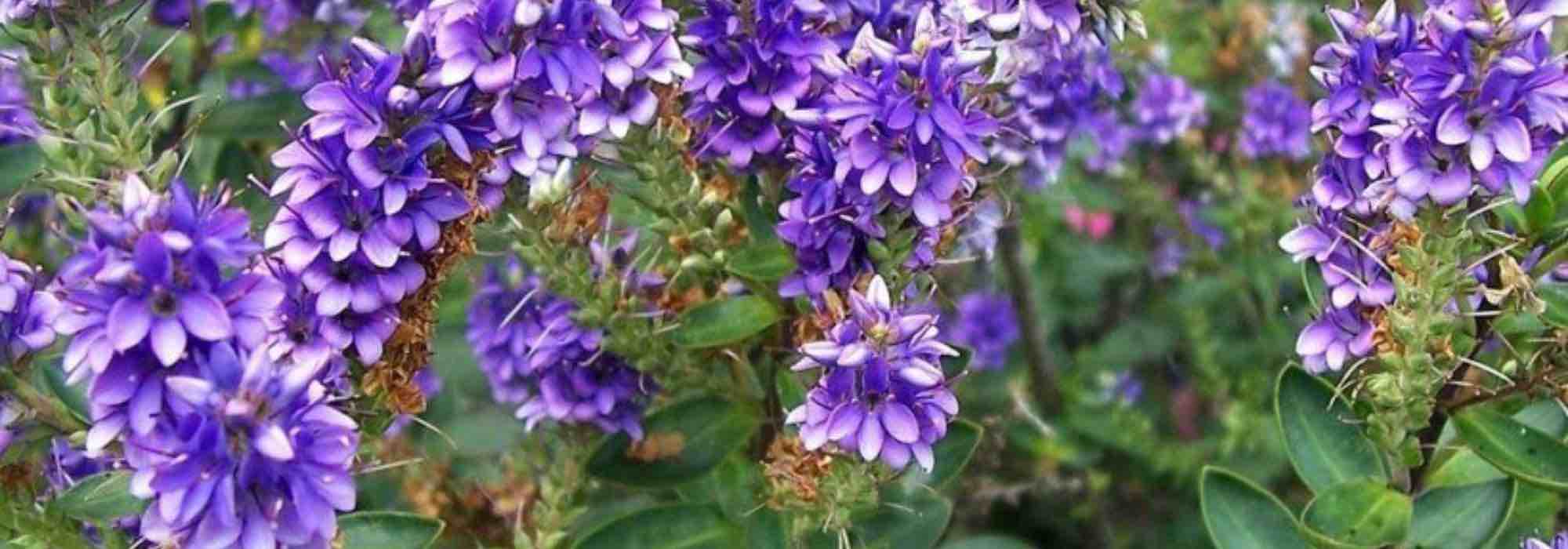
The shrubby veronicas or Hebes encompass a beautiful diversity of plants. Some varieties are valued for their flowering, while others are appreciated for their ornamental foliage. There are cultivars with a compact silhouette and others with a more bushy appearance.
This diversity makes it easy to combine them in any garden, large or small. These bushes will adapt to all styles, from the most manicured to the most natural. Here are 6 ideas to easily create different scenes with Hebes at home.

In a flowering pot on the balcony or a windowsill
In containers, small Hebes with a well-compact habit will be perfect. Opt for ‘Green Globe’ or ‘Emerald Green’, true little green balls with very bright leaves. Their flowering is rather rare and discreet, so these varieties will be paired with hardy geraniums for pots, such as ‘Jolly Jewel Pink’ with its bright pink flowers. Add an annual like Lobelia ‘Anabel Snow White’ with its long flowering in mini clouds, as well as some small moss Phlox, like ‘Moerheimii’. You will achieve a pot with dominant pink and white tones.
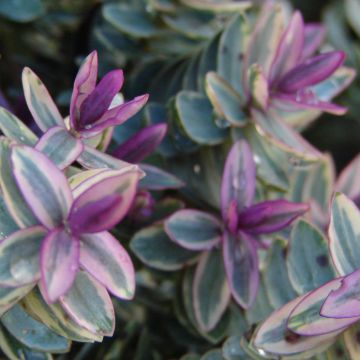
You can also choose a variegated Hebe variety for added dynamism, such as ‘Tip Top’. Its foliage combines cream, silver-green, and purplish pink. To highlight these colourful leaves, add a small grass like blue fescue (typical variety or cultivar ‘Elijah Blue’). Complete with a hardy geranium ‘Dreamland’ with soft pink flowers, or ‘Silvia’s Surprise’ with pink flowers and a white centre.
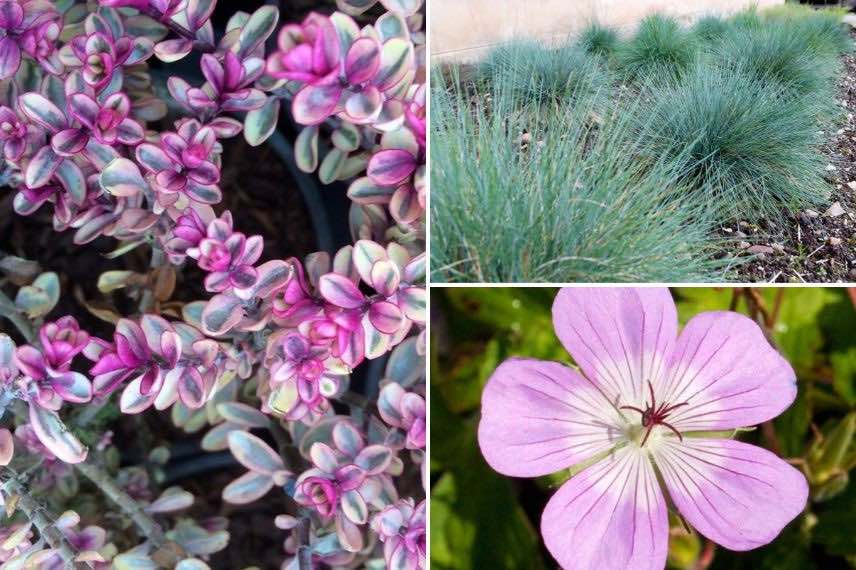
Hebe ‘Tip Top’, Festuca glauca and Geranium wallichianum ‘Silvia’s Surprise’
In a container on the terrace or in an urban garden
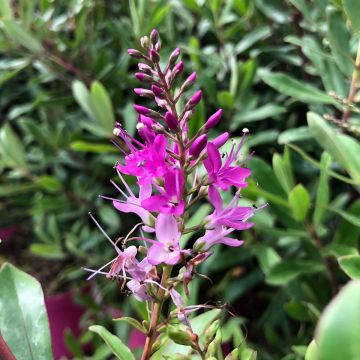
Bush veronicas are well-suited for urban garden cultivation, thanks to their pollution tolerance. In a container on the terrace or patio, opt for Hebe ‘Linda’, which reaches about 80 cm in all directions. It will brighten up the summer season with its generous pink flowering.
Plant alongside it a grass that will add a light graphic touch and an exotic feel, such as Pennisetum x advena ‘Rubrum’. This annual variety features beautiful red-purple leaves, with shades turning to black chocolate in sunny exposure. The purplish-pink flowering in spikes will accompany that of our Hebe during the summer.
At their feet, consider a small creeping stonecrop like Sedum takesimense ‘Atlantis’, which also enjoys sunny exposures and well-drained soils. This variety is not lacking in colour: variegated foliage with cream margins, turning pink in autumn; young red shoots; floral buds that are initially pink, then bloom into bright yellow.
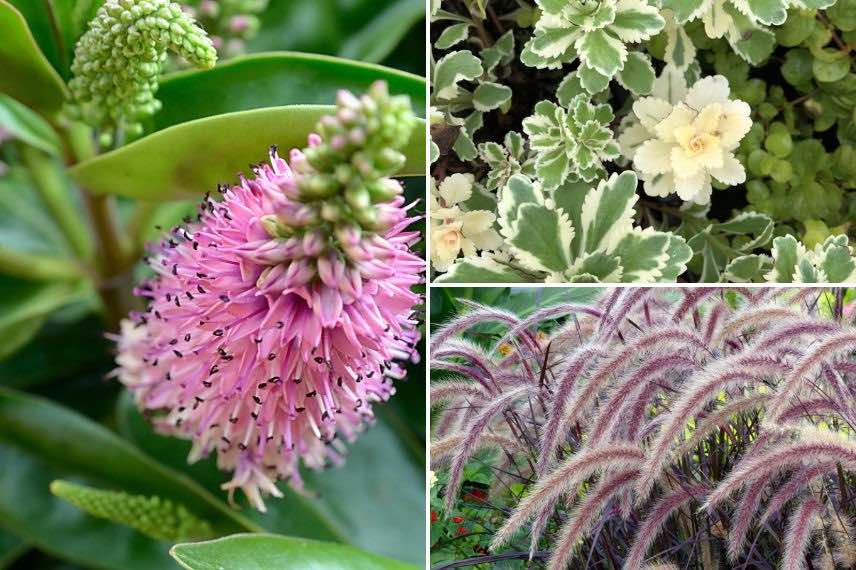
Hebe ‘Linda’, Sedum takesimense ‘Atlantis’, Pennisetum setaceum ‘Rubrum’
Discover other Hebe - Shrubby Veronica
View all →
Available in 1 sizes
Available in 1 sizes
Available in 1 sizes
Available in 1 sizes
Available in 1 sizes
Available in 1 sizes
Available in 1 sizes
Available in 1 sizes
Available in 1 sizes
Available in 1 sizes
To dress a partially shaded rockery
Hebe varieties with a spreading habit, broader than tall, make perfect groundcovers. They can thus adorn a not too dry rockery, situated in a semi-shaded position protected from the scorching rays of the sun.
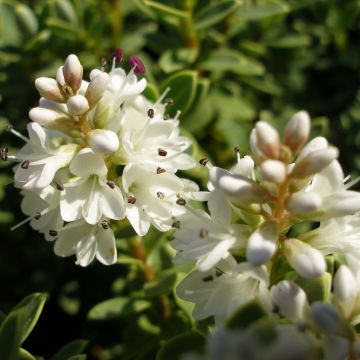
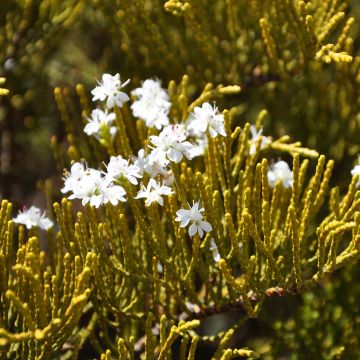
First, plant a Hebe vernicosa (90 cm spread and 50 cm height), with its delicate white flowering. Its low hardiness will limit it to regions south of the Loire when planted in the ground. In a different style, the Hebe ochracea will also work very well, with its green scale-like leaves tinged with orange-copper hues. More hardy, it can withstand temperatures down to -12°C.
Add a summer heather such as Calluna vulgaris ‘Tib’ with bright pink flowers, or ‘Spring Torch’ with a softer cream-pink. Complete with the ornamental foliage of the shore absinthe, with its silvery almost white leaves. A aubrieta will form a beautiful complementary carpet and precede the flowering in spring, ensuring a flowering rockery for many months.
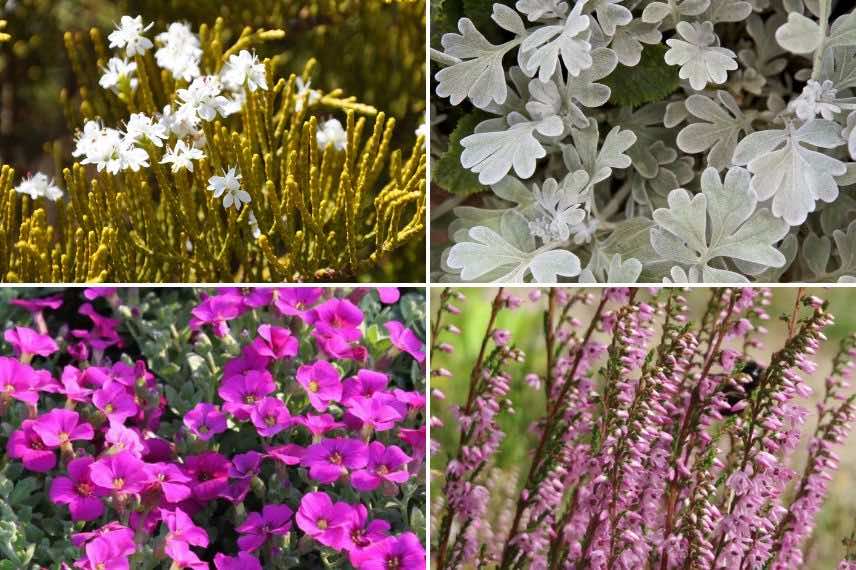
Hebe ochracea, Artemisia stelleriana ‘Boughton Silver’, Calluna vulgaris ‘Tibs’, Aubrieta gracilis ‘Florado Rose-Red’
Read also
How to choose a Hebe?In a seaside garden
Hebes have a good tolerance to sea spray, making them excellent candidates for seaside gardens. However, our bushes should be protected from prevailing winds and scorching sun, ideally grown against a low wall.
In the warm regions of southern France, opt for small-leaved shrubby veronica varieties that cope better with drought. Consider the Hebe ‘Wiri Image’ (with mauve-blue flowers) or the Hebe ‘Wiri Charm’ (with pink-purple flowers), both easy-going varieties. The Hebe franciscana ‘Blue Gem’ also tolerates dry, poor soils well.
Add a blue spiraea, such as Caryopteris clandonensis ‘Heavenly Blue’ (with blue-purple flowers) or ‘Stephi’ (with pink-lilac flowers). Catmints will also make good companions, chosen in similar shades.
To add more colour and dynamism, grow St John’s wort with yellow flowers, which will contrast beautifully with the pink-blue-purple palette. You can also consider euphorbias, such as Euphorbia cornigera or Euphorbia waldsteinii ‘Betten’. The variegated green, cream, and yellow foliage of an Elaeagnus ebbingei ‘Eleador’ will complete this picture.
A white-flowered vitex like ‘Silver Spire’ will add a touch of lightness and height, just like a common myrtle.
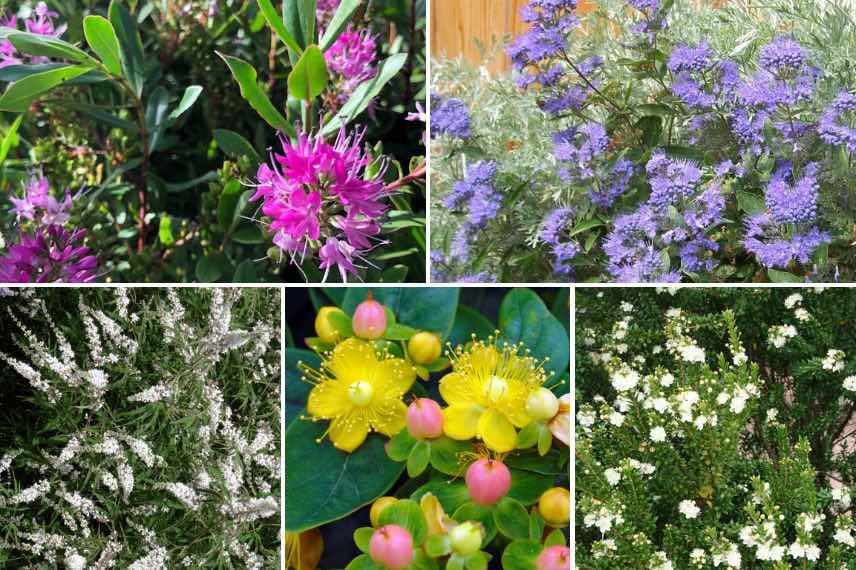
Hebe ‘Wiri Charm’, Caryopteris clandonensis ‘Heavenly Blue’, Myrtus communis, Hypericum ‘Magical Beauty’, Vitex agnus-castus ‘Silver Spire’
In a contemporary style graphic garden
The smallest and most compact bush veronicas have a very neat appearance, making them well-suited for structured and minimalist gardens, playing with shapes and contrasts.
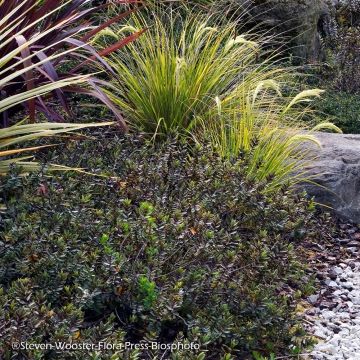
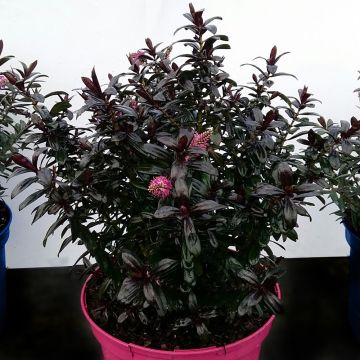
Our Hebes ‘Garden Beauty Purple’ and ‘Raspberry Ripple’ can replace boxwood borders, thanks to their well-rounded silhouette. The same applies to Hebe pinguifolia ‘Sutherlandii’, which can even adapt to topiary pruning. Meanwhile, the small ‘Joan Mac’ will provide a beautiful contrast with its dark, purple, and glossy foliage all year round. In regions subject to severe frosts (below -6° to -8°C), these varieties can easily be grown in pots, stored away during winter.
Add alliums for their ornamental flowering and verticality, such as ‘Early Emperor’, ‘Globemaster’, or ‘Forelock’. Also try angelicas Angelica taiwaniana or Angelica gigas.
Complete with the decorative ribbon-like foliage of ophiopogons, adding a touch of exoticism (Ophiopogon albo ‘variegata’ or ‘Hosoba Kokuryu’). For lightness, add a Stipa pulcherrima.
In terms of flowers, Persian fritillaries will not go unnoticed, with their tall flower spikes adorned with bells. Choose ‘Purple Dynamite’, ‘Green Dreams’, or ‘Ivory Bells’ for a touch of refined light. Also consider Iris germanica.
Shrubs such as Hydrangea arborescens ‘Annabelle’ or even a standard rose like the Décorosier ‘Opalia’, with its semi-double pure white flowers, will complete the picture.
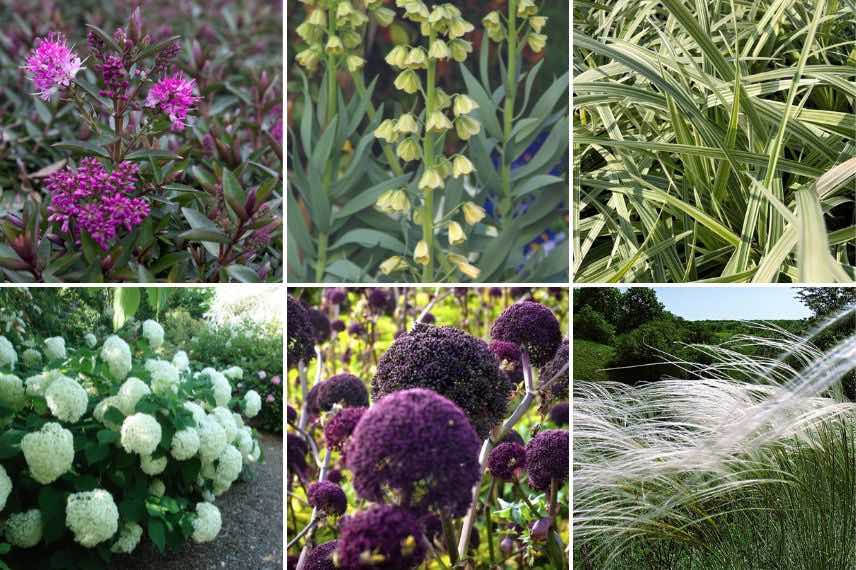
Hebe ‘Raspberry Ripple’, Fritillaria persica ‘Ivory Bells’, Ophiopogon ‘Albovariegatus’, Stipa pulcherrimma, Angelica gigas, Hydrangea arborescens ‘Annabelle’
In a shrub hedge with a long summer flowering period
For a hedge that comes alive during the long summer months, choose Hebe franciscana ‘Blue Gem’. It has a flexible silhouette, reaching up to 1.5 metres in height and spread. From June to September, it reveals an abundant flowering with blue-violet spikes. A shrubby veronica like Hebe andersonii, which flowers with pink-violet spikes, would also be suitable.
Add alongside it a hydrangea, such as Hydrangea macrophylla ‘Endless’, or a Escallonia ‘Apple Blossom’ or a Ceanothus pallidus ‘Marie Rose’.
In the background, install a Buddleia davidii ‘Santana’, bright with its variegated green foliage edged in yellow.
The flower colours will harmoniously blend shades of white, violet, and pink. To add a touch of lightness, include the decorative foliage of some grasses or a silver wormwood.
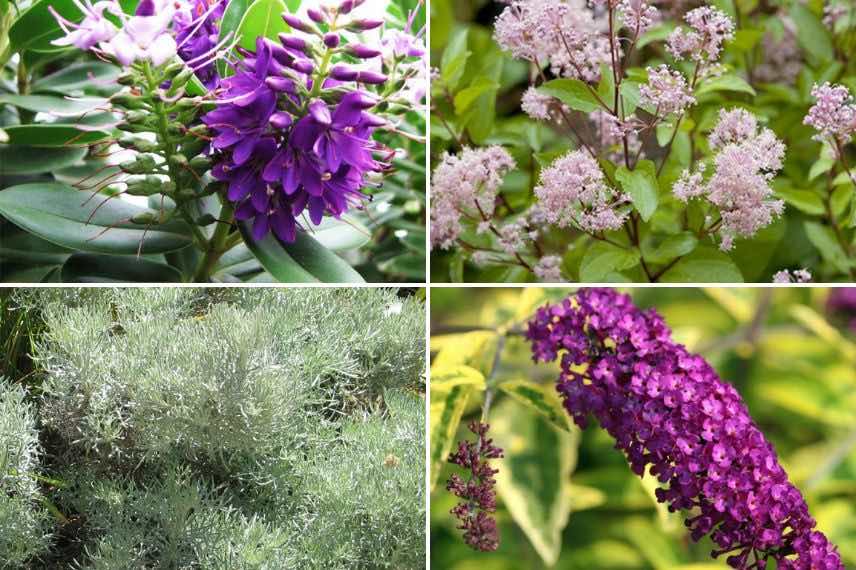
Hebe franciscana ‘Blue Gem’, Ceanothus pallidus ‘Marie Rose’, Buddleia davidii ‘Santana’, Artemisia alba ‘Canescens’
- Subscribe!
- Contents
![[plant_list category="arbustes" species="Hebe"]](https://en.promessedefleurs.eu/blogwp/wp-content/uploads/2023/03/Comment-associer-lHebe-.png "[plant id=\"hebe\" care=\"association\"]")
Comments