





























Pairing periwinkles
our ideas and inspirations for pairing periwinkles in the garden
Contents
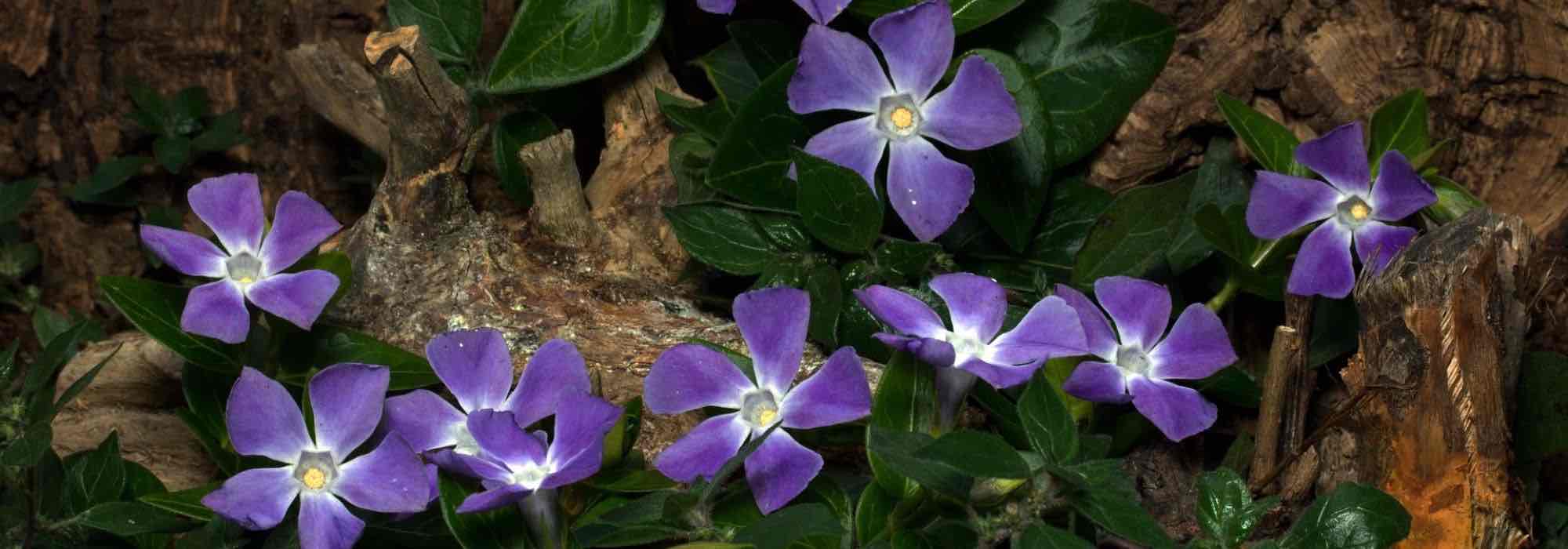
Periwinkles or Vinca are evergreen groundcover perennials with glossy green foliage and generous flowering in spring, and sometimes again in autumn. They are very useful for covering areas that are a bit challenging to cultivate, whether in shade or hard-to-reach spots. With their year-round foliage, dense cover, and prolific flowering, they can even become invasive with their stolons that spread and cling tenaciously. Discover how to make the most of their undeniable advantages and which plants to pair them with for good companionship, avoiding harmful competition.
Here are 10 ideas for pairing periwinkle in the ground in the garden or in pots on the balcony!

As groundcover at the base of trees
Of course, the first obvious use of periwinkles is to take advantage of their strengths. They cover a large area of ground thanks to their stolons, and as they grow in almost any soil and under all light conditions, it is interesting to use them at the base of trees, in the shade, where grass refuses to grow and where other groundcovers do not have the same coverage capacity as they do, developing completely evergreen foliage and one to two flowerings per year. Periwinkle flowers less in the shade than in partial shade, but it still blooms.
If you wish to bring light to a shaded area, you can opt for variegated periwinkle varieties. The Vinca minor ‘Illumination’ is the brightest with its largely yellow foliage, marginate with green. It does not spread as much as the type species Vinca major and Vinca minor, with Vinca major being the most aggressive species. You can pair it with ivy with green or variegated foliage, depending on the effect you wish to create, to vary the shapes and colours of the foliage. For example, choose Hedera helix ‘Glacier’, variegated with silver, or a dark green glossy ivy like ‘Ivalace’, which also brings light to a dark spot. Periwinkles and ivies have varieties with variegated green and white or green and yellow foliage, so you can also coordinate them.

Clockwise: periwinkle at the base of a tree, Hedera helix ‘Ivalace’, Vinca minor ‘Illumination’, Hedera helix ‘Glacier’
Read also
Periwinkle: planting, growing and careOn a difficult-to-reach slope
Even more challenging than the shaded area between tree roots is the slope with compromised access, where ideally, something should be planted once and for all. Here too, vinca can assist you: once established, even though it has average growth, its rootstock and stolons will conquer the available surfaces, creating a dense carpet that will require no further intervention. Even if the surface is sloped, this is not a problem, as vinca adapts to drier soil, where water runs off more than it penetrates. If you cannot water at all, choose vinca provided the spot receives shade during the day. On a sun-baked slope, succulent plants like Delosperma are more suitable. In partial shade or shade, vinca can provide cover.
Discover other Vinca - Periwinkle
View all →
Available in 2 sizes
Available in 1 sizes
Available in 2 sizes
Available in 1 sizes
Available in 2 sizes
Available in 1 sizes
Available in 2 sizes
Available in 0 sizes
Available in 0 sizes
Available in 2 sizes
In carpet with bulbs
Let’s now discuss associations with multiple plants, as while periwinkle can thrive on its own, it is also willing to share space under certain conditions. Choose plants that are not afraid of its competition, specifically robust and hardy bulbs that tend to naturalise. Periwinkles flower from March to May or from April to June, sometimes as early as February for certain varieties. Prefer Vinca minor and its varieties for an association with bulbs. This species is shorter, less bushy, and less aggressive.
Plant bulbs with staggered flowering throughout spring. Start with small daffodils like ‘Jet Fire’, Tête à Tête, which are bright yellow, or ‘WP Milner’ with cream-white trumpets. Also plant Muscari such as Muscari armeniacum ‘Big Smile’ and botanical tulips like Tulipa linifolia, Tulipa clusiana chrysantha ‘Tubergen Gem’, Tulipa kolpakowskiana. Don’t forget a few primroses, such as Primula veris. For a vibrant association, choose a blue-flowered periwinkle like the species type Vinca minor.
For autumn, also consider planting bulbs of the colchicum ‘The Giant’ to accompany the second flowering of certain periwinkles, such as Vinca minor ‘Anna’. The periwinkle covers the foliage of the colchicum when it begins to yellow.
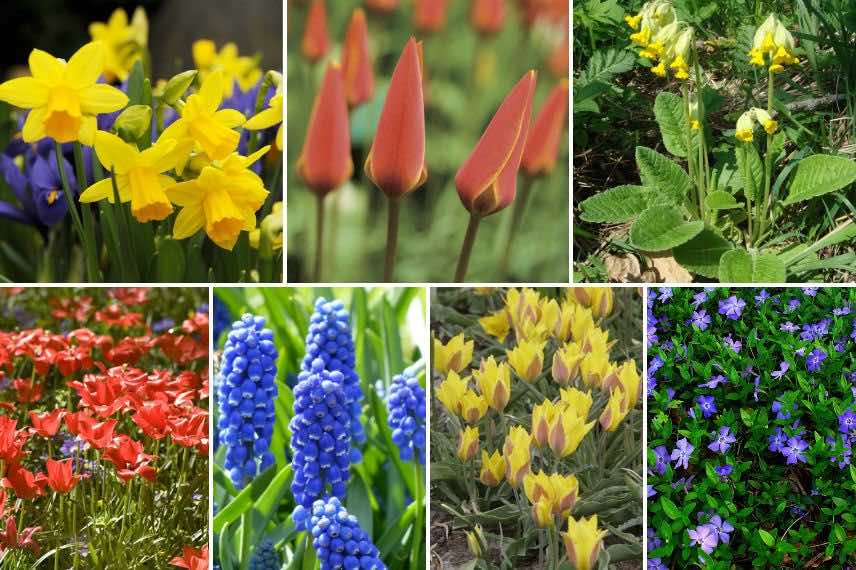
Narcissus ‘Tête à Tête’, Tulipa clusiana chrysantha ‘Tubergen Gem’, Primula veris, Vinca minor, Tulipa kolpakowskiana, Muscari armeniacum ‘Big Smile’, Tulipa linifolia
In a spring woodland bed with perennials
Let’s choose the exposure that suits periwinkle best, which is partial shade, and add plants for fresh and partial shade to create a perennial bed with a woodland atmosphere. Periwinkle serves as an effective groundcover, and the perennials are sturdy, upright, and reliable.
The Oriental hellebores and wood spurge bloom in late winter and early spring, perfect for accompanying the flowering of periwinkles. Choose a delicately variegated periwinkle that is more restrained in its growth, such as Vinca minor ‘Ralph Shugert’. In echo to its white margin, plant a variegated hosta like Hosta ‘Emily Dickinson’. A few clumps of Fritillaria meleagris ‘Alba’ and Leucojum vernum complete the scene.
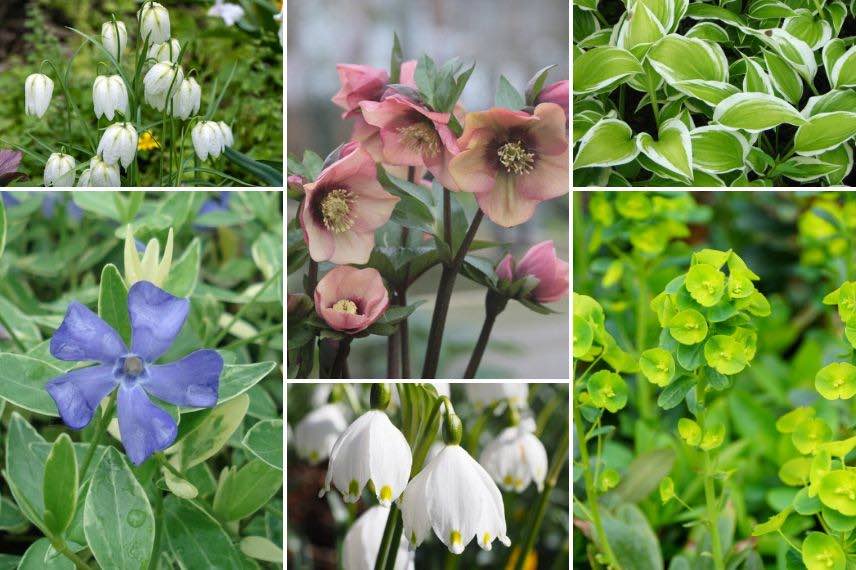
Fritillaria meleagris ‘Alba’, Helleborus orientalis Peach with red centre, Hosta ‘Emily Dickinson’, Euphorbia amygdaloides, Leucojum vernum, Vinca minor ‘Ralph Shugert’
In rockery
The Vinca difformis, like other periwinkles, can grow in sunlight, but it is important to avoid scorching summer sun, particularly during the hottest hours and in the full sun of the southern regions. Periwinkles tolerate drought and thrive in poor, well-drained soil as well as in clayey, more compact soil. Plant it in a rockery where its stolons can weave between the stones. The Vinca difformis has Mediterranean origins and does not withstand frosts below -7° C.
In a stone garden, pair the Vinca difformis with Marigolds, Oregano, Thyme, and Lavender. All these plants are drought-resistant and melliferous, creating a buzzing festival of activity.

Vinca difformis, Origanum vulgare ‘Compactum’, Tagetes patula, Thymus serpyllum, Lavandula ‘Hidcote’
In the non-burning sun in autumn
Many Vinca minor bloom a second time in autumn, in September and October. This is the perfect opportunity to create an autumn scene, in the gentle sun, accompanied by robust foliage and flowering plants, in a festival of colour.
Plant Artemisia schmidtiana ‘Nana’ with common sage, Ceratostigma plumbaginoides, Vinca minor ‘Anna’, and Loropetalum chinense ‘Black Pearl’.

Ceratostigma plumbaginoides, Artemisia schmidtiana ‘Nana’, Vinca minor ‘Anna’, Salvia officinalis, Loropetalum ‘Black Pearl’
In a pot
You guessed it, given its characteristics, periwinkle grows very well in pots where it cascades beautifully and for a long time. Choose either a hanging basket to plant it alone, or ideally a container tall enough for it to joyfully spill over the edges. A planter perched on a balcony railing also allows it to drape down quite low.
- In a pot, for example, in partial shade, plant a dwarf holly or Ilex meserveae ‘Gentle’, a robust hardy geranium like ‘Rozanne’, a fern like Dryopteris erythrosora with a Vinca minor ‘Atropurpureum’ with its lovely purple flower.
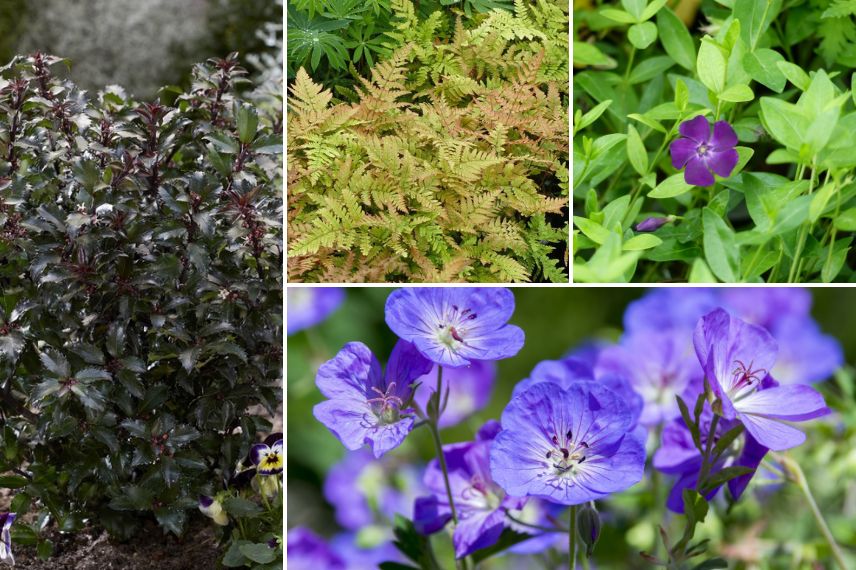
Ilex meserveae ‘Gentle’, Dryopteris erythrosora, Vinca minor ‘Atropurpureum’, Geranium ‘Rozanne’
- Also try, still in partial shade, periwinkle with Heuchera ‘Lime Rickey’, a Carex ‘Ice Dance’, and a Polypodium vulgare.
- For a taller display, in a larger pot, plant a Nandina domestica with a Carex ‘Everest’ and a Vinca minor ‘Ralph Shugert’, marginate with white like the Carex.
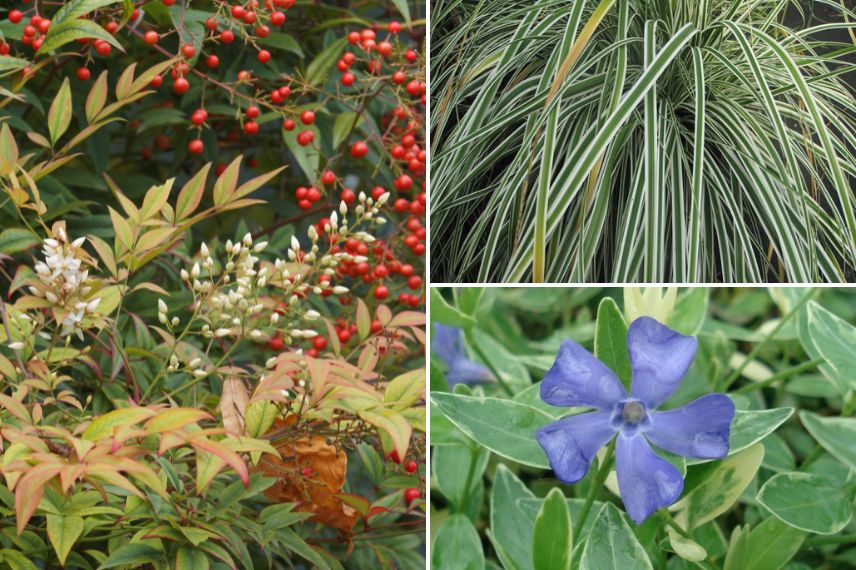
Nandina domestica, Carex ‘Everest’, Vinca minor ‘Ralph Shugert’
On the edge
As a groundcover, periwinkles are obviously suitable for borders, in all exposures. Once again, choose a variety from the species Vinca minor, which is shorter, 15 to 20 cm, less bushy, and less invasive than Vinca major.
Plant them, for example, in shady or semi-shady borders, where Camassia leichtlinii ‘Alba’, Tiarella cordifolia, Bergenias ‘Dragonfly Angel Kiss’, and Carex muskingumensis in yellow, in front of, why not, a Viburnum davidii.

Bergenia ‘Angel’, Tiarella cordifolia, Carex muskingumensis, Vinca minor ‘Argenteomarginata’, Camassia leichtinii ‘Alba’
In white
Several lovely varieties of periwinkles develop white flowering. Here is a monochrome association in white to bring light to a shaded area.
Plant a Blechnum spicant with clumps of Polygonum odoratum or Solomon’s seal, an Asarum europaeum, and bulbs of lily of the valley, Convallaria majalis, all accompanied by a white periwinkle such as Vinca minor ‘Gertrude Jekyll’.

Polygonum odoratum, Vinca minor ‘Gertrude Jekyll’, Blechnum spicant, Asarum europaeum, Convallaria majalis
In harmony of purple
Let’s finish with a harmony in purple for pleasure, featuring plants already seen above, this time in different colours.
Why not pair Vinca minor ‘Atropurpurea’ with Fritillaria meleagris, Artemisia stelleriana ‘Boughton Silver’, and a particularly dark oriental hellebore, ‘Slaty Blue’.

Fritillaria meleagris, Helleborus ‘Slaty Blue’, Vinca minor ‘Atropurpurea’, Artemisia stelleriana ‘Boughton Silver’
- Subscribe!
- Contents
Comments