





























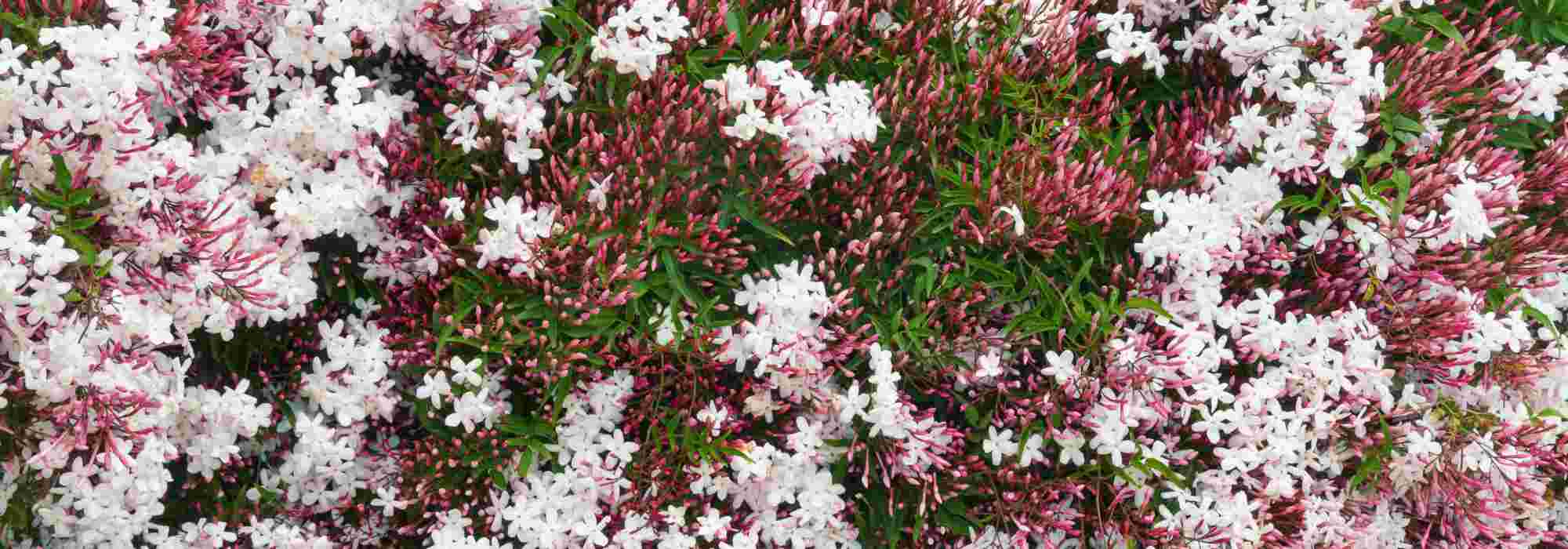
Growing winter white jasmine in the garden or in pots
Our tips to successfully grow Jasminum polyanthum in the ground or in pots
Contents
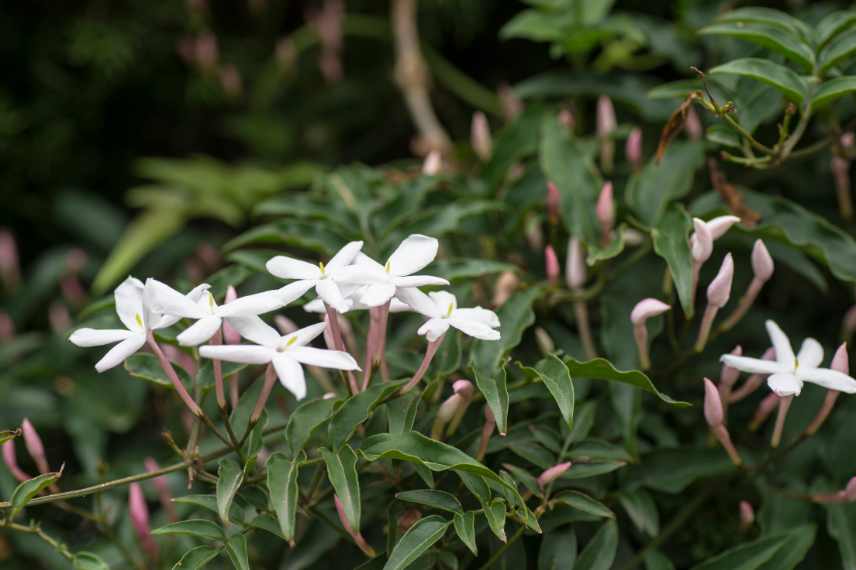
Jasminum polyanthum, also known as white jasmine, winter jasmine*, Chinese jasmine, or pink jasmine in English, is a stunning climbing plant with a delightful fragrance. This jasmine reveals strong pink tubular flower buds before blooming into thousands of small flowers in porcelain pink and then white shades.
White jasmine is evergreen or semi-evergreen depending on the severity of the climate. We appreciate its long flowering period, from early spring to summer, as well as its rapid growth. However, this jasmine is a bit tender, so it should only be planted in the ground in regions with a mild climate. The Jasminum polyanthum grows to 3-4 m in height but can climb up to 7-8 m, scaling trellises and pergolas.
We will tell you everything you need to know to successfully grow Jasminum polyanthum, whether you plant it in the garden or in a pot.
*: do not confuse it with the other white jasmine (common jasmine or Jasminum officinale), which is much hardier, nor with winter jasmine or Jasminum nudiflorum, which is yellow and scentless!
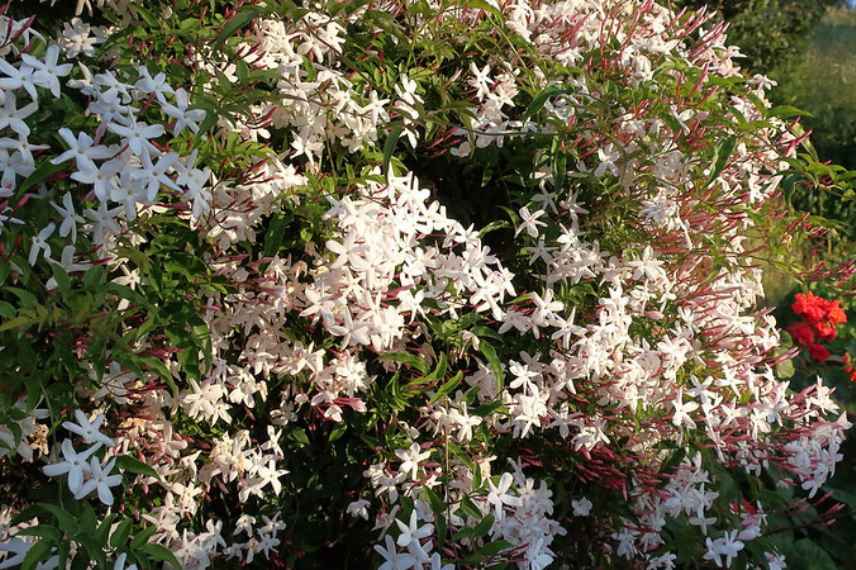
Jasminum polyanthum (© Cultivar 413)

What exposure and location?
Winter white jasmine can be planted either in the ground or in pots in most regions, depending on your area: indeed, it has limited hardiness, down to -8°C, with its aerial parts affected from -4°C. It is therefore possible to grow it in the ground in regions with mild winters that do not experience severe frosts (Atlantic coast, Mediterranean region), provided it is placed in a sheltered area from cold winds. Planted against a sunny wall in a mild region, it will benefit from daytime warmth.
Plant it in full sun, and preferably in partial shade in the south of France. Its flowering will be much more abundant in full sun, and in a warm situation, it will also flower for a longer period, until early summer. It is wise to position it near an entrance or a frequently used passage to enjoy its fragrance, or in a pot on a terrace to make the most of its intense perfume.
→ See also Which jasmine to plant according to your region?
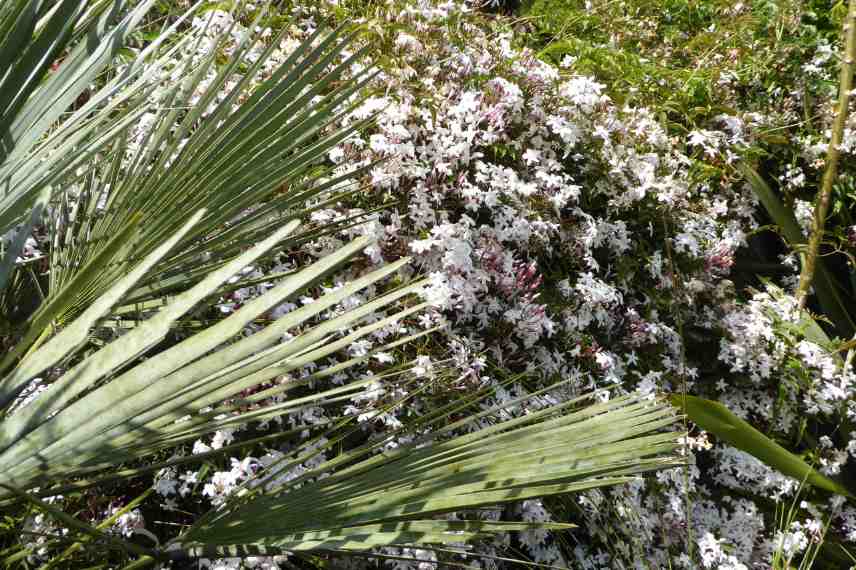
The avalanche of flowers from Jasminum polyanthum planted in an Angers garden in June (© Gwenaëlle David)
Read also
Jasmin : planting, pruning and careWhat type of substrate?
Jasminum polyanthum accepts any ordinary garden soil, as long as the soil remains cool, fertile (rich in humus) and very well-drained. It can tolerate calcareous soils.
If you plant it in a pot, provide a good potting mix (such as potting mix for Mediterranean plants), and possibly a bit of fertiliser or compost.
A slow-release fertiliser such as ground horn can be added at planting.
Discover other Jasmine
View all →
Available in 0 sizes
Available in 0 sizes
Available in 0 sizes
Available in 1 sizes
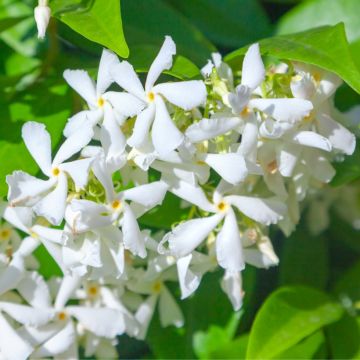
Available in 3 sizes
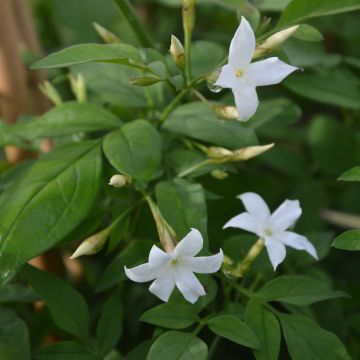
Available in 3 sizes
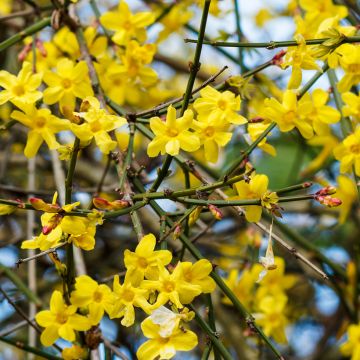
Available in 3 sizes

Available in 2 sizes
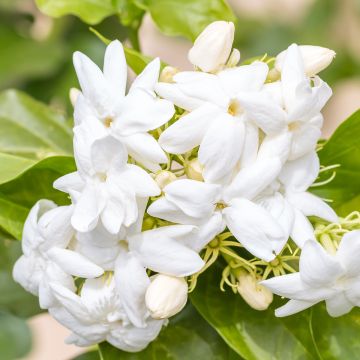
Available in 1 sizes
Available in 1 sizes
On what support?
White jasmine can grow in the ground up to 8 m tall with a spread of over 2 m. Its habit is initially vertical and then becomes ramified.
As a climbing plant, it does not have suckers or tendrils to attach itself. It therefore needs a sufficiently large support to hold its incredible volume and flowering. This can be a pergola where it cascades magnificently, as well as walls equipped with wires, the railing of a staircase, trellises, and large willow arches… You will assist it at the start of its growth by directing its shoots onto the support.
In a pot, it will have smaller dimensions but will remain vigorous. A large double stake or ladder-type support, or even a small obelisk in a large container to guide its flexible shoots, will be suitable.
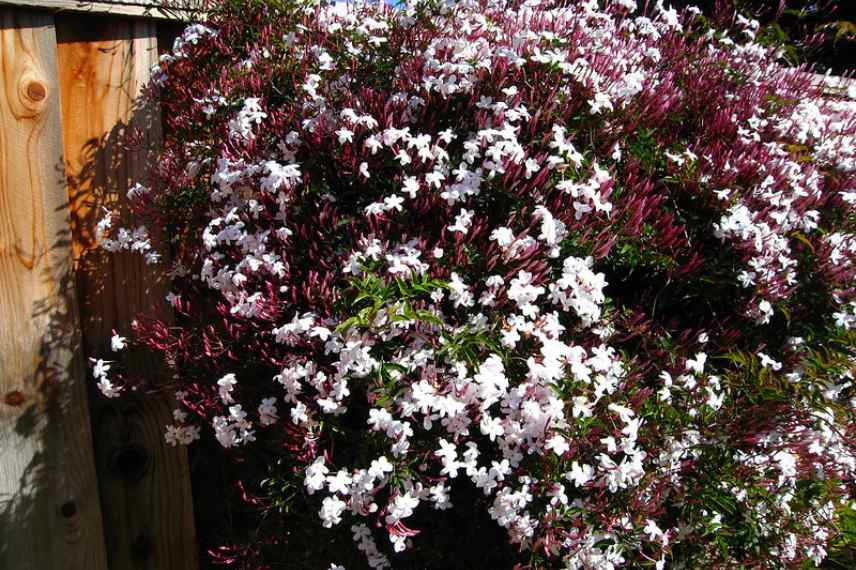
Jasminum polyanthum growing along a wall ©Alan Moore
Read also
Choosing a JasmineWhen should you plant it?
Jasminum polyanthum is ideally planted in spring, in April or May, to give it time to settle in. In mild climates (Atlantic coast, Mediterranean region), it can be planted in early autumn.
→ Are you unsure about the climate in your area? Check our article: What is a mild climate?
How to plant winter white jasmine?
In the garden
- Moisten the root ball by bottom watering the jasmine
- Dig a hole two to three times wider than the root ball
- In poorly draining soil, spread gravel or clay pebbles to prevent stagnant moisture around the roots during the winter season
- Prepare a soil mix by incorporating compost and a bit of potting soil
- Position the pot slightly tilted towards its support
- Backfill the hole with the same mix
- Lightly firm the base and water generously
- Spread a plant mulch to retain soil moisture (a mix of grass clippings and shredded material, for example)
- Train the branches onto the support
In a container
Jasmine will grow to a height of about 1.5-2 m. The substrate must be very well-draining to avoid stagnant moisture at the roots.
- Moisten the root ball by bottom watering the jasmine
- In a large pot of at least 40 L, spread a good layer of drainage (gravel or clay pebbles)
- Remove the pot, and plant the jasmine in a mix formed of 50% potting soil or special Mediterranean plant soil
- Attach the stems to the support
- Water at planting, then every three to four days during growth
- A mulch is also recommended here to keep the substrate cool
How to winter jasmine?
In many regions, the elegant Jasminum polyanthum can only be grown in a pot or container so that it can be brought indoors in autumn, around October. It is indeed sensitive to recurring frosts, and at -6°C its leaves and buds can scorch.
Planted in a large pot of at least 50 cm in diameter, the white jasmine should be stored in a bright, frost-free location during winter, such as an unheated conservatory or a temperate greenhouse. A temperature of 15°C is ideal, but not higher, as a period of cold allows the jasmine to produce more flowers at the end of winter. Water it very lightly during the winter months, ensuring the substrate dries well between waterings.
You can take your pot outside once the last frosts have passed, usually around April.
Care and maintenance
Water generously as soon as the flowers appear. The Jasminum polyanthum will need watering during the first summers. Afterwards, it requires little watering.
A balance and shaping pruning is sufficient at the end of its flowering (August), but it is not necessary. However, you can thin out plants that have become too large.
In the case of pot planting, we recommend repotting every 2 years, to be done in spring.
- Subscribe!
- Contents
Comments