


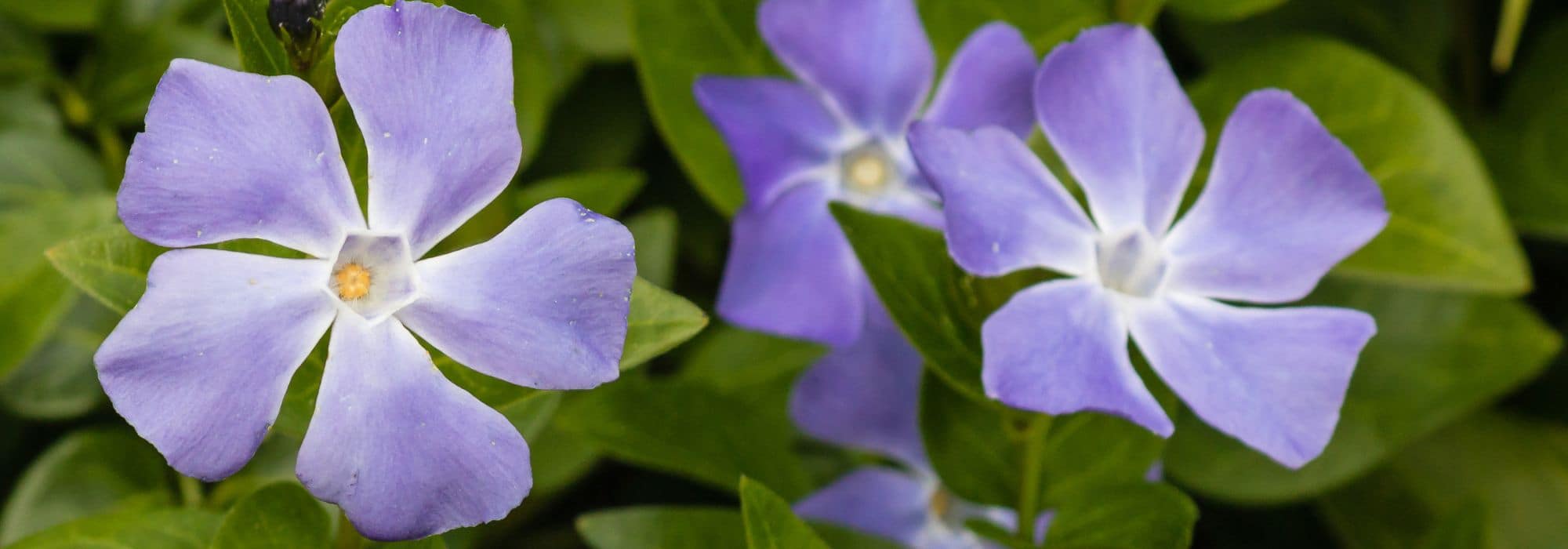
Invasive periwinkle: how to control its spread or eradicate it?
Our practical tips
Contents
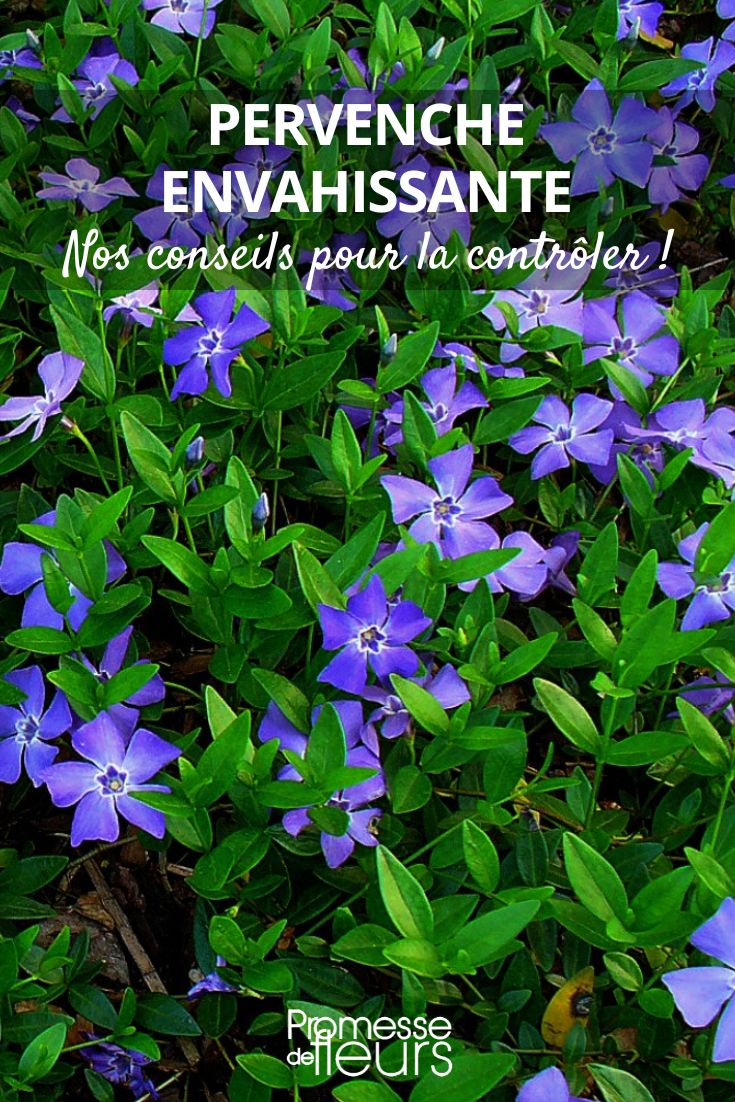
With its delicate little blue or white flowers, its handsome evergreen leaves and its gentle appearance, periwinkle hides its invasive nature well! Especially the greater periwinkle (Vinca major). Perfect for dressing up the large woodland gardens or a slope in partial shade, it can however quickly displace other plants in your garden. With its stolons (creeping stems that root at the nodes), this groundcover plant overruns the flower beds in just a few seasons, if left unchecked. Discover, in this article, the various methods to control, or even eradicate the greater periwinkle from your garden.

Greater periwinkle in a nutshell
The greater periwinkle (Vinca major) is a perennial groundcover plant, valued for its evergreen foliage and pretty blue, white or purple flowers. It is characterised by creeping stolons that readily root, forming a dense groundcover carpet… even running rampant! Its rapid growth and ability to adapt to a range of soils make it a very hardy plant. It prefers shaded or semi-shaded areas and thrives in well-drained soil rich in organic matter. It is perfect for forming a dense groundcover beneath trees or for effortlessly covering a large slope.
However, these same qualities make it invasive. With its ability to spread rapidly, it can smother neighbouring plants, beds and low hedges.
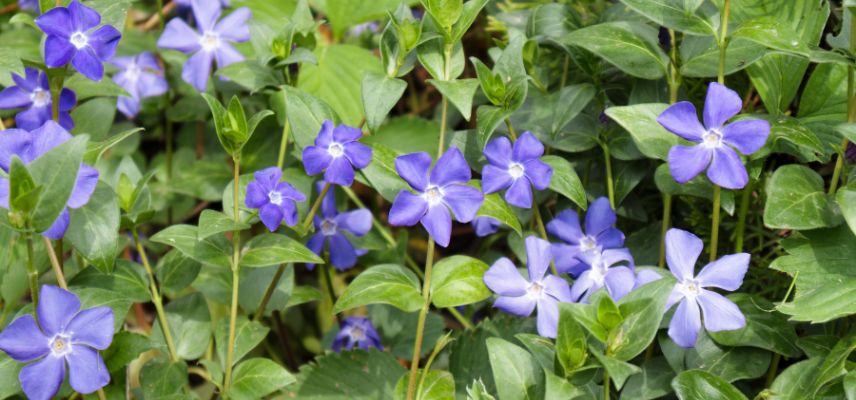
The periwinkle is perfect in woodland shade, but can rapidly colonise a bed.
Read also
Periwinkle: planting, growing and careTips for preventing the spread of periwinkle.
To minimise the spread of the greater periwinkle (Vinca major), start by choosing its location carefully. Plant it in areas where its growth can be controlled, such as under large trees in woodland shade or a shaded bank, but above all keep it away from beds and more delicate plants.
Install buried edging at least 20 cm deep to prevent its creeping stems and creeping roots from extending too far. Above ground, a border about 15 cm high above the soil surface is sufficient to slow surface spread.
Controlling the spread of periwinkle
To control the spread of the greater periwinkle, regular pruning is essential. Prune it at least twice a year, or more, in spring and autumn, cutting the invasive stems with a well-sharpened pruning shear. This technique helps keep the plant under control and encourages a more compact growth.
If the plant has taken root outside its designated area, manual removal is the most effective method. Be sure to remove all the roots to prevent rapid regrowth.
Finally, using mulch can limit the growth of the greater periwinkle. Opt for organic mulches such as wood chips, fallen leaves or straw. By covering the soil around the plants, the mulch blocks light and slows (but does not stop completely) the spread of creeping shoots, while improving soil quality and retaining moisture.
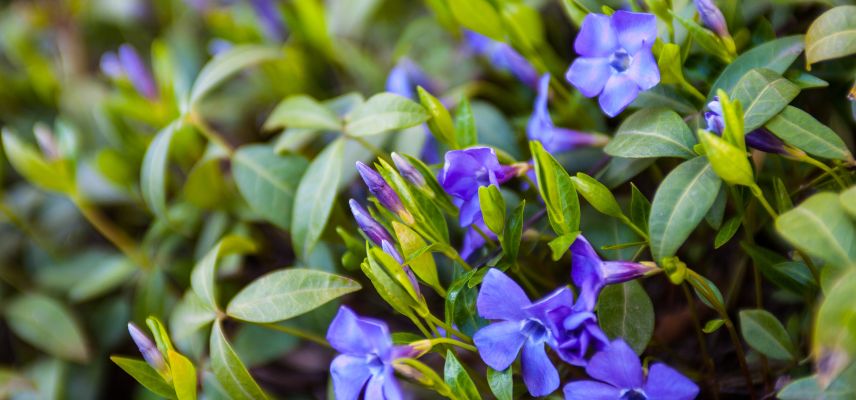
The greater periwinkle (Vinca major).
Read also
Choosing periwinklesHow to get rid of periwinkle?
Manual removal
Manual removal is the most direct and effective way to get rid of greater periwinkle in your garden.
1-Before you start, equip yourself with gardening gloves and water the soil generously around the plant to facilitate root extraction.
2- Then loosen the soil with a garden fork and lift it to remove the plant with its roots.
3- After this initial removal, continue to monitor the area. New shoots may appear from forgotten root fragments. Repeat the operation as soon as you spot new shoots to prevent greater periwinkle from taking over. Consequently, do not replant immediately after the first removal, but wait a few weeks.
Using a black tarpaulin
The second effective method to say goodbye to greater periwinkle is to cover it with a black tarpaulin. By depriving the periwinkle of light, it will wither in the long term. Here’s how to proceed :
1- Obtain a black tarpaulin large enough to cover the entire area.
2- Spread the black tarpaulin over the infested area, extending well beyond the edges to prevent stolons from creeping out in search of light.
4- Secure the edges of the tarpaulin with stones, stakes or any other heavy object to prevent it from blowing away.
5- Leave the tarpaulin in place for at least six months, or even a full year, to ensure all parts of the plant are deprived of light and die.
Why avoid weedkillers?
We discourage the use of chemical weedkillers, as they can contaminate soil, water and affect local wildlife. They will also harm neighbouring plants and the health of your soil, not to mention your own health.
Alternatives: little periwinkle and hardy geraniums.
The little periwinkle
If you’ve fallen for the small blue flowers of the greater periwinkle, prefer a less invasive alternative: the little periwinkle (Vinca minor). It spreads a little more slowly, where the soil is bare, without colonising the plants already in place. It is easier to control, while providing effective ground cover, even if it will still require a little maintenance. It produces flowers just as attractive as those of the greater periwinkle, blue, purple or white depending on the variety. It adapts well to a range of soils and also thrives in woodland and on slopes.
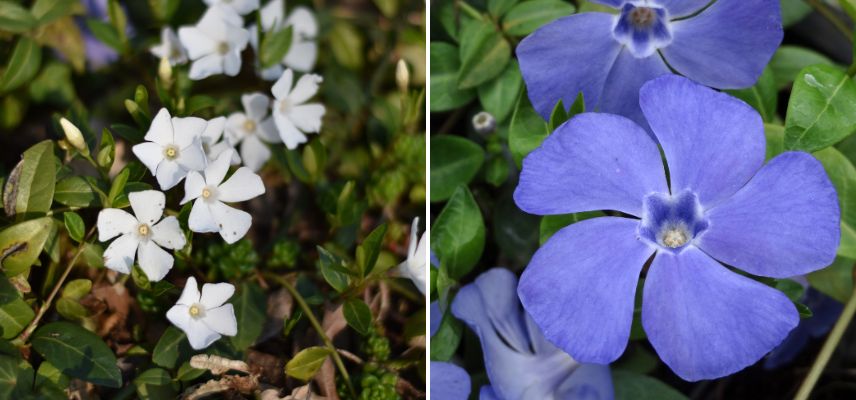
Two little periwinkles: Vinca minor ‘Alba’ and the Vinca minor
The hardy geraniums
Another elegant, non-invasive choice: hardy geraniums, and in particular the Geraniums macrorrhizum which also enjoy partial shade and full shade. They also thrive on slopes or in woodland, and offer pretty white flowers for the variety ‘Spessart’ and pink flowers for ‘Bevan’s Variety’.
Unlike periwinkles, hardy geraniums simply spread, over time, until they reach about 50 cm across, without crowding nearby plants. Moreover, they require little maintenance.
And for sun or partial shade, a little favourite for the Rozanne variety, for its delicate blue flowers, just as attractive as those of the greater periwinkle and with a long flowering period.
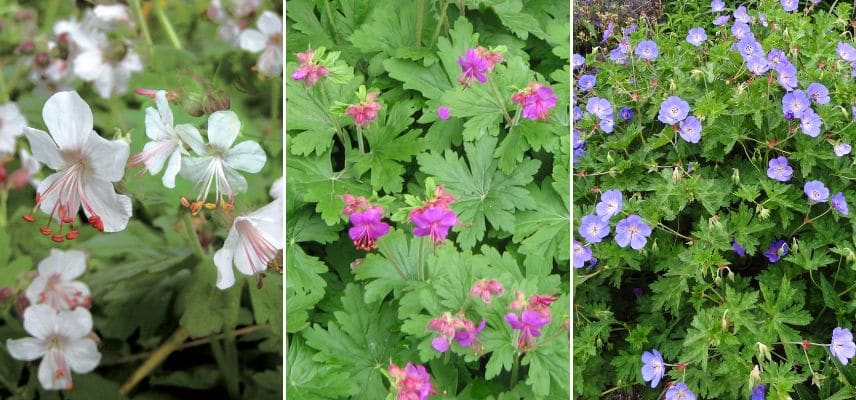
Hardy geranium macrorrhizum ‘Spessart’, ‘Bevan’s Variety’ and the Geranium ‘Rozanne’
- Subscribe!
- Contents
Comments