






























Protection of standard and weeping roses in winter
Why, when, and how to protect them from severe cold?
Contents
Winter protection for roses, which are generally hardy bushes down to -20°C, is unnecessary for many varieties and in numerous regions. However, for standard and weeping forms, it’s a different story, as the graft located high on the stem is highly exposed to winds and frost. Therefore, specific winter protection is required, along with some additional maintenance care to help them withstand the cold of winter. This type of rose is indeed more vulnerable to late frosts.
Discover our tips to best prepare your standard and weeping roses to face winter!

Your standard or weeping roses grown on a single stem are more sensitive to the cold: protect them to ensure they have great vigour all summer (Photo: S. Nilsson)

When?
It all depends on your region, the current climatic conditions, and the age of your rose bush! However, it is generally estimated that November, the planting season for roses, is also a good time to protect your standard and weeping roses, when frosts set in.
Start by lightly pruning the crown of your standard roses, and shorten the long branches of your weeping roses by about twenty centimetres: this will help you better cover them with fleece.
There are two main approaches to pruning roses: a single pruning at the end of winter, and a two-step pruning, one in November and another in February-March. For standard and weeping roses, a single pruning at the end of winter is preferred. Pruning recent plants too short can indeed risk weakening them by exposing them to the cold.
Read also
Pruning rosesProtection of the graft point
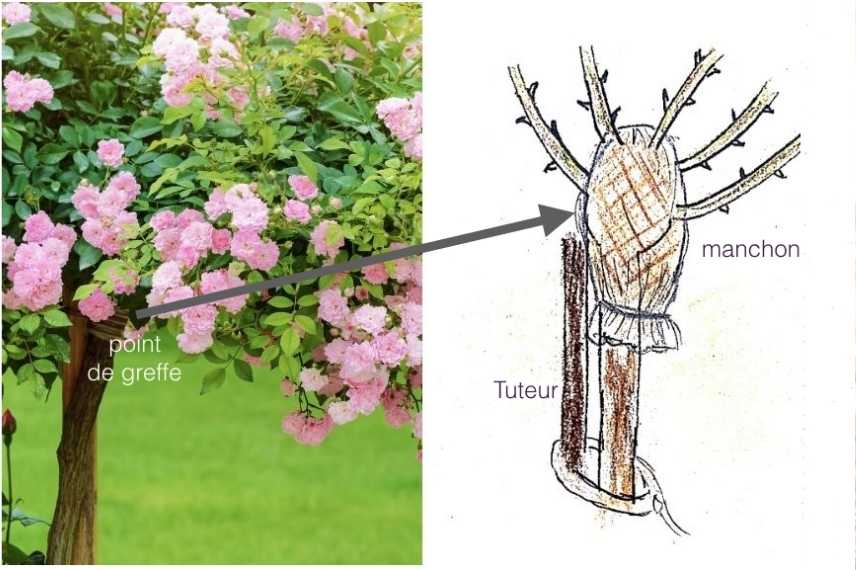
Several actions can effectively protect a standard or weeping rose in winter. The most important is the protection of the graft point, a sensitive swelling resulting from the junction between the rootstock and the scion: as it is located at least 80 cm high, it is particularly exposed to the cold winds of winter, as well as to frost. This graft point will always need monitoring for standard or weeping roses, as it is an entry point for diseases, potential injuries, and especially… the cold!
You must therefore take special care to protect this easily identifiable scar tissue a few centimetres below the bouquet of branches, whether they are planted in the ground or in pots. Surround the graft point with a warm sleeve that you can make from various easily obtainable materials.
- Prepare your sleeve using pieces of fabric (cotton, wool, synthetic, hessian, it doesn’t matter) to create a long strip about 10 cm wide, sufficient to cover the entire graft point and wrap it several times. Your sleeve should be placed at the base of the branches to adequately cover the swelling.
- Position it around the graft, and start wrapping it while stuffing it with thick but airy material such as wadding, or plant materials like dry moss, very dry leaves, or straw.
- Secure it with string or raffia, without compressing, to hold the sleeve in place.
- You will remove this protective sleeve when temperatures begin to rise and your standard or weeping roses no longer have to fear morning frosts, around April.
Discover other Tree Roses - Stem Roses
View all →
Available in 2 sizes

Available in 4 sizes

Available in 2 sizes
Available in 2 sizes

Available in 1 sizes

Available in 2 sizes

Available in 3 sizes

Available in 2 sizes

Available in 2 sizes

Available in 2 sizes
Crown protection
You will need to protect the crown of your standard or weeping rose during the first few years of planting, or if you are growing it in a pot, by wrapping it in a fleece. Beforehand, you should lightly prune the branches of your ball or dome of roses to make the task easier.
The non-woven fleece is a breathable material that specifically acts against the cold, insulating the rose while allowing light and rain to pass through, thus preventing any drying out. A fleece with a density of 30g/m2 is sufficient for your standard and weeping roses. You can reuse it for several winters in a row. Ajute winter cover, with a loose weave, is also perfect for enveloping your standard rose balls and domes, and is perhaps a bit more aesthetically pleasing.
You will secure this fleece with raffia or string ties, encompassing the protective sleeve you will have previously installed. The fleece should be removed as soon as temperatures rise, without waiting too long. March is generally mild enough in most regions to uncover your rose. Don’t hesitate to slightly open the fleece on sunny winter days!
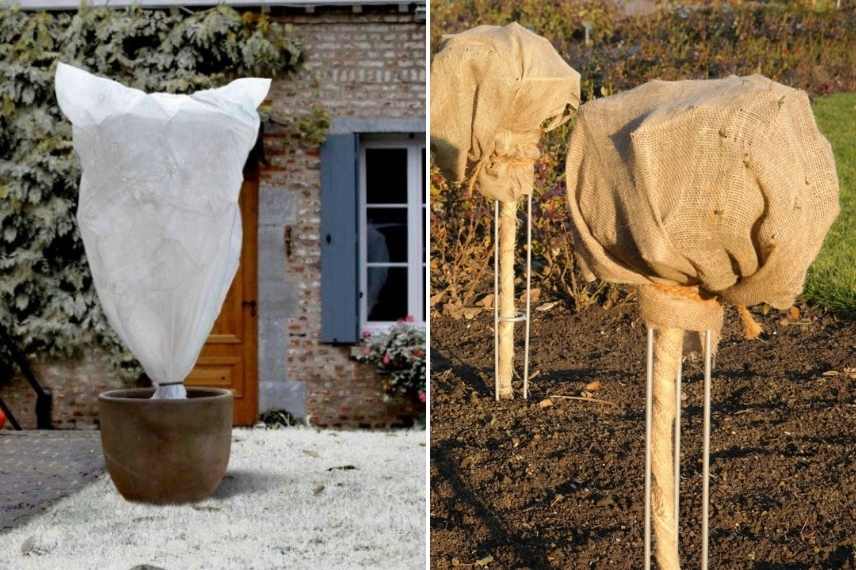
Complete protection with fleece (left), and just the crown with jute fabric (right)
Read also
When and how to prune bush roses?Hilling up
If you live in a region with a harsh climate, or if you have just planted your standard or weeping rose in the ground, do not hesitate to provide it with double protection by hilling up around its base. This operation, which involves covering the lower part of the rose stem with several centimetres of soil, significantly protects it, not by covering the grafting point at the bottom as one might do with “classic” roses, but by:
– providing additional support at its base during the first few years, making it less susceptible to strong winds,
– the mound of soil formed creates a sort of thermal bell that is quite significant in mountainous regions, allowing for a gain of 1 or 2 degrees during severe cold spells.
One important recommendation: use dry garden soil to avoid any risk of rot.
Remember to remove this small mound of soil in March, as soon as your roses no longer need it.
Protecting Your Potted Roses
The previous recommendations regarding the protection of the grafting point and the crown also apply to your standard and weeping roses when planted in containers or pots. Proceed in the same way as for your standard or weeping roses planted in the ground.
Your pot has a distinct advantage: it is mobile! This means that if your pot is located in an area that is a bit too exposed to the winds (especially the very cold east winds in winter), do not hesitate to move it to shelter it as much as possible from the wind: bring it closer to the house, or under a canopy, and insulate the pot from the cold ground by placing it on blocks or on a wooden wheeled stand. A small wooden pallet, although less aesthetic, can work perfectly if you have two pots to elevate, for example.
For pot planting, protecting the substrate is important: the standard or weeping rose has a limited volume of soil, which acts as a frost barrier. It will be difficult to mound the base in any container. Therefore, if your rose has just been planted or if you live in a region with harsh winters, mulching at the base is beneficial: use straw or well-dried leaves, which you will place all around the stem.
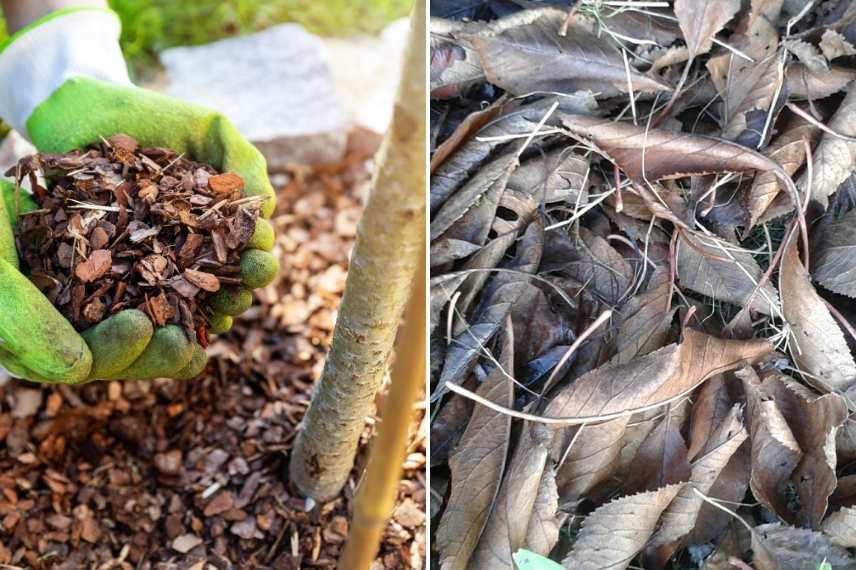
Mulch around the stem with plant debris, well-dried leaves, or straw
- Subscribe!
- Contents

Comments