


How to pair yellow flowers in the garden?
Our tips for yellow pairing with plants
Contents
The pairing of yellow flowers in a garden raises interesting points, because, while this colour may seem a little plain given how common it is in nature, when thought through carefully and not left to chance, it enables very interesting, vibrant or soft, uplifting combinations. Yellow flowers bring a touch of warmth and brightness, reminiscent of the sun. To succeed in pairing them, it is essential to understand which other colours and plant types they harmonise best with. This helps create interesting contrasts or soft gradients that catch the eye and enhance your borders. By choosing the right combinations, you can achieve a vibrant yellow garden that awakens the senses and highlights the natural beauty of your garden.

Yellow in the garden
In a garden or border, yellow attracts and stimulates with its brilliance.
- In full sun at noon, it’s a far better choice than white, which struggles to withstand the sun’s glare.
- As the day ends and its light becomes softer and warmer, golden too, it takes on a golden hue. It is in harmony with the sun and echoes its hues.
- In spring, when the garden is still in its flowering phase, it blooms in acid tones, from soft yellow to chartreuse. In summer it gleams with bright yellow, and autumn sees many flowers bloom in very warm hues, in ochre yellow, dark yellow and golden yellow.
- Yellow is a primary colour whose opposite on the colour wheel is violet.
- It wears cool or warm hues like other colours. In its most delicate shades, cream yellow, canary yellow, vanilla yellow, it brings a lot of softness.
Yellow is widely represented across many plant species, no doubt because it attracts numerous pollinators. It is a colour that some gardeners dislike. It all comes down to nuances and light exposure.
The must-have yellow flowers
- Let’s begin with the early-spring stars: the spurges and their large cymes of flowers in yellow-green, acid yellow or chartreuse yellow.
- However, that isn’t the first yellow that comes to mind. When you combine the words “flower” and “yellow”, you’re probably thinking of the golden yellow of the sunflower. In this bright shade, you’ll also find among perennials and bulbs: the crocus, some narcissi, rudbeckias, echinaceas, hemerocallis, solidagos, achilleas, kniphofias, and the oenotheras. For many of these flowers, there are varieties with softer, more acidic or more ochre tones.
- The yellow of the verbascums or mulleins is a shade lower and cooler, while Sysirinchium striatum is even softened, with a somewhat shy yellow, a little warmer at the heart.
- For the softest yellows: think of wild primroses, the Primula vulgaris, and some narcissi with vanilla-yellow such as the Narcissus ‘Yellow Cheerfulness’.
But all of this is only a glimpse of the vast palette of yellow-coloured flowers.
- Among yellow-flowering shrubs, famous examples come to mind: forsythia, naturally the Mimosa, Cornus mas, St. John’s wort, broom, the botanical azaleas such as the Rhododendron luteum, Hamamelis and Mahonia for winter flowering, the list is almost as long as for perennials.
- Yellow-flowering climbers are well represented among certain roses, honeysuckles, the clematis originating from the Tangutica species, the tangutica, the Fremontodendron californicum, some jasmines such as Jasminum humile ‘Revolutum’ or winter jasmine Jasminum nudiflorum, among nasturtiums and the yellow-flowered Thunbergia for the annuals.
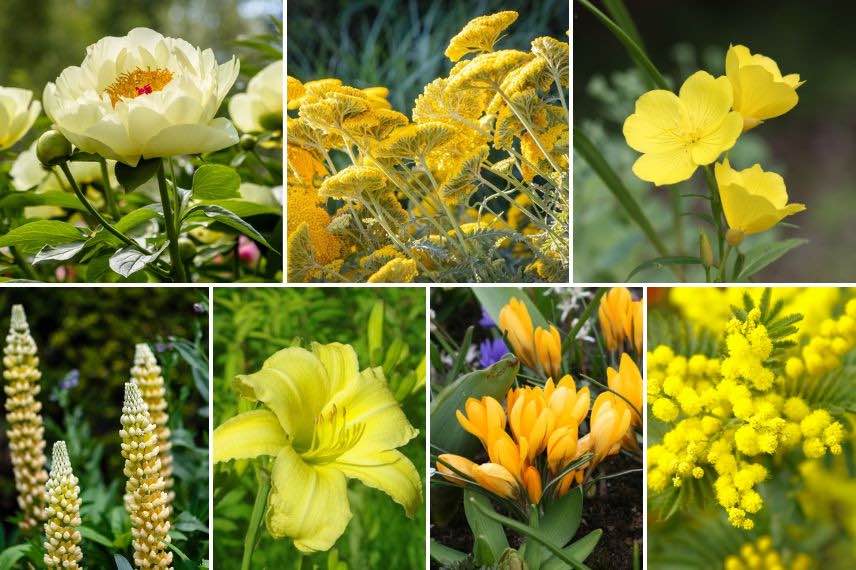
So many different yellows (clockwise) from Paeonia lactiflora ‘Lemon Chiffon’, Achillea filipendulina ‘Golden Plate’, Oenothera missouriensis, Mimosa, Crocus ‘Grand Jaune’, Hemerocallis citrina and Lupinus ‘Gallery Yellow’
Yellow flowers paired with flowers of other colours
When thinking about pairing a flower colour, you wonder which other flowers, of a different colour, it can be paired with. Don’t forget the importance of the foliage, which will be covered in the next chapter. And let’s start by pairing yellow flowers with other yellow flowers.
In a yellow monochrome
Let’s begin with monochrome pairings, in a yellow range, and varying the shapes of the flowers. You have plenty of choice; you’re unlikely to go wrong, and yet the result isn’t the one you’d expect. The green of the foliage ties the whole thing together.
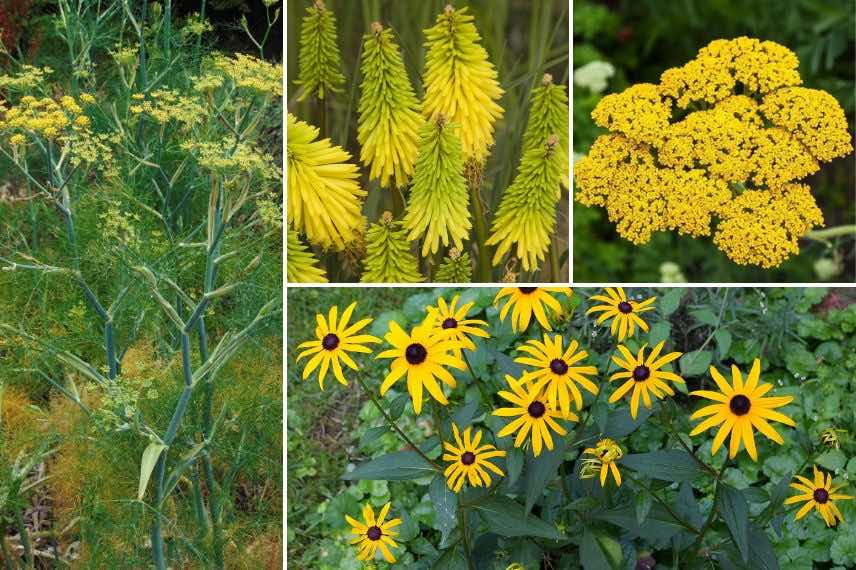
Kniphofia yellow-green, Golden yarrow, Rudbeckia with a dark centre are harmonised by the bluish-green foliage of Rudbeckia and fennel on the left.
With orange or red flowers
Increase the contrasts of a few tones with an association with orange and/or red flowers. There, keep a light hand and work the shades, avoid tones that are too bold to avoid an overdose. Think, for example, of dark red or burgundy tones paired with yellow flowers with lemon or chartreuse hues, which lean toward green. These yellow tones with a touch of green are also very effective with soft orange to coral orange flowers.
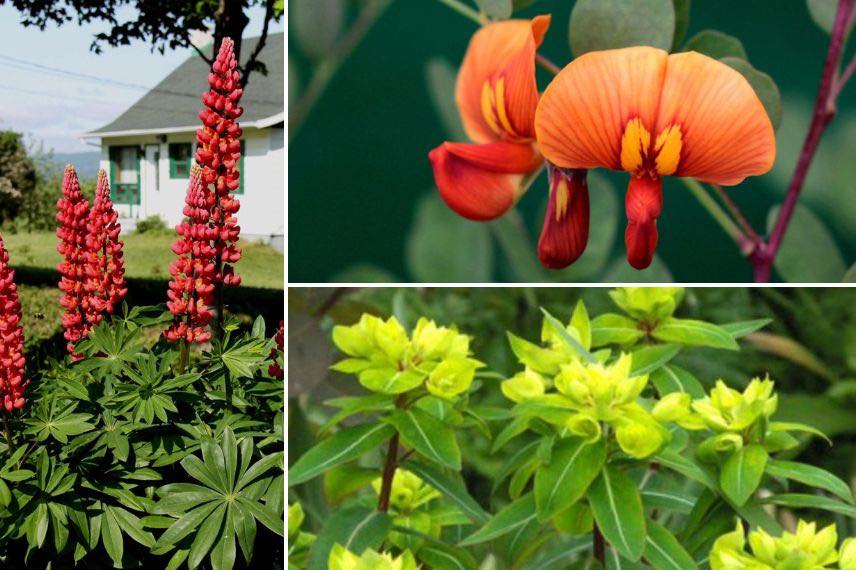
The intense acid yellow of Euphorbia pairs with the red of the lupin and the orange-red of Baguenaudier, because the red flowers chosen are of a fairly soft and dark hue.
With violet/purple flowers
We will not propose a pure yellow-and-blue contrast, which evokes Provencal kitchens of the 1970s or the beds of some roundabouts.
However, yellow and its complementary colour, purple, without overdoing it, dramatically wake the eye. The violet, cooler and softer, pleasantly complements the yellow nuances. By extension, yellow and blue-violet or blue-indigo are also interesting pairings. This is also the case with mauve shades paired with acid yellows.
With purple/pourpre flowers
Finally, yellow flowers pair well with purple-coloured flowers for an intense contrast, but tempered by the more muted nuance of purple.
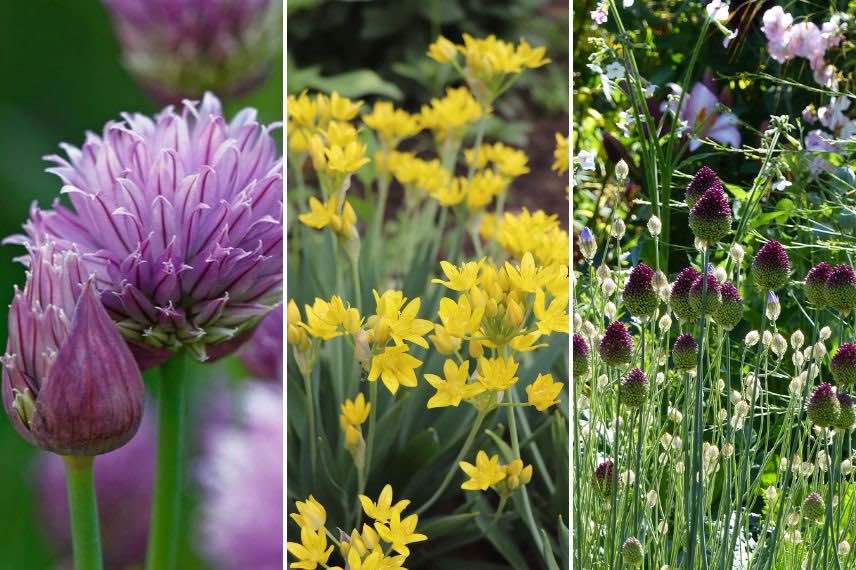
Three alliums to show their harmony in yellow, mauve and purple. Purple, complementary to yellow, also works very well and an acid yellow would also look superb
Yellow flowers paired with colourful foliage
Green foliage pairs very well with yellow flowers, but other combinations can be equally interesting. Once again, this also depends on the hues you choose.
With coppery foliage
In a warm harmony, yellow flowers are enhanced by coppery or bronze foliage, which intensify their presence while adding softness. We particularly have Carex in mind.
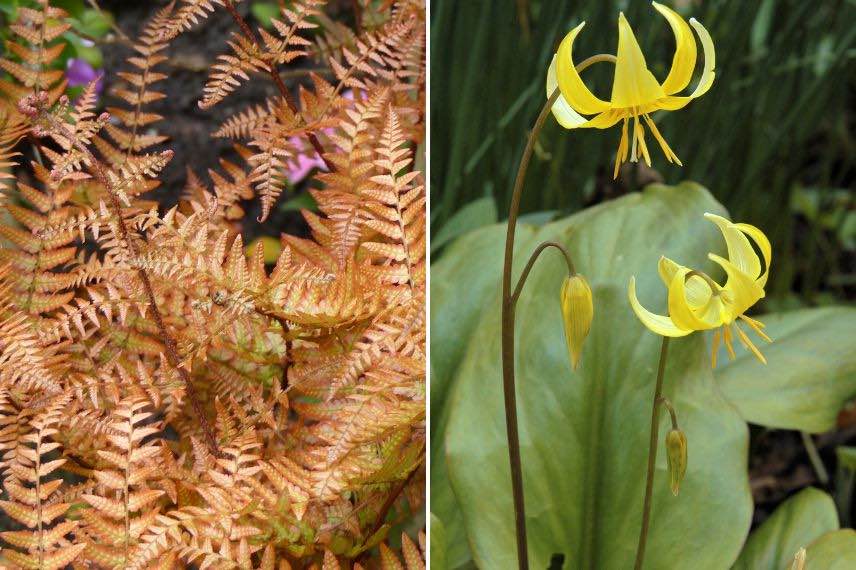
In the understorey, the coppery foliage of Dryopteris erythrosora accompanies the yellow flower of Erythronium pagoda and the soft bronze reflections of its foliage. The hint of mauve pink seen behind the fern would be welcome in this mix
With variegated foliage
Yellow flowers find a lovely echo in variegated yellow or cream foliage, but a light touch is required and apply in small doses to avoid cluttering the view with too much information.
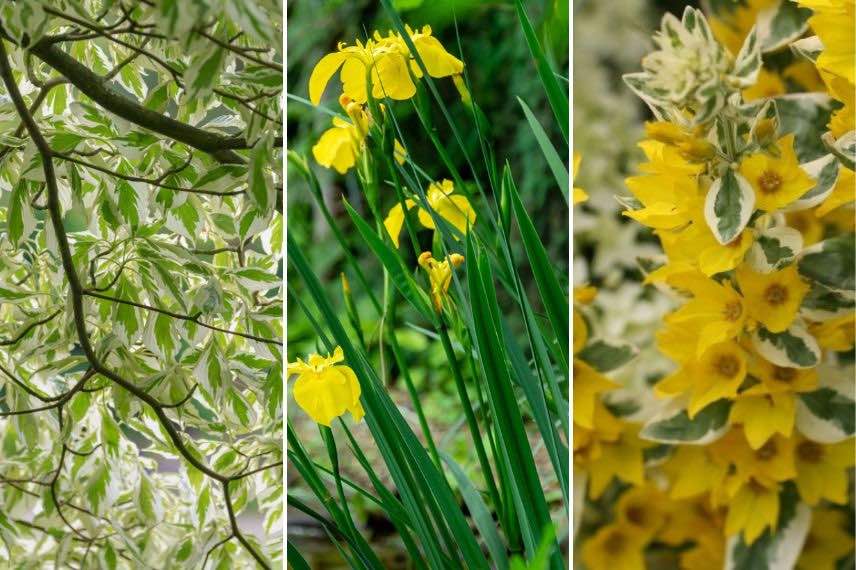
A Pagoda dogwood with green and white foliage could be in harmony not far from Lysimachia punctata ‘Alexander’, the quintessence of pairing variegated foliage with yellow flowers, but this duo should be tempered by plants with entirely green foliage such as marsh iris, hostas or ferns, for example
With grey or blue foliage
Finally, grey foliage gently enhances yellow and can help soften its brightness if it is deemed too strong, and to finish the foliage section, the cool, blue-tinged foliage of certain conifers, with a cool shade, pairs well with yellows, in a gentle way as well.
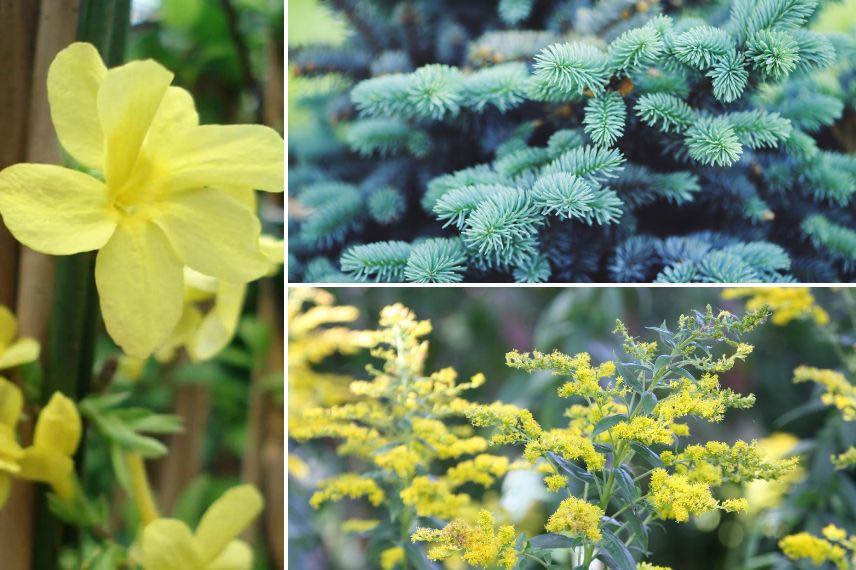
A blue-tinged conifer can easily stand alongside Jasminum nudiflorum in winter and Solidago in summer
Pairing yellow flowers with partial shade
If the article’s subject naturally evokes sun-loving borders, there are species with subtler yellow flowers that thrive in partial shade. Partial shade helps prevent their soft colour from being overwhelmed by too much light. For example, Epimediums, the Epimediums, the Lamium galeobdolon ‘Hermann’s Pride, or the Kirengeshoma palmata.
To these plants with soft yellow, pale yellow or vanilla-yellow hues, you can pair partial-shade companions and foliage with a few softly coloured flowers.
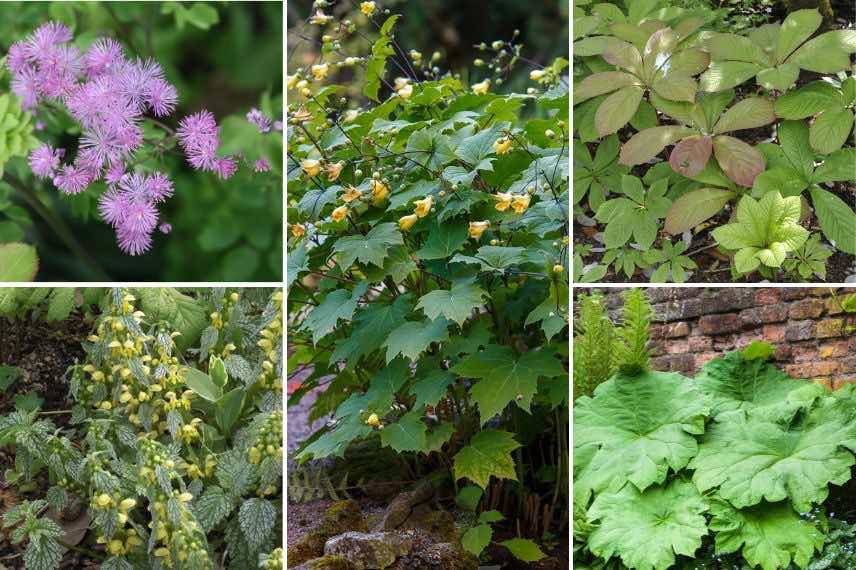
Imagine here that Lamium galeobdolon in the lower left carpets the ground, while a Thalictrum with purple flowers rises in the middle, complemented by the foliage of Rodgersia and Astilboides tabularis
Pairing yellow flowers along riverbanks in moist soil
Yellow-flowered plants are very common in damp habitats, along riverbanks or simply in cool, moist soil. Think of Inula magnifica, the Ligularias, the Lysimachias, Iris pseudacorus, or the avens and Caltha palustris for the smaller ones.
Pair these tall, luxuriant plants with other lush, colourful foliage of vigorous riverbank plants and a variety of flowering forms.
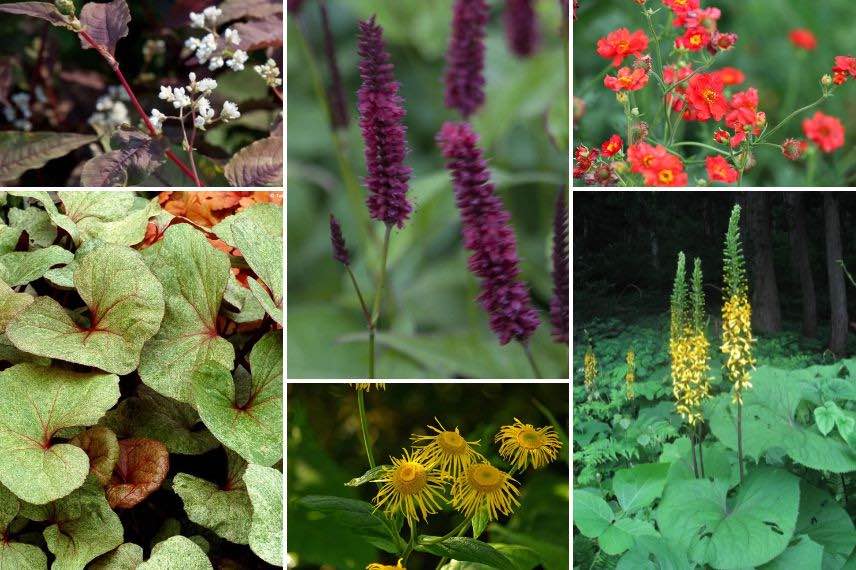
Ligularia stenocephala at the bottom right and Inula magnifica beside it are accompanied by an avens ‘Scarlet Tempest’ with red flowers, Persicaria amplexicaulis ‘Blackfield’ with burgundy-purple spikes, and the handsome, mottled foliage of Ligularia dentata ‘Garden Confetti’ and purple foliage of Persicaria ‘Red Dragon’
Yellow flowers in a Mediterranean garden
In a Mediterranean garden, you also find many species with yellow flowers. Think of the flowering of immortelle or Helichrysum italicum, Helichrysum italicum, Santolina, des yarrow, but also Sedums or Delospermas. They are paired with plants with grey foliage, the indigo-blue of Sages or the violet of lavenders, the deep blue of Agapanthus, the steel-blue of Eryngiums or the mauve-blue of rosemary.
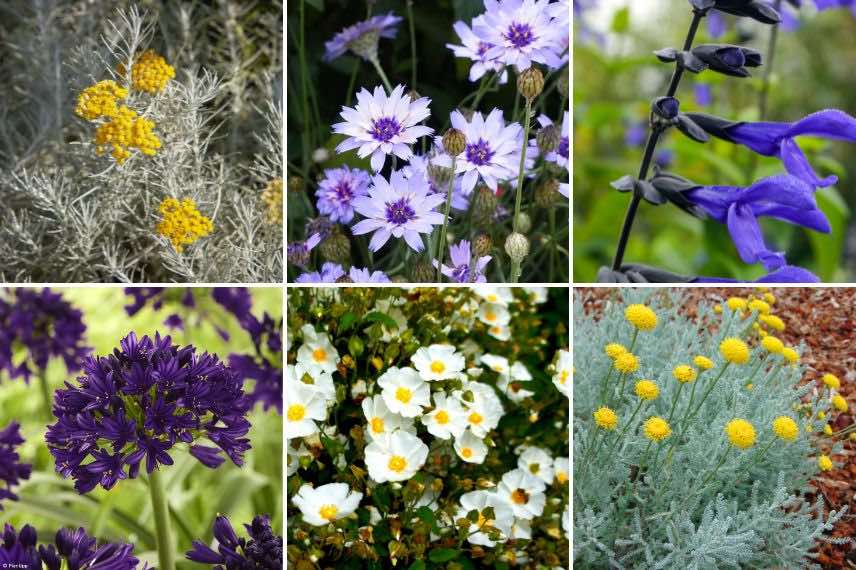
Helichrysum italicum and Santolina meet the blue of Catananche, the indigo of Salvia guaranitica and the violet of Agapanthus ‘Black Magic’, tempered by a white rockrose.
- Subscribe!
- Contents
Comments