





























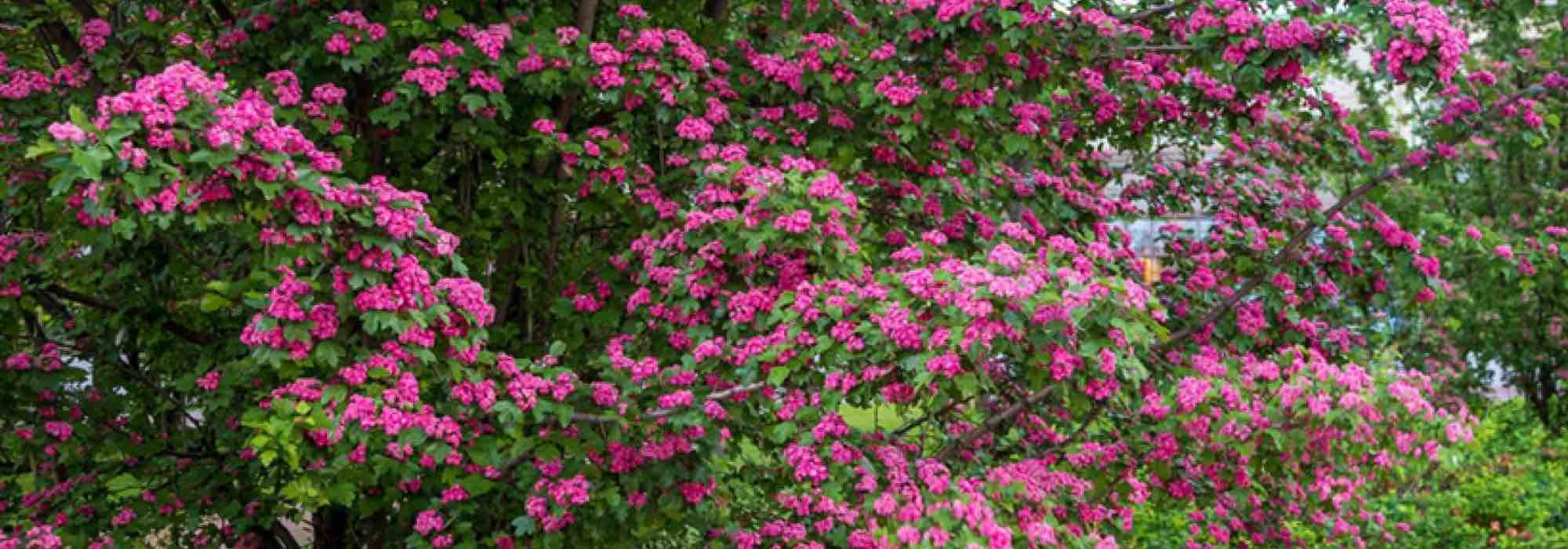
Choosing the right hawthorn for your garden?
Our selection and advice
Contents
Hawthorn offers spectacular flowering, elegant foliage and decorative fruits, it’s a real treasure for the garden. Hardy, versatile and easy to grow, it adapts to many styles and uses: a defensive hedge, a solitary tree or a key element of a natural garden. But faced with the diversity of species and varieties, choosing can be difficult. Pruning, habit, foliage, flowers, fruits or the presence of thorns, each criterion matters in finding the ideal hawthorn. In this article, discover our hawthorn selection and tips, so that you find the one that best meets your needs, while showcasing your garden.

According to its mature size
The most widespread hawthorn species are the largest, the Aubépine monogyne (Crataegus monogyna) and the Aubépine lisse ou à un style (Crataegus laevigata) are long-lived shrubs, which can reach between 5 and 10 m in height at maturity, with a spread of 4 to 8 m. The Cockspur hawthorn (Cockspur hawthorn (Crataegus crus-galli), commonly known as Virginia hawthorn, can reach up to 8 metres in height with a 5 m spread.
Some hawthorns remain very small, forming shrubs or small trees suitable for small gardens, 2–3 m tall at maturity and 1–2 m wide, such as Crataegus x media ‘Tortuosa Charlier’, Crataegus monogyna‘Compacta’, Crataegomespilus dardarii ‘Jules d’Asnières’ or Crataegus monogyna‘Versicolor’.
Medium-sized hawthorns typically reach 4–6 metres in height with a corresponding spread. This is the case for Crataegus laevigata ‘Paul’s Scarlet’, which measures 6 m in all directions.
Think long-term: hawthorns can live for several decades. Planting a variety too large for a confined space can cause problems as they mature.
Note that some specimens of the most common species show remarkable longevity, such as the Crataegus laevigata at Bouquetot in Eure, a notable tree planted around 1360.
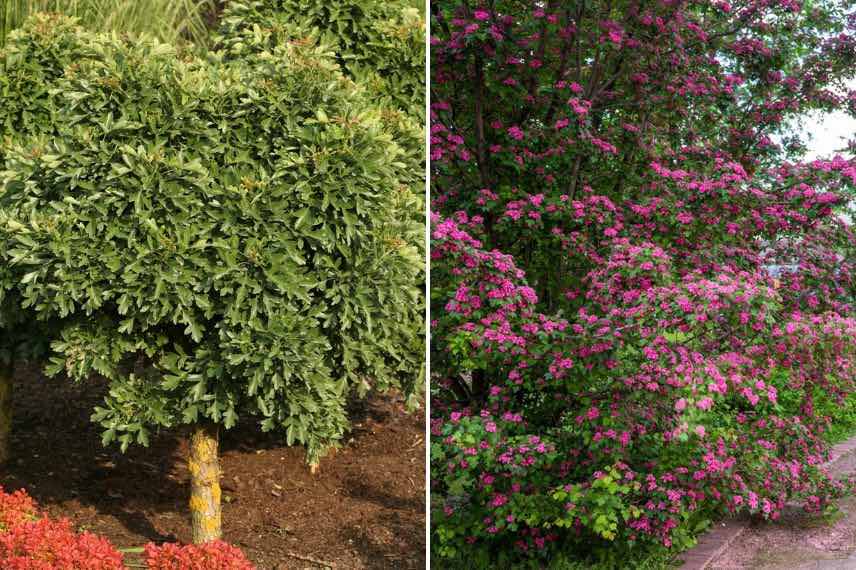
The small Crataegus monogyna ‘Compacta’ and the Crataegus ‘Rosea Flore Pleno’ of medium size
According to its habit
Hawthorns generally have a spreading habit, with branches that extend widely to form a rounded or almost flat crown. This type of habit lends a certain presence and a sense of maturity to the garden.
The Crataegus monogyna‘Stricta’ has a columnar habit, characterised by vertical growth with tight branches that stay close to the trunk. This type of habit is particularly interesting for gardens where width is limited, but height is desired. The columnar hawthorn is ideal for creating elegant alignments along a path, bordering an entrance, or structuring a garden with a modern and graphic touch. As it grows, it forms a slender silhouette that reaches about 10 metres in height, while remaining relatively narrow, with a spreading habit of only 3 metres. This habit is particularly appreciated in formal or contemporary gardens, where it can play a strong structural role, while offering the hawthorn’s classic virtues: abundant flowering in spring and decorative fruits in autumn.
The Crataegus monogyna ‘Flexuosa’, for its part, stands out for a very compact habit and twisted, interwoven branches, giving the impression of a shrub with restricted growth. Its twisted and interwoven shoots give it a unique silhouette. It is particularly valued for its graphic presence in winter, when its naked branches reveal their contorted shapes.
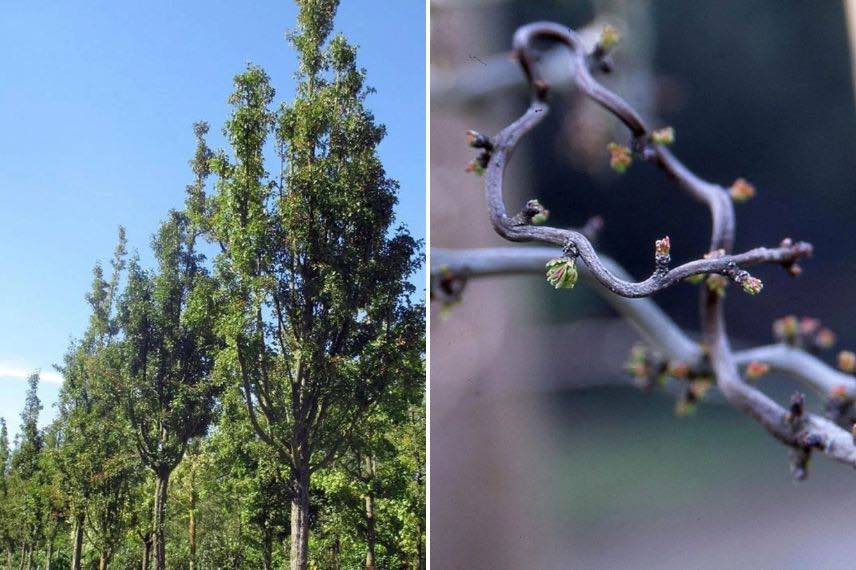
The cultivar ‘Stricta’ with a columnar habit and the twisted branches of ‘Flexuosa’
According to its foliage
Hawthorn leaves are generally green, deeply lobed, and measure between 2 and 6 cm in length. They are arranged alternately along the twigs and often have a slightly glossy surface. The shape of their lobes gives the foliage an elegant appearance, imparting a sense of lightness to the garden.
Depending on the species and variety, the shape or texture of the foliage may vary slightly. For example, some hawthorns have smaller leaves or more finely cut leaves. In autumn, the leaves of many species take on golden or bronze hues, for example Crataegus crus-galli, which also develops entire leaves.
A pleasant surprise, some hawthorn varieties develop variegated foliage. Among them, Crataegus monogyna Crataegus monogyna ‘Variegata’ se distingue par un feuillage vert rehaussé de panachures et bordures blanc crème, pour un effet lumineux et décoratif.
Crataegus chlorosarca ‘Variegata‘ features foliage speckled with yellow, contrasting with its dark branches and small white spring flowers.
Finally, Crataegus x media ‘Gireoudii’‘ puts on a particularly attractive show in spring. Its young leaves and shoots emerge with a blend of pink and white variegation, which then contrasts with the mature green foliage. This play of colors creates a striking effect early in the season.
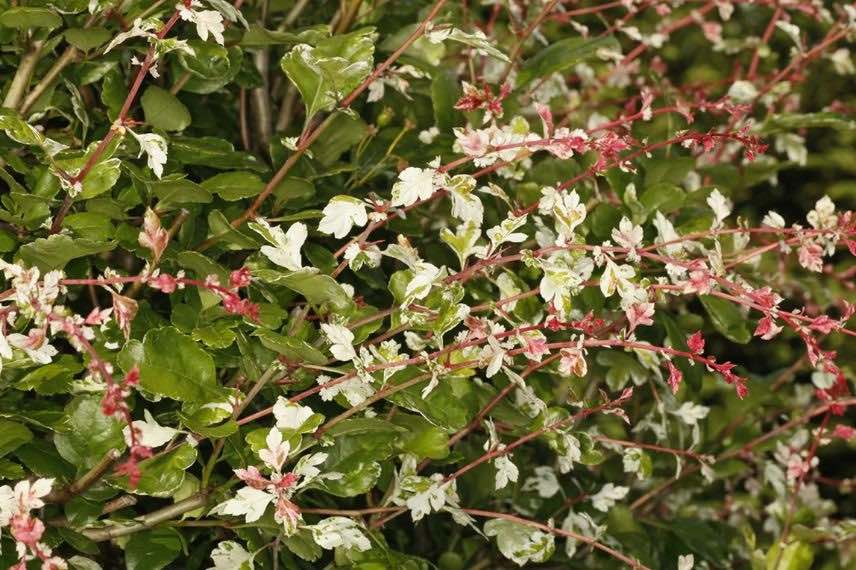
Crataegus x media ‘Gireoudii’
Read also
How to pair Hawthorns?A hawthorn with or without thorns
One of hawthorn’s best-known characteristics is the presence of long, sharp thorns that cover its branches, providing natural protection against intrusions. These thorns make hawthorns ideal for defensive hedges, but they can also pose problems in certain settings, particularly for gardens frequented by children or in spaces where one wishes to avoid the risk of injuries.
Crataegus grignonensis is a remarkable thornless species, arising from a natural cross-breeding observed at Grignon Park, France.
Let’s mention also Crataegus monogyna ‘Compacta’. This hawthorn is not only compact, reaching barely 2 to 3 metres in height, but it is also thornless. Its dense, rounded habit makes it ideal for small gardens or confined spaces where one would like to include a hawthorn without risking injuring passers-by or pets.
According to the colour and shape of its flowers
Flowering is undoubtedly the hawthorn’s most spectacular moment. In spring, the tree or shrub is covered with a multitude of small, delicate flowers grouped in corymbs, creating a true floral cloud that attracts pollinators. The flowers, usually single and with five petals, resemble those of the Rosaceae family to which hawthorn belongs.
Wild hawthorn, such as Crataegus monogyna, bears white flowers. This flowering is often lightly scented, bringing a gentle fragrance to the garden. But many ornamental varieties have been selected to offer pink or red flowers.
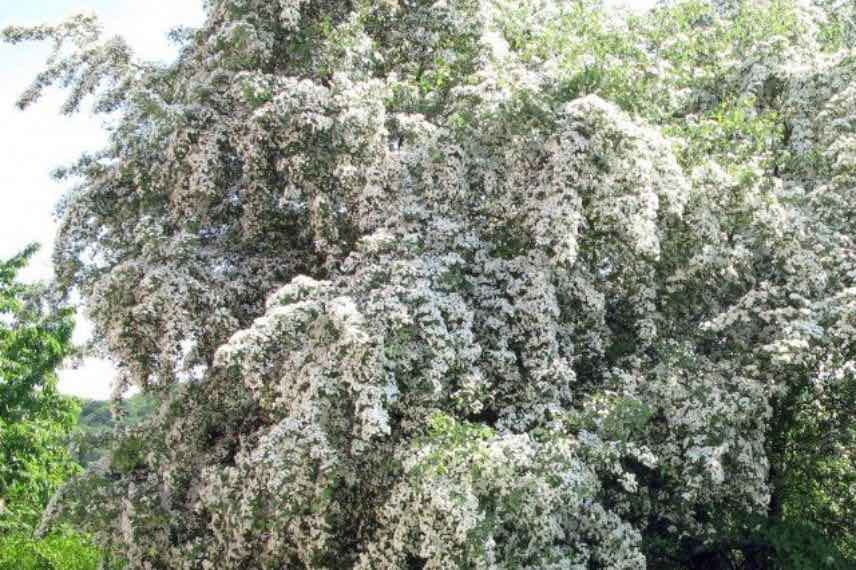
The exuberant white flowering of Crataegus monogyna
The Crataegus laevigata‘Paul’s Scarlet’ offers double flowers ranging from dark pink to blood red. This variety, with its striking visual impact, contrasts beautifully with the glossy green foliage. ‘Rosea Flore Pleno’ is adorned with double flowers in a fairly strong medium pink, creating a romantic and elegant ambience.
As for Crataegus laevigata ‘Princess Sturdza’, it bears beautiful single, bi-coloured flowers, pink with white centres.
The choice of flowers, whether by colour or by shape, allows hawthorn to suit different garden styles. A white-flowered variety will bring a classic, natural touch, while a hawthorn with red or pink flowers will be perfectly suited to a garden that favours colour accents or romantic touches. By opting for double flowers, one will achieve a more polished and ornamental look.
→ Also read:
- Our must-have white-flowering hawthorns for the garden.
- Discover pink- and red-flowering hawthorns
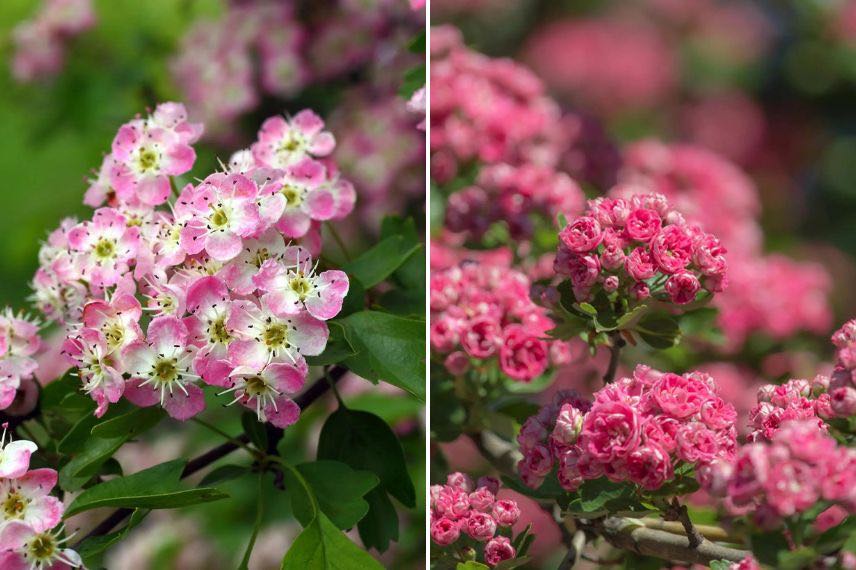
Crataegus ‘Princess Sturdza’ and ‘Rosea Flore Pleno’
For its fruits
After flowering, hawthorn reveals another facet of its charm: its fruits, known as hawthorn berries. These small round or oval fruits, often red but sometimes yellow or orange depending on the species, or red and then black, appear in late summer and provide lasting ornamental interest into autumn, even winter.
The red fruits are the most common, notably on Crataegus monogyna and the Crataegus laevigata.
Their bright hue creates a striking contrast with the foliage, especially in autumn when the leaves take on golden or bronze tones.
These persistant fruits remain attached to the branches long after the leaves have fallen, during the colder months.
Some hawthorns, such as Crataegus pinnatifida ‘Big Ball’ and the Crataegus mexicana, are prized for their large fruits, used in cooking.
The Crataegus azarolus, a typically Mediterranean species, produces fruits called azeroles, also eaten in compotes.
Yellow or orange fruits are less common, but just as decorative, they are found on Crataegus monogyna ‘Xanthocarpa’.
Beyond their aesthetic appeal, hawthorn fruits are a valuable resource for wildlife. Rich in sugars and nutrients, they provide a preferred food for many birds such as blackbirds, thrushes and starlings, as well as for some small mammals in winter.
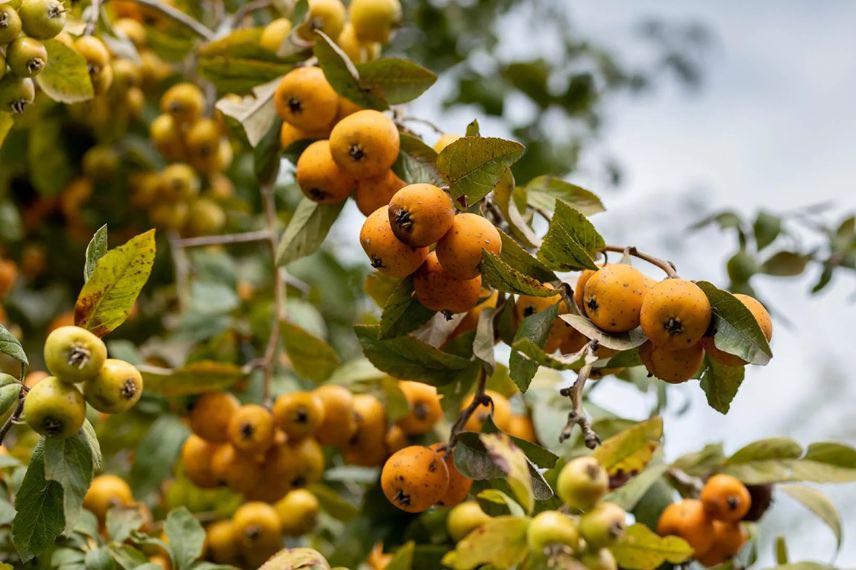
The manzanillas of Crataegus mexicana
Depending on its use
Hawthorn is a versatile plant that fits into many contexts, thanks to its aesthetic appeal and ecological benefits.
- As a specimen : a hawthorn with a majestic habit, such as Crataegus laevigata ‘Paul’s Scarlet’ with its double red flowers, becomes an ideal focal point in a large garden. Compact varieties such as Crataegus monogyna‘Tortuosa Charlier’ are suitable for small spaces and pots, offering attractive flowering and fruiting without crowding.
- In a border : likewise, for a border, favour numerous compact-growing varieties.
- In a hedge : the thorny hawthorns, such as Crataegus monogyna or Crataegus crus-galli, are perfect for forming dense, impenetrable defensive hedges, but also cottage-style hedges.
- In an eco-friendly garden : hawthorns such as Crataegus laevigata or Crataegus grignonensis (thornless) attract pollinators and birds, promoting biodiversity. They fit perfectly into cottage-style or wild gardens.
- In an ornamental garden : varieties with variegated foliage, such as Crataegus monogyna‘Variegata’, or with spectacular flowering, such as Crataegus laevigata‘Rosea Flore Pleno’, bring a sophisticated and luminous touch to a border.
- Subscribe!
- Contents

Comments