


Pairing ideas with Phalaris
6 successful pairing ideas
Contents
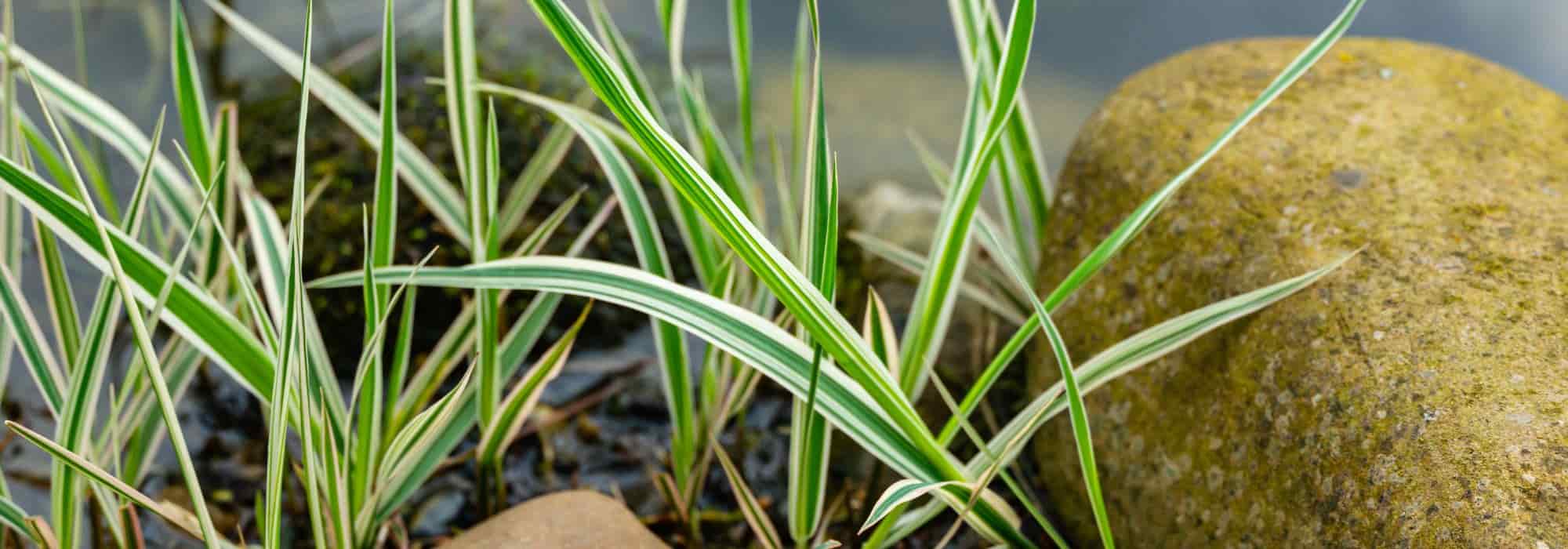
Phalaris is a vigorous grass, adding volume, verticality, and light to the garden, thanks to its green or variegated foliage. Moreover, with its easy cultivation and rapid growth, it quickly forms a dense groundcover, thanks to its running rootstock. It is also known as ‘Shepherd’s Ribbon’, ‘Alpiste’, or ‘false reed’. This hardy perennial is low-maintenance and tolerates all fresh to moist soils, but it can also withstand drought. Phalaris is useful for stabilising a slope or the banks of a water feature, as well as in a grass border, under the shade of trees, and even in pots.
Discover 6 ideas for pairing Phalaris.

On the banks of a pond
Phalaris is a plant renowned for its usefulness in stabilising the banks and slopes bordering a pond. Its natural grass-like appearance will fit seamlessly at the water’s edge, even slightly submerged. To accompany it, it can be paired with other perennials that enjoy moist soils, with a natural, slightly wild silhouette. One might consider meadowsweet for its beautiful feathery flowering and its height that will rival that of Phalaris. In the same vein, a loosestrife can be planted for its long pink-mauve flower spikes that bloom in summer.
Other equally elegant grasses can be planted, such as Acorus calamus ‘Variegatus’ for its beautiful bright green foliage, striped with cream-white. A Miscanthus sinensis ‘Purpurascens’ will provide a fluffy silver flowering at the end of summer, and its green foliage will take on reddish-orange hues as autumn temperatures set in.
On the flowering perennial side, you might choose a marsh marigold‘Polypetala’ with its golden yellow spring flowering, a Kaffir lily, a yellow flag iris, or a white arum for its unique conical flowering.
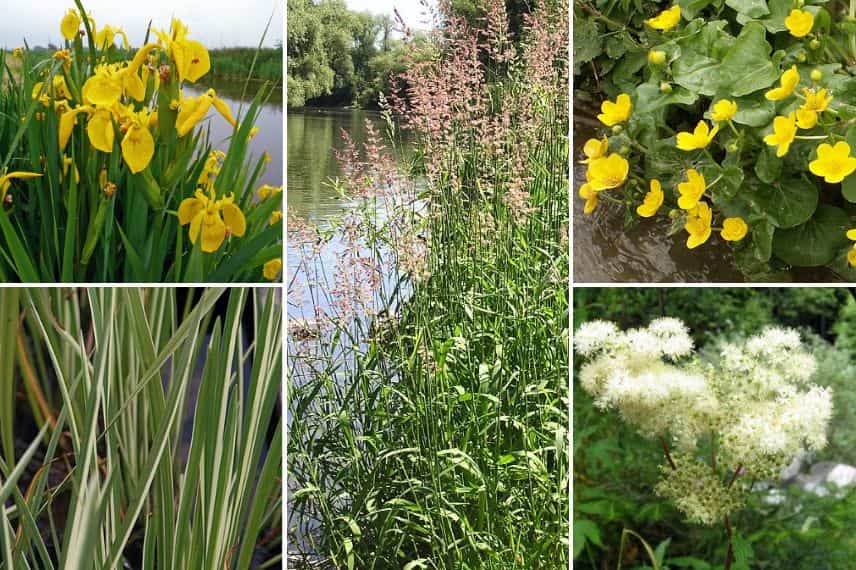
Yellow flag iris, Acorus calamus ‘Variegatus’, Phalaris arundinacea, marsh marigold ‘Polypetala’ and Filipendula ulmaria
Read also
Grasses: which variety to choose?Under the shade of the trees
Easy to grow, Phalaris thrives in partial shade under trees and is not afraid of root competition. To add brightness, we recommend Phalaris arundinacea ‘Picta’ for its green leaves edged in cream white. It will create a lovely, vigorous, and effective groundcover. It can be paired with other perennials that enjoy the same growing conditions: a semi-shaded exposure, root competition with surrounding trees, and likely dry soil in summer.
The large-flowered comfrey (Symphytum grandiforum) meets all these criteria and forms a carpet of white flowers with sky-blue tips. Similarly, Geraniums macrorrhizum will create dense cushions with evergreen foliage and delicate flowers. Add an Acanthus mollis for its large sculptural leaves and spectacular flower spikes.
Finish off with a few Corsican hellebores and Japanese anemones to extend the flowering period. You can also install a Carex morrowii ‘Aureovariegata’ whose variegated foliage will resemble that of Phalaris in miniature.
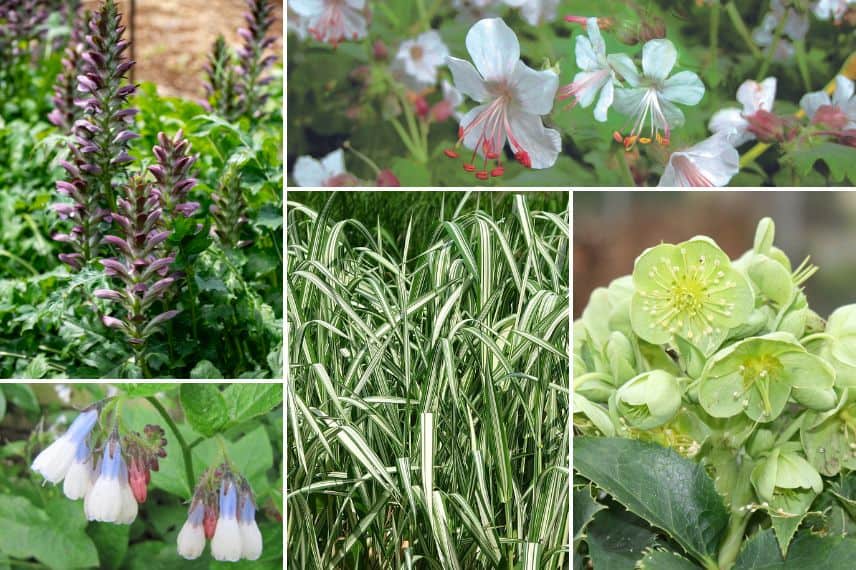
Acanthus mollis, large-flowered comfrey (Symphytum grandiforum), hardy geranium macrorrhizum ‘Spessart’, Phalaris arundinacea ‘Picta’, and Corsican hellebore
In a natural garden
With their natural grass-like silhouette, Phalaris will find their place in a country or naturalistic garden. Easy to grow, they will thrive in all types of soil. They can be paired with other lush grasses, such as a Pennisetum for its fluffy spikes or a Miscanthus for its tousled shape.
Plant a few perennials with a country-style flowering, such as Anthemis, Achilleas, and an Echinacea for its daisy-like appearance. A knotweed will provide a long flowering period with colourful spikes. Add a touch of lightness with the airy flowers of a Gaura. Similarly, a Buenos Aires Verbena will offer a cloud-like flowering with its violet panicles, all while being light and airy. If you prefer lavender blue, a Perovskia will charm you with its upright habit. At the back of the border, plant an Eupatorium maculatum ‘Atropurpureum’ for its large, intensely purple flowered umbels. Extend the flowering season into late autumn by installing an Autumn Aster and Japanese Anemones.
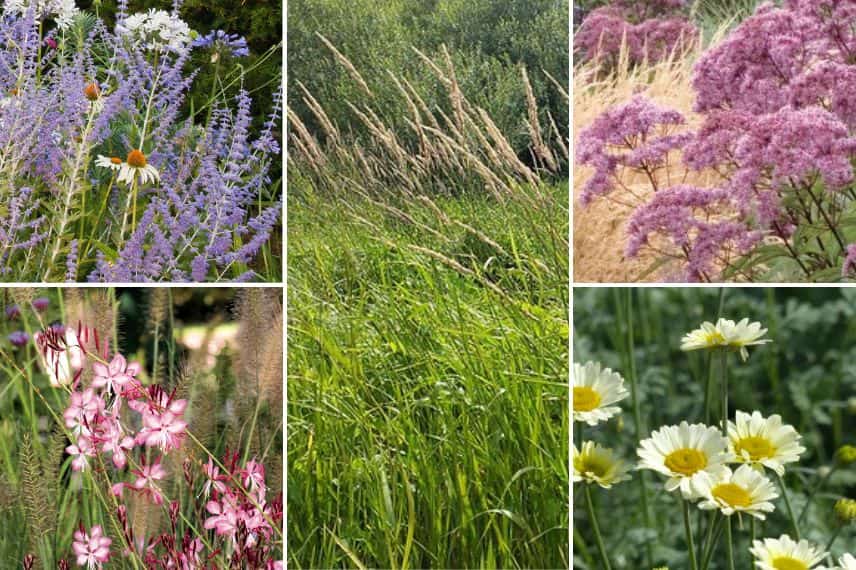
Perovskia and Anthemis, Gaura and Pennisetum, Phalaris, Eupatorium maculatum ‘Atropurpureum’ and Anthemis
Read also
7 grasses for wet soilIn a pot on the terrace
With its ribbon-like leaves resembling those of the reed, Phalaris is easily grown in pots or containers on the terrace. Moreover, this pot culture helps to limit its vigorous spread through its running rhizomes. Among the varieties, Phalaris arundinacea ‘Picta’ will bring brightness to a terrace with its broad green leaves striped with white.
Nearby, you can place other plants with equally exotic appearances, such as Cordyline or a Phormium. A Pennisetum setaceum ‘Rubrum’ will stand out with its beautiful warm hue, ranging from purple-red to chocolate.
If you enjoy the abundant flowering of annuals and biennials, place pots or hanging baskets nearby containing petunias, begonias, or cannas for their exotic flowers. Among the perennials, the flowering balls of Agapanthus or the exoticism of Alstroemerias will be appreciated. For a rustic terrace, Verbena bonariensis ‘Lollipop’ is preferred for its natural appearance.
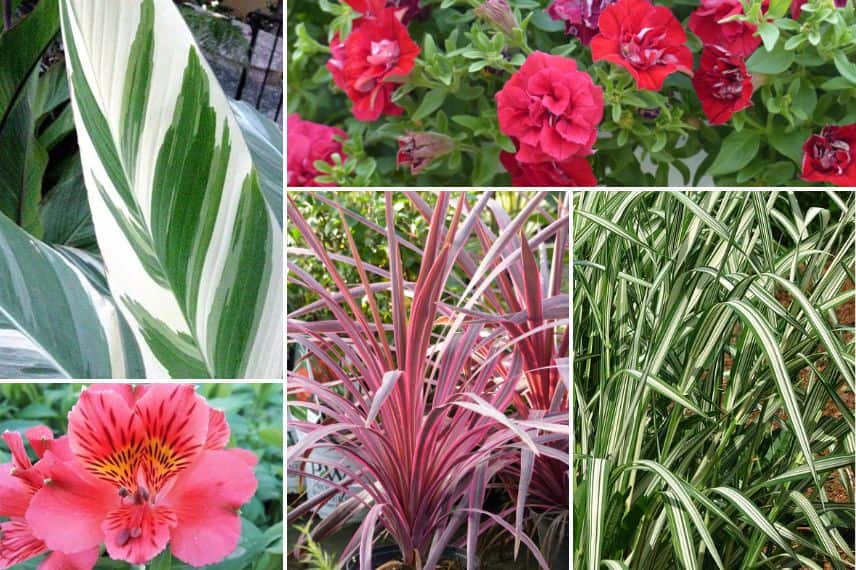
Canna ‘Stuttgart’, Alstroemeria Duchesses ‘Elisabeth’, Surfinia petunia ‘double red’, Cordyline australis ‘Southern Splendour’, Phalaris arundinacea ‘Picta’
In a contemporary garden
In a contemporary garden, Phalaris will bring movement and highlight the clean, structured lines of other plants that make up this garden, such as the traditional balls of boxwood. However, the roots of Phalaris should be contained using a rhizome barrier or in a pot, to prevent it from spreading easily at the expense of other plants.
It can be paired with other grasses, such as Hakonechloa macra for its lush, dense, rounded foliage. A Calamagrostis acutiflora ‘Karl Foerster’ will also be very interesting for its tall vertical silhouette. A Phormium will add structure with its broad upright leaves. If your soil is very wet, prefer a spiralled rush (Juncus effusus ‘Spiralis’) for its unique spiralled stems.
Next, we will add roundness with the ball-shaped flowers of agapanthus, bulbs of ornamental garlic ‘Mount Everest’, or a Hydrangea arborescens ‘Annabelle’. We will bring verticality by incorporating beautiful steppe lilies or silver candles with their long flower spikes. If you have space, a Cornus controversa ‘Variegata’ will echo the variegated foliage of Phalaris arundinacea ‘Picta’.
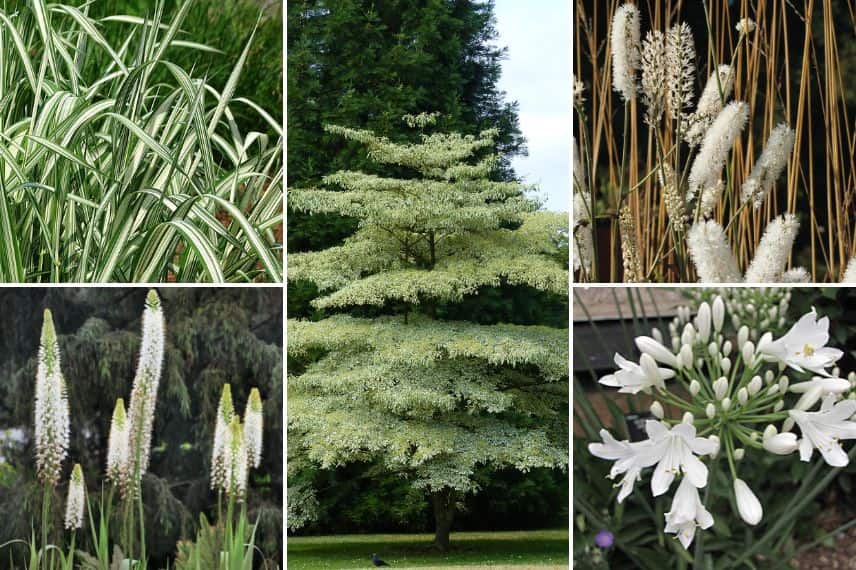
Phalaris arundinacea ‘Picta’, steppe lily, Cornus controversa ‘Variegata’, silver candles (Actaea simplex ‘Atropurpurea’) and Agapanthus
In a bed of grasses
With their silhouettes reminiscent of reeds, Phalaris will naturally blend into a mass of grasses. You can vary the shapes, sizes, and silhouettes by pairing them, for example, with a Stipa tenuifolia for its light tuft resembling a handful of tousled hair. In a larger context, Stipa gigantea will add verticality and volume with its fine, light inflorescences, purplish-silver at the beginning of summer, then golden in winter. For a touch of originality, consider Miscanthus sinensis ‘Gold Bar’ with its green foliage, striped with gold, which will bring brightness, especially to small gardens. The Muhlenbergia capillaris will stand out in a border with its evergreen foliage and majestic flowering in spikes of white to pale pink, turning shrimp pink in autumn.
To highlight these grasses, intersperse them with long-flowering perennials, such as Persicaria amplexicaulis ‘var. pendula’ for its raspberry-red flower spikes or Echinaceas for their long, natural summer flowering. And why not a stunning Perovskia atriplicifolia ‘Blue Spire’ for its lavender-blue flowers, all in lightness. For a border that blooms even in autumn, incorporate a Sedum and an autumn Aster.
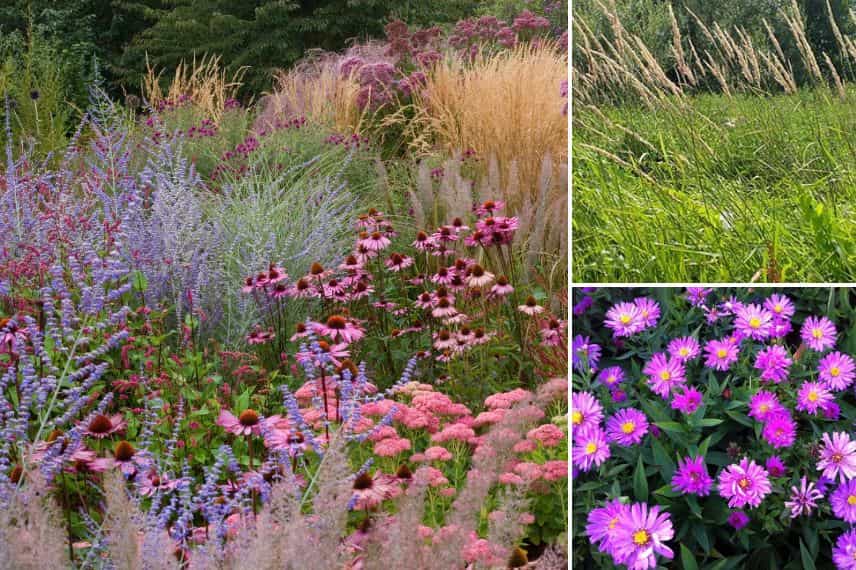
A garden of grasses, composed of: Stipa, Perovskias, Chinese fountain grass, Echinaceas, and Sedum, Phalaris arundinacea and Aster dumosus ‘Rosenwichtel’
For further reading
- Discover all our varieties of Phalaris.
- To find out more, browse our complete sheet on Phalaris – shepherd’s ribbon: cultivation and care.
- Subscribe!
- Contents
Comments