





























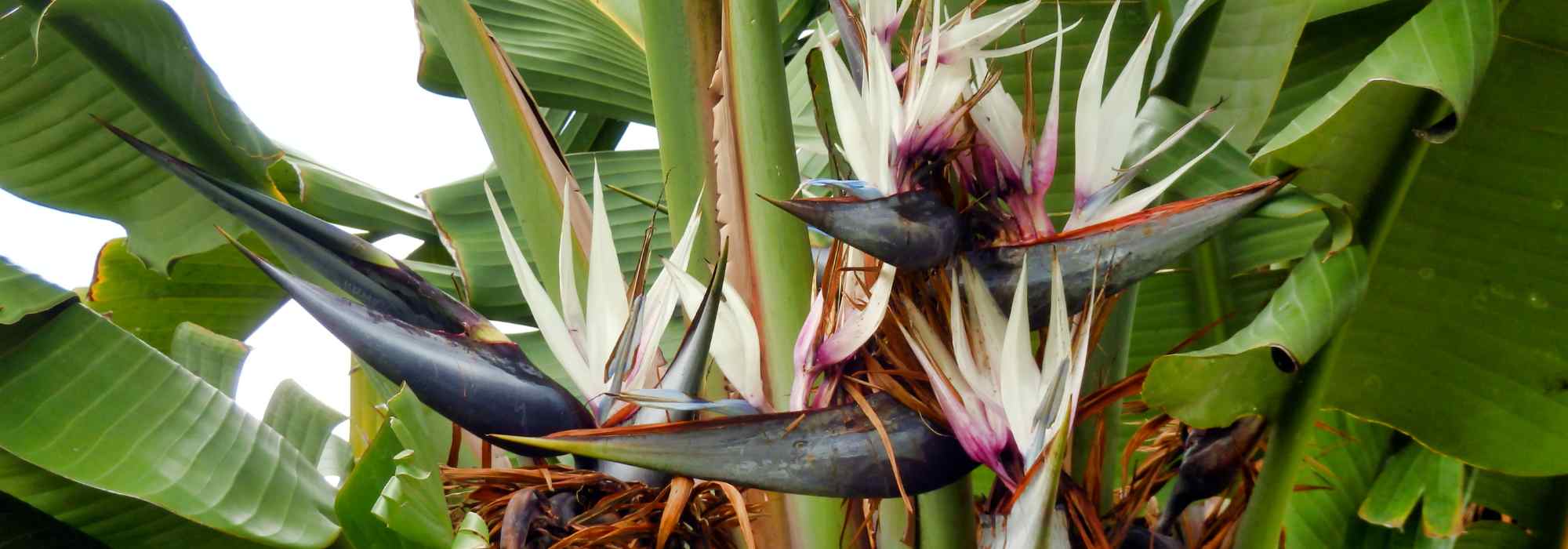
Grow a Bird of paradise indoors
Our tips for successfully growing Strelitzia at home
Contents
Bird of Paradise, or Strelitzia is an exceptional tropical-looking plant, whose broad leaves and spectacular flowers you can admire in your garden in carefully chosen regions. But growing it indoors at home, in a living room large enough, is entirely feasible if you meet its needs! It is now a common sight in the indoor plants section of garden centres.
Discover how to grow this jewel of the South African flora indoors, with invaluable tips on how to keep it and watch it thrive year after year.

About the Bird of Paradise
Captivating attention in Mediterranean and tropical gardens, Strelitzia is one of the most recognisable ornamental plants thanks to its unique flowering, with orange- or white-coloured, bird’s-head-shaped flowers. This tall frost-tender plant comprises five species, all native to South Africa, but it struggles below 5°C and cannot tolerate freezing temperatures. The bird of paradise can therefore be grown outdoors in our climate only on the Mediterranean fringe or in a few microclimates along the Breton coast.
But it is increasingly seen in home décor magazines, where it majestically graces interiors, as it grows relatively quickly in a pot, gradually displaying a handsome mass of leaves worthy of banana plants or Alocasias. Don’t deny yourself the pleasure, for, just like those tropical plants that grow outdoors in very privileged regions, it is among the newcomers in the indoor plant range.
However, it is more as a green plant that you will enjoy it at home, much like a banana plant, because it produces flowers mainly in winter and spring (whereas it flowers year-round under subtropical outdoor conditions), between March and June, a period when it often remains indoors. Its oval, smooth, tough, bright green leaves with a slight blue tinge and neatly veined, borne on rigid petioles, make it a genuine indoor plant. So don’t expect to adopt it at home for bouquets, but for enjoying the exoticism of its foliage!
In the trade for pot culture, the orange-flowered Strelitzia reginae and the white-flowered Strelitzia nicolai are what you will mainly find. This giant white Strelitzia (Strelitzia nicolai), larger and taller, will take up a little more space at maturity. A dwarf cultivar, Strelitzia reginae ‘Humilis’ or ‘Pygmaea’ (about 80 cm tall) allows it to be grown in smaller pots.
→ Discover our comprehensive guide in Strelitzia, Bird of Paradise: Planting and care.
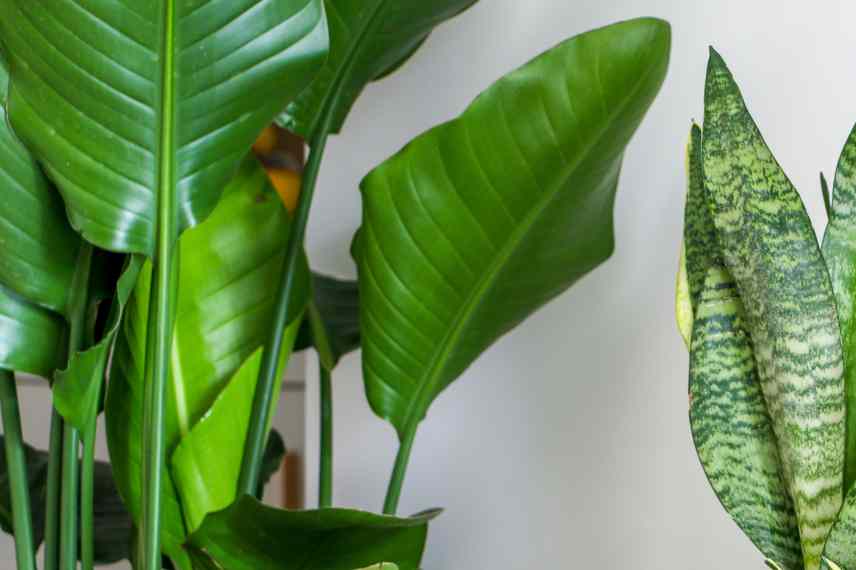
The Strelitzia becomes an indoor plant with striking green foliage when it cannot be grown in its garden
Where should a Strelitzia be placed indoors?
Bird of Paradise needs space as it will unfurl its sheathing leaves, spreading out, and it can grow in a pot up to 2 m tall after several years, sometimes a little more if conditions are favourable for the Strelitzia nicolai (compared with 6–8 m for some in hot climates!). Ceiling height should therefore be taken into account.
It also obviously needs plenty of light. Therefore keep this large plant ideally in a living room or in a large bedroom, as it grows, with its fan-shaped leaves for the Strelitzia nicolai species.
As with outdoor growing, Strelitzia requires a sunny position: near a window facing east or west, and even south-facing in winter, to provide bright or indirect light, or a little farther back in bright interiors with large windows, for example. Avoid it if your flat or house doesn’t receive enough light. It will grow very well between 15° and 21°C during the winter months, but don’t place it against a radiator and don’t overheat the room! Turn the pot regularly to expose all sides to the light.
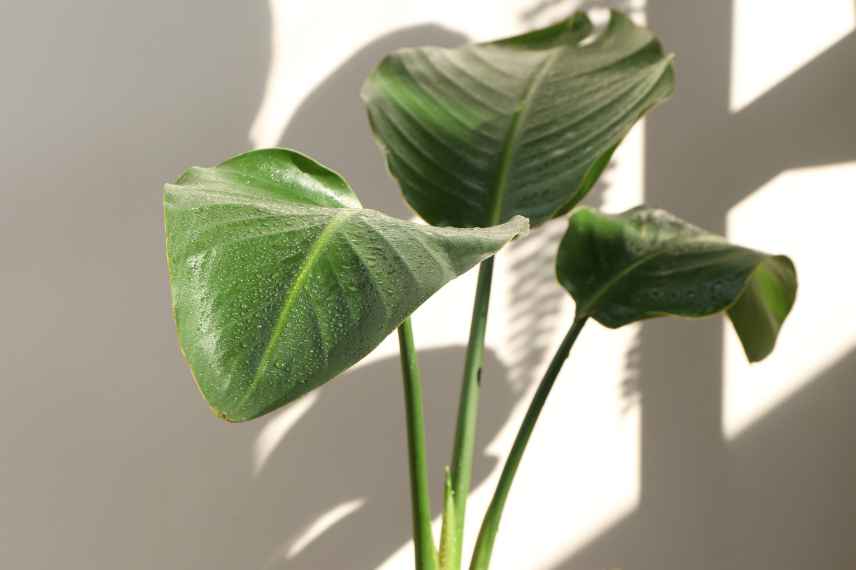
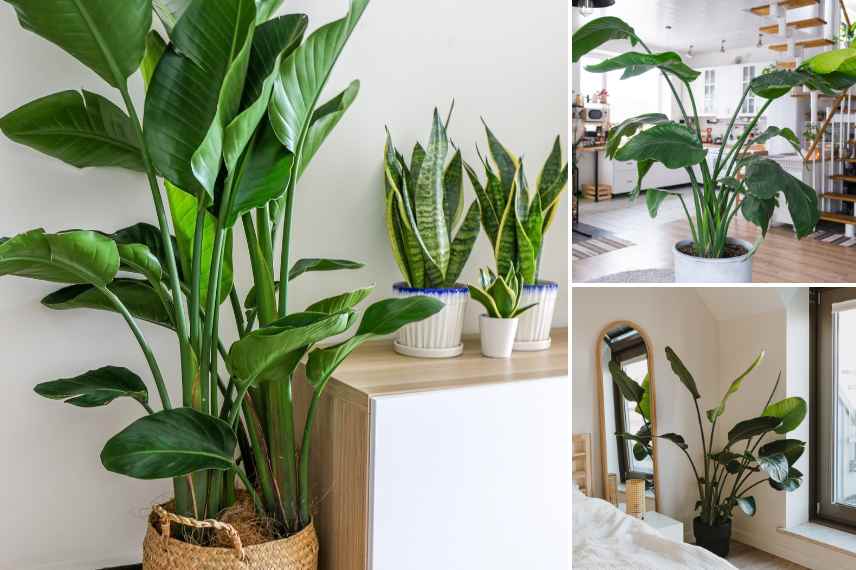
In a design-forward apartment, Scandinavian décor, or a country house, it is truly versatile and adapts anywhere, so long as you provide it with the right light conditions. This plant thrives in a cool greenhouse, in an orangery or in a conservatory that is only lightly heated where temperatures will not fall below 12°C. It can join other exuberant plants such as a Monstera or an indoor palm, or even a smaller Sansevieria as shown in the illustration below, or stand alone in a seagrass-woven cachepot for a strikingly exotic effect.
What growing medium and what type of pot?
With its broad leaves, the Bird of Paradise requires a potting compost rich in organic matter, which must be lightened by mixing in sand or, better, leaf mould compost if you have some to aerate the substrate. This will help achieve slightly acidic soil (pH between 6 and 7) that suits it well. A good potting compost for tropical plants containing peat moss, perlite or vermiculite is also possible, as it provides good drainage.
Strelitzia is one of those plants that likes to be a little snug in its pot, as with Clivias, for example. It is often recommended to stimulate its (possible) flowering. But after purchase at a garden centre, do not hesitate to repot it immediately into a pot slightly larger in diameter (2–3 cm more).
The Strelitzia nicolai grows larger and requires a pot of at least 30 cm in diameter when it is purchased at a height of between 80 and 90 cm.
In terms of material, it can stay in a plastic pot, which has the advantage of better moisture retention, or invest in a terracotta pot that is well breathable (but will be heavier to move).
Do not place it in a drip tray. You will control its watering either with a mini Oya planted in the substrate, or by performing the finger test in the soil (see below). Finally, ensure that the pot has good drainage holes to prevent any water buildup that would rot its roots.
Read also
Growing Strelitzia in a potHow to pot a Strelitzia?
- Choose a pot with a diameter of at least 25–30 cm, whose bottom is perforated (adjust the pot size to the species, dwarf or not, of Strelitzia: see above).
- Spread a layer of gravel or clay pellets 2 to 5 cm thick at the bottom of the pot.
- Add a base layer of substrate mix comprising one third indoor or tropical plant potting compost, one third river sand, and one third garden soil or leaf mould, then place the Strelitzia in the centre so that the collar remains 2 cm below the rim of the pot.
- Fill the pot with the prepared soil mix.
- Firm the soil around the collar.
- Water slowly and evenly.
- Place your Strelitzia in a cache-pot, with a saucer at the bottom.
Specific care for indoor cultivation
Watering
One golden rule for growing Strelitzia indoors is to let the potting mix dry out between waterings. In winter, Strelitzia tolerates soil that is almost dry; in any case water only when the potting mix is dry by inserting your finger into the soil, as it is indeed in its rest period. A watering every two weeks is normally sufficient if kept at a temperature of 15–20°C. Keep the potting mix just moist until early spring.
You will water it more generously from April onwards until September, especially if you leave it outside in summer, generally once a week. These recommendations should be nuanced depending on your region with summers hotter or cooler and on the size of the pot.
For this broad-leaved plant, don’t hesitate to mist with rainwater once a month if your plant never goes outdoors, and to use water always at room temperature. Finally, last tip that applies to many indoor plants: never let water stagnate in the saucer inside your cache-pot.
Leaf cleaning
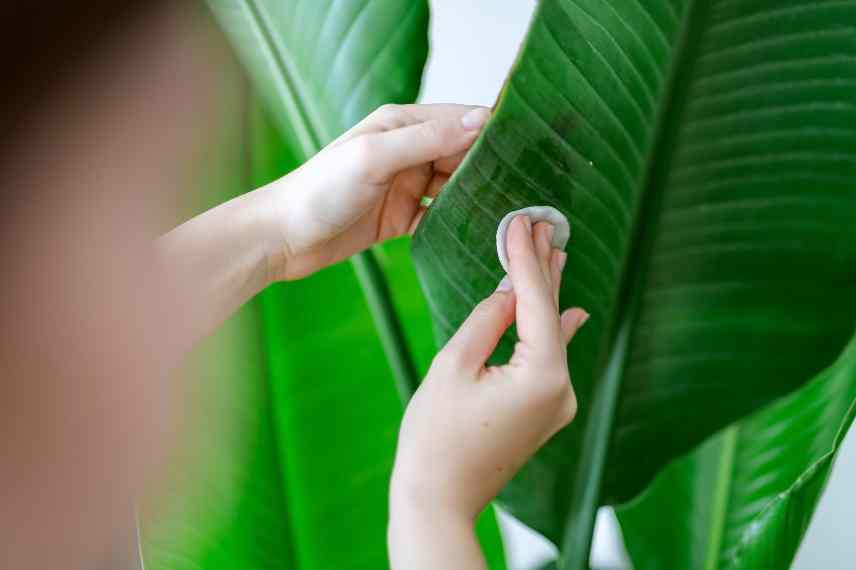
The broad leaves should be cleaned fairly regularly to remove the dust that accumulates on them. Using a cotton pad or a soft cloth dampened with water, delicately clean each face of the leaves. One can also mist the leaves by spraying them, which amounts to the same, but it is important to remove any excess dust so that the lamina benefits as much as possible from the ambient light.
During these delicate operations, the leaves may tear as observed with banana plants. This will have no impact on the development of your bird of paradise. Personally, I simply run a makeup-removal pad along the direction of the nervature, it’s easy and the plant seems to thank you!
I tell you more in: How to clean the foliage of indoor plants?
Fertilisation
Make a application of fertiliser in liquid solution for green plants every two to three weeks, between March and September only.
Ideally use a balanced liquid fertiliser (NPK 10-10-10) diluted to half the recommended dose. Gradually reduce the frequency from late September and stop completely in winter.
Summer period
As soon as the nights warm up (10–12°C), in May, take your plant outside to spend the summer outdoors, on a terrace, a balcony or by the edge of a pool, first for a few hours in partial shade under a shrub or a taller plant, then gradually more into the sun, to avoid burning its foliage after months spent indoors. This summering is very important for Strelitzia, allowing it to benefit from a night-time and day-time temperature differential, favouring its future flowering.
You will bring it back indoors again around September or October depending on the region.
→ Also read our tips in Taking indoor plants outdoors in the warmer months – all our tips.
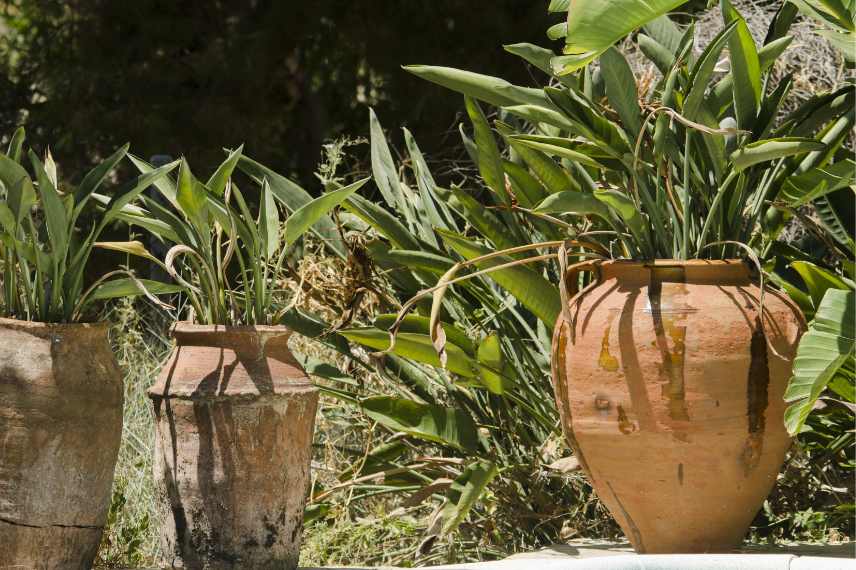
In summer, if you have the opportunity, place your small pot inside a nice outdoor pottery
Pruning
Strelitzia does not require pruning. Simply trim dead or yellowing leaves at their base to maintain a tidy appearance.
Repotting
Repot every two to three years, in March or April, or possibly in September if you cannot do it in spring.
To refresh the substrate more easily as the Strelitzia grows, I recommend performing a top-dressing once a year, also in spring, by adding a generous layer of potting compost and compost on the surface of the pot.
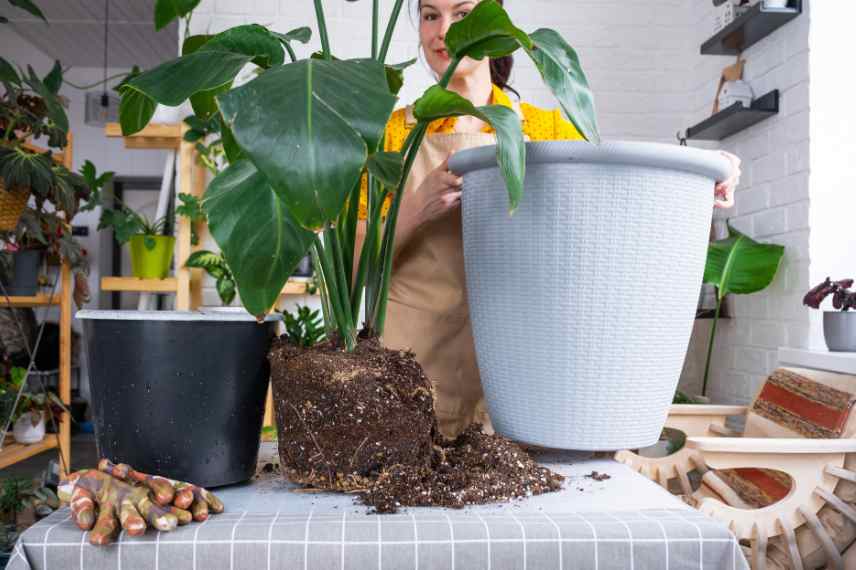
The Strelitzia gradually grows, and it is important to offer it a little more substrate at its disposal
Can a Strelitzia flower indoors?
That’s a question that comes up often among enthusiasts of this plant like no other…
As noted above, there’s a good chance you won’t see a young Strelitzia flower when grown indoors. For most species, they need to be mature, at least 5 to 8 years old, therefore potted in a pot large enough to accommodate their root system, and they must have benefited from warmth, light and humidity appropriate to begin behaving as they would in the ground, and thus grow sufficiently. Whether it’s a Strelitzia nicolai or a Strelitzia reginae, if it graces you with flowering indoors, it will do so between January and June.
Ideally, though not always easy to recreate indoors, would be to grow it at an average winter temperature of 12°C, watering sparingly but sufficiently: this little stress will more readily induce a flowering in spring. So those grown in a conservatory or a winter garden under these conditions will be the luckiest!
Have you managed to make yours flower? Share your gardening tips and photos with us!
→ Pascale explains why a Strelitzia doesn’t flower in this article.
Its indoor diseases
Like many houseplants kept indoors in dry air, Bird of Paradise can be prone to mealybugs, which make the foliage sticky. Isolate it from other plants to prevent spread.
Use a natural insecticidal (neem oil diluted in water) or soapy water (optionally with a small amount of alcohol) to treat infestations. Dab the leaves with a cotton wool ball or cloth soaked in the liquid solution. Repeat this treatment about ten days later if any mealybugs remain. In any case, ensure that your plant is well-drained.
With proper watering, your Strelitzia should not experience any other minor issues. If brown spots appear, it’s probably a sign that you’re overwatering it or that the potting mix isn’t well drained, or that the saucer under the pot stays constantly damp.
- Subscribe!
- Contents
Comments