





























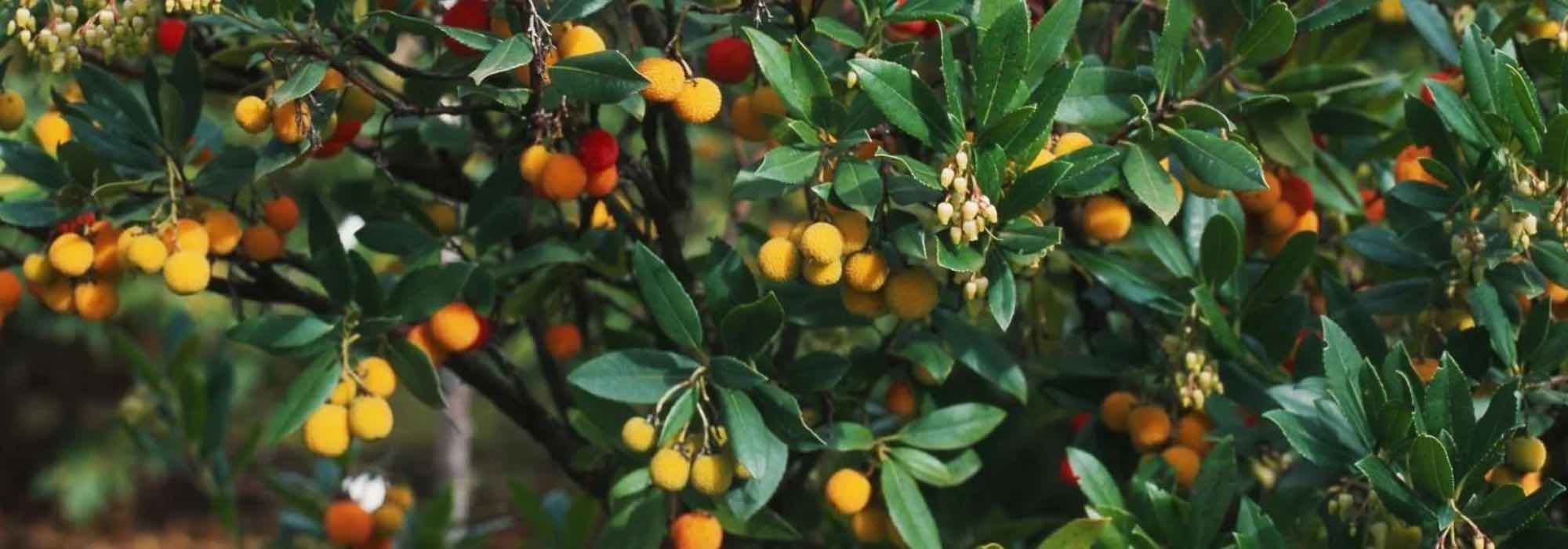
Growing a Strawberry tree in a pot
To make the most of its qualities, even in a small space
Contents
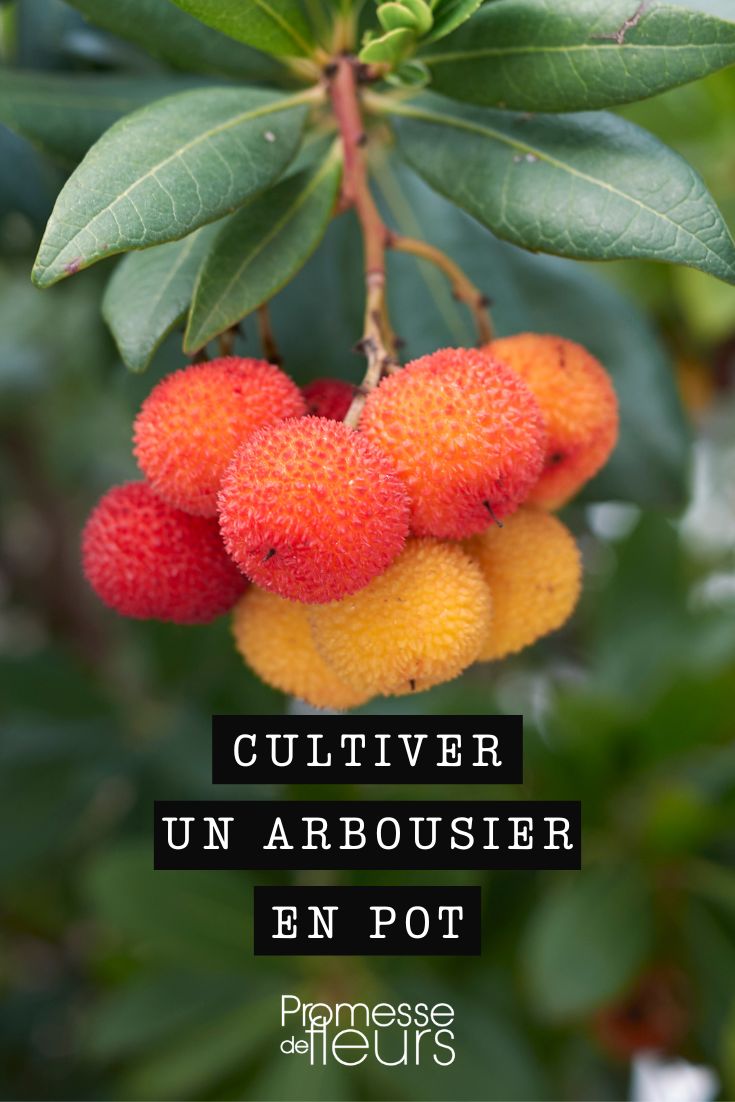
The strawberry tree, of its most well-known species Arbutus unedo, is a Mediterranean bush that never fails to impress. With its evergreen leaves, its white bell-shaped flowers and its red fruits that resemble strawberries, it adds a touch of beauty and exotic charm to any space. Even better, its small fruits, called arbutus berries, are edible and delicious, perfect for making jams or homemade liqueurs.
But did you know that it is entirely possible to grow this bush in a pot? Yes — even if you only have a balcony or terrace, you can enjoy the bush’s many ornamental features and its generous fruiting. It is often a better option in colder regions, where you can move it to shelter during cold snaps, as the strawberry tree does not like very harsh winters. In addition to its decorative aspect, it is a relatively easy plant to care for, provided you know its specific needs. In this article, discover everything you need to know to grow the strawberry tree in a pot.

Choosing the right variety
Before you start growing your potted strawberry tree, it’s essential to choose the variety that best suits this mode of cultivation. Not all strawberry trees adapt to the constraints of pot culture in the same way, which is why some varieties are preferable.
Opt for varieties with a more compact growth habit such as Arbutus unedo ‘Compacta’, which remains relatively small, around 2.5 m in height and 1.5 m in spread at maturity, ‘Atlantic’, ‘Roselily’ or Arbutus unedo ‘Rubra‘, a variety with dense foliage and pink-tinged flowers. These varieties are not prone to becoming too invasive, which is perfect for a small space.
The strawberry tree is a relatively hardy bush, tolerating around -12°C, but beware, a plant grown in a pot is always more sensitive to cold due to the exposure of its roots in the pot. Depending on the region you live in, it’s important to check whether it can tolerate winter temperatures or plan to protect it from the cold by moving it to shelter. The cultivar ‘Marina’ is a little more frost-sensitive.
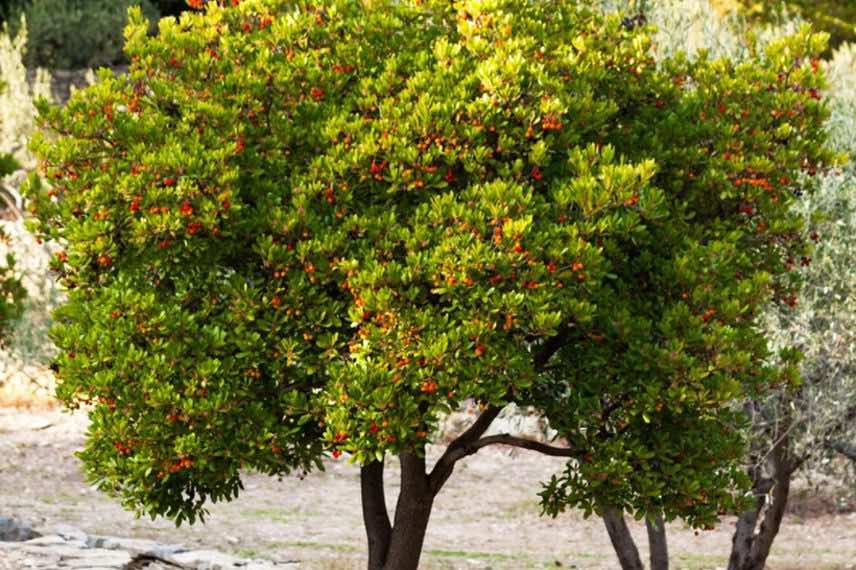
the strawberry tree ‘Compacta’
What type of pot? What size?
A strawberry tree needs space to develop its roots properly, even when potted. Choose a container with a diameter and depth of at least 40 to 50 cm. A terracotta pot is an excellent option, as its porous material helps prevent waterlogging. However, plastic pots, which are lighter, can also be suitable, especially if you want to move the plant around easily. Make sure the pot has drainage holes to prevent waterlogging.
Which substrate?
The strawberry tree mainly needs a well-drained substrate, that’s its main and essential requirement, to prevent its roots from suffocating or rotting. It is, moreover, undemanding. You should also avoid calcareous substrate, though it tolerates it somewhat. Commercial potting mixes are generally slightly acidic, and if you use garden soil, use it for at most one third, so even if it is calcareous, it shouldn’t pose a problem.
Use a quality all-purpose potting mix, to which you will add one third of garden sand and/or perlite to improve drainage.
Plan a layer of gravel, clay balls or pottery shards at the bottom of the pot to ensure optimal drainage. This prevents excess water from accumulating and protects the roots from moisture.
If your strawberry tree needs support, which is very likely, consider installing a stake. This will help it stay upright and not bend in the wind.
When and how to plant a strawberry tree in a pot?
Plant the strawberry tree in a pot, preferably in spring, ideally in March–April, or in autumn, in September–October, to encourage establishment. Planting is possible from February to November, avoiding periods of intense heat and frost, but the shrub will have more difficulty becoming established and will require more care and water.
How to proceed :
- Soak the root ball of the strawberry tree in a basin for about 30 minutes.
- Start by placing a drainage layer of about 5 cm of gravel, clay pellets or broken pottery at the bottom of the pot.
- Fill the pot with your soil and potting mix to about one third of the pot, leaving space for the root ball of your strawberry tree.
- Gently remove the strawberry tree from its pot, taking care not to damage the roots. If the roots are compacted, tease them apart slightly with your fingers. Place the root ball in the pot.
- Fill the pot with your substrate, pressing down gently to eliminate air pockets. Leave a 2–3 cm space at the top of the pot to facilitate watering.
- Water generously after planting to help the soil settle firmly around the roots and hydrate your strawberry tree.
Avoid letting water stagnate in a saucer under the pot. If you use a saucer, be sure to empty it regularly to protect the roots from excess moisture.
Where should you place the strawberry tree in a pot?
The strawberry tree is a bush that loves the sun. Install it in a sunny spot where it can enjoy at least six hours of direct light per day. If you live in a particularly hot region, a light shade in the afternoon can be beneficial to avoid thermal stress.
In addition, place the pot out of strong winds, as the foliage and branches can be weakened by gusts and the shrub is less sensitive to winter cold when well sheltered. The strawberry tree tolerates sea spray.
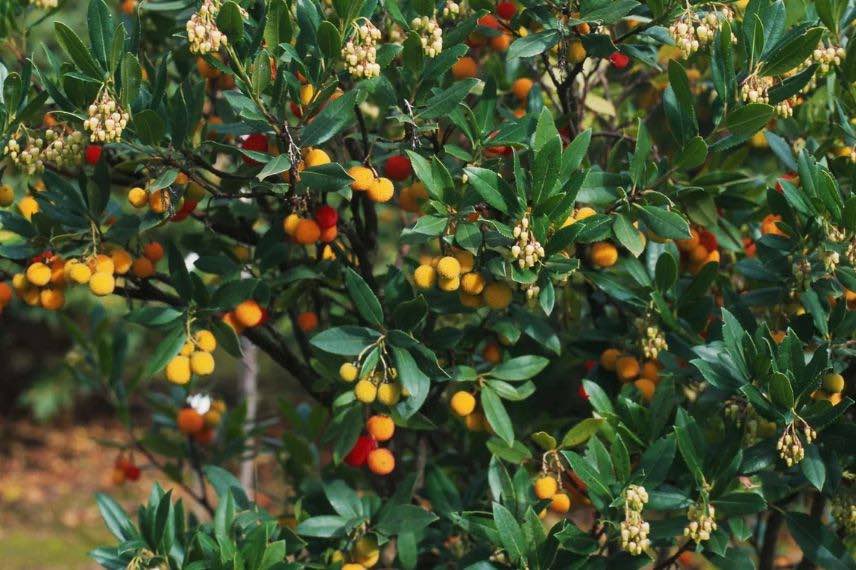
Flowers and fruits of the strawberry tree appear simultaneously on the tree
Watering and Fertilisers
Watering
The myrtle that thrives in dry soil nevertheless needs regular watering in pots, especially during the first few years and during hot periods. Water when the potting compost is dry. Reduce watering in winter. It is better to have a generous but spaced watering than frequent, light watering, so that water reaches deep roots.
Fertilising
Well-decomposed compost applications in spring and autumn are very beneficial for improving the structure of the growing medium, lightening it further, while providing it with gentle nutrients. If you cannot obtain any, and to stimulate growth and encourage fruiting, a balanced organic fertiliser (such as manure or vermicompost) is ideal. If your myrtle shows signs of deficiency (yellowing leaves, slow growth), you can also add a potassium-rich mineral fertiliser, essential for fruit production.
Care
Pruning and care
Arbutus unedo in a pot, slow-growing, does not require pruning. In spring, simply remove dead, diseased, or crossing branches, or perform a very light pruning to maintain a balanced growth habit.
Watching for signs of stress
Although Arbutus unedo is rarely attacked by insects, it can sometimes suffer aphid infestations, especially if the plant is weakened. Be attentive to signs and adjust care accordingly.
Pests
To combat aphids, spray a mixture of water and liquid soap on the leaves, paying particular attention to the undersides of the leaves where these pests hide.
Winter protection
If you live in a region where winters are severe (temperatures below -10°C), it’s important to protect your strawberry tree. Even though the strawberry tree is a relatively hardy Mediterranean bush, growing in pots makes it more vulnerable to cold, as its roots are less well insulated than when it is planted in the ground. In the early years after planting, when the young plant is even more sensitive to cold, apply protective measures as soon as frosts are forecast, even light frosts.
Depending on where you live, apply a thick organic mulch to the surface of the pot in areas with moderate frosts or move the pot indoors to a bright, frost-free room when stronger frosts are forecast.
Harvest
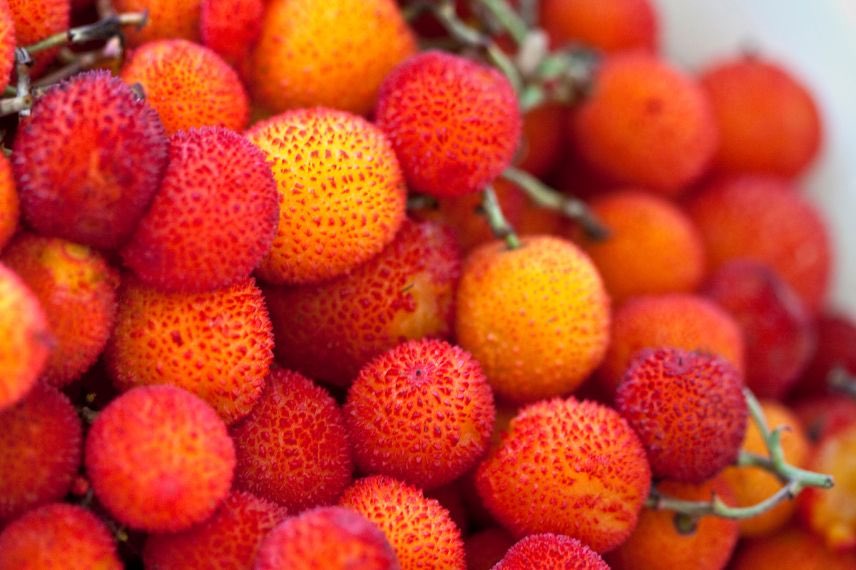
Strawberry tree fruits generally ripen in autumn, sometimes into early winter, depending on climate in your region. Fruits transition from green to yellow, then to bright red when fully ripe. A ripe strawberry tree fruit should be well coloured and slightly soft to the touch. Do not pick them too early, as they will not continue to ripen once detached from the branch.
To harvest them, simply detach them gently from the branch. Be careful not to damage the plant by pulling too hard. It is often preferable to use your fingers or small scissors to cut the fruit without damaging the shoots.
Once harvested, strawberry tree fruits can be eaten fresh, although their gritty texture may surprise and their raw flavour is not particularly memorable. Their sweet, slightly tangy flavour makes them an ideal basis for making jams, jellies, or even desserts such as tarts and compotes. They can also be used to make liqueurs or homemade syrups, perfect for flavouring cocktails. For a Mediterranean touch in your cooking, try incorporating them into original recipes, such as sauces to accompany meat or fish dishes.
The strawberry tree is a symbol of the Mediterranean region, and its fruits have been enjoyed for centuries. In Spain, for example, strawberry tree fruits are used to produce a traditional liqueur called licor de madroño. This fruit also holds a special place in the folklore of certain regions, where it is regarded as a symbol of prosperity.
→ See Olivier’s recipes for using strawberry tree fruits and discover their benefits.
- Subscribe!
- Contents
Comments