





























How can I naturally get rid of scale insects on houseplants?
Tips and solutions to eliminate these tenacious parasites
Contents
One morning, while you were watering your houseplants, a tiny brown growth catches your eye. Oh no! It is mealybugs, these pests that top the list of garden pests. These small, unobtrusive insects, yet formidable, can quickly weaken—even destroy—a collection of plants if you don’t act in time. You’ll need to call on natural, gentle and effective methods to eliminate these parasitic pests.
Discover eco-friendly strategies and treatments to say goodbye to mealybugs and restore the vitality of your houseplants. And don’t forget our prevention tips to help keep them at bay.

Knowing your enemy to defeat them more effectively!
To better tackle a pest, it’s essential to understand it well. Scale insects are small insects in the order Hemiptera, and in the family Coccoidea. The term scale insect does not refer to a single species, but to a highly diverse group. Scale insects mainly develop when environmental conditions are favourable and when plants are weakened by stress. Thus, heat and poor air circulation, typical of indoor conditions, such as a lack of light, inappropriate watering or a nutritional deficiency, favour the appearance of scale insects. They also thrive on your neglect in terms of inspecting the foliage, enabling them to grow rapidly and unchecked.
Two types of scale insects on houseplants
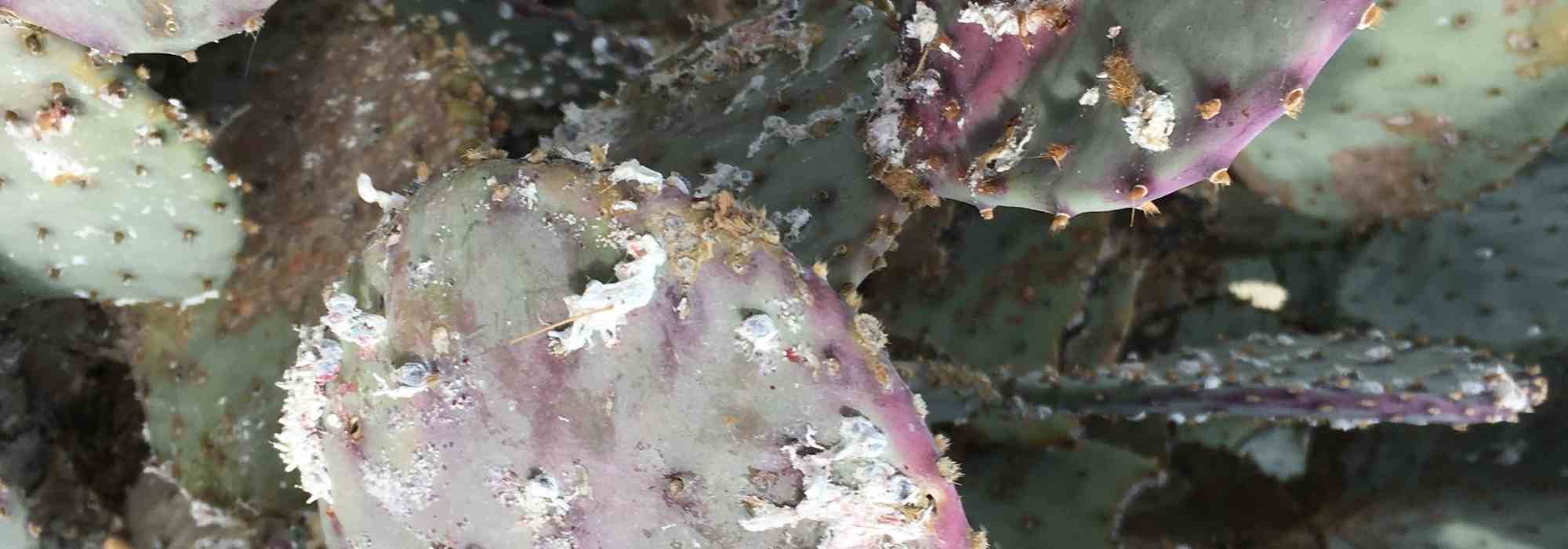
- Mealybugs (or cottony scales) : they are the most common and the most visible. They resemble small cottony white or greyish masses, often grouped in the leaf axils, on the stems or on the undersides of the leaves. They shelter under this waxy protective covering that makes them resistant to many treatments
- Armoured scales (or shield scales) : they are immobile and resemble small brown, black or greyish bumps, firmly attached to the stems and the leaf veins. Their protective shell, not removable, makes them even more difficult to reach with sprays.
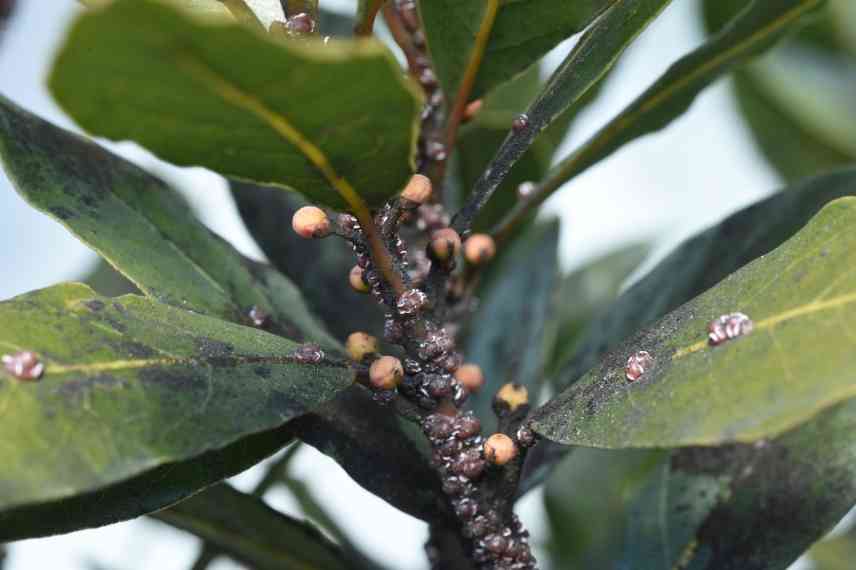 Armoured scales
Damage caused
Regardless of their type, scale insects feed on the plant’s sap thanks to their piercing-sucking mouthparts.
- The plant loses vigor, growth slows, and the leaves turn yellow
- They excrete a sweet, sticky substance called honeydew
- Honeydew fosters the development of a black fungus, the sooty mould, which, although not directly pathogenic, hinders photosynthesis and spoils the plant’s appearance.
The first step: isolation and cleaning of the foliage
As soon as scale insects are discovered, two immediate actions are essential to prevent a widespread infestation of all your indoor plants and to prepare the treatment:
- Isolate the infested young plant: scale insects spread rapidly by contact between leaves or even via gardening tools. This is why it’s urgent to move the infested plant away from all the others. Place it in a separate room, ideally well-lit, to facilitate treatment
- Clean the foliage by hand: this is the longest but most effective step to immediately reduce the population of parasitic pests. With a cotton bud moistened with 70% alcohol, dab or gently wipe each visible scale insect. Alcohol dissolves the waxy shell of mealybugs and penetrates under the shell of shield scale insects, killing them instantly. Be sure to inspect thoroughly the undersides of the leaves, the stems and the nodes, as these are their favourite hiding places. Then rinse the plant with clean water to remove the alcohol residues and honeydew. If the plant is severely affected, prune the most affected branches and dispose of the debris in the bin (never in the compost, to avoid spreading the problem).
Natural spray treatments
Once the initial cleaning has been completed, proceed with a follow-up treatment to eliminate larvae and hidden scale insects, as they can be well concealed. There are different natural methods.
The classic black soap
Black soap is one of the safest and most versatile natural remedies for gardening. It acts by contact. It destroys the insects’ protective envelope, suffocating them. It is also an excellent cleaner for removing honeydew and sooty mould.
- The recipe: Mix 1 to 2 tablespoons of liquid black soap (without glycerin, or additives) for 1 litre of lukewarm water. Optionally add 1 teaspoon of vegetable oil (rapeseed or olive) to strengthen the occlusive effect, and a teaspoon of 70% alcohol. There are also ready-to-use mixtures
- Application: Spray the entire young plant generously, focusing on the undersides of the leaves and the stems.
- Frequency: Repeat the operation every 5 to 7 days for 3 to 4 weeks, as you need to target the different generations of scale insects (adults, larvae and eggs).
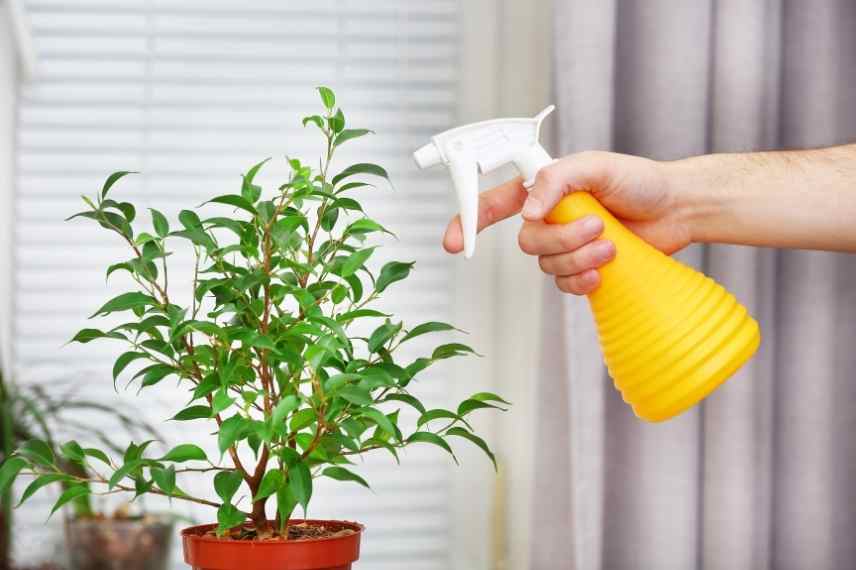 The sprays of a black-soap-based mixture are relatively effective</caption]
Neem oil for a rapid knock-down effect
Neem oil is a powerful natural insecticidal and fungicidal agent, used in organic farming.
It acts in two ways: by contact, suffocating the insects, or by ingestion. In this case, azadirachtin disrupts the reproduction and moulting cycle of scale insects.
- The recipe: Mix 1 teaspoon of pure Neem oil with 1 litre of lukewarm water. Add a few drops of liquid black soap to help the oil mix with the water
- Application: spray the plant in a targeted manner.
- A precaution: Neem oil has a strong odour that may be unpleasant for some. Ensure the room is well ventilated after application. Always test on a small leaf before treating the entire young plant.
Plant macerations
Although less powerful than Neem oil, some macerations can serve as a repellent and light treatment. Among others, garlic, an excellent natural repellent. Simply chop 3 to 4 garlic cloves and steep them in 1 litre of water overnight. Strain and spray.
Integrated pest management: why not?
For gardeners seeking a more sophisticated and durable solution, biological control (or integrated pest management) is the ultimate method. It involves introducing natural predators of mealybugs. If it’s relatively easy outdoors, it’s more challenging for indoor plants. You can still try by relocating the affected plants to a sunlit conservatory or garage.
The easiest predator to introduce is the mealybug destroyer (Cryptolaemus montrouzieri). These small Australian ladybirds are the most effective predator of mealybugs. They are often sold at the larval stage, which is the hungriest. The larvae closely resemble the mealybugs because they are coated in a white wax, which helps them camouflage themselves while feeding on the eggs and adults of the pests. They are released directly onto infested plants. They require a minimum ambient temperature and must not be used with insecticidal products, even natural ones such as neem or insecticidal soap, for risk of killing them.
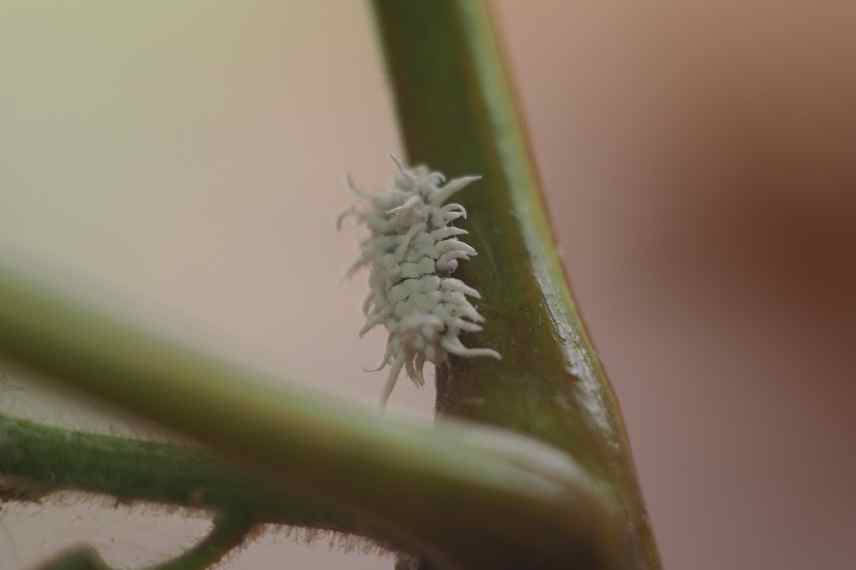
Larvae of the Cryptolaemus montrouzieri ladybird
Prevention is the best form of treatment
A healthy plant is a resilient plant. The environment in which it grows is the key to preventing scale insects from returning.
Regular inspection
This is the most important step. Get into the habit of inspecting your plants at least once a week, by lifting the leaves and checking the axils and stems. Detecting a nascent infestation makes treatment a hundred times easier.
Optimising growing conditions
Scale insects are often attracted to weakened plants.
-
Ensure your plant receives the right amount of light. A plant that lacks light becomes weakened and an easy target
-
Avoid water stress: too much water or too little
-
A balanced fertiliser regime in spring and summer helps the plant develop its own immune defences.
Leaf cleaning
Dust on the leaves hinders photosynthesis. Regular wiping with a damp cloth not only keeps the plant clean but also helps to spot pests.
The quarantine
When buying a new plant, keep it isolated for 3 to 4 weeks in a separate room before introducing it to the other plants. This gives you time to check that it is not harbouring scale insects or other pests.
Are some indoor plants more susceptible to scale insects than others?
Some indoor plants are significantly more susceptible to mealybugs, often due to their structure or sap that is particularly attractive.
Here are the plant families most commonly and severely affected:
- Succulents and cacti: Their folds and areoles provide ideal hiding places, and their slow growth makes infestations difficult to detect and manage. They are particularly attractive to mealybugs.
- Orchids : They are highly susceptible, especially to armoured scale insects that attach to the leaves and flowering stems
- Ficus : Their rich sap attracts mealybugs, and their numerous leaf axils provide plenty of hiding places
- Araceae (such as Monstera, the Philodendron or the Dieffenbachia) : Their large leaves and stems are frequently attacked.
As a general rule, plants with many nooks and crannies (lush, bushy plants or those with deep leaf veins) or those that produce a lot of sugary honeydew are prime targets for these pests.
- Subscribe!
- Contents
Comments