


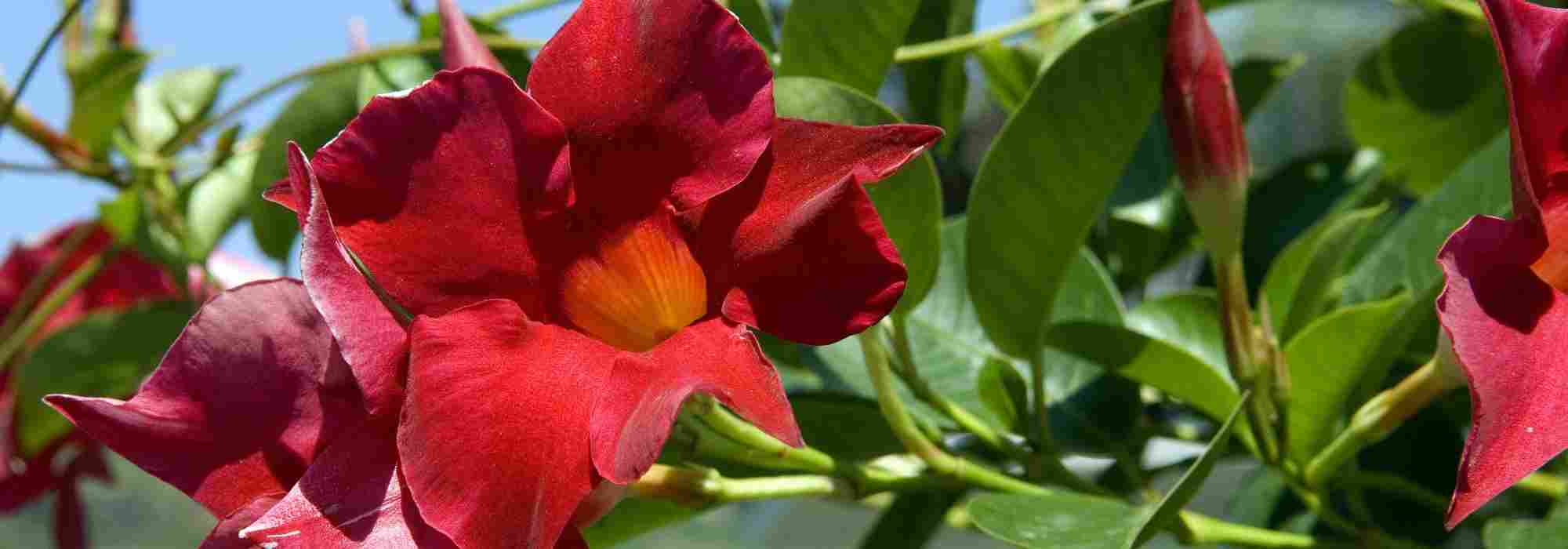
Choose dipladenias with a compact habit!
Our compact mandevilla varieties
Contents
Known as a tropical ornamental plant with vigorous growth, designed to climb on a trellis or a pergola, Dipladenia, also known as Mandevilla, has benefited in recent years from a spectacular revival thanks to the development of compact-habit varieties. This genetic evolution, the result of meticulous cross-breeding and rigorous selections, has enabled the production of dipladenias with a bushy, structured and floriferous habit, which retain all the aesthetic appeal of climbing species, without the drawbacks associated with their vigour, which can be difficult to channel. In pots or planters, these compact dipladenias are perfect.
Discover our non-climbing dipladenias, their horticultural and aesthetic characteristics, as well as our planting and cultivation tips to help you integrate them into the garden.

Why choosing compact dipladenias?
Compact Dipladenia stands out above all for its naturally ramified and moderate growth. It does not seek to climb, but forms a small dense, well-shaped shrub that reaches, on average, 30 to 60 centimetres in height depending on the variety. This ball-shaped silhouette, almost spherical for some selections, makes it a plant of choice for small spaces, window boxes and pots on balconies and terraces, or mixed borders where it can play a focal role due to its floribundity.
Ornamentally, these compact forms retain all the qualities that made the classic Dipladenia a success: a generous flowering, often continuous from spring to autumn, with trumpet-shaped corollas displayed in a beautiful palette of colours, from the deepest red to pure white, including a wide range of pinks and creams, and even yellows. The foliage, dense and glossy, offers a handsome evergreen texture, ensuring visual interest even between two flowering periods.
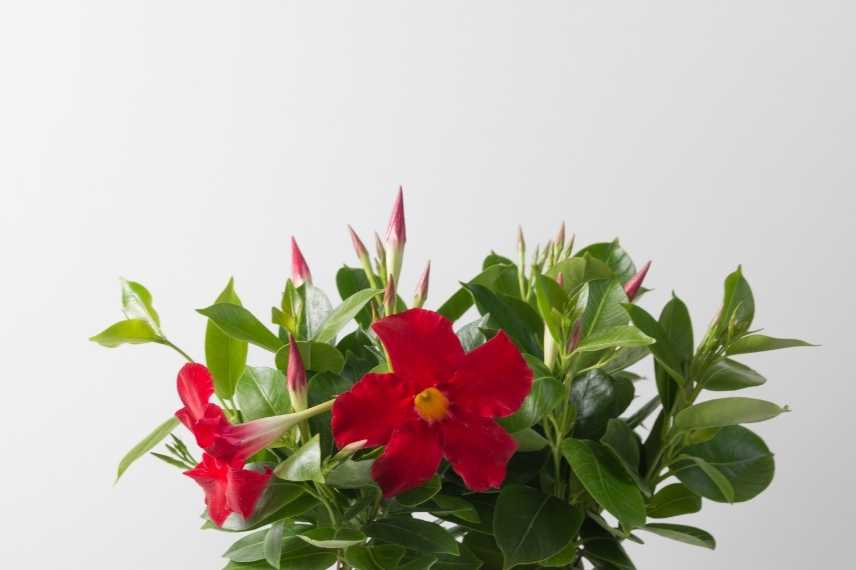
The dwarf Dipladenia stands out above all for its naturally ramified and moderate growth
Their ability to adapt to container culture or to ground cultivation, their relative drought tolerance and their low maintenance and pruning needs make them particularly attractive to gardeners seeking to diversify their summer displays while reducing constraints. Grown on their own or in combination, Dipladenias with a compact habit integrate easily into sophisticated plantings, in both mild climates and sheltered locations.
Finally, note that Dipladenia is frost-tender, often grown as an annual. With a compact habit and its reduced dimensions, it proves easier to overwinter. This makes it possible to grow it anywhere.
Our selection of remarkable compact dipladenia varieties
Here is our selection (not exhaustive) of the most beautiful mandevilla varieties with a denser habit and less vigorous growth than the climbing varieties.
The Dipladenia Bella ‘Compacta Red’ variety
The ‘Compacta Red’ variety from the Bella series, developed by the German company InnovaPlant, hardly hides its main asset, namely its very compact form. This hybrid, derived from Dipladenia sanderi, offers a rounded, compact habit with a slight trailing tendency, as it has short stems. It stands out for its exceptional floribundity. Its height and width reach 30 to 35 cm, and it flowers in large star-shaped flowers in a bright red, 6 to 8 cm across, lasting until the first frosts. Its dark green, glossy foliage provides a wonderful frame for this intense flowering.
It thrives on balconies and terraces, in summer pots, in combination with some Coleus and white petunias. Yet it can easily be planted in the ground in regions with very mild climates.
The Diamantina® Jade series varieties
The Diamantina® dipladenia series was developed by Florensis. It comprises three sub-series: Jade, Opal and Agate XXL, each sub-group addressing specific uses, from compact bushy forms to the more vigorous plant for trellising. Among these sub-series, Jade is surely the most compact. It is indeed the first range to offer a truly bushy and lush habit, semi-trailing, which does not require support. These varieties also feature early, uniform and abundant flowering. All remain within a height and spread of 40 to 50 cm. This series offers a wide range of colours:
- Dipladenia x sanderi Diamantina® ‘Jade Red’ with beautiful flowers in a true red that does not fade in the sun
- Dipladenia x sanderi Diamantina® ‘Jade White’ with exceptionally pure white flowers
- Dipladenia x sanderi Diamantina® ‘Jade Pink’ with pale pink flowers, enhanced by a small yellow-orange heart
- Dipladenia x sanderi Diamantina® ‘Jade Scarlett’ with blooms of a splendid scarlet red.
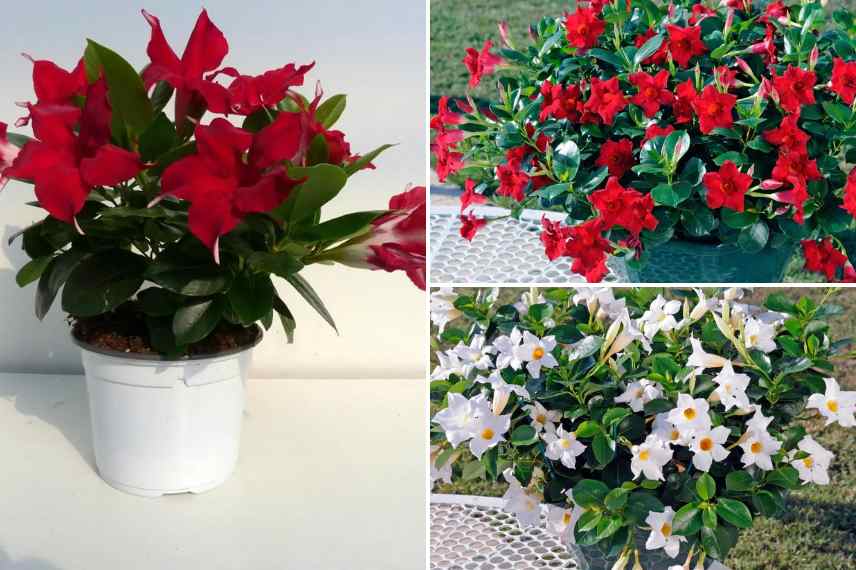
In clockwise order from top left, Jade Red, Jade Scarlett and Jade White
To these specimens, XXL versions with flowers 7 to 9 cm wide can be added: ‘Jade XXL White’ and ‘Jade XXL Red’.
All these varieties are perfect for containers, pots and window boxes, on balconies or terraces, but also in borders or dense flower beds.
The Diamantina® Opal series varieties
This series produces varieties with a slightly climbing habit, but with compact growth. Reaching 30 to 50 cm in height, they are well suited to hanging baskets and light trellising. Like the other varieties, their flowering is long-lasting and abundant, and relatively early. The different representatives of this series come in a range of red, pink and especially a stunning yellow. Fast-growing, they work wonderfully in pots.
-
- Dipladenia x sanderi Diamantina® ‘Opal Fuchsia Flammé’ stands out with pink flowers and a fuchsia throat
- Dipladenia x sanderi Diamantina® Opal Citrine 2.0’ is unique with its unfading golden-yellow flowers.
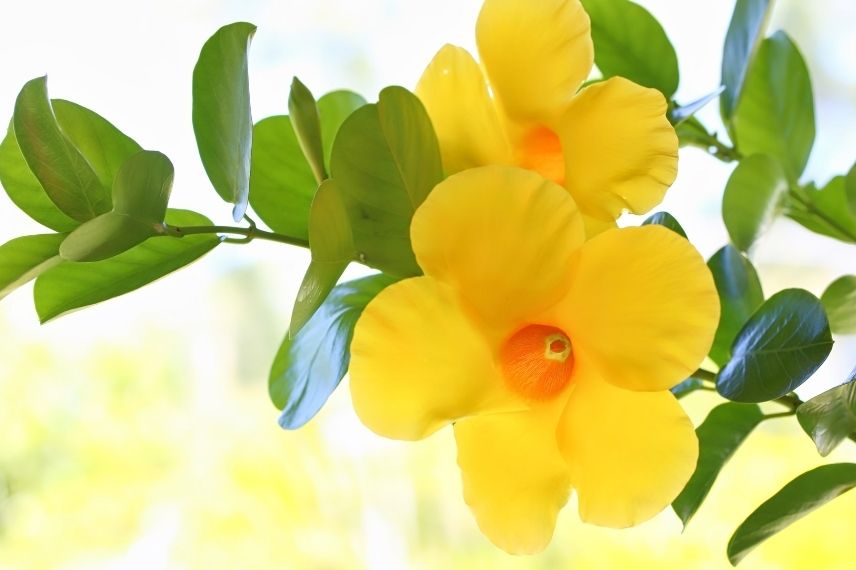
The unique Dipladenia Diamantina® ‘Opal Citrine’
The Diamatina® Tourmaline series varieties
The most recent Tourmaline series is an integral part of the Diamantina® range. Dipladenias do not have a climbing habit: they form compact shrubs, typically 30 to 60 cm high and wide, suitable for pot culture without support. They also possess distinctive traits that make them desirable ornamental plants: generous flowering with large trumpets in novel colours, and thick, glossy foliage giving a lush appearance.
- Dipladenia x hybrid Diamantina® ‘Tourmaline Pink’ bears large flowers, 10 to 11 cm across, in a rare pale pink around an orange centre
- Dipladenia x hybrida Diamantina® ‘Tourmaline Intense Fuchsia’ offers large flowers in a fuchsia pink of rare intensity.
Planting and care for compact dipladenia varieties
The success of growing compact dipladenias depends above all on careful planting and maintenance, especially when grown in pots or containers, which is often the case for these varieties with a compact habit.
Planting
Planting is ideally carried out between mid-April and mid-May, after the last frosts, especially in a continental climate. In mild climates, earlier planting is feasible. Dipladenias establish themselves in a sunny position, with some shade during the hottest part of the day.
Dipladenias prefer a light, rich and very well-draining substrate. A base of potting soil mixed with perlite or vermiculite (20 to 30%) yields excellent results. You can also incorporate some mature compost and a handful of coarse sand to improve drainage. Planting is done in perforated pots in which a layer of expanded clay balls is placed. In the open ground, only in areas with very mild winters, the soil must be deeply loosened.
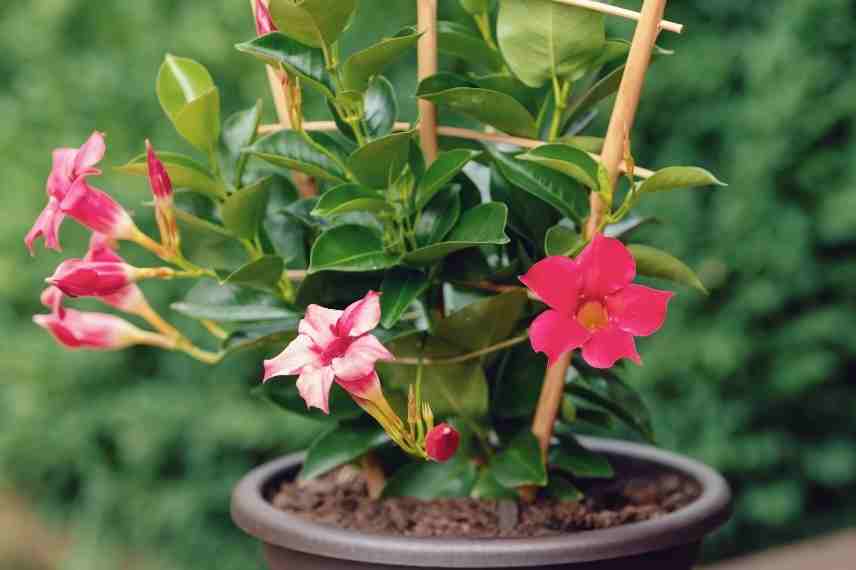
Compact dipladenias require only a light support. Some do not require any at all
Summer maintenance
Dipladenias are relatively easy to care for during the growing season:
- Watering should be regular but moderate, two to three times a week in pots, once a week in the ground
- Feeding with a liquid fertiliser for flowering plants every two to three weeks
- Pinching of new growth in spring promotes branching and flowering.
Over-wintering
Hardiness of dipladenias is very limited. The survival threshold temperature is around +5°C. As night temperatures fall below 10°C, bring your dipladenias into a bright, well-ventilated frost-free space, but not too warm (10–15°C is ideal). A conservatory, a temperate greenhouse or a bright garage will do. Watering will be reduced.
Before wintering, a small maintenance prune can be done to remove faded flowers, damaged leaves, and to shorten the stems slightly. In March, a second pruning can be carried out to revitalise the vegetation before the new season.
- Subscribe!
- Contents
Comments