





























Crown grafting to propagate or rejuvenate a tree: how and why?
Give your trees a new lease of life with crown grafting
Contents
Crown grafting is a grafting technique widely used in arboriculture to transform or rejuvenate a tree. Whether you’re looking to save a damaged specimen, change a fruiting variety or maximise the yield of an orchard, this method offers an effective and accessible solution for all. It is distinguished by its ability to give a second life to a tree by combining the vigour of an existing rootstock with the specific qualities of a carefully chosen scion.
Ideal for mature, large-diameter trees, crown grafting is both precise and adaptable. It relies on a solid understanding of tree anatomy, perfect timing and meticulous execution. But don’t be intimidated! With the right tools, a little practice and tailored guidance, any gardener, amateur or professional, can master it.

Crown grafting: what is it?
Simple and clear description
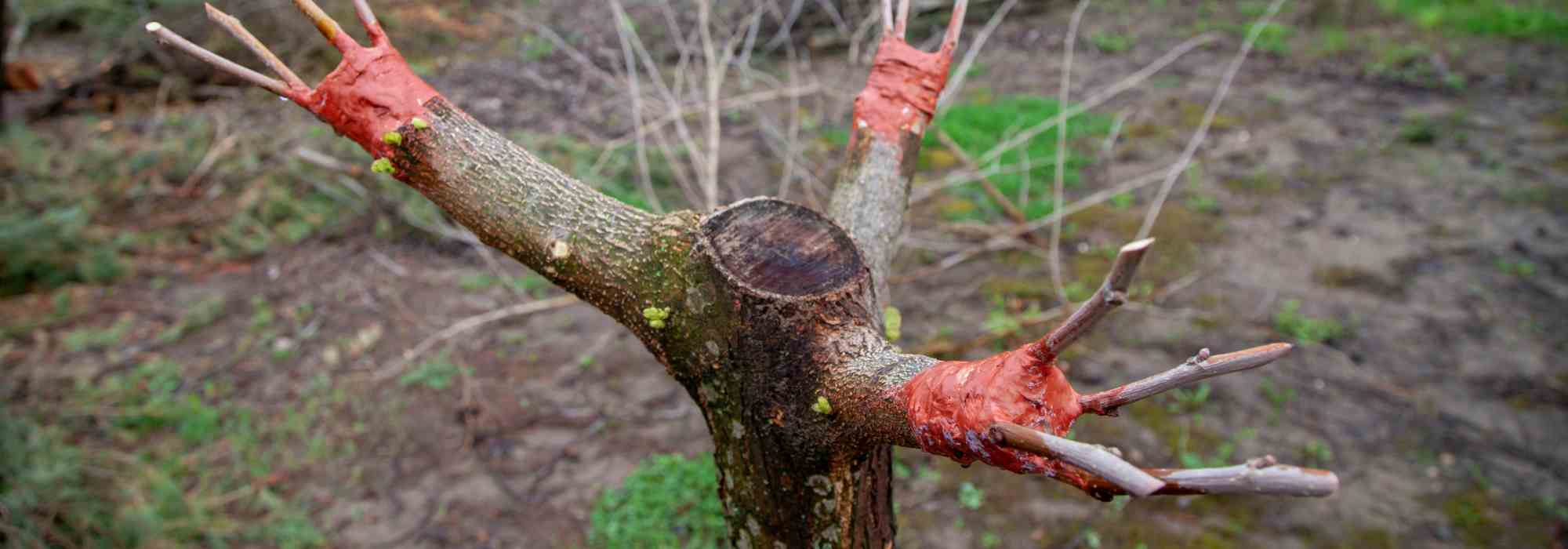
The crown grafting is a grafting technique that involves inserting several scions (segments of branch bearing buds) into the trunk or a main branch of a tree, under the bark. This method allows replacing part or all of the tree’s above-ground system while keeping the same rootstock. It is particularly used on medium to large trees, where the diameter of the trunk or branches is large enough to accommodate several scions.
The principle rests on perfect contact between the cambium (the living layer beneath the bark responsible for the tree’s growth) of the graft and that of the rootstock, which enables their fusion and sap flow.
Why is it called “crown” grafting?
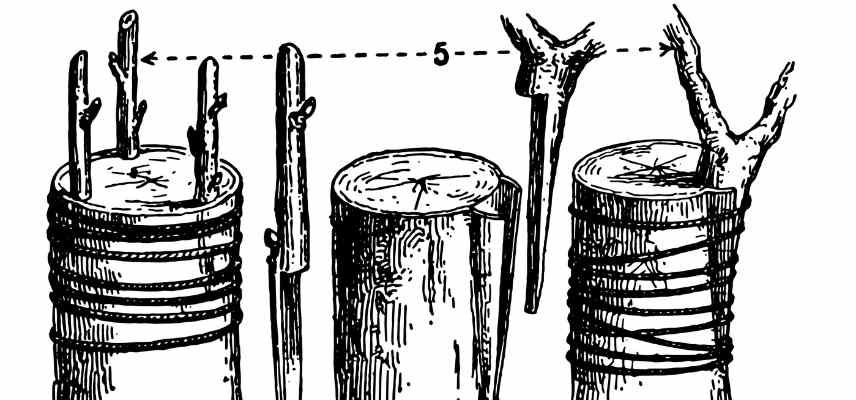
Crown grafting is called so because of the circular arrangement of the scions around the trunk or a branch. Scions are inserted at different points around the circumference of the wood, thus forming a “crown”. This technique is particularly useful for maximising the chances of success, as each scion has its own connection point with the rootstock, increasing the likelihood that at least some scions survive and thrive.
x
Its importance in arboriculture and gardening
Crown grafting is essential in arboriculture and gardening for several reasons:
- Varietal renewal: it allows changing the variety of a tree while preserving its root system. For example, an apple tree can be grafted to produce a new variety of apples better suited to your needs.
- Tree rejuvenation: old trees can be revitalised by grafting young and vigorous branches.
- Saving damaged trees: if a tree’s above-ground system has been damaged (by a storm, excessive pruning or disease), crown grafting can breathe new life into the tree.
- Production optimisation: it is often used in commercial orchards to improve the quality or quantity of fruit without waiting for the growth of a new tree.
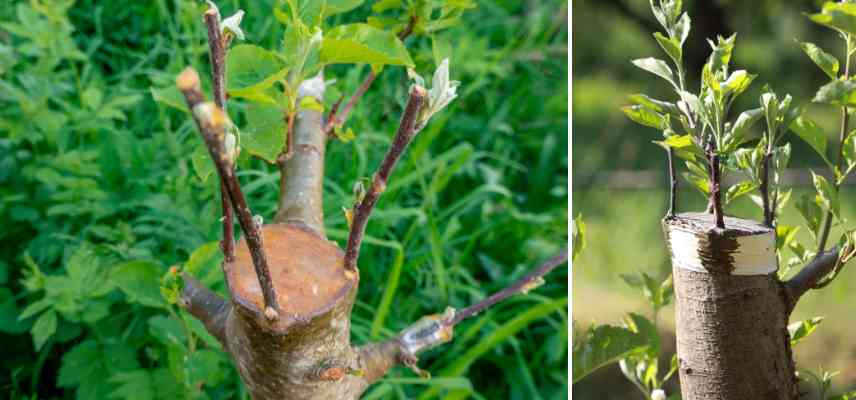
Crown grafting of an apple tree
Read also
Buying a grafted tree: for or against?The basics of crown grafting
Prerequisites
Crown grafting is a versatile technique that can be used on many types of trees, including:
- Fruit trees : apple trees, pear trees, cherry trees, plum trees, walnut trees and citrus trees. It is particularly valued for these species because it allows improving or altering fruit production.
- Ornamental trees : maples, lilacs, or other trees can also benefit from crown grafting to introduce branches from a different variety or to revitalise an ageing tree.
- Forest trees : in some cases, this graft is used on forest species such as oak or birch, although this is less common.
Ideal period for performing this graft
- Spring : the optimal period is just after the sap rise, when the tree begins to wake from its winter dormancy. This generally corresponds to March–April in temperate climates.
- Sap rise : it is essential, as the sap rise makes the bark easier to lift, facilitating the insertion of the grafts. It also ensures a good flow of nutrients to the grafts, increasing their chances of taking.
To avoid: grafting too early, in winter, or too late, in midsummer, as these periods do not favour healing and the growth of the grafts.
Necessary conditions
To maximise your chances of success, several conditions must be met:
- Tree state :
- The rootstock must be healthy, with no signs of disease or parasites.
- It must be robust enough to withstand the grafting process, with a trunk or branch diameter of at least 5 cm (ideal for accommodating several grafts).
- Required tools :
- Grafting knife : well sharpened for clean cuts.
- Pruning saw : for preparing the rootstock.
- Grafting tape or raffia : to hold the grafts in place.
- Grafting wax : to seal wounds and protect against potential infections.
- Environment :
- Work in clean conditions to avoid any contamination.
- Ensure the tree is not subjected to water stress before or after grafting (water if necessary).
- If possible, choose a wind-free day with moderate humidity to prevent the grafts from drying out.
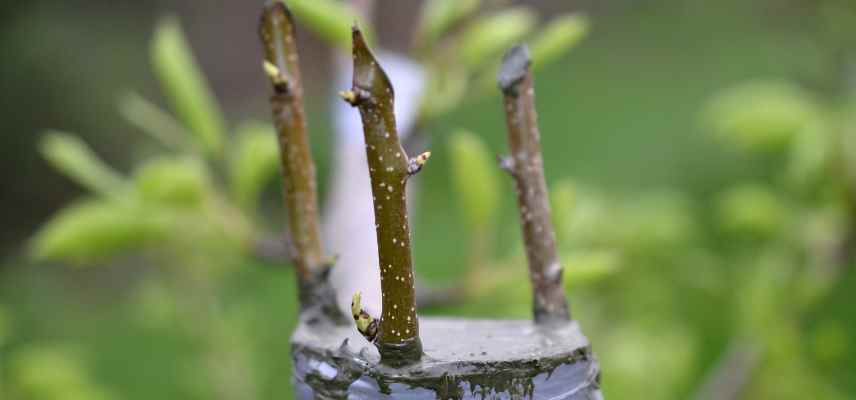
The tree should be mature enough to have a trunk or branches with a minimum diameter of 5 cm
Anatomy and terminology
- The rootstock
This is the lower part of the tree that includes the roots and a portion of the trunk. Its role is to provide:- The basic structure of the tree.
- A well-developed root system capable of feeding the scions.
- Tolerance to soil conditions, diseases or parasites (depending on the rootstock variety chosen).
- The scion
This is a section of branch taken from a donor tree, containing viable buds. Its role is to:- Develop the tree’s above-ground portion.
- Produce leaves, flowers and, in the case of fruit trees, fruits.
- Provide the characteristics of the variety to be grown (taste of the fruit, cold tolerance, aesthetics of the flowers, etc.).
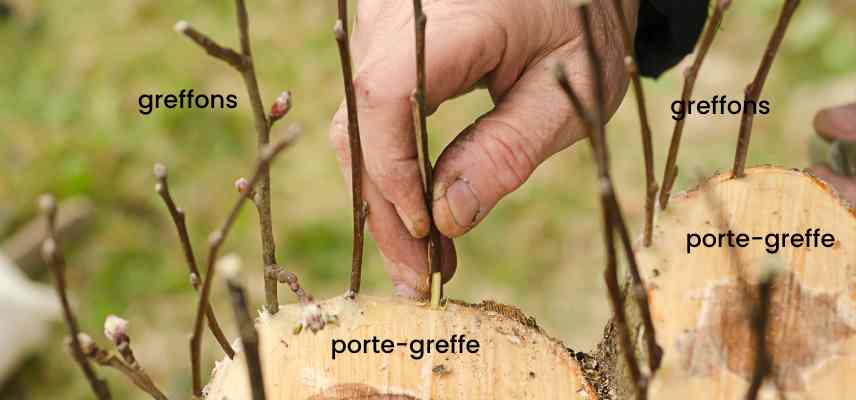
Below the rootstock, and above the scions, grafted
Importance of cambium and its alignment
The cambium is a thin layer of living cells located between the bark and the wood. It plays a major role in graft success because:
- This is where the graft union between the rootstock and the scion forms. The cambium is responsible for the tree’s radial growth and the transport of nutrients.
- Good alignment of the cambiums ensures sap flow between the rootstock and the scion, thereby ensuring the survival and growth of the scion.
Perfect alignment: the key to success!
When inserting the grafts, it is essential to:
- Place the cambium of the scion in direct contact with that of the rootstock.
- Ensure both cambiums remain aligned after securing, even if the rootstock’s bark is thick.
Detailed steps for crown grafting
1. Rootstock preparation
- Selection of a healthy rootstock : choose a tree in good health, free from signs of disease or parasitic infestation, and with a trunk or main branch diameter of at least 5 cm.
- Cutting the main branch : use a pruning saw to cut the branch cleanly, leaving a neat, horizontal section. Then smooth the cut with a sharp knife to avoid irregularities.
2. Selection and preparation of scions
- Criteria for an optimal scion : take one-year-old, healthy branches with well-formed buds. Scions should be collected during dormancy (winter) and stored in a cool and humid place until use.
- Preparation : cut the scions to a length of 10 to 15 cm (2–3 buds) and trim their base to a bevel to provide a smooth and elongated surface.
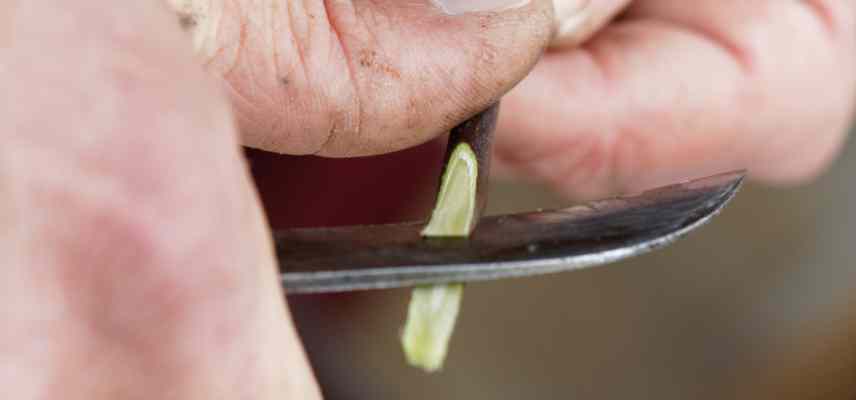
3. Insertion of scions into the rootstock
- Crown incision : with a grafting knife (or grafting tool), lift the bark from the rootstock by 2–3 cm, creating vertical slits spaced around the circumference.
- Placement of the scions : insert the scions into the slits, ensuring their cambium is well aligned with that of the rootstock. Orient them slightly outward for harmonious distribution.
4. Fixing and protection
- Bindings : firmly secure the grafts with grafting tape, raffia or an elastic band, without over-tightening to avoid damaging the tissues.
- Protection : apply a grafting wax or a special wax to all exposed areas (including the main cut and the base of the scions) to prevent desiccation and protect against infections.
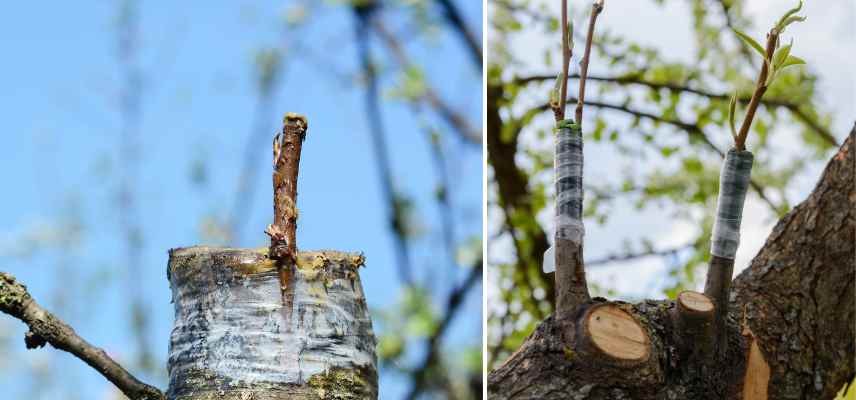
Read also
Grafting trees: different techniquesPost-graft care and follow-up
1. Immediate care after grafting
- Monitor the seal : check that the grafts are well secured in place and that the sealant or wax protects the wounds effectively. Repair any cracks or detachment.
- Watering and nutrients : ensure a regular supply of water, especially during dry periods, to maintain good hydration. A moderate soil amendment may be helpful, but avoid excess nitrogen fertilisers, which could stimulate unwanted growth.
2. Evolution of the graft
- Early signs of take : wait 3 to 4 weeks to observe the first buds opening on the grafts. A light growth is a good indicator of success.
- Managing the shoots : remove shoots and buds arising from the rootstock, as they can compete with the grafts and hinder their development.
3. Common problems and solutions
- Failure to take
- Possible causes : poor alignment of the cambium layers, poorly prepared scions, unfavourable weather conditions (late frost, excessive heat).
- Solution : attempt grafting again at a more suitable time.
- Infections or parasites
- Prevention : use a quality sealant and regularly monitor for the appearance of fungi or insects.
- Treatment : apply specific treatments (fungicidal or insecticidal) if necessary, and remove the affected parts.
Frequently asked questions
-
How long does it take to see results?
The first signs of success in a crown graft usually appear within 3 to 4 weeks after the operation. The buds of the grafts begin to swell, then to open, indicating that the graft has taken. However, for full establishment and stable growth, one must wait until the end of the first growing season. The fruit, if it is a fruit tree, will often only be produced after 2 to 3 years, depending on the tree and the grafted variety. -
Is it possible to graft several varieties onto the same tree?
Yes, crown grafting is ideal for transforming a tree into a multi-variety tree. This allows several types of fruit or flowers to be grown on a single tree. For example, an apple tree can bear red, green and yellow apples if each graft belongs to a different variety. However, it is important to choose varieties that are compatible with each other and with the rootstock, particularly in terms of vigour and flowering period, to ensure harmonious growth. -
Which trees are not suitable for crown grafting?
Crown grafting is mainly suited to trees with thick bark and woody growth, such as fruit trees (apple, pear and cherry trees) and some ornamental trees. It is less well suited to species with thin or fragile bark, such as shrubs or, of course, non-woody perennial plants. In addition, some varieties that produce a lot of latex or resin, such as conifers, are difficult to graft with this technique because secretions can hinder graft take. -
Is it possible on very old or very young trees?
Crown grafting can be performed on mature trees, even very old ones, as long as they are in good health. It is often used to revitalise declining trees or to replace their variety. However, if the tree is very old and in poor condition (weakened roots or a rotten trunk), the chances of success decline, and may even be nil. For young trees, crown grafting is rarely performed, as the diameter of their trunks or branches is then insufficient to accommodate grafts. In these cases, other grafting techniques, such as the cleft graft or English whip graft, will be preferable.
- Subscribe!
- Contents
Comments