


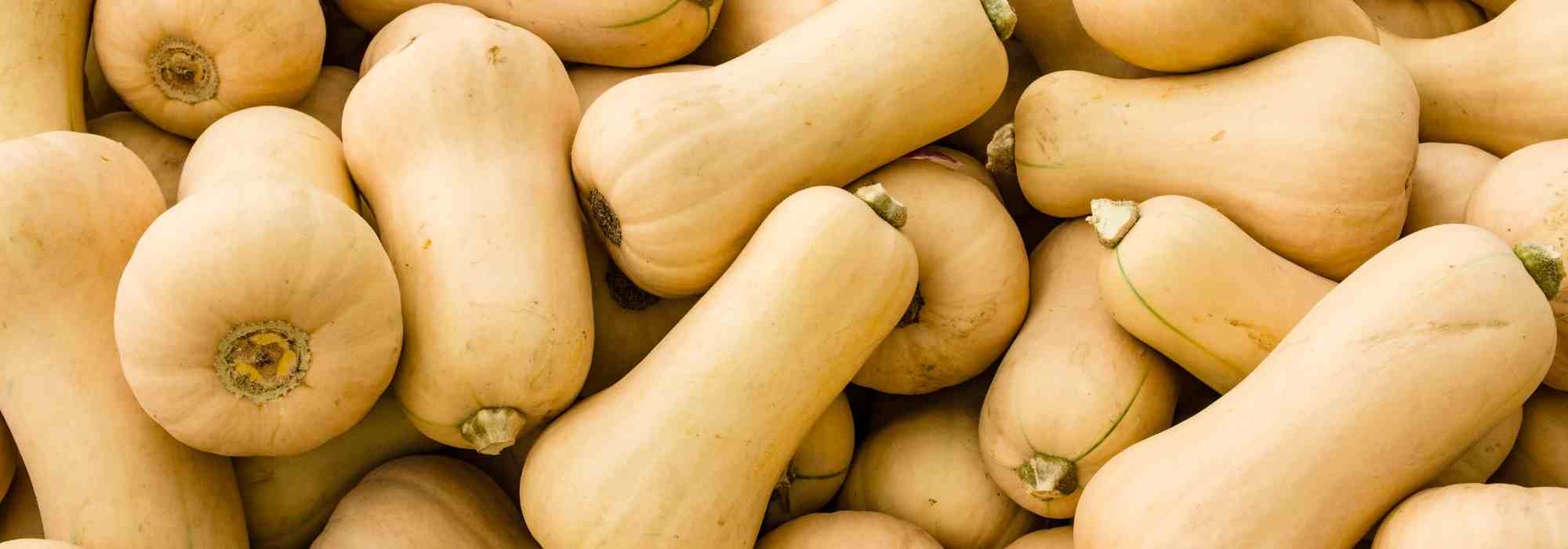
How to grow butternut squash? Our tips
Everything you need to know about growing butternut squash, from sowing to harvest
Contents
The autumn star in the vegetable garden!
Undeniably, the butternut squash has, over the past couple of decades, grown in popularity in the garden as well as in the kitchen.
With its pear-shaped form and its mild, buttery flavour, it delights cooks. As for its ease of cultivation, it proves popular with gardeners. To the point where it deserves a place in vegetable gardens, or even on a balcony. Growing this variety of squash is rewarding in several respects.
Let’s discover together everything you need to know about growing butternut—from sowing to planting, from care to harvest and storage—so you can enjoy it all winter.

Everything you need to know about butternut squash
A member of the Cucurbitaceae family, butternut squash is a musky squash (Cucurbita moschata). “Butternut” is an English term that, on its own, conveys the culinary characteristic of this squash: butter-nut. The French vernacular name is equally evocative: “doubeurre”. As for the designation “peanut squash”, it tends to refer to its shape. Originating in Central America, this type of squash was introduced to France in the mid-19th century. But its consumption has expanded very widely in the following years.
A pear-shaped squash
This annual plant, creeping or sprawling, produces long, ramified stems, sometimes substantial, with broad, lobed foliage, often slightly villous.
As it is a monoecious plant, it produces male and female flowers. Male flowers are borne on a straight peduncle, females have a swelling at the base, corresponding to an early stage of fruit. Flowers are pollinated by insects.
Butternut squash is an elongated fruit, bottle-shaped or pear-shaped, with one end narrower than the other. The skin is smooth, particularly hard, of a light beige colour when ripe. The flesh is dense, orange or deep yellow in colour, sweet, and easy to work with in cooking.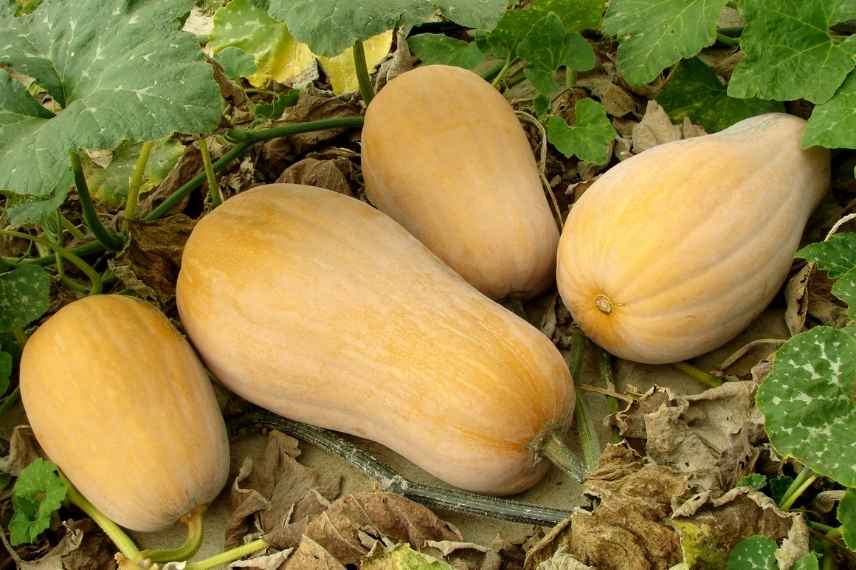
Its advantages and uses
Butternut squash is very easy to cook, in soups, purées, gratins, flans, tarts, or small cubes roasted…
Very nutritious, it is rich in vitamin A (the famous beta-carotin), in dietary fibre and minerals.
Read also
Sowing of squashes and courgettesWhen and how to sow seeds?
Sowing butternut squash, under cover or in open ground, is not difficult in itself. You simply need to observe the right timing, the ideal conditions and the sowing techniques.
When to sow the seeds?
In temperate countries and regions, the sowing of butternut seeds begins under cover from the end of March to the start of April, as soon as nights are not too cold. Seed sowings can be carried out in a conservatory, under a frame or in a greenhouse. But care should be taken not to sow too early, as young squash plants dislike temperatures that are too low due to frost.
To sow directly in the ground, wait until frosts have passed and the soil is well warmed, from late April to mid-May, depending on the region.
Germination usually occurs after about 5 to 10 days, depending on temperature and conditions.
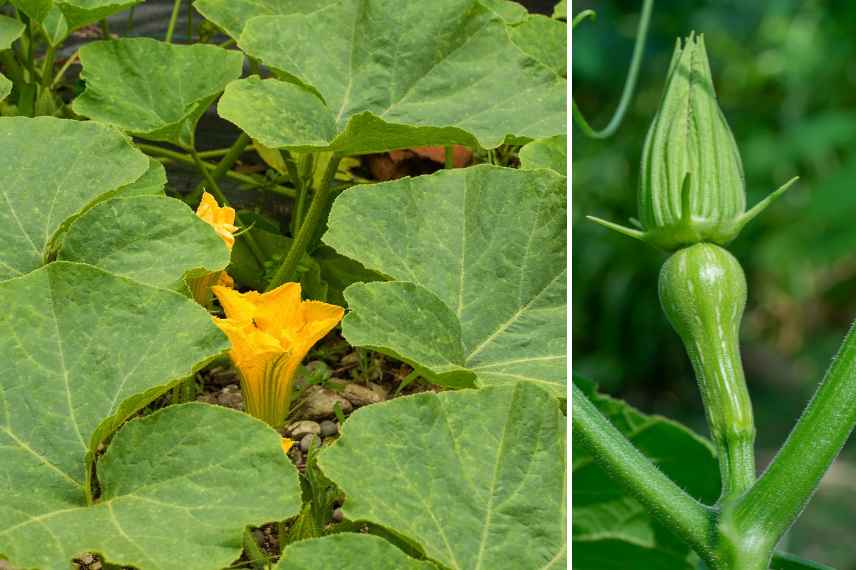
Leaves and flowers of butternut
How to sow butternut?
It is possible to soak the seeds in warm water for one to two hours before sowing to soften their coat and promote uniform germination. But soaking is optional.
Under cover
- Fill pots, seed trays, terrines or pots with seed-sowing compost or a mix of compost and garden soil
- Place 2 to 3 seeds per pot, at a depth of about 1 to 2 cm
- Lightly firm to ensure seed–soil contact
- Water with a fine spray using a spray bottle
- Keep the substrate moist, without waterlogging
- Place the pots in a temperate place, ideally between 18 and 20 °C
When the seedlings have two to three true leaves, thin out to keep only the most vigorous seedling in each pot.
In open ground
When the soil is well warmed, you can sow directly in open ground, in little pockets in compost-enriched soil.
- Make small pockets with 2–3 seeds at a depth of 1–2 cm
- Cover gently with soil and lightly firm
- Optionally cover with a cloche or fleece until the seedlings have started, if nights are cool or if slugs are about
- Once the young shoots have emerged, keep only the strongest
Where, when and how to plant butternut squash?
Once your sowings are well underway or your butternut squash seedlings are ready, it’s time to transplant.
When to plant?
Wait until the risk of frost has definitely passed before planting, or you risk losing the plants. Indeed, butternut squash is very sensitive to cold and frost. Generally, plant around mid-May or late May, depending on the region. Seedlings sown under cover should have 3 to 4 true leaves, excluding cotyledons. Overall, transplanting takes place about three weeks after sowing.
Where to plant?
Butternut squash loves warmth and grows vigorously. The ideal is therefore to plant in full sun, in well-drained soil, rich in humus, loose and deep. Avoid soils that are too damp.
Soil preparation is essential. That’s why it should be enriched in advance with well-rotted compost or decomposed manure.
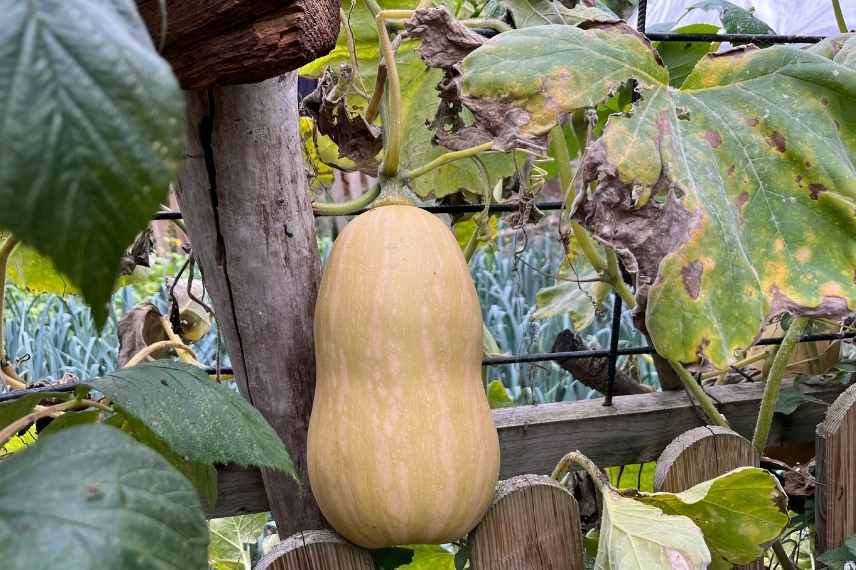
Gardeners with limited space can grow butternut squash on a trellis or mesh
How to plant?
- Dig holes about ten centimetres wide and deep, spaced 1 m apart
- Place a handful of well-rotted compost, good potting compost or decomposed manure at the bottom of the hole
- Place the plant and backfill with soil
- Gently firm the soil around the plant
- Form a shallow watering basin around the plant to catch the water
- Water generously after planting to thoroughly hydrate the roots
- Apply mulch around the plant to conserve moisture, suppress weeds, and protect the plant.
Gardeners with limited space can grow butternut squash on a trellis or mesh. Heavily laden fruits may sometimes require support.
Read also
Squashes: buyer's guideWhat care do butternuts require?
Once the plants are in place, regular monitoring is necessary to produce good fruit.
Watering
Butternut squash needs plenty of water, but does not tolerate excess humidity on the foliage. That is why you should water at the base, without wetting the leaves, if possible with rainwater at room temperature.
Watering should be regular, at around 10 L two to three times per week, depending on how warm it is.
Pruning
For squashes with large fruits such as the butternut, we can pinch to direct growth. At the two-leaf stage, pinch the main stem to encourage branching into two stems. Once the fruits are forming, you can pinch the shoots above the fruit, leaving two additional leaves.
Pollination
As a reminder, the plant produces male and female flowers separated but on the same plant. If pollinator insects are not sufficiently present, some female flowers may not be fertilised. Manual pollination is therefore necessary. It suffices to collect pollen from a male flower with a finger, a small brush or a cotton bud, and apply it to the pistil of a female flower.
It is often advised to grow several plants to increase the chances of cross-pollination. Planting melliferous flowers nearby such as borage, calendula, cosmos to attract bees and other pollinators is a good idea.
Protecting the fruits
It is enough to place a tile or a rigid support under each fruit to prevent direct contact with wet soil, which promotes rot.
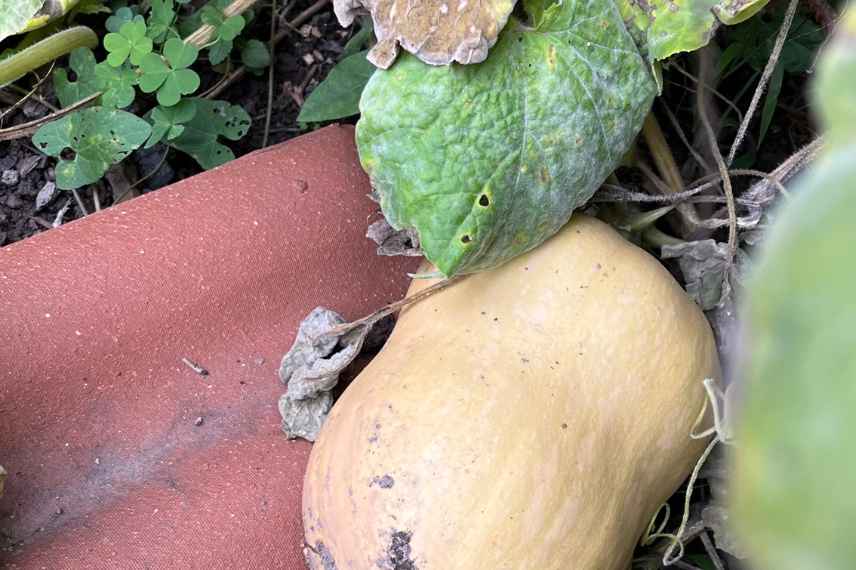
Protected by a tile, the butternut is not troubled by soil moisture
Managing diseases and pests
Butternut, like other squashes, can be susceptible to certain diseases or pest attacks. The most common being powdery mildew, Botrytis and downy mildew. Among pests, aphids, whiteflies and spiders are the most problematic. I invite you to read Leïla’s article: diseases and pests of squashes and courgettes.
Harvest and storage
We harvest the fruits at full ripeness, before frosts. The skin should be hard, with a uniform cream colour, and the peduncle should be lignified. In fact, retain 1 cm of this peduncle at harvest.
Ideally, butternuts should be stored in a cool, well-ventilated, dark room (10–15 °C), on straw, boards or crates. A garage or attic is ideal. Under good conditions, they can be stored for 6 to 12 months depending on the variety.
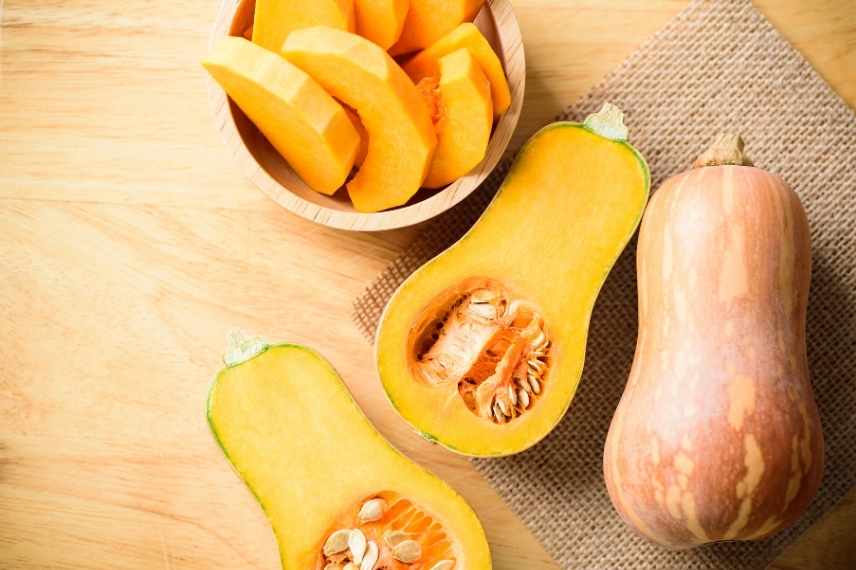
Butternuts keep all winter
- Subscribe!
- Contents

Comments