





























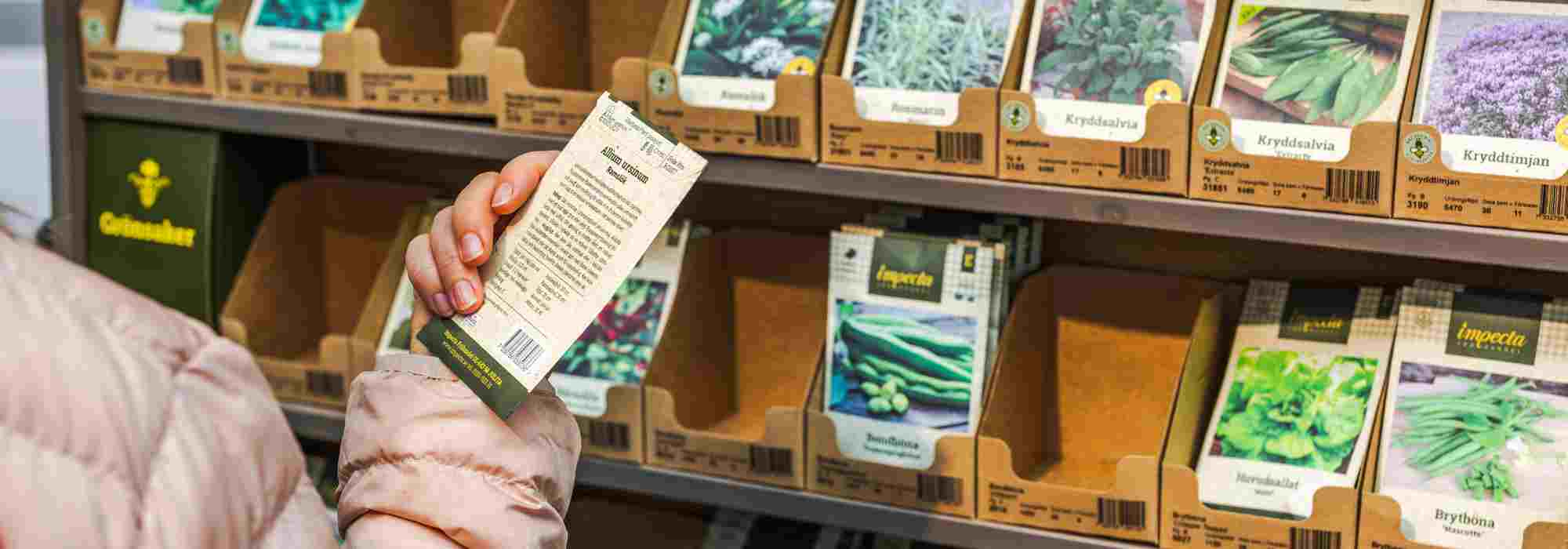
How to read and interpret the information on seed packets?
Understanding the different data points to make informed choices and achieve successful sowing
Contents
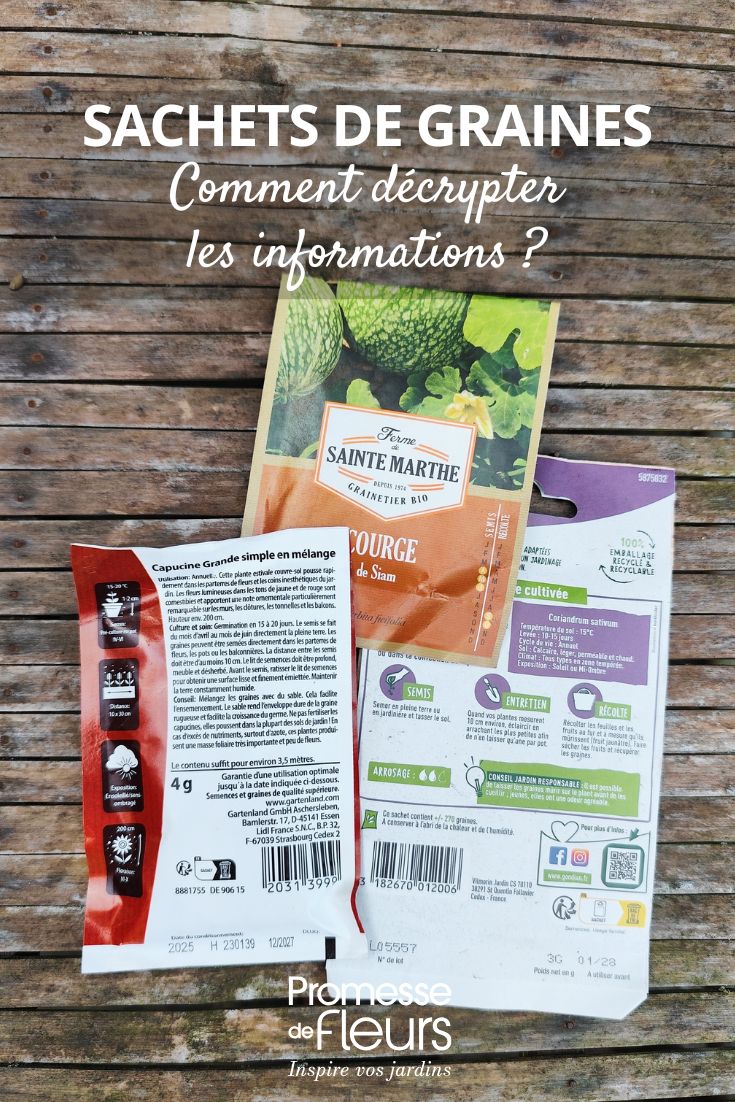
When buying seeds to start your future crops of vegetables, annuals, perennials or bushes, you will be faced with a wide range of seed packets. On each packet you will notice various pieces of information that are important and will help you choose the right plant from the available varieties. But you also need to understand the jargon sometimes used by seed producers.
Let’s therefore look at how seed packets are generally presented and how to decipher the information they contain to make an informed choice.

Information about the plants: species and variety
These are obviously the first pieces of information that will interest us: which type of plants do the seeds correspond to?
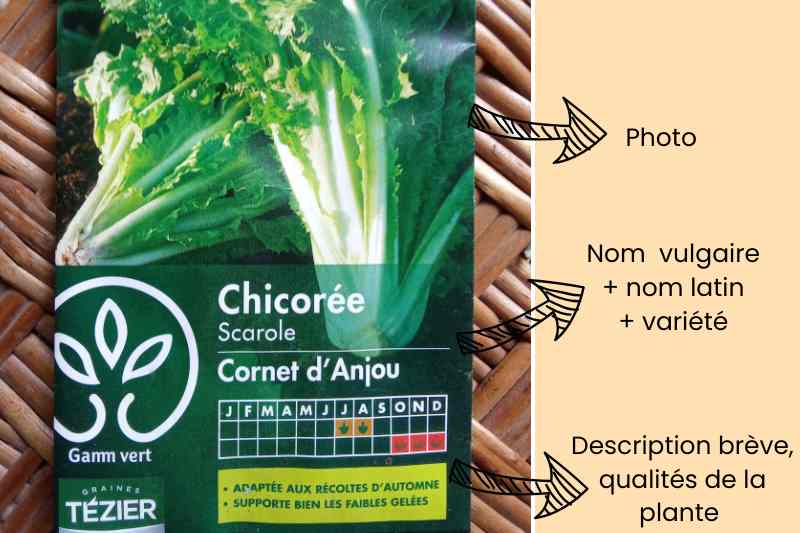
Generally, the packet will first display a photo or illustration of the plant at maturity. The common name is also given (for example ‘ramsons’), sometimes associated with the Latin botanical name (Allium ursinum). Some seed merchants also indicate the plant type and its life cycle: perennial vegetable, annual flower, biennial, perennial, etc.
Sometimes you’ll also find a short description of the plant and practical tips: its virtues and uses, its size at ripeness, the colour of its flowers, the characteristics of its foliage, its silhouette, etc.
Growing tips for successful sowing
Next, seed packets often contain a wealth of information on how to grow the plants. These are more technical details.
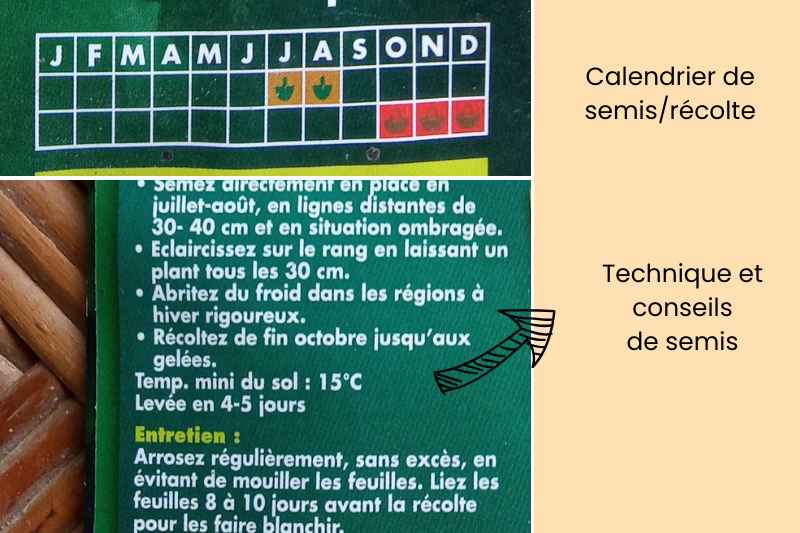
- The ideal sowing period. It often spans one or more months.
- The harvest period or the flowering period, which can be expressed in months or days after sowing (e.g., 18 days from sowing to the plant reaching maturity for radishes).
- The sowing technique. It can be in clusters, (several seeds in one hole), by broadcasting (scattering seeds by hand) or in rows (sowing aligned in rows). The term “in place” (directly in the ground) or “indoors / under cover” may also appear. Some seed companies provide a lot of technical indications on their packets: sowing depth, germination temperature, number of days to germination, exposure, spacing, watering, soil type, etc. To make reading of all this information easier, seed companies often choose to use pictograms: water drops for watering, arrows for spacing, sun or cloud for exposure, etc.
Seed information
The quality labels
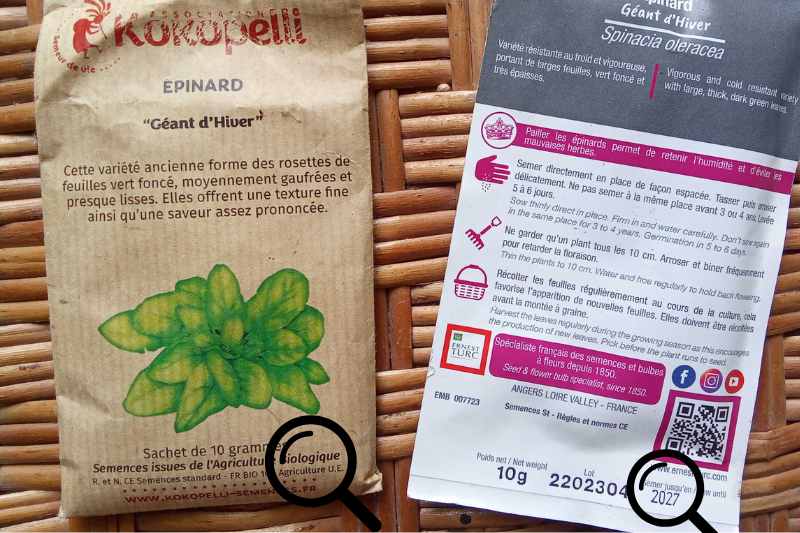
There are several. The most common is the AB label (green and white logo), created by the French Ministry of Agriculture in 1985. It ensures that the seeds meet the organic standards and have been certified by an organisation approved by the public authorities. Checks to verify the proper application of the rules may be carried out. There is also the Eurofeuille logo, which corresponds to the European label. Both are distinct from seeds produced by conventional farming.
By choosing organic seeds, you can be sure that:
- that the plants from which they were harvested are not derived from controversial GMOs;
- that they have not been treated with chemical products (pesticidal, insecticidal, fungicidal…);
- that you support a more sustainable model of agriculture, which uses environmentally sound practices and reduces humanity’s reliance on chemical inputs.
Organic seeds may come from old and/or local varieties, which deserve to be rediscovered, even if they are less common. They can also be considered easier to grow, since they will not have been grown with large amounts of synthetic fertilisers, and therefore experience somewhat tougher growing conditions (although some fertilisers are permitted in organic farming).
We should also mention the Demeter label, which certifies that the seeds conform to the biodynamic agriculture standards: use of natural preparations to revitalise soils, respect for natural cycles (notably lunar), etc.
Some seed packets may also display the wording “untreated seeds”, which means that the seeds have not undergone any treatment after harvest (but this does not guarantee that the parent plant did not receive any).
The F1 designation
The F1 designation, for First Filial Generation, is not always well known to the general public. It refers to seeds derived from a hybridisation, i.e. a cross between plants to improve the qualities of a variety: tomatoes less susceptible to late blight, courgettes more productive, etc. They are not GMOs since the plant’s genetic material is not modified.
But they have a major drawback: they are not reproducible. This means it is impossible to obtain the same variety the following year using the seeds, as the plant’s qualities are linked only to the first generation (they are not stabilised for subsequent generations). It is therefore imperative to buy seed every year, which creates a dependence. If you wish to harvest your own seeds for sowing in the future, do not choose F1 seed packets, but ensure they are reproducible seeds.
Let us take the opportunity to dispel a common misconception: not all organic seeds are necessarily reproducible. Some may be derived from F1 hybrids. However, for moral and environmental coherence, many labelled seed producers actually prioritise seeds that can be reseeded from one year to the next. Note that seeds from old varieties will necessarily be reproducible.
Coated or pelleted seeds
This information indicates that the seeds are covered with a coating, usually clay-based, which gives them a more regular shape, making handling easier, as well as the addition of nutrients favouring the germination of seedlings.
They are to be distinguished from coloured seeds which are treated, usually against certain fungal diseases (caused by fungi), such as damping-off.
Further information about the seeds
Finally, you will be able to read on seed packets:
- the number of seeds, sometimes expressed in grams, as an approximate count (+ or -) or in s/p, which simply means “seeds per packet” ;
- the date of harvest;
- the DLUO, i.e. the best-before date guaranteeing a good germination rate;
- optionally, the germination rate, expressed as a percentage (89 % means that 89 seeds in 100 are expected to germinate if the sowing conditions are favourable) ;
- the name and address of the seed supplier;
- the lot number, which may be useful in the event of germination problems.
- Subscribe!
- Contents
Comments