





























How to water succulents properly?
Common mistakes to avoid
Contents
Often perceived as hardy plants, succulent plants and cacti have a reputation for needing little water. Yet, although they are naturally adapted to arid mediums, their watering demands attention and precision. Too often, excesses or prolonged omissions jeopardise their health.
A stubborn misconception leads one to believe that they hardly need watering, or that a simple sprayer is enough to care for them. However, these unsuitable practices are the cause of many failures, particularly in indoor cultivation.
This article aims to help you understand the true water needs of succulent plants, to tailor your watering to the growing conditions, and to avoid common mistakes that may jeopardise their longevity.

Understanding the specific needs of succulents and cacti
Succulent plants, also known as succulents, and cacti have developed physiological strategies that allow them to withstand prolonged periods of drought. Their secret lies in their ability to store water in certain parts of their anatomy: thick leaves, fleshy stems or even tuberous roots depending on the species. This store enables them to survive in environments with little rainfall, but that by no means means they do not need water.
Adapted to arid environments, succulent plants are adept at managing evapotranspiration thanks to mechanisms such as daytime stomatal closure or a distinctive photosynthetic metabolism (CAM, or Crassulacean Acid Metabolism). However, they do not tolerate prolonged periods without moisture, especially during growth. Too much water stress depletes their reserves, weakens their metabolism and can severely slow their development, or even lead to the loss of parts of the plant.
It’s also important to distinguish between cacti and other succulent plants. All cacti are succulents, but not all succulents are cacti. Cacti (such as Opuntia, Echinopsis or Mammillaria) are recognised by their areoles, these small cushion-like structures from which spines emerge. Conversely, other genera such as the Crassula, Echeveria, Haworthia, Sedum or Aeonium are non-cactus succulents: their leaves are often fleshy, sometimes coated with a waxy bloom, but they do not have areoles or true spines.
Understanding these structural differences helps tailor watering to each plant’s mode of water storage. For example, a Haworthia, which stores water in its compact leaves and often grows in partial shade, will have slightly different water needs from a globose cactus grown in full sun.
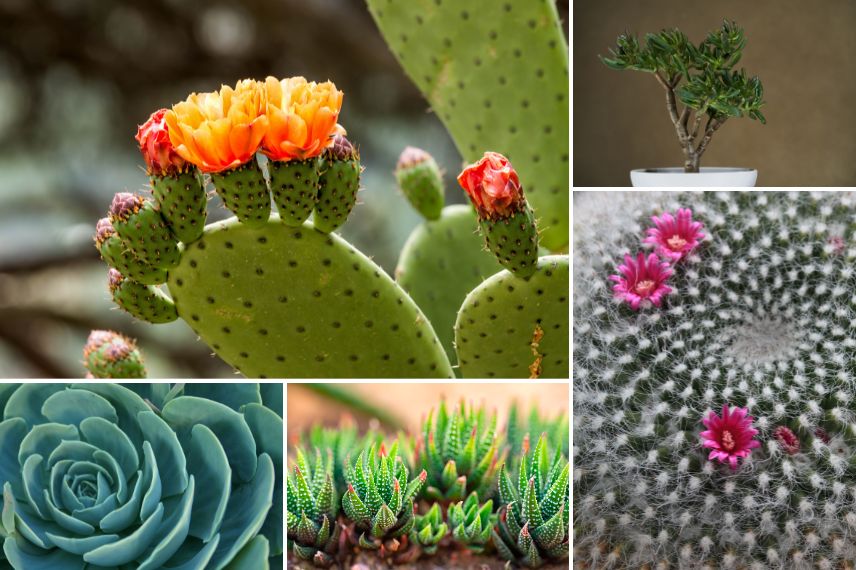
Opuntia at the top left, Crassula at the top right. Echeveria at the bottom left, Haworthia at the centre bottom and Mammilaria at the right.
Factors influencing the watering of succulents
Watering of succulents does not follow a fixed rule: it depends on many parameters related to the substrate, the container, cultivation conditions and the seasons.
- A potting mix that is too compact retains water, which promotes root rot. A well-drained substrate, based on potting mix lightened with sand, perlite or gravel, ensures rapid drainage of excess water and good root aeration. This helps reduce the risk of root oxygen deficiency.
- The pot also matters. A terracotta, porous container promotes evaporation of moisture and dries out faster than a plastic pot, which retains moisture longer. In all cases, drainage holes are essential to remove the excess water.
- The more the plant is exposed to direct sunlight and heat, the faster the water evaporates. Conversely, in cooler or shadier conditions, evaporation decreases and watering should be more spaced out.
- During the active growth period (usually from spring to summer), succulents require more water. In winter, many of them enter dormancy: their water consumption falls, and watering should be reduced, or even halted.
- In heated interiors, the air is often dry, which increases evaporation. In a greenhouse or conservatory, heat and humidity may be greater, while outdoors, watering must also take into account rain, wind and temperature fluctuations.
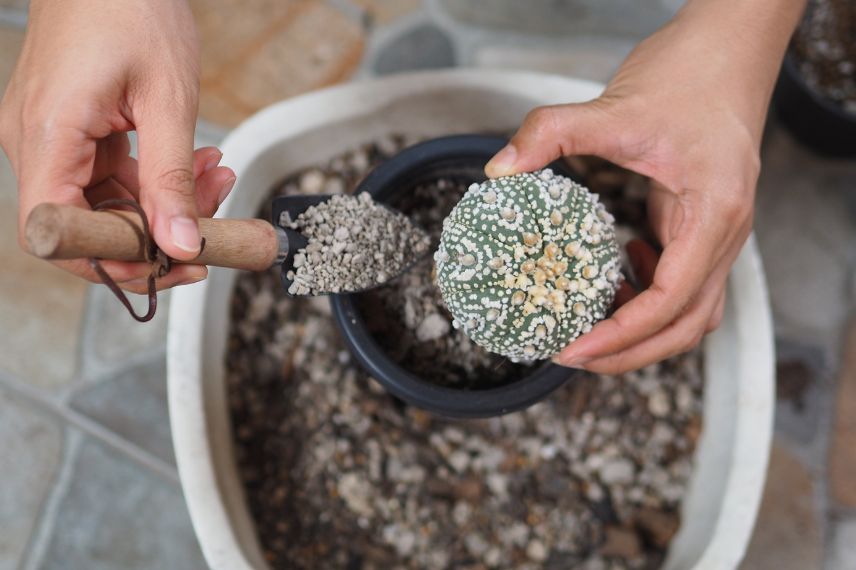 Always use a draining substrate: either a cactus and succulent potting mix, or potting mix lightened with sand, gravel or perlite.
When should you water succulents or cacti?
Watering of succulents relies on observation rather than a rigid schedule. A potting mix that is completely dry throughout its depth, and foliage that softens slightly or wrinkles are indicators that the plant is starting to draw on its reserves and that a watering is necessary.
Watering frequency varies with the seasons. In the growing season, in spring and summer, watering every 7 to 10 days is generally sufficient, depending on heat and light. In autumn and especially in winter, when the plant enters dormancy, it is essential to greatly reduce water inputs: we limit ourselves to a watering every 3 to 4 weeks, or even suspend watering altogether for the hardiest species.
Oli’s little note : the golden rule, applicable to all succulent plants, remains this: it’s always better to be a little too dry than too wet. Overwatering is far more dangerous than the occasional missed watering.
Read also
7 Easy-to-grow succulent plantsHow should you water a succulent plant properly?
-
Top watering is suitable for most situations, provided you do not over-water excessively. Soaking, on the other hand, is best for small pots or plants that have recently been repotted, ensuring good drainage afterwards.
-
Water deeply enough for the water to reach the roots. Watering that is too light hydrates only the surface, which causes the plant to form shallow roots, more susceptible to drying out.
-
Let it dry out completely between two waterings. The substrate should become dry throughout before watering again. This cycle of moisture and dryness mirrors the natural rhythm of arid seasons.
-
Avoid wetting the collar or the foliage. Some succulents, such as Echeveria, dislike stagnant moisture on their leaves or at the base of the rosette. This can promote rot, especially in a cool or poorly ventilated environment.
-
Prefer watering in the morning to allow residual moisture to evaporate during the day, reducing fungal risks. Indoors, this also helps prevent the atmosphere from becoming too damp at night.
Good to know! Preferably use room-temperature water with low mineral content, such as rainwater or filtered water, to avoid thermal shocks and mineral deposits on the substrate and the roots.
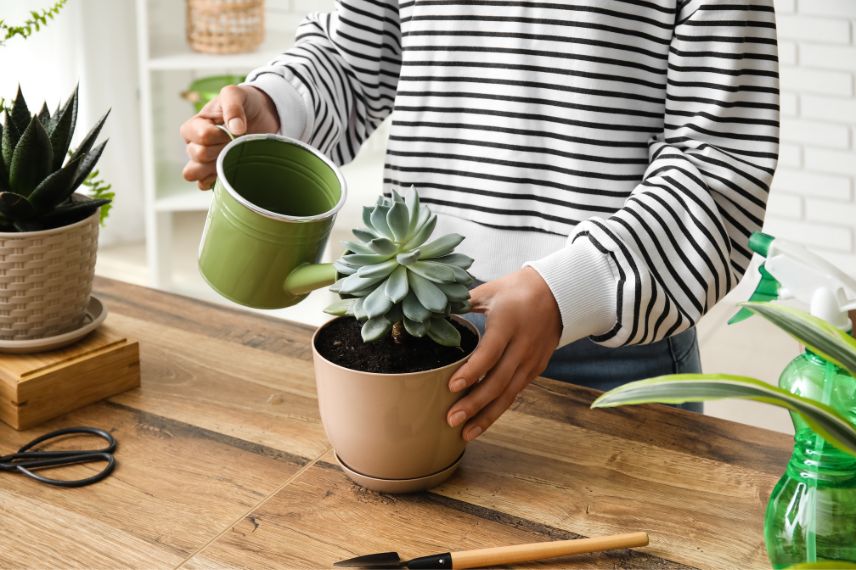
Water from the top and do not wet the foliage. Remember to empty the saucer afterwards!
Most common watering mistakes (and how to avoid them)
-
Watering too frequently, even in small quantities: this prevents the substrate from drying out completely and promotes root rot.
-
Leaving water to stagnate in the saucer: roots stay in moisture, which can lead to root asphyxia or fungal diseases.
-
Using a non-draining substrate: a potting mix that is too dense retains water, slows drainage and compromises root aeration.
-
Planting in pots without drainage holes: excess water cannot escape, creating a saturated, waterlogged environment that is dangerous for the plant.
-
Spraying instead of watering: this does not adequately hydrate the roots and may also promote the appearance of spots on the leaves.
-
Watering during winter dormancy: in the absence of growth, water is not absorbed and stagnates, greatly increasing the risk of rot.
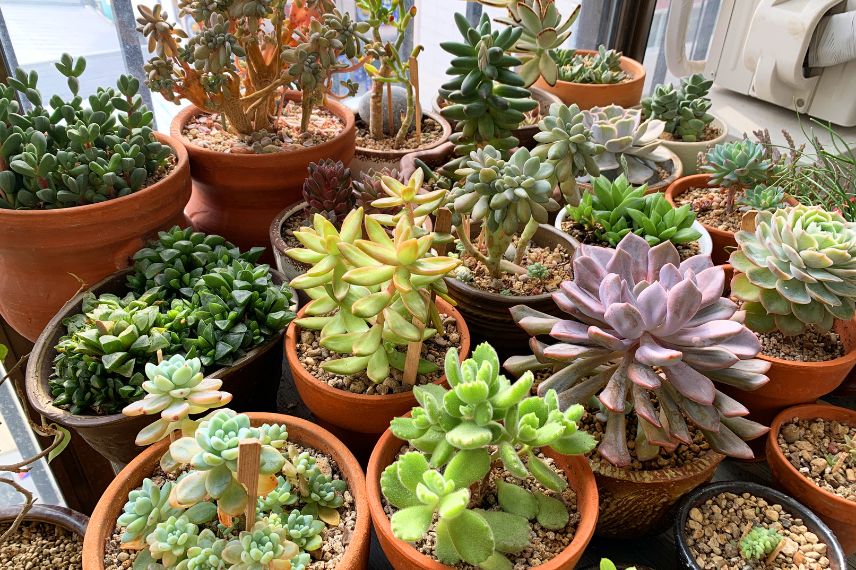 Plants like to be grouped together. This helps retain moisture better. The same goes for cacti and succulent plants.
Symptoms of overwatering or underwatering in cacti and succulent plants
Overwatering
Overwatering is often manifested by leaves that are wilted, sometimes translucent, with black or brown spots on the leaves or at the base of the plant, or even collar rot. The leaves can end up dropping all at once. If these signs appear, act quickly: remove the plant from the pot, check the roots, drain or repot if necessary, and stop watering until the substrate dries completely.
Underwatering
Underwatering, on the other hand, causes a progressive wilting of the foliage, often accompanied by a crinkled or wilted appearance, but without blackening. The plant then goes into survival mode. A thorough watering usually rehydrates it and restarts its activity, provided the substrate is still healthy.
Oli’s tip: insert a finger (or, if needed, a thin skewer) into the substrate: if it comes out dry and clean, the plant can be watered; if it is still damp, wait a few days.
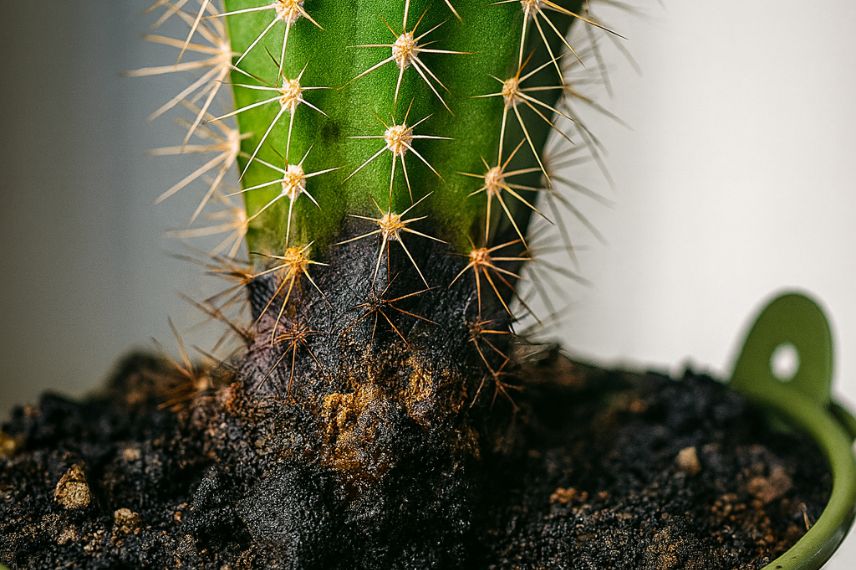
Overwatering and poorly draining substrate will cause collar rot in cacti and succulents. (AI-enhanced image)
A few specific cases to be aware of
- Some monocarpic succulents, such as agaves, flower only once before dying. Towards the end of their life, they become more sensitive to excess water: reduce watering at this stage to avoid premature deterioration.
- Indoor-grown tropical succulents prefer more moderate, regular watering. They do not tolerate excesses, but also fear prolonged droughts, especially indoors in heated environments.
- Young plants and cuttings, during rooting, require closer attention: the substrate must never stay waterlogged, but must not dry out completely either. Humidity should be light, but constant, until the roots are well formed.
- Outdoors, watering depends largely on the climate. In summer, the heat may require more frequent watering, unless it rains. In winter, it is imperative to protect sensitive succulent plants from persistent moisture, especially in cold and damp climates.
- Subscribe!
- Contents
Comments