





























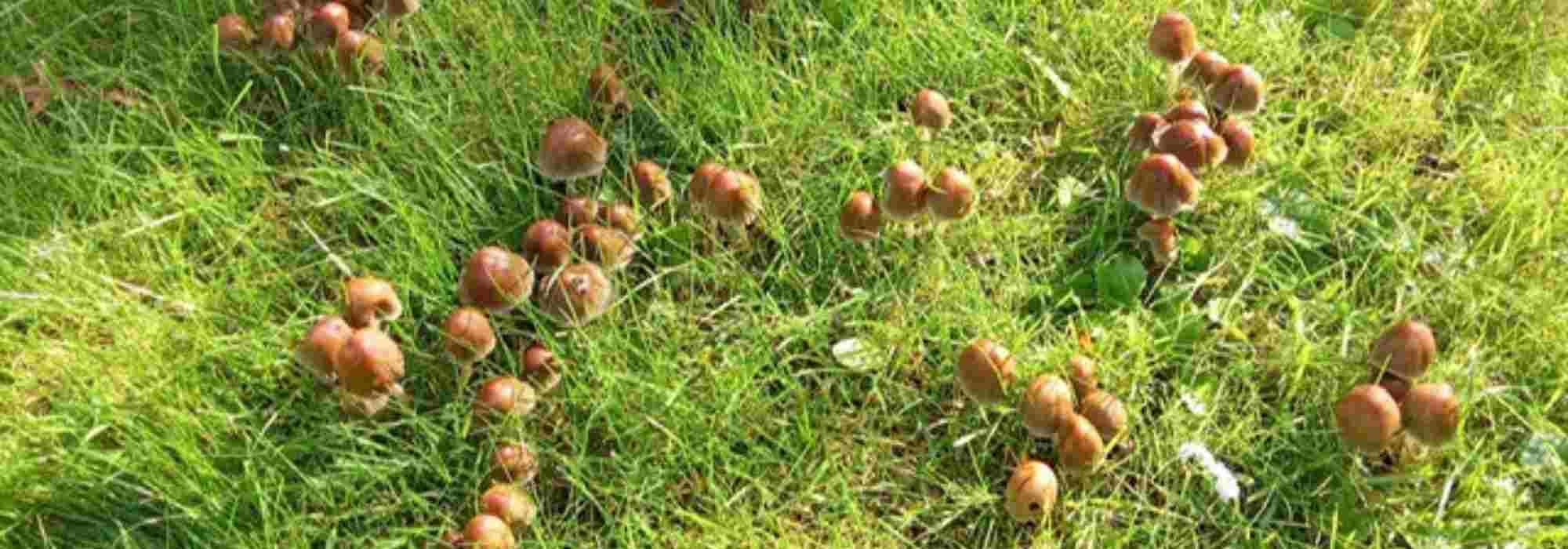
Mushrooms in the lawn: what to do?
Why do they appear, and should we get rid of them?
Contents
It is not uncommon to see a flush of mushrooms in autumn or spring, right in the middle of your lawn. Mushrooms do sometimes grow in our lawns, in patches or in rings. Should you be concerned? What does this mean for the lawn’s health? Should you remove them, or simply ignore them? Are they edible? We answer these legitimate questions in this article.

Why do mushrooms grow in the lawn?
Mushrooms often pop up in the middle of lawns after spells of rain and when night-time temperatures cool a little. This is usually the case in autumn, when humidity is high with recurring rains, but also to a lesser extent in spring, and when temperatures hover around 15–20°C. Suddenly, from day to day, circles or randomly extended patches of mushrooms appear in certain areas of the lawn.
It is indeed the moisture that triggers these shoots that bother us as the lawn greens up nicely! Mushrooms will grow more precisely in semi-shaded or shaded areas, where the lawn stays wet longer during rainfall.
These growths usually disappear as quickly as they occurred, generally as soon as temperatures rise a little. So wait a little before mowing.
When they are arranged in a circle, they are called fairy rings or witches’ circles. They are ring-shaped mycelia that grow in soils rich in organic matter. Learn much more in our article on the topic: What is a fairy ring: explanations, legends and mysteries.
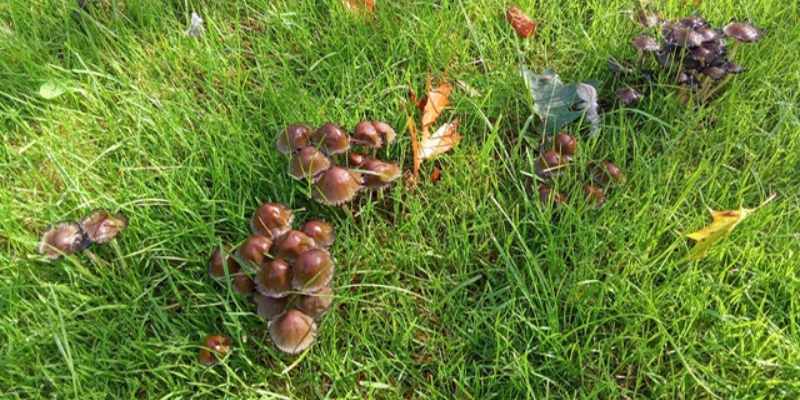
Tufts of small mushrooms appear overnight! (Photo by Gwenaëlle Authier)
What does that mean for lawn health?
Generally, mushrooms are observed on fairly poor soils, or on soils that are poorly drained or too compact. But that isn’t always the case. Mushrooms will also grow on lawns where organic matter is plentiful, such as lawns mowed with a mulching system, i.e., leaving finely chopped grass on the soil in large quantities (a situation often found in large gardens). The dense felt that forms over time, if not kept in check, will provide a bed conducive to the growth of mushrooms.
N.B.: Mushrooms thrive particularly well on another surface: mulched beds with insufficiently decomposed wood chips, on which they feed until these chips are incorporated into the soil through decomposition.
Which mushrooms grow on lawns?
The phenomenon of mushrooms appearing on the lawn is quite noticeable in autumn, as many fungi have a life cycle that makes them grow during this season. But don’t expect to see death caps or porcini on your green carpet…
Lawn mushrooms can take various forms, ranging from small umbrella-shaped mushrooms (the most common and generally harmless) to more complex structures such as mycorrhizal vesicles (fungi that are ball- or coral-shaped, much more toxic). At first glance, one often thinks you recognise morels or boletes. Unfortunately, on our lawns, there are mushrooms of little interest, some hallucinogenic, even toxic or deadly: the psilocybe, the Armillaria mellea at the base of trees or on stumps, the Paxillus involutus, and Amanita species…
In fairy rings, Marasmius oreades is frequently seen growing, also called the fairy ring mushroom, which is indeed edible. Nevertheless, please note that identifying mushrooms from an app or guide is not reliable (some sources are not trustworthy!), and this is best left to experienced mycologists.
Read also
Manual scarifier: how to use it?Are these mushrooms edible?
We could easily rustle up a good panful of these providential mushrooms within easy reach on the lawn… However, Caution is essential. Lawn mushrooms growing in colonies are rarely interesting mushrooms from a culinary standpoint, and a great many are toxic. As we’ve just noted, you need to be a seasoned expert to identify a mushroom, because nothing resembles an edible, gilled mushroom more than a poisonous, gilled one. Not to mention all mushrooms that can cause gastrointestinal symptoms, severe allergic reactions up to kidney damage, and of course deadly mushrooms. You’ve been warned!
Should we leave them or delete them?
Rest assured, this appearance of mushrooms on the lawn is purely cosmetic. These mushrooms are, in fact, not harmful to the lawn itself.
To limit these mushroom shoots that may dismay you, soil aeration is essential, as is removing excess organic matter.
This can be done with small ventilated cleated soles sold commercially to reduce soil compaction.
Scarification carried out in autumn will be beneficial for this kind of minor issue, as it will help clear the lawn of thatch, mulched mowing debris and lignified debris that have accumulated there.
Otherwise, remember to rake the lawn regularly, especially in shaded areas, to remove excess grass growth and fallen leaves.
If you have a large number of tree stumps and mushrooms proliferating nearby, don’t hesitate to call in a professional to remove some of them (it will also make mowing easier!).
Finally, some lawn mushrooms can be toxic to pets. If you have pets, it is recommended to monitor your lawn and remove any suspicious mushrooms immediately.
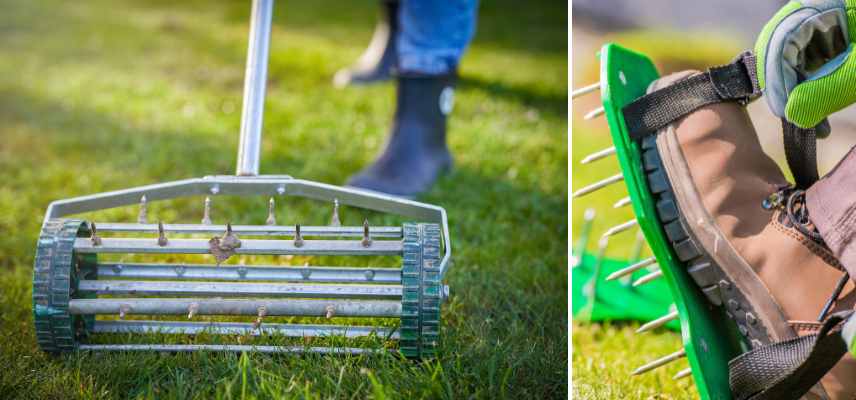
Scarification and lawn aeration should be considered if you notice a lot of lawn mushrooms
- Subscribe!
- Contents
Comments