


Myrmecochory: When Ants Become Gardeners
Discover a fascinating way ants disperse seeds of certain plants.
Contents
In nature, everyone has a role: the bee forages and carries pollen from one flower to another, birds feed on seeds and disperse them further through their droppings, the wind disperses the volatile pollen grains or dandelion achenes. On and under the soil of our forests and gardens, others play an equally important role. Namely the discreet, silent and hardworking ants that disseminate some seeds as well. As for payment, it goes without saying! Indeed, between ants and certain plants, a vital alliance for both parties, myrmecochory, is established.
Discover the ins and outs of this win–win collaboration, dubbed myrmecochory, where the plant “uses” the ant to ensure its longevity.

What exactly is myrmecochory?
Derived from the Greek myrmex (ant) and khorein (to move), the term “myrmecochory” designates seed dispersal by ants. Far from being a mere accident of fate, it is a genuine biological collaboration! It is even one of the most sophisticated modes of seed dispersal there is.
Unlike seed dispersal by birds, which relies on the random ingestion of fleshy fruits, myrmecochory is a form of mutualism, a collaboration. An exchange of services and goodwill in which each partner benefits.
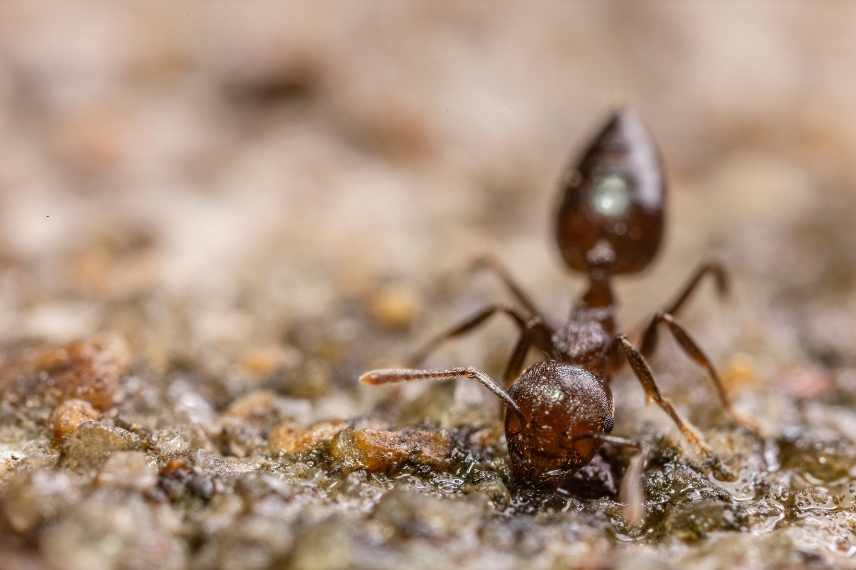
Often discreet, the ant plays a crucial role in the dispersal of certain seeds.
And this mechanism rests on a subtle chemical manipulation by the plant for the benefit of the ant, which moves the seed horizontally and vertically. It is this dual action that makes the ant a highly effective dispersal agent.
The elaiosome, the ultimate reward
The ant thus moves a seed horizontally along the ground before burying it. But, you may wonder, why would an ant go to the effort of transporting a seed sometimes two or three times heavier than itself? The answer lies in one word: the elaiosome.
Elaiosome, a delicacy for ants
The elaiosome is a small fleshy and oily outgrowth, often whitish or translucent, attached to the seed. Rich in lipids, proteins, and vitamins, it plays no role in the plant’s germination. Its sole function is to act as a prime lure for ants. But the plant does not stop at offering an edible reward to ants; it ‘signals’ the presence of the seed to them by mimicking, via the elaiosome’s composition, the oleic acids found in dead insects. For the ant, this seed becomes a prime delicacy for itself or the larvae. A true energy-rich treat, utterly irresistible.
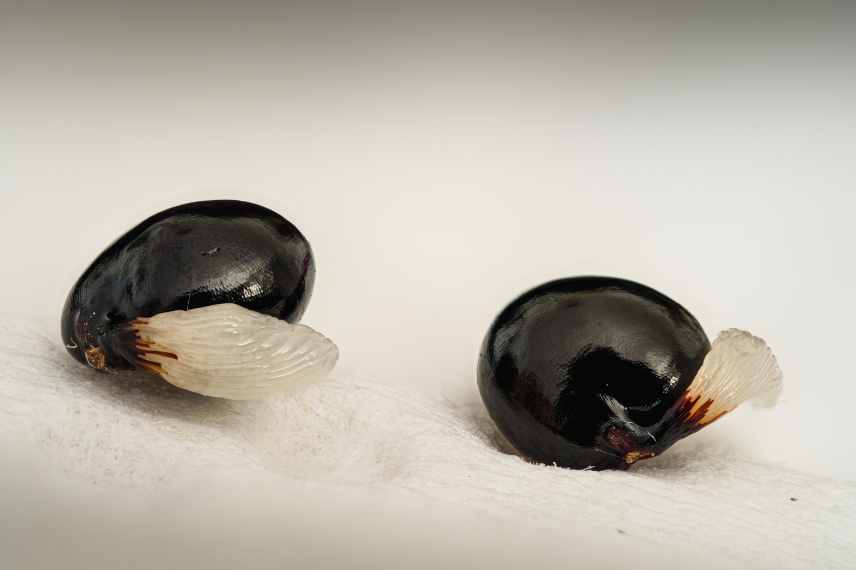
Elaiosome of a seed
The transport process
When a worker ant discovers a seed equipped with an elaiosome, it grasps it with its mandibles and eagerly carries it back to the nest, spanning hundreds of centimetres, even tens of metres. Not without its fair share of obstacles! Once inside, the elaiosome is consumed by the larvae or the workers. The seed itself, protected by a hard and smooth integument, and which does not interest the ants, remains intact. Having become cumbersome, it is then transported to the colony’s refuse dumps or abandoned in an underground gallery.
And that’s where the magic happens: the seed ends up being sown in an ideal environment, protected from predators and surrounded by nutrients. Perfect for germination!
Which plants use this mode of seed dispersal?
Around 11,000 plant species worldwide practise myrmecochory. In our temperate gardens and European forests, this mode of dispersal is particularly common among spring plants. These plants are called myrmecochorous, often small in size and with early spring flowering, which produce seeds that drop at the base of the parent plant:
- The violet and the wild pansy (Viola sp.) : Violets produce seeds equipped with a white and shiny elaiosome that immediately attracts ants.
- The primrose (Primula vulgaris) : It is also a typical example of a myrmecochorous plant that flowers early in spring. Just as the ants begin to become active. This is why in gardens and woodlands, one often sees new primroses, spaced a few metres apart, usually at the foot of walls or in lawns.
- The Snowdrop (Galanthus nivalis) : Its seeds drop to the soil as soon as flowering ends, ready to be carried away by the season’s first worker ants.
- Greater celandine (Chelidonium majus) : Often considered a “weed”, its presence in wall crevices and unlikely corners is due to the tireless work of ants.
- Cyclamen : After flowering, the cyclamen stem coils like a spring to deposit the seeds as close to the soil as possible, making it easier for the ants to collect them.
- The wood anemone (Anemone nemorosa) and the hepatic anemone (‘anémone hépathique (Hepatica nobilis) : They colonise the woodlands thanks to this partnership, forming vast carpets of flowers in spring.
- Corydalis (Corydalis) : these spring flowers produce black seeds with a very visible white elaiosome.
- Lamium (Lamium) : common on woodland edges and shaded areas, lamium is often myrmecochorous.
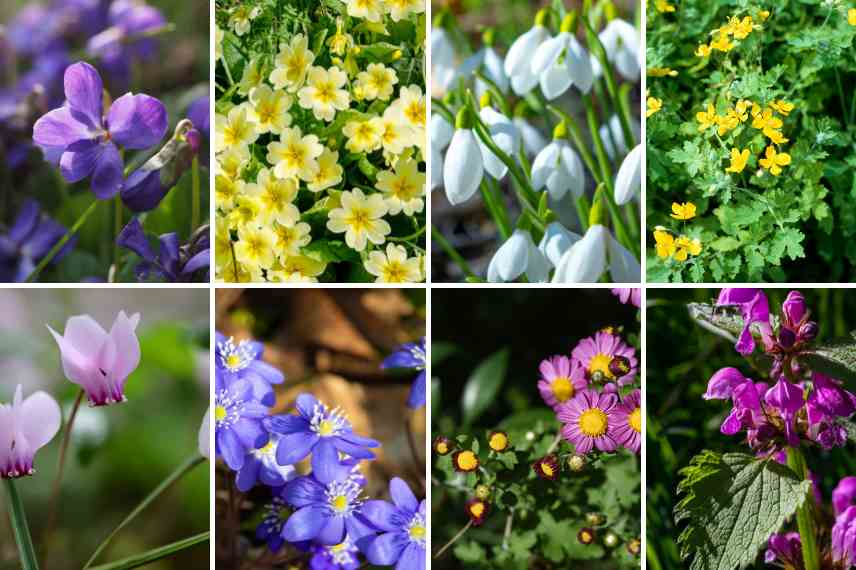
Myrmecochorous plants
The advantages of this partnership between plants and ants
At first glance, myrmecochory is a wholly astonishing phenomenon, but it is not anecdotal. It is, in fact, a genuine survival strategy that offers considerable benefits to both parties.
The benefits for the myrmecochorous plant
- A protection against predation: A seed left on the surface of the soil risks being eaten by a rodent or a bird. By being carried underground, it escapes the gaze and the predation of these granivores, which would have been content to eat it
- A protection against fire: In fire-prone environments, such as scrub vegetation in the Mediterranean or Australian bush, seeds buried by ants survive the passage of flames. Protected from heat and flames, they germinate as soon as the fire is extinguished and bring landscapes back to life.
- A tailor-made fertiliser: The waste zones of ant nests are extremely rich in nitrogen and phosphorus. The seed therefore germinates in a high-quality ‘potting mix’
- A bypass of competition: By moving the seed far from the mother plant, the ant allows the new plant to avoid direct competition for light, nutrients and water with its parent.
Benefits for the ants
The elaiosome provides a stable and easy-to-collect food source. In some nutrient-poor environments, it is an essential protein resource for the development of the colony’s larvae.
And for the gardener?
By observing ants, these tireless workers, the gardener can only learn patience and humility. And also letting go. Indeed, to have a beautiful garden, one must of course sow and plant, tend and prune, fertilise and water… but one must also let those who participate indirectly but effectively do their part. And what could be more beautiful than a carpet of violets beneath the shade of a fine tree?
How can the gardener foster this collaboration?
Understanding myrmecochory can change how we view the garden. What’s more, ants are often poorly regarded in the garden. We want to drive them away or, worse, eradicate them. But consider an ant that carries a seed not as an invader, but as a cultivation ally. That’s already an important step towards preserving them.
Next, you can encourage their presence in a natural garden with just a few simple steps:
-
Limit insecticidal products: the use of pesticidal products, even natural and non-targeted ones, disrupts the pheromone trails of ants and decimates colonies.
-
Preserve litter layers: Do not obsessively tidy every centimetre of soil. Fallen leaves and plant debris are the ants’ highways where they travel without us really noticing.
-
Embrace wandering: If a violet grows between two paving slabs or at the foot of a wall, it’s probably the work of an ant. Let these plants establish themselves where they have been sown. They will form, like primroses, magnificent carpets of flowers in spring.
Myrmecochory, a very delicate balance
Unfortunately, this partnership is under threat. The introduction of invasive ant species, such as the Argentine ant, disrupts this cycle. Unlike our local species, these ants often consume the elaiosome on site without transporting the seed, or outright devour the seed, thus breaking the mutualistic relationship. These ants are already widespread along the Mediterranean, in the southern departments and in Corsica.
Climate warming also plays a role: if flowering of plants and ant activity are no longer synchronised, seed dispersal can no longer take place, risking the survival of certain plant species in the long term.
- Subscribe!
- Contents
Comments