






























The easiest houseplants to propagate by cuttings
Everything you need to know to successfully take cuttings from indoor plants
Contents
Propagating your houseplants by cuttings is a simple, economical and very rewarding practice. Propagation by cuttings allows you to obtain new plants without spending a penny, while watching the magic of nature at work. Some species lend themselves particularly well to propagation by cuttings and develop roots in record time, even without sophisticated equipment. This is the case with pothos or chlorophytum. It is therefore an ideal technique for gardeners or plant lovers who are beginners. You can thus brighten your home and share your cuttings with your loved ones.

Among houseplants easiest to propagate by cuttings, coleus is one of the champions.
Why propagating your houseplants?
Propagating houseplants mainly allows you to save money, by freely multiplying species you already enjoy. It is also a great source of personal satisfaction, as one follows step by step the birth of a new young plant from a single stem. Finally, propagation by cuttings promotes sharing with loved ones, while remaining a gentle and respectful method for the mother plant.
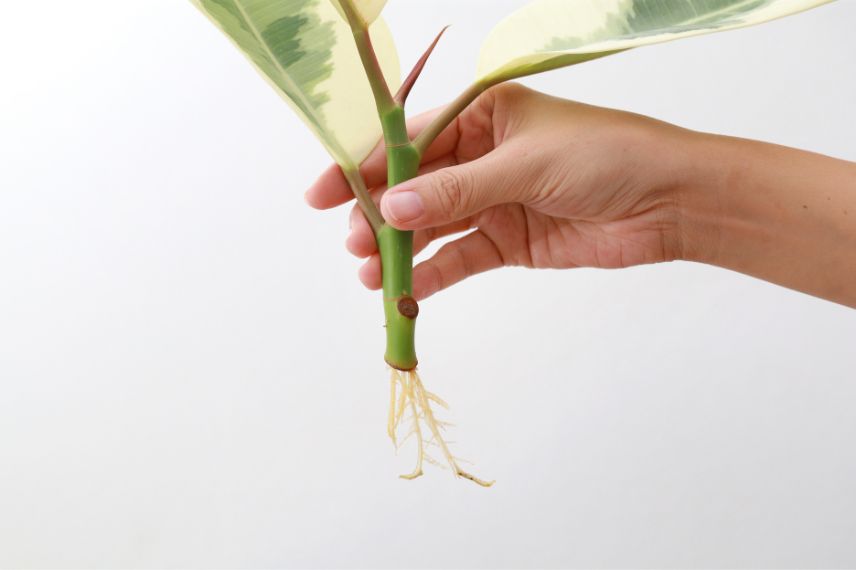 Producing your own plants is always very rewarding. Now it’s time to repot this young rubber plant, Ficus elastica.
Read also
Propagating cacti and succulentsEasiest green plants to propagate
Water propagation by cuttings
Some houseplants, such as Pothos or Tradescantia, are perfect for water propagation because they readily develop roots. Simply place a cut stem just below a node in a glass of water to quickly see new roots appear.
– Pothos (Epipremnum aureum)
The Pothos is one of the easiest plants to propagate. Simply cut a section of stem bearing a node, remove the lower leaves and place it in a glass of water. Roots appear in about ten days and the cutting can then be potted on.
– Spiderwort (Tradescantia)
The indoor Tradescantia, commonly known as spiderwort, roots very quickly. A stem simply placed in a glass of clear water develops fine roots in a few days. It is an ideal plant for beginners to propagate by cuttings and enjoy a new, decorative pot quickly.
– Coleus (Solenostemon)
Much loved for its colourful foliage, the Coleus is perfect for learning to propagate. A simple stem placed in a glass of water roots in a few days. The cutting can then simply be potted on to obtain a new plant.
Propagation in pots
Many houseplants can also be propagated directly in pots. Simply take a section of stem and plant your cutting in a light, moist substrate, sometimes covering with a mini-greenhouse to optimise success.
– Philodendron scandens
With its long flexible stems and heart-shaped leaves, the Philodendron scandens is very easy to propagate. Take a piece of stem with at least one node and place it in a light potting compost (or in water). The plant roots readily and quickly resumes growth.
– Monstera (Monstera deliciosa)
Monstera is well suited to propagation thanks to its aerial roots already present on the stem. Simply cut a section of stem bearing a leaf and an aerial root, then plant it directly in a pot (in water, that also works). New roots develop quickly, giving rise to a vigorous plant.
– Chlorophytum (spider plant)
The Chlorophytum naturally multiplies from small plantlets attached to its long stems. Simply detach them gently and replant in a small pot of moist potting compost. They quickly root and produce new plants with little effort.
– Syngonium (Syngonium podophyllum)
The Syngonium, prized for its lobed leaves, is propagated by cutting a stem bearing a node. In moist potting compost, the syngonium cutting roots quickly. It is a hardy plant that beginners will find easy to grow.
Cacti and succulents
The propagation of cacti and succulents is often very straightforward: many species are incredibly easy to propagate. It usually suffices to take a leaf or a stem and let it dry before placing it on a substrate, thus enabling new plants to form quickly.
– Echeveria
In Echeveria, you can simply detach a healthy leaf from the base of the rosette. After a few days of air-drying to prevent rot, place it on dry substrate. Tiny roots and a new rosette appear within a few weeks.
– Crassula (jade plant)
Crassula propagates very easily by stem or leaf cuttings. After a short air-drying healing period, the cutting is placed on light, well-drained potting mix. It quickly forms roots, even with little care.
– Opuntia (prickly pear)
Opuntia is propagated from a cladode (pad). Let it dry for a few days, then plant it lightly in a well-drained sandy substrate. Roots appear quickly and the plant soon resumes growth.
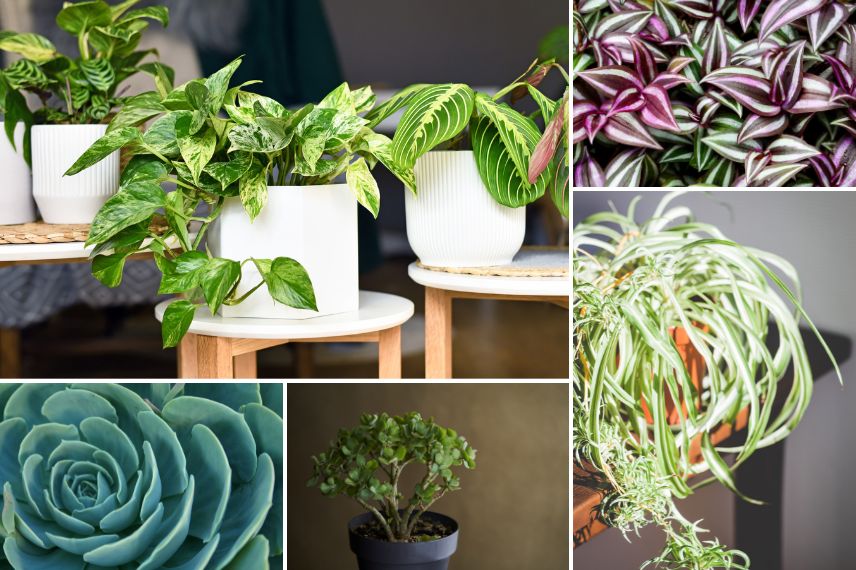 Some plants are easier to propagate by cuttings than others: Pothos, Tradescantia, Echeveria, Crassula or Chlorophytum.
Common mistakes to avoid
-
Avoid overwatering: a substrate that is too damp or poorly drained can cause a cutting to rot before it even develops roots.
-
Ensure sufficient light: a cutting placed in too dark a spot takes root slowly and may weaken quickly.
-
Choose the right stem for propagation: very young stems are fragile and dry out quickly, while very old stems root poorly; prefer semi-woody, flexible shoots, but already well-formed.
- Subscribe!
- Contents
Comments