





























Planting and growing Catalpas in pots
Our tips for a successful growth
Contents
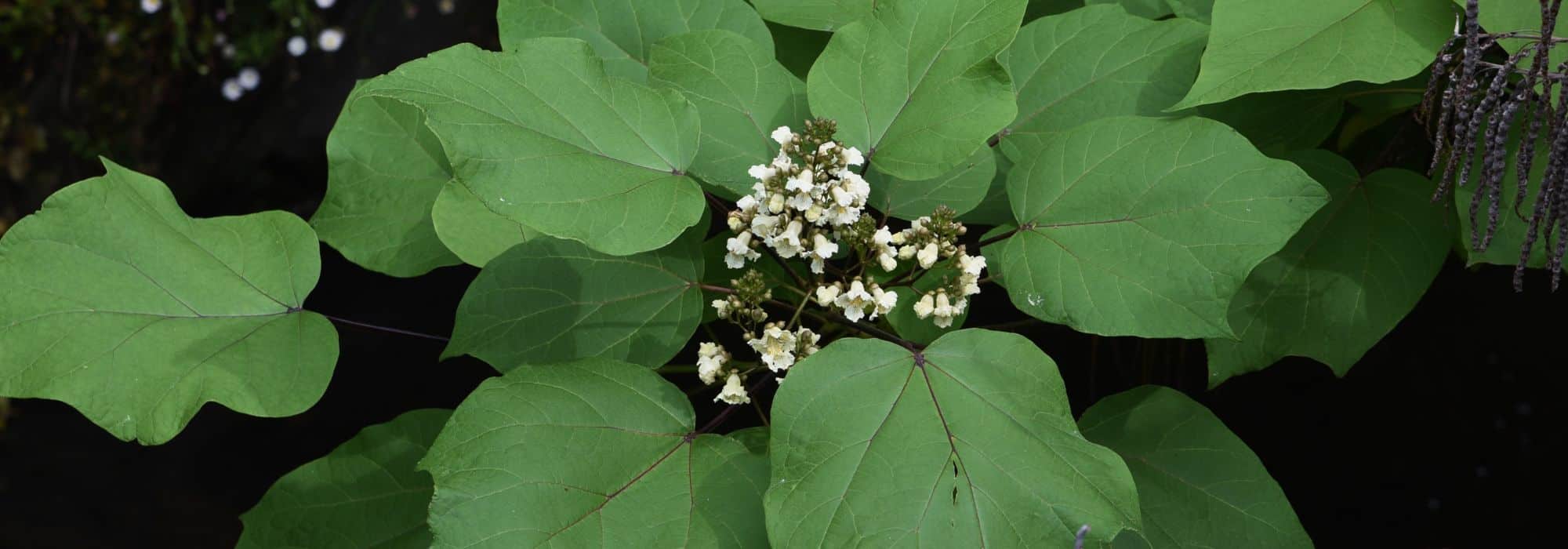
Catalpa, or Indian bean tree, is appreciated for its generous, heart-shaped foliage, but also for its summer flowering in white clusters. If it is usually planted in garden soil to enjoy its shade, Did you know you can also grow it in a pot, to enjoy its benefits even in compact spaces such as terraces and balconies? Discover our tips for successful planting and growing your catalpa in a container.

Why planting Catalpa in a pot?
Planting a catalpa in a pot is a great idea for many reasons:
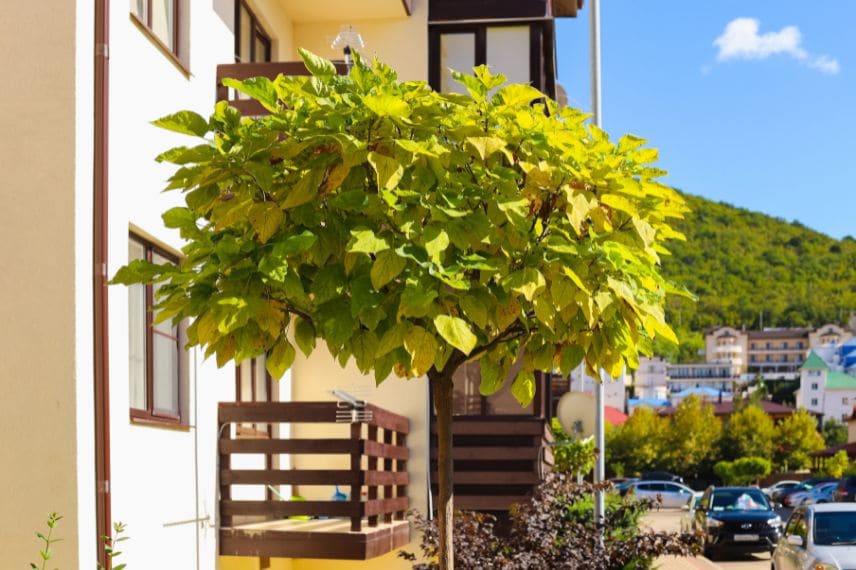
- A decorative tree suitable for small spaces: in a container, the catalpa’s pruning remains under control, making it perfect for adorning a terrace or balcony.
- A notable degree of mobility: with the pot, the catalpa can be moved as required, especially to adjust its sun exposure or to protect it in winter.
- Ease of maintenance: in a pot, the roots are contained, which simplifies watering, pruning and monitoring.
- A major aesthetic asset: the catalpa, with its large heart-shaped leaves and clusters of white flowers, adds an elegant and natural touch.
Read also
Catalpa: planting, pruning and careWhich catalpa variety to choose?
Not all catalpa varieties are suitable for container culture. It is preferable to choose cultivars with a moderate growth habit. When purchasing, also opt for a small tree, which will adapt better to its container, especially since catalpa trees grow rapidly. Here are a few suggestions:
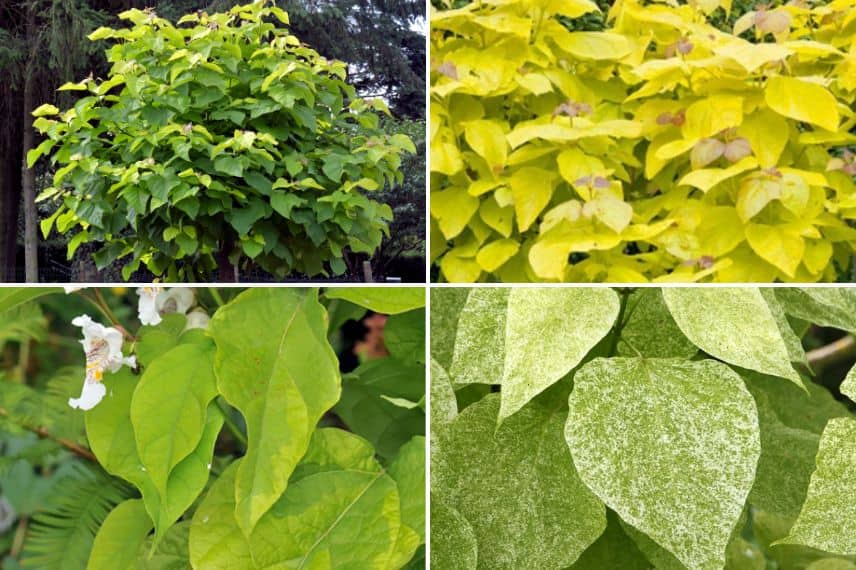
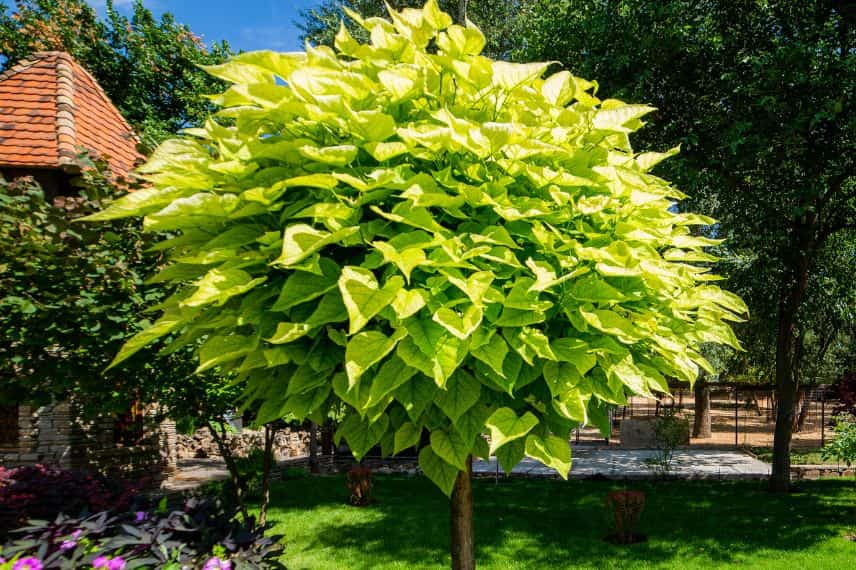
- Catalpa bignonioides ‘Nana’ : also known as ball catalpa, it is among the slowest-growing varieties. It has a compact, ball-shaped habit. Ideal for small spaces, it does not produce flowers, but its dense foliage provides welcome shade.
- Catalpa bignonioides ‘Aurea’ : this variety is distinguished by its bright golden-yellow foliage. In open ground, it can reach a 7-metre spread at maturity, but container cultivation can significantly reduce its dimensions. Its summer flowering, white with purple centres, is followed by long decorative pods.
- Catalpa bignonioides ‘Variegata’ : this variety is distinguished by its variegated green and cream-white foliage, which brightens the space. With a moderate mature size, it is perfectly suited to container culture, where its growth will be even more contained. Its white summer flowering adds an elegant, fragrant touch.
- Catalpa speciosa ‘Pulverulenta’ : this catalpa is notable for its leaves lightly dusted with white, which give it a delicate, refined look. Smaller than the common catalpa, it is ideal for container culture, where it brings a unique charm thanks to its ornamental foliage. In summer, it bears beautiful white flowers with yellow centres.
When should you plant a catalpa in a pot?
The ideal period for planting a catalpa in a pot depends on climate conditions:
- In spring : mild temperatures promote rapid rooting and vigorous growth.
- In autumn : planting at this season allows the catalpa to settle in well before winter, but this method should be reserved for regions with mild winters.
Avoid, if possible, planting a catalpa in summer, to avoid the tree’s water stress, even with regular watering. In winter, planting is not advised due to the risk of frost.
Which pot should I choose to grow a catalpa?
For a catalpa with a well-developed root system, you should start by choosing the right pot:
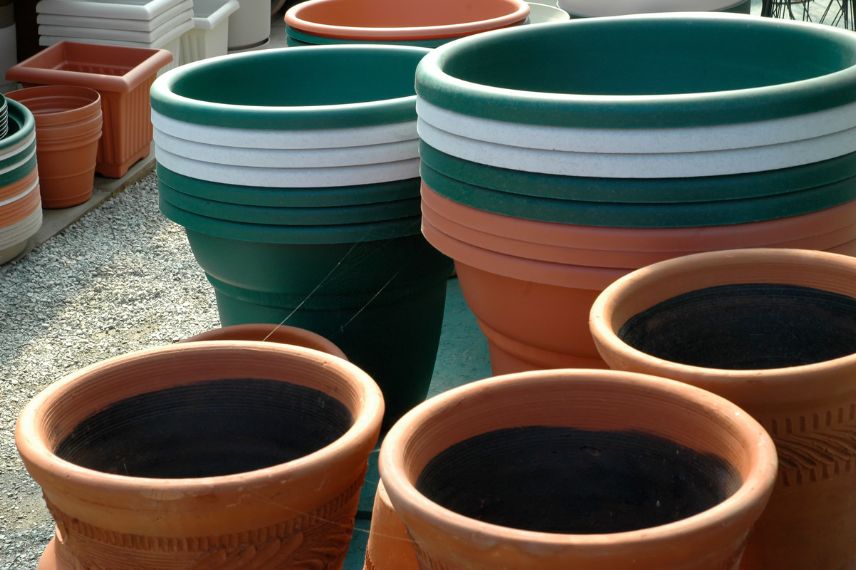
- An appropriate material :
- Terracotta offers good breathability, which reduces the risk of root suffocation. However, potting compost dries out more quickly, and you will need to be diligent with watering.
- Plastic retains moisture better, but beware of water stagnation. Watering should therefore be done sparingly. Another advantage: plastic pots are lighter and easier to move.
- A large pot : the pot must be at least 50 cm in diameter and depth, with enough volume to accommodate the tree’s root system.
- Good drainage : make sure the pot has drainage holes to prevent water accumulation, which can lead to root rot. Place a suitable saucer underneath the pot.
What type of growing medium should I choose for catalpa?
A good substrate will guarantee healthy growth of your catalpa in a pot. To choose it:
- A drainage layer: place clay balls or gravel at the bottom of the pot to ensure good water drainage.
- A quality potting compost:
- Use a good-quality universal potting compost rich in organic matter.
- Add coarse sand (one part sand to three parts potting compost) to improve drainage and prevent compaction. Note: choose river sand or quarry sand only.
- If you can, add a portion of garden soil to improve the substrate structure.
- An appropriate fertiliser : incorporate a slow-release fertiliser or well-rotted compost to provide essential nutrients during the first few months.
How to plant a catalpa in a pot?
Now, put on your gardening gloves and let’s get started:
1- Prepare the pot :
- Create a drainage layer (clay pebbles or gravel) at the bottom of the pot to prevent water from stagnating.
- Add a first layer of substrate, but do not fill the pot completely, to leave space for the root ball of the tree.
2- Install the root ball:
- Gently remove the Catalpa from its original container to avoid damaging the roots.
- Place the root ball in the centre of the pot. Adjust the amount of soil beneath the root ball so that the base of the trunk (the collar, where the roots begin) sits just below the rim of the pot.
3- Add the substrate :
- Fill the pot with substrate around the root ball, making sure to fill all the gaps. Gently press to stabilise the plant, but avoid pressing too hard to prevent air circulation in the potting mix.
- Water thoroughly to moisten the whole thing.
4- Install a stake if necessary :
- If your Catalpa is young or fragile, drive a stake beside the trunk to keep it upright. Secure it with flexible ties to avoid damaging the bark.
Where to place the potted catalpa?
For your catalpa to thrive in a pot, choose its location carefully:
- Light exposure: Place the pot in a sunny spot that receives at least 6 hours of sun per day. This will promote the growth of the tree and encourage abundant flowering. Note that the catalpa can also tolerate light shade, but its flowering will be less abundant.
- Wind protection: Place the catalpa in a sheltered spot away from strong winds that could damage young branches and dry out the leaves.
- Ample space: Provide ample space around the pot to allow branches and foliage to spread freely without constraint.
After planting: care and maintenance of a catalpa in a pot
Watering:
- Water as soon as the surface of the potting mix is dry, especially during hot or windy periods, as evaporation is faster in pots.
- Ensure water does not pond in the saucer to prevent root rot. Ideally, empty it 10 to 15 minutes after watering. In winter, reduce watering, but do not let the root ball dry out completely.
Fertilising:
- Apply compost on the surface or, if not available, a balanced fertiliser (type NPK 10-10-10) or liquid fertiliser monthly, from March to September.
- In autumn and winter, cease fertilising to allow the tree to rest.
Pruning:
- Regularly remove dead, damaged or poorly oriented branches to maintain an aesthetically pleasing and balanced growth habit.
- Perform a light pruning at the end of winter to stimulate branching and to prepare for spring growth.
- If your Catalpa is young, shorten the main shoots to encourage a more compact and dense development.
- For more information in our tutorial: How to prune a Catalpa?
Repotting:
- Repot your Catalpa every 2 to 3 years, ideally in spring, when growth resumes. This gives the roots more space and the potting mix to regain its richness.
- Choose a pot slightly larger (an extra 5 to 10 cm in diameter) so as not to disturb the roots.
- Gently lift the root ball from the old pot. Remove damaged roots or those forming a dense mass at the bottom. Add fresh potting compost, formed of potting compost, sand and garden soil, to renew the nutrient supply.
Top-dressing:
- If repotting is not planned, carry out a top-dressing each year to provide fresh nutrients to your Catalpa.
- Remove 5 to 10 cm of surface potting mix, taking care not to damage the roots. Replace with fresh potting mix enriched with compost or organic fertiliser. This also helps improve drainage.
Winter protection:
- Place the pot out of cold winds, such as along a sunny wall.
- Add a thick mulch to the potting mix to limit temperature fluctuations.
Pest monitoring:
- Regularly inspect the leaves and stems for the presence of pests such as aphids or scale insects.
- If necessary, use natural treatments, such as a solution of black soap, to quickly eliminate them.
- For more information, read our article: Diseases and pests of Catalpa.
- Subscribe!
- Contents
Comments