





























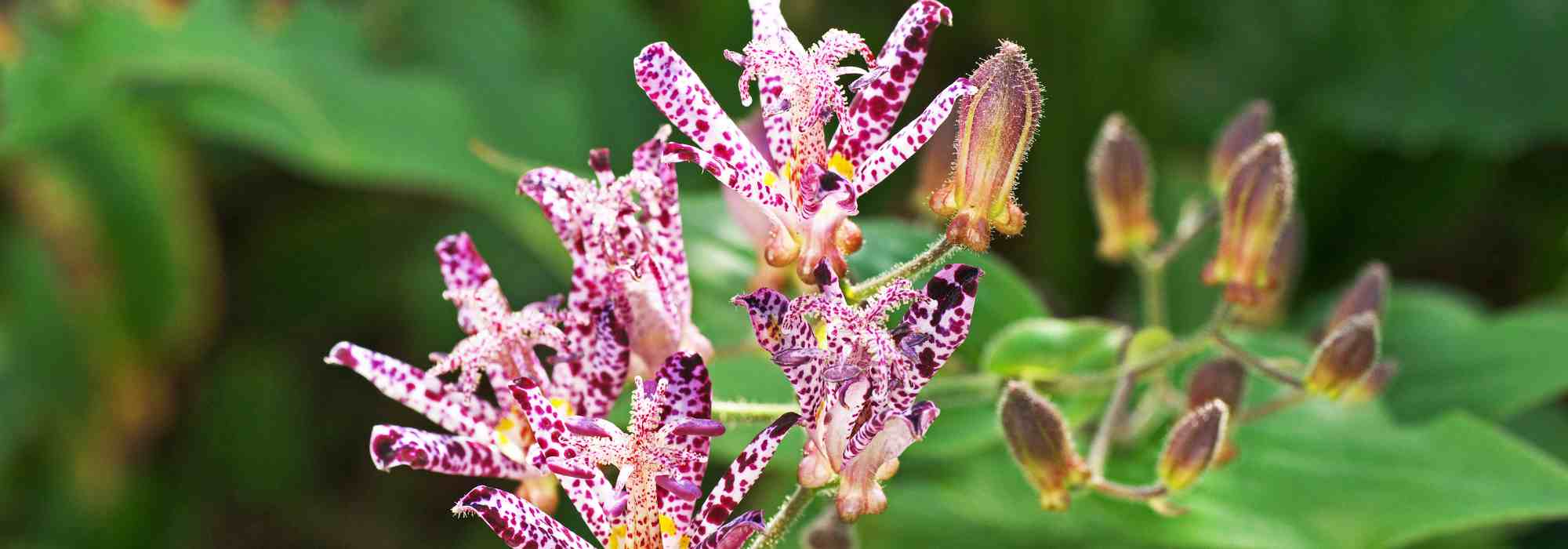
Spotted-flowering plants
Original and refined flowers!
Contents
Some flowers are speckled, their petals dotted with dash-like markings, tiny spots or fine striations. This colourful aspect gives them an exotic air. Among the best known are orchids and lilies, but a few others deserve our attention for a garden like no other.
Here are some of the most beautiful speckled blooms!

Perennials
Hellebores
Some Oriental hellebores display small speckles on their petals that significantly add to their charm. Varieties bearing the epithet “guttatus” do indeed refer to the Latin etymology of the word, namely speckled or mottled. This is particularly the case with the Oriental hellebore ‘Double White guttatus’, the Oriental hellebore ‘Double White guttatus’ or the Oriental hellebores ‘Rose guttatus‘ and the hellebores ‘Double Green guttatus‘ and ‘Apricot guttatus‘.
The ViV® series also offers a few ravishing hellebores, sprinkled with tiny speckles that stand out well, as with the Oriental hellebore ViV ‘Serafina’, ‘Maeva’ or ‘Celestina’, and some hellebores with anemone-like hearts such as the Oriental hellebore Anemone ‘Yellow guttatus’.
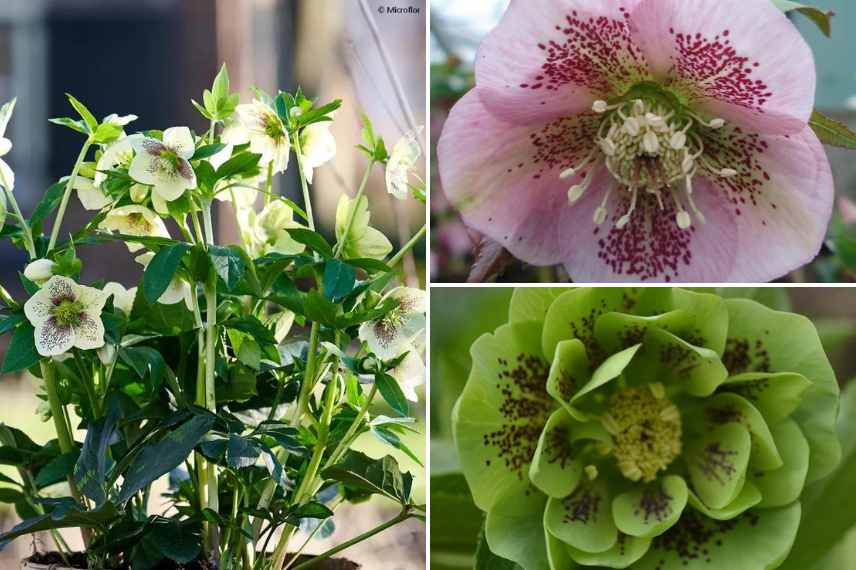
Hellebore ViV ‘Maeva’, ‘Rose guttatus’ and ‘Double Green guttatus’
Tricyrtis
One of the most appealing features of Tricyrtis is their petals delicately speckled, as if dusted with violet ink, often on a white background. The toad lilies, their other common name, delight us all with this originality, in addition to the shape of their small flowers, rising like miniature garden orchids in partial shade.
Among the loveliest is the Tricyrtis hirta, also called toad lily, whose variety ‘Miyazaki‘, or the Tricyrtis formosana.
All these Tricyrtis reach 60–70 cm tall, forming, in good growing conditions, charming splashes of colour in late summer and early autumn. Truly hardy, they establish themselves quite readily.
Their needs: a rich soil that stays moist, and light shade or partial shade.
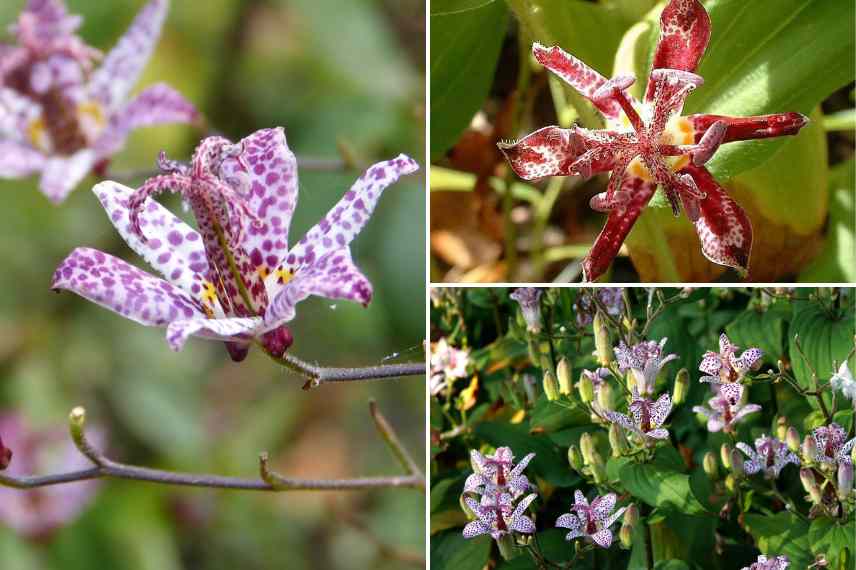
Tricyrtis ‘Hirta’, ‘Raspberry Mousse’ and Tricyrtis formosana
Belamcanda chinensis or Leopard Lily
The Belamcanda is a distinctive rhizomatous perennial, in the same family as irises, recognisable by its , parsemées de . These markings, resembling splashes, spread over a bright yellow or orange background, giving the plant a look that is both graphic and natural. Standing 50 to 90 cm tall, this leopard flower, another evocative name, carries glaucous, fan-shaped foliage. These pretty perennials typically flower in August. Not demanding, hardy and easy to grow, they tolerate a soil that is well drained and enjoy sun or partial shade.
The species Belamcanda chinensis is distinguished by its generous flowering and slender habit. More discreet and less common, the Belamcanda punctata offers finer spots, but just as decorative.
Their needs: they adapt to most soils, provided they are well-drained, and they enjoy sun or partial shade. It is a hardy perennial and easy to grow.
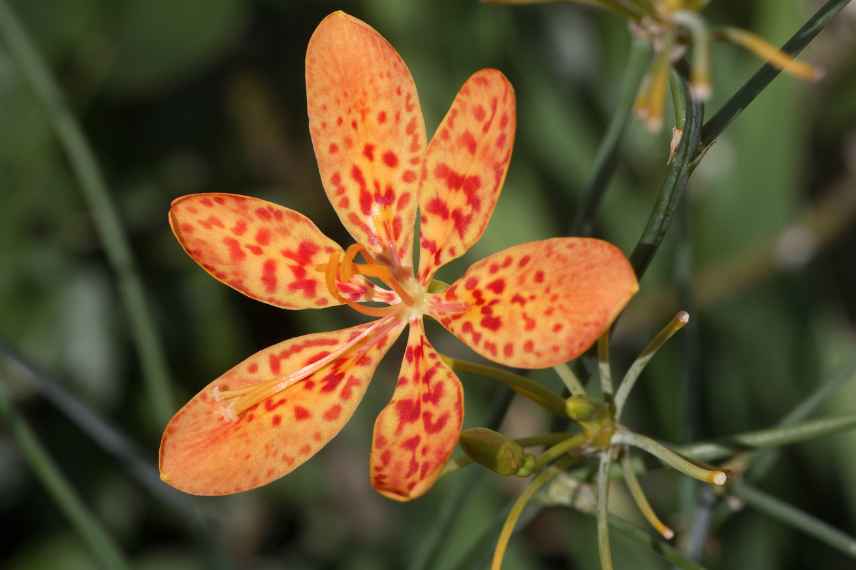
Belamcanda chinensis
Other delicate little wonders…
We find these flowers sprinkled among a few other lovely perennials or annuals, such as the delicate and graceful Campanula punctata ‘Milky Way’, the violet ‘Freckles’ or Viola sororia ‘Freckles’, or among some annuals such as the Petunia ‘Mystery Sky’ and Petunia ‘Night Sky’, truly speckled all over the bloom.
Bulbous plants
The grand family of bulbs and rhizomes also treats us to many strikingly unusual beauties, with evocative names!
Snake’s-head fritillary
Grows in damp soils, this fritillary is far from resembling its lofty cousins, the imperial fritillaries. Its Latin name meleagris reminds us of the resemblance to the unusual appearance of the pendant corollas, like the mottled plumage of the guinea fowl. Unlike that, there is no greyish colouring here, but a sublime, unusually purple check that makes the small bulbous plant (30–40 cm tall) stand out against the spring green of meadows.
Its needs: acidic, light, well-drained soil that stays cool and moist, a sun or semi-shaded exposure, and plenty of space around it.
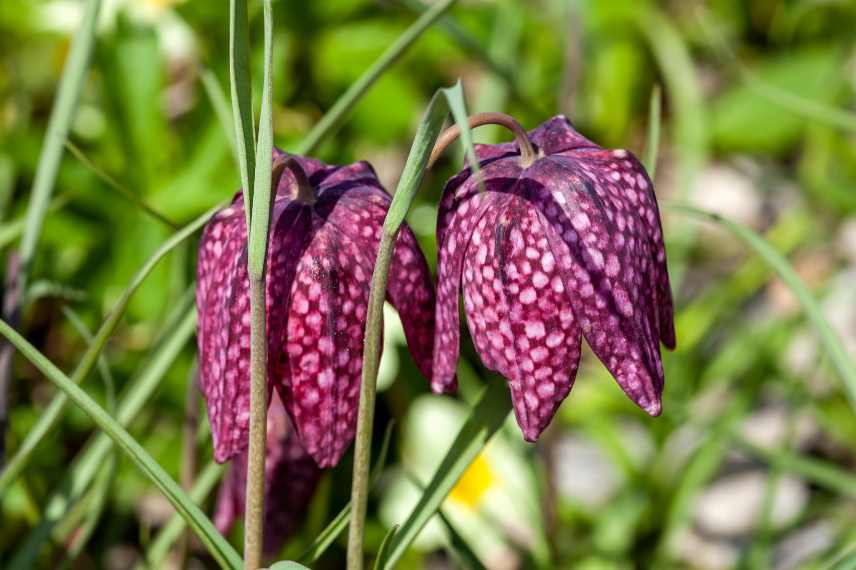
Fritillaria meleagris
Tigridia pavonia
Another bulbous plant of interest when talking about speckled flowers: the Tigridia pavonia. This plant not common in gardens deserves our attention. All the flowers of this botanical genus reveal, in their heart a throat entirely maculated, tiger-striped. The different varieties feature warm colours, ranging from yellow to orange, and coral pink. Some are white and pink. This pretty plant whose triangular flower is another surprise, thrives in rich and very well-drained soils.
Its drawback? It is not very hardy, tolerating about -4°C, making it suited to mild-climate gardens or sheltered coastal regions.
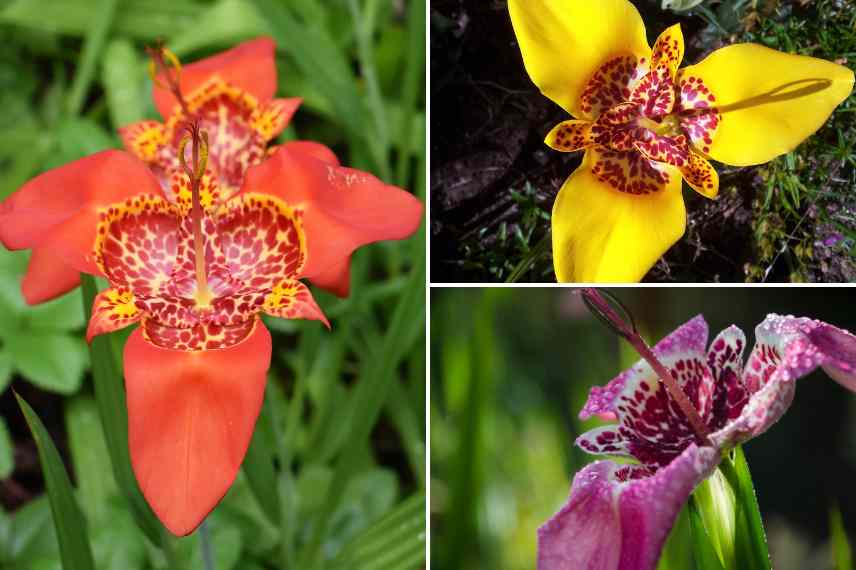
Tigridias
The botanical lilies
The flowering of the lilies, late spring or summer, adds a true exotic touch to borders. They also often boast bold patterns: spots, stripes or blotches reminiscent of a wildcat’s coat. Among the most spectacular, the Lilium lancifolium (tiger lily) bears bright orange petals dotted with black spots, while the Lilium pardalinum plays with stronger contrasts between yellow, orange and brown. Smaller in size, martagon lilies charm with their reflexed flowers, finely speckled with purple on a pink, yellow, purple or white background. The Lilium tigrinum is a superb species that includes a double-flowered variety, ‘Flore Pleno‘. Finally, Lilium canadense is a botanical rarity, while hybrids in the longiflorum group and some oriental lilies also wear these atypical blotches.
Their needs: these species, often hardy, thrive in full sun or partial shade, in well-drained, rich soil.
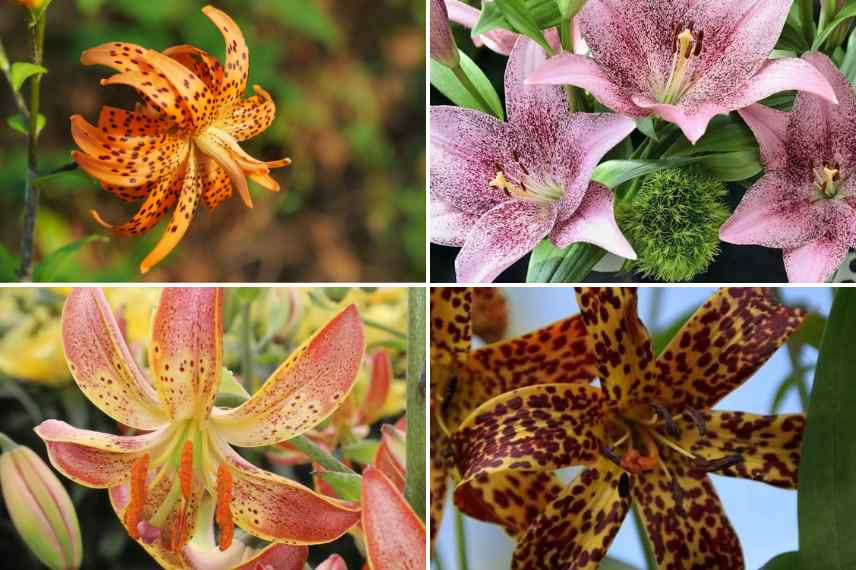
Lilium tigrinum ‘Flore Pleno’, Hybrid lilies (Lilium longiflorum) ‘Sweet Sugar’, Lilium martagon ‘Slate’s Morning’ and Lilium canadense
Cannas
These are perhaps the best-known rhizomatous plants, with some varieties that are all speckled. You can see these exotic little spots on varieties often yellow to orange. This gives them a touch of eccentricity you may love… or not!
Among the speckled Cannas: ‘Cleopatra‘ blending yellow, orange and red, ‘En Avant‘, ‘Confetti‘ with soft tones of cream, yellow and pink, and ‘Yellow Humbert‘, frankly more yellow, or the canna ‘Picasso’, bright yellow heavily dotted with red giving orange tones, and ‘Petit Poucet‘, in the same vein but more compact.
Their needs: a bit like dahlias, they need sun, a cool soil, and are overwintered for winter in regions with cold winters.
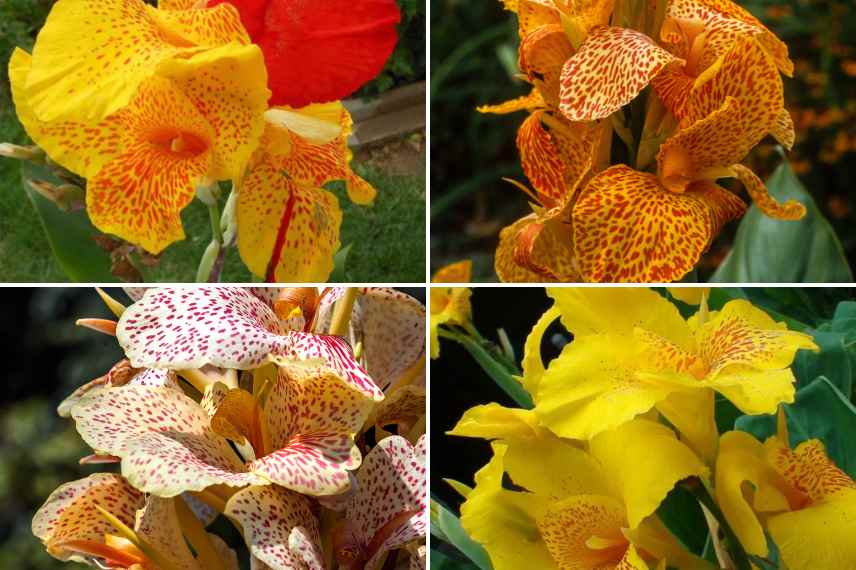
Canna ‘Cleopatra’, ‘En Avant’, ‘Confetti’ et ‘Yellow Humbert’
Some Dahlias
If dahlias are prized for their long flowering and their very diverse flower shapes, a few cultivars also reuse patterns speckled with contrasting colours or very gentle ones. This is the case with the Dahlia ball ‘Marble Ball’, garnet-mottled, the elegant Decorative Dahlia ‘Mats’, the surprising Dahlia Honka ‘Destiny’s Teacher’, the ball dahlia ‘Jowey Provence‘, the dahlias ‘Anatol‘ and Bristol Stripe’, or ‘Mick’s Peppermint’.
Their needs: sun, heat to bloom well, a well-drained and always cool soil; they are also hungry feeders!
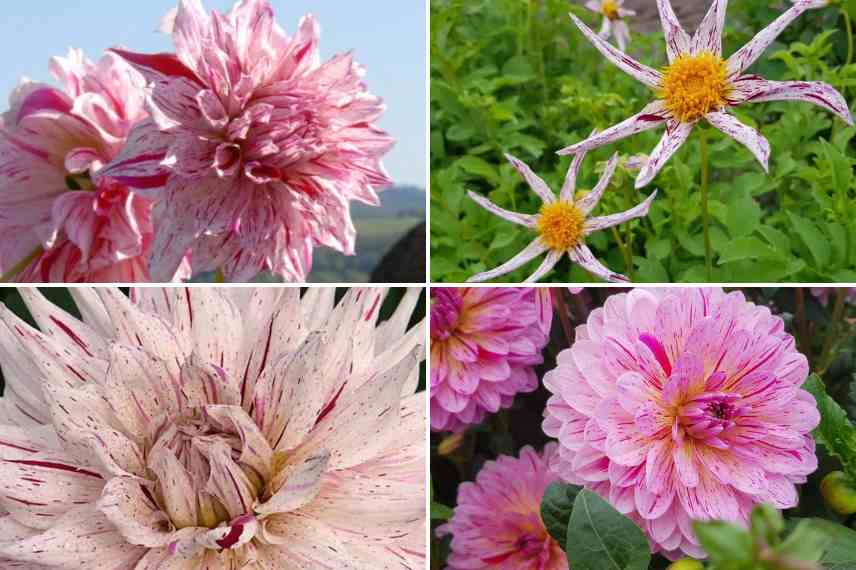
Dahlia ‘Anatol’, Dahlia Honka ‘Destiny’s Teacher’, ‘Mick’s Peppermint’ and ‘Tropical’
Nomocharis
The Nomocharis aperta, and even more so the Nomocharis pardanthina, also surprise with their pale pink flowers speckled with tiny, more pronounced dots. This summer-flowering bulb, not common in our gardens, deserves its place in the undergrowth and cool-shaded areas. With excellent hardiness, Nomocharis will thrive in acidic, well-drained soil.
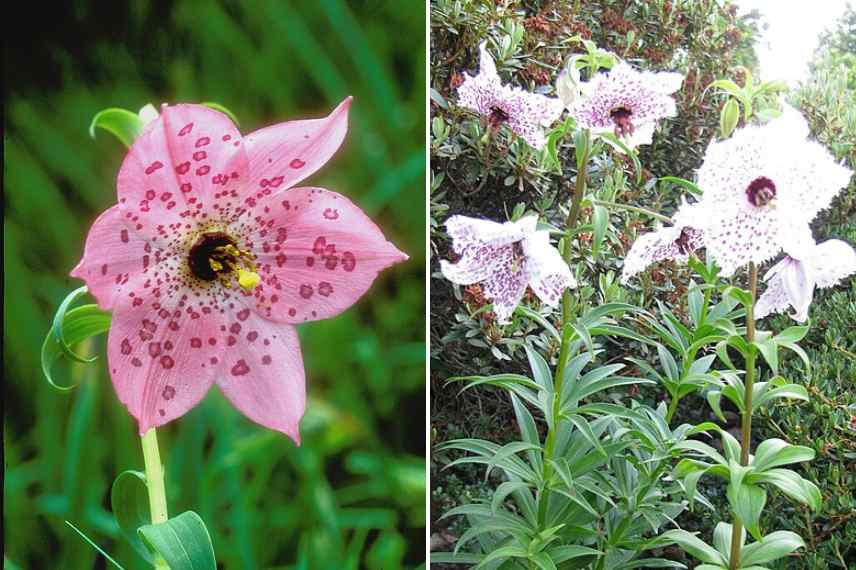
Nomocharis aperta (© Ernst Gügel-Wikimedia Commons) and Nomocharis pardanthina photographed at the Royal Botanic Garden Edinburgh (© Lokal_Profil-Wikimedia Commons)
Some winter clematis
Clematis cirrhosa or wax-flowering clematises have a trait all of their own : not only do they bloom against the grain of other spring- or summer-flowering clematises, in mid-winter, but some are recognisable by their entirely maculate flowers, as if dusted! This beautiful feature of winter-flowering clematis is seen more particularly in Clematis ‘Freckles’ (‘freckles’ if translated), ‘Winter Parasol’, and in Clematis cirrhosa var. balearica.
Their foliage is often semi-evergreen, or even evergreen in milder regions, and some unfurl with a beautiful bronze colour. They grow up to 3–4 m tall depending on variety, and remain relatively hardy (between -10°C and -12°C when planted in soil).
Their needs: like other classic clematis, they also prefer to keep their roots shaded. They bloom best only in full sun, in a south-facing position. Another requirement is very well-drained soil.
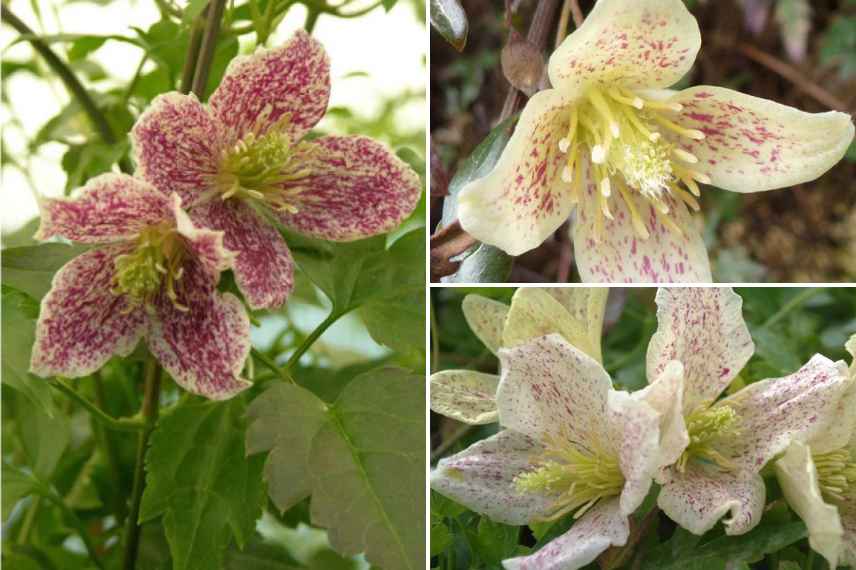
Clematis ‘Freckles’ on the left, and on the right Clematis balearica and the variety ‘Winter Parasol’
Read also
5 bi-coloured lilies for a unique gardenOrchids
Finally, of course, in this selection we must mention the orchid family that adorns our interiors… but also the garden!
Orchids to grow indoors or under glass
They are epiphytic plants, which require very particular growing conditions that I will not detail here, each with, among other things, distinct day- and night-time temperatures.
Phalaenopsis are the best sellers, and come in many colour variations, including stunning speckled blooms as with ‘Mituo Sunrise’. The Oncidium splendidum and lanceanum, but also many Paphiopedilum such as the Paphiopedilum chamberlainianum or the Cymbidium, the strange Catasetum Orchidglade ‘Jack of Diamond’, Odontoglossum, Brassia verrucosa and maculata… and many more.
The Ansellia africana, also known as leopard orchid, is, for its part, a very handsome and large orchid (up to 1.5 m), yellow-green and widely spotted with brown.
Hardy orchids to grow in the garden
Some other orchids are perfectly acclimatised to our latitudes, and are also speckled or striped on their lip or sepals, like Cypripedium, the famous lady’s slipper, as well as Hardy orchids to grow in the garden (Olivier details their needs).
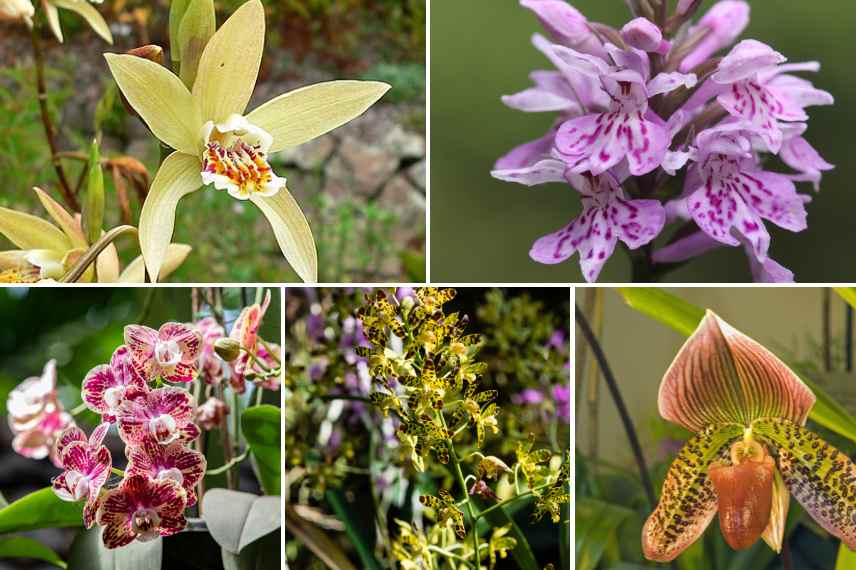
At the top, terrestrial orchids: Bletilla ochracea (©Wikimedia Commons Stan Shebs), and Dactylorhiza maculata. At the bottom, Phalaenopsis, Ansellia africana and Paphiopedilum
- Subscribe!
- Contents
Comments