





























The houseplants you won't see in your neighbour's living room
Dare something new in your urban jungle
Contents
Say goodbye to the usual indoor plants. For an interior that surprises and reflects real personality, some plant varieties go off the beaten track. Strange foliage, sculptural silhouettes or exotic looks, these rare plants fascinate as much as they decorate. Little known to the general public, they all have a little extra something: a surprising flowering, an intriguing form or a novel texture. Here is a selection of singular indoor plants, ideal for creating a look unlike any other!

Striking foliage: remarkable textures and colours
When foliage becomes a work of art, each plant makes its mark as a statement piece in the décor. Light play, velvety textures and novel patterns… True botanical curiosities!
Begonia amphioxus offers a slender, bold silhouette with its light-green, finely cut leaves, speckled with spots and red-edged margins. Rare in cultivation, this tropical plant prized by collectors readily establishes itself in a terrarium or a humid conservatory, provided it is given soft, steady light. Note, however, that this plant has demanding cultural requirements and is best left to collectors.
In a more flamboyant vein, Episcia ‘Pink Acajou’ draws the eye with its velvety foliage and metallic sheen, ranging from bronze-green, soft pink and silver. This variety, nicknamed ‘Flame Violet’, thrives in hanging growth or on a shelf, creating a cascading plant display with a spectacular effect. It prefers slightly humid conditions and bright, indirect light.
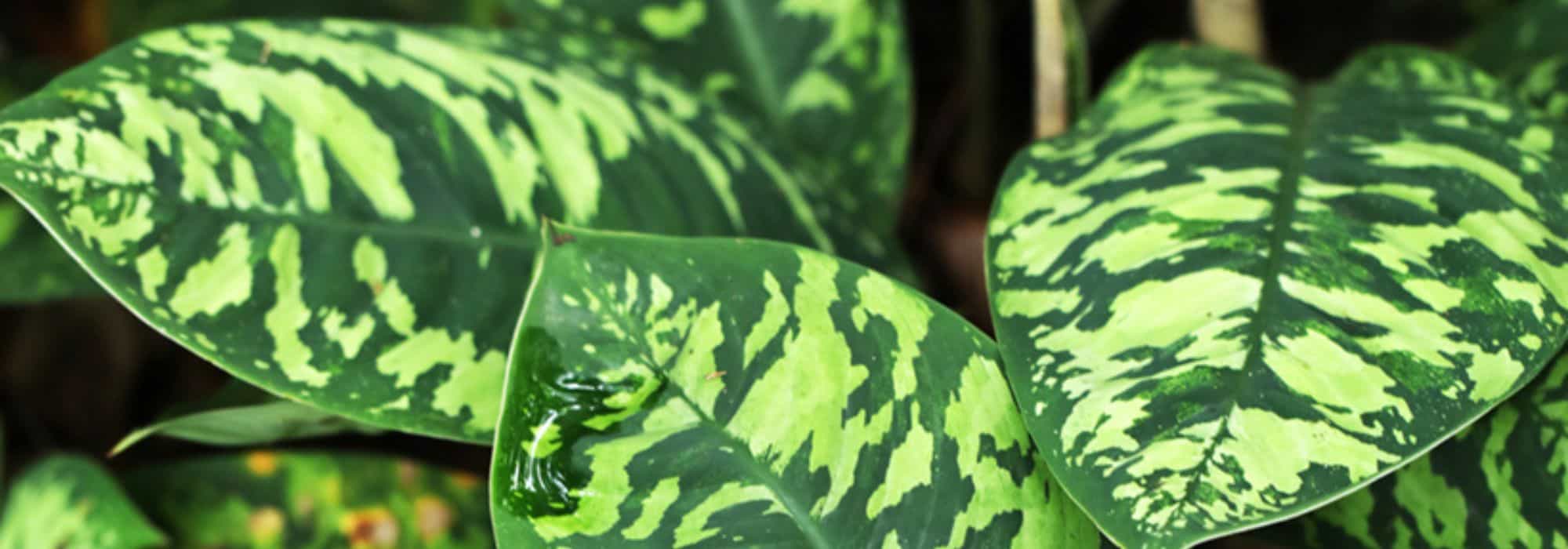
More understated, yet just as original and easy to grow, Homalomena ‘Camouflage’ unfolds broad marbled leaves, with green patterns inspired by forest lattices. Compact and decorative all year round, it naturally fits into urban or contemporary interiors, from living room to bathroom.
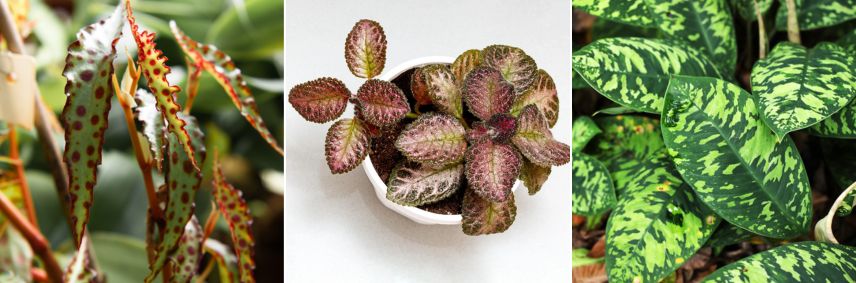
Begonia amphioxus, Episcia ‘Pink Acajou’ and Homalomena ‘Camouflage’
Sculptural and unexpected: plants that make a bold silhouette
Some indoor plants stand out for their distinctive shape and growth habit, which can sometimes turn heads. These living plant sculptures are perfect for structuring an empty corner or breaking up the lines of a decor that’s too bland.
With its spiralled stems like a corkscrew, the Cereus forbesii ‘Spiralis’ is the perfect example of the plant that makes its presence felt. This candle cactus, with its powdery blue-green hue, naturally finds its place in a sunlit living room or a well-exposed conservatory. It suits design enthusiasts as much as beginner gardeners, and can reach impressive heights over time.
Another original subject, the Elephant Ear Kalanchoe (Kalanchoe beharensis var. ‘Subnuda’) displays an astonishing arborescent habit. Its triangular, smooth and undulate leaves form a substantial tuft at the top of sinuous stems, a touch futuristic. With its offbeat appearance, this succulent evokes arid landscapes and thrives in bright interiors or on a sheltered terrace.
Philodendron tortum, for its part, brings an airy note with its finely dissected, fern-like leaves. Refined, tropical, almost ethereal, this philodendron thrives in a large pot with a minimalist design. Its rapid growth and delicate foliage make it ideal for creating a focal point in a chic jungle or minimalist decor.
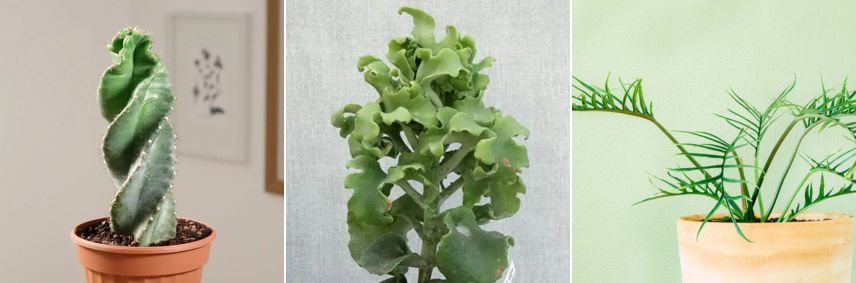
Cereus forbesii ‘Spiralis’, Kalanchoe beharensis ‘Subnuda’ and Philodendron tortum
Tropical ambience: humidity as a canvas for expression
Some plants thrive in conditions close to those of humid tropical forests. They grow well in a bright bathroom, a temperate conservatory, or a living room where air remains mild and slightly humid (if necessary, simply mist their foliage regularly).
Aechmea tayoensis, native to equatorial forests, impresses with its dense, rigid rosette of leaves, and especially with its spectacular central inflorescence, formed of pink-orange bracts and yellow-pink flowers. This rare bromeliad thrives in a bright room with controlled humidity. Its flowering marks the apex of its life cycle, but it leaves behind young offsets, ready to take over.
With its large velvety leaves veined with pale veins, Anthurium clarinervium adds a graphic and elegant note to a living room. Its strong contrasts make it an ideal subject for creating a refined tropical ambience.
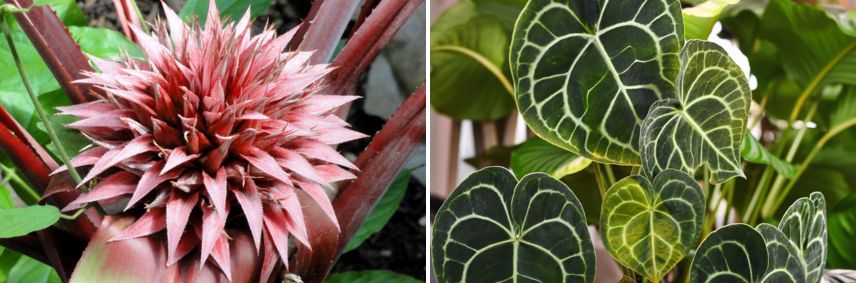
Aechmea tayoensis and Anthurium clarinervium
Read also
The easiest indoor plants to growCompact and easy: originality without constraint
Who said you had to be an expert to grow stunning houseplants? Some species, as uncommon as they are appealing, prove low-maintenance and adapt easily to our interiors, even in small spaces. They are also perfect if you have little time to devote to them.
The Ledebouria socialis, or Purple Squill, captivates with its silvery leaves speckled with green, with purple undersides. Its lanceolate foliage forms a low clump, showcased in a simple pot. Low-water requirements, it thrives on a bright shelf in a living room, in a kitchen or a study.
Another plant with character, the Kalanchoe marmorata reveals bright green foliage, sometimes bluish depending on exposure and marbled with purple. Compact, drought-tolerant, it easily finds a place in a sunny interior, on a south- or west-facing windowsill. It fits perfectly into a collection of succulents.
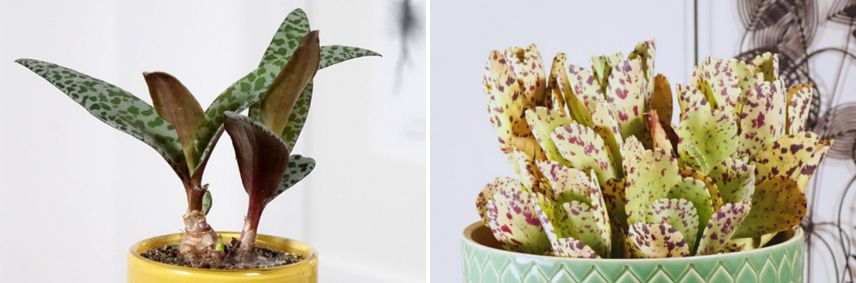
Ledebouria socialis and Kalanchoe marmorata
How can you successfully grow and incorporate these unusual plants into your home?
To acquire rare or unusual plants, you need to provide them with the right conditions to thrive. Most plants appreciate bright, but filtered light, such as behind a window facing east or west, away from direct sun that burns the leaves. For a south-facing window, install a light sheer curtain or move the plants back by several tens of centimetres.
- regular ambient humidity, which can be recreated with a spray bottle or by grouping them together. You can also place their pot on a bed of damp clay pebbles.
- require a draining substrate and spaced watering, allowing the soil to dry thoroughly between two waterings.
To showcase their shapes and textures, place them in plain ceramic or terracotta pots, on open shelves or hanging supports.
By choosing the right location according to their needs and pairing them with other complementary varieties, these plants become true showpieces, capable of transforming the ambience of a room while remaining easy to live with for some.
- Subscribe!
- Contents
Comments