
Ravenala madagascariensis - Traveller's palm
Ravenala madagascariensis - Traveller's palm
Ravenala madagascariensis - Traveller's palm
Ravenala madagascariensis
Back-to-school special offer!
Get €10 off for every €50 you spend! And get up to €40 off on a single order.
How does it work?
1. Shop your favourites
Add your favourite plants to your basket. For every €50 you spend (excluding delivery charges, store credit and the plastic-free option), you’ll receive a €10 voucher.
€50 spent = €10 voucher
€100 spent = €20 voucher
€150 spent = €30 voucher
€200 spent = €40 voucher
2. Place your order
Once your basket reaches one of the spending thresholds, place your order. You can even choose your delivery date!
3. Receive your voucher
As soon as your order has been shipped, you’ll receive an email containing your personal voucher code and its value.
4. Use it on your next order
Your voucher is valid for 90 days from the date you receive it. It can be used once only, on a new order worth at least the value of the voucher, excluding delivery charges.
Please note: Vouchers can be combined with other offers, but cannot be split or refunded.
Why not try an alternative variety in stock?
View all →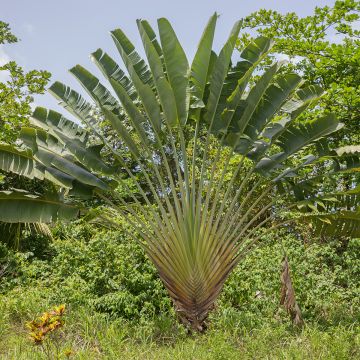
Available in 1 sizes
This plant carries a 12 months recovery warranty
More information
We guarantee the quality of our plants for a full growing cycle, and will replace at our expense any plant that fails to recover under normal climatic and planting conditions.
Would this plant suit my garden?
Set up your Plantfit profile →
Description
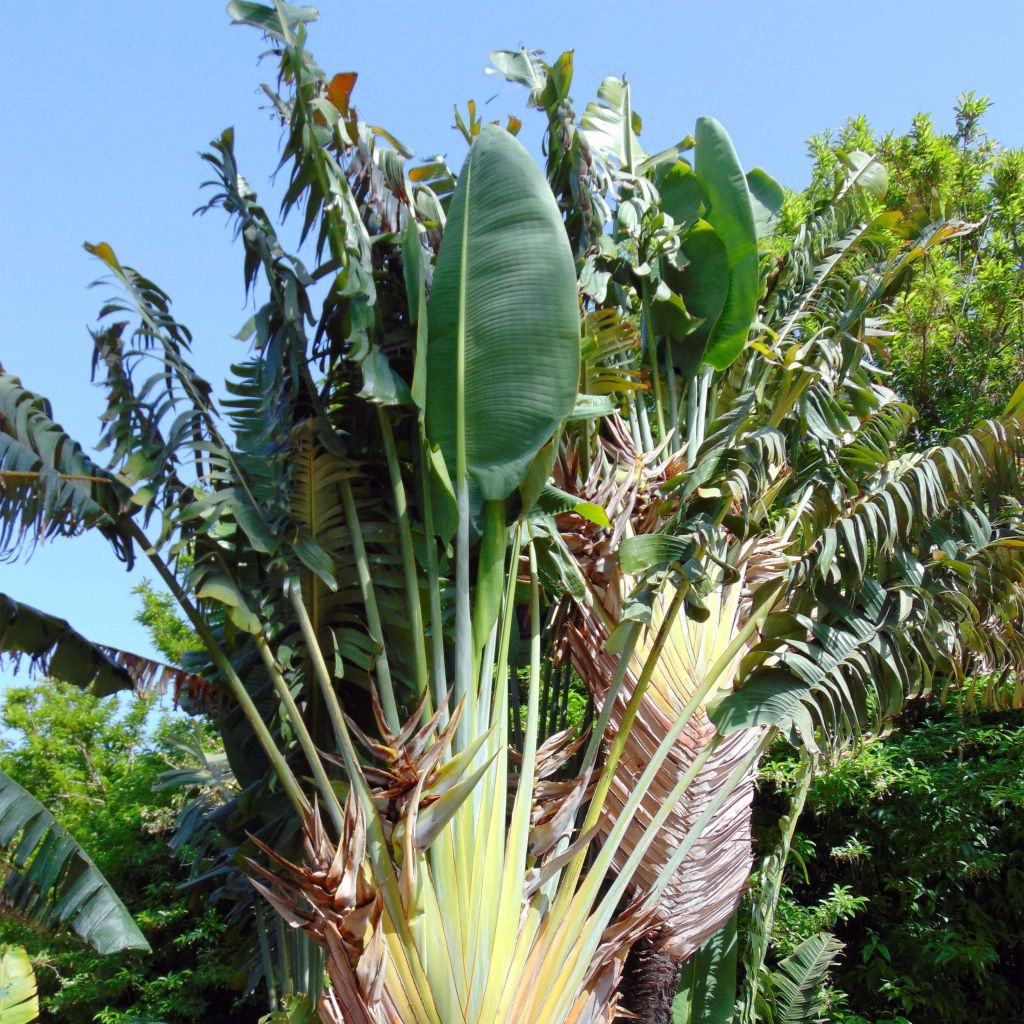
The Ravenala madacascariensis, known by its common name the Traveller's Tree, is a magnificent tropical plant, wonderfully exotic, emblematic of the island of Madagascar and cultivated in all tropical zones of the world for garden ornamentation. This arborescent plant has a silhouette recognisable above all others, with a false trunk supporting long pinnate leaves similar to those of some banana plants, but perfectly arranged in a fan shape, all in the same plane. Under good conditions, mature plants offer a beautiful cream-white flowering which strongly evokes that of the Bird of Paradise Strelitzia alba. This frost-tender plant can only be planted in the ground in extremely sheltered locations within the orange tree cultivation zone. Elsewhere, it is grown in a container, to be moved into a conservatory or greenhouse from September until mid-May.
The Ravenala madascariensis belongs to the Strelitziaceae family (the Bird-of-Paradise plants), and is also a distant cousin of banana plants and gingers. It is native to Madagascar, where it grows in sandy or stony soils, very moist at depth. It is an arborescent plant and not a tree, like palms or bananas: it does not produce a true trunk, but a stipe. It owes its name 'Traveller's Tree' to its ability to store water; its abundant sap is drinkable and easy to extract with a machete. Conversely, the rainwater that accumulates at the base of its leaves, sometimes stagnant, is mainly useful to some small animals such as amphibians, beetles, and mosquitoes. In the wild, the Ravenala develops a stipe exceeding 10 m in height and stands up to 20 m from the ground. In Madagascar, the pollination of the flowers is carried out by lemurs and bats.
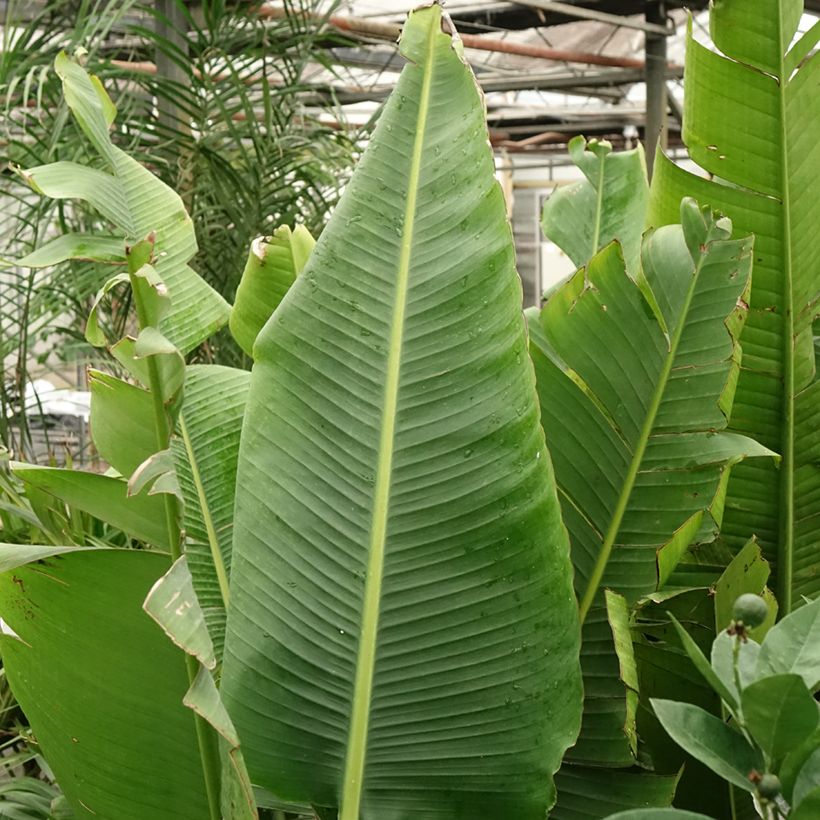
Grown in a large container, the Traveller's Tree rarely exceeds 3 m in height, even less if it is planted in a pot of smaller volume. It is roughly as wide as it is tall. Its stipe is brown in colour. It supports vast leaves that can measure 3 m long for plants established in the ground, divided into numerous trailing segments on each side of the central midrib. They are arranged in a fan shape, all in the same plane. Their cup-shaped base holds rainwater. The leaf petioles are tightly packed, dark in colour, edged with orange, and covered with a whitish wax. They are longer than the leaf laminae. When it flowers, this Traveller's Tree produces large, very original white flowers, composed of 3 sepals, 3 petals and 6 stamens, contained within spathes measuring 15 to 20 cm long. In Madagascar, flowering begins in September. The fruits somewhat resemble hard bananas; they contain numerous seeds surrounded by fibres of an intense blue.
The Ravenala madagascariensis is a magnificent plant for a conservatory or heated greenhouse. This plant must not lack light, heat, space, water, nor nutrients during its growth period. One can easily create an exotic setting around it by adding a strelitzia, cannas and banana plants, Castor Oil Plant, gingers, and a small palm such as the Sabal minor, for example. In the most sheltered gardens on the French Riviera, one can attempt to grow it in the ground, with regular watering in summer, and provided there is good winter protection.
Report an error about the product description
Ravenala madagascariensis - Traveller's palm in pictures

Flowering
Foliage
Plant habit
Botanical data
Ravenala
madagascariensis
Strelitziaceae
Madagascar
Planting and care
Ravenala madascariensis is a tropical plant, very tender, which does not tolerate frost. It can only be grown in the ground in the most sheltered gardens of the French Riviera. Fortunately, its cultivation in pots is quite easy, allowing the plant to be stored frost-free in winter, in a bright, cool, and well-ventilated area, provided you have enough space once the plant reaches its mature size. Very large plants, which are difficult to move, can remain year-round in a conservatory or greenhouse. Plant it in fertile soil, rich in organic matter, moist throughout the growth period and in a location sheltered from the wind. Position your Traveller's tree in full sun, preferably facing South. It thrives in moist but well-drained soil. It needs plenty of light and full sun to develop harmoniously. In winter, when planted in the ground, wrap the plant in horticultural fleece to gain a few precious degrees, and cover the base with a thick mulch. Watering should be regular and plentiful in summer, more moderate in winter.
Container cultivation:
Use a large pot with holes in the bottom. Add a 5 cm layer of clay pebbles or pot shards to facilitate the drainage of water. Create a mixture of potting compost and garden compost, and place your container in a very bright room, not too heated in winter. A few hours of full sun per day are essential to induce flowering, but beware of the harsh midday sun behind glass. Filter the light to avoid scorching the foliage. Move your plant outdoors from May to September.
Water regularly during the growth period. Never let water stagnate in the saucer. During the rest period, place the plant in a bright and cool room (around 13°C) and water moderately.
A very large plant, impossible to repot, will benefit from a top-dressing of potting compost and garden compost once a year, in spring.
Planting period
Intended location
Care
Planting & care advice
-

-
-
-
-
-
-

-
This item has not been reviewed yet - be the first to leave a review about it.
Recently viewed products
Haven't found what you were looking for?
Hardiness is the lowest winter temperature a plant can endure without suffering serious damage or even dying. However, hardiness is affected by location (a sheltered area, such as a patio), protection (winter cover) and soil type (hardiness is improved by well-drained soil).

The flowering period indicated on our website applies to countries and regions located in USDA zone 8 (France, the United Kingdom, Ireland, the Netherlands, etc.)
It will vary according to where you live:- In zones 9 to 10 (Italy, Spain, Greece, etc.), flowering will occur about 2 to 4 weeks earlier.
- In zones 6 to 7 (Germany, Poland, Slovenia, and lower mountainous regions), flowering will be delayed by 2 to 3 weeks.
- In zone 5 (Central Europe, Scandinavia), blooming will be delayed by 3 to 5 weeks.
In temperate climates, pruning of spring-flowering shrubs (forsythia, spireas, etc.) should be done just after flowering.
Pruning of summer-flowering shrubs (Indian Lilac, Perovskia, etc.) can be done in winter or spring.
In cold regions as well as with frost-sensitive plants, avoid pruning too early when severe frosts may still occur.
The planting period indicated on our website applies to countries and regions located in USDA zone 8 (France, United Kingdom, Ireland, Netherlands).
It will vary according to where you live:
- In Mediterranean zones (Marseille, Madrid, Milan, etc.), autumn and winter are the best planting periods.
- In continental zones (Strasbourg, Munich, Vienna, etc.), delay planting by 2 to 3 weeks in spring and bring it forward by 2 to 4 weeks in autumn.
- In mountainous regions (the Alps, Pyrenees, Carpathians, etc.), it is best to plant in late spring (May-June) or late summer (August-September).
The harvesting period indicated on our website applies to countries and regions in USDA zone 8 (France, England, Ireland, the Netherlands).
In colder areas (Scandinavia, Poland, Austria...) fruit and vegetable harvests are likely to be delayed by 3-4 weeks.
In warmer areas (Italy, Spain, Greece, etc.), harvesting will probably take place earlier, depending on weather conditions.
The sowing periods indicated on our website apply to countries and regions within USDA Zone 8 (France, UK, Ireland, Netherlands).
In colder areas (Scandinavia, Poland, Austria...), delay any outdoor sowing by 3-4 weeks, or sow under glass.
In warmer climes (Italy, Spain, Greece, etc.), bring outdoor sowing forward by a few weeks.
Shipping country and language
Your country of residence may be:
Your country of residence is:
For a better user experience on our website, you can select:
Your shipping country:
-
 Austria
-
 Belgium
-
 Bosnia & Herzegovina
-
 Bulgaria
-
 Croatia
-
 Cyprus
-
 Czechia
-
 Denmark
-
 Estonia
-
 Finland
-
 France
-
 Germany
-
 Greece
-
 Hungary
-
 Iceland
-
 Ireland
-
 Italy
Italy
-
 Latvia
-
 Liechtenstein
-
 Lithuania
-
 Luxembourg
-
 Malta
Malta
-
 Netherlands
-
 Poland
-
 Portugal
-
 Romania
-
 Serbia
-
 Slovakia
-
 Slovenia
-
 Spain
Spain
-
 Sweden
-
 Switzerland
Language:
-
French
-
 English
-
Spanish
-
Italian
-
German
-
Portuguese
-
Dutch
-
Finnish
My Account
Hello
My wish lists
My cart
Log in / Register
Existing customer?
This form is protected by reCAPTCHA - the Google Privacy Policy and Terms of Service apply.
New customer?
Create an account to track your orders, access our customer service and, if you wish, make the most of our upcoming offers.