






























Sweet peas: the most fragrant varieties
The best varieties of highly fragrant sweet peas for the garden
Contents
Sweet peas, Lathyrus odoratus, are charming scented annuals, climbing or bushy, prized for their delightfully fragrant flowers. Their name alone evokes the elegance and softness of old-fashioned flowering and fragrant gardens of days gone by. Easy to sow from seed, in spring or as early as autumn, scented sweet peas are among the easiest scented annuals to grow. In summer they reveal a generous flowering, in soft or vibrant colours, always fresh. Summer-flowering sweet peas offer a colourful and fragrant display throughout the long days of summer, perfect for brightening up trellises and borders or for composing delicate bouquets. They enchant us with their fragrance, sometimes sweet, sometimes heady, and their old-fashioned flowering. Here is a selection of the best scented sweet pea varieties to choose from!

Do all sweet peas smell nice?
Sweet peas emit a sweet, floral and slightly powdery fragrance, reminiscent of honey, jasmine or orange blossom. They are sometimes nicknamed the “musky pea” for their suave and slightly spicy scent, or the “odorous gesse” in homage to its intensely floral fragrance and its voluble habit.
When seeking the fragrance among sweet peas, it’s best to turn to two major historical lines: the Grandiflora and the Spencer.
It is at the heart of these lines that the most intense aromas are found, the ones that perfume a garden from the early hours of the day or as evening falls.
The Grandiflora group, born in the late 19th century under the impetus of the British plant breeder Henry Eckford, was selected specifically for the beauty of its flowers and their rich fragrance. These sweet peas, highly prized in Victorian times for bouquet-making, have smaller corollas than those of modern varieties, but their delicacy is offset by a fragrance that is often very pronounced. It is they who preserve this floral fragrance, almost nostalgic, which makes all the charm of gardens of yesteryear.
In the early 20th century, another type appeared: the Spencer. Arising from a spontaneous mutation, it is renowned for its large flowers with undulated petals, a more elegant habit, and spectacular colours, ranging from pure white to pale yellow, from mauve to deep pink, including flame-coloured or speckled tones. If the fragrance is sometimes somewhat lighter than that of the Grandiflora, some Spencer varieties have managed to combine opulence and aromatic intensity with aplomb.
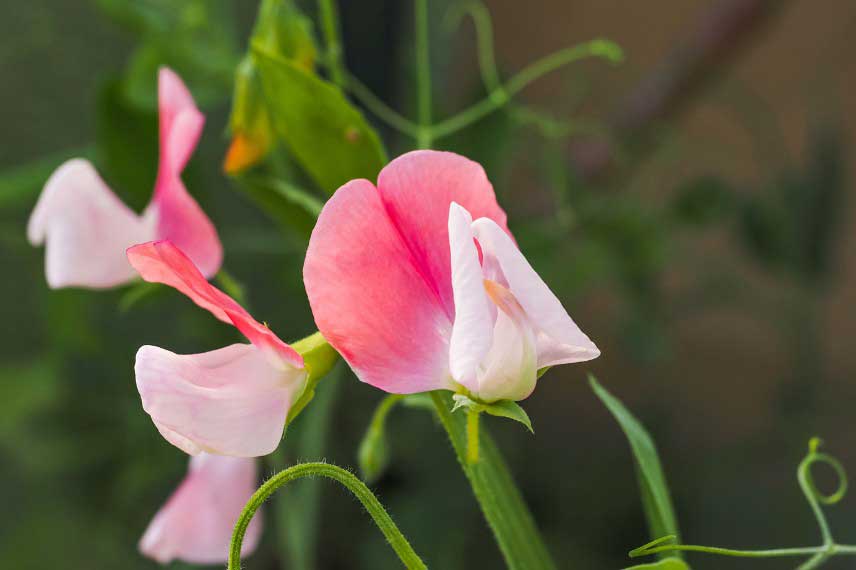
Lathyrus odoratus 'Painted Lady'
Created in 1737, the Lathyrus odoratus ‘Painted Lady’ is one of the oldest sweet pea varieties still cultivated today — and it has not lost any of its charm, for it is also one of the most fragrant sweet peas. Its small two-tone flowers, delicately shaded with soft pink and pure white, exude a sweet and refined fragrance, regarded for nearly three centuries as one of the most enchanting of all sweet peas. A true classic of fragrant gardens.
This vigorous annual climber easily reaches 2.5 m in height on a light, well-exposed support. It prefers rich, well-drained soil, and flowers generously from June to September, attracting pollinators.
To celebrate the beauty of this summer-flowering sweet pea, in a large, generous English-style garden bed, pair ‘Painted Lady’ with Delphinium belladonna ‘Casablanca’ which offers pure white, single flowers all summer, or with Nigella damascena ‘Miss Jekyll Alba’, with airy cream-white flowers and finely cut foliage. A pairing that evokes poetry and natural elegance.
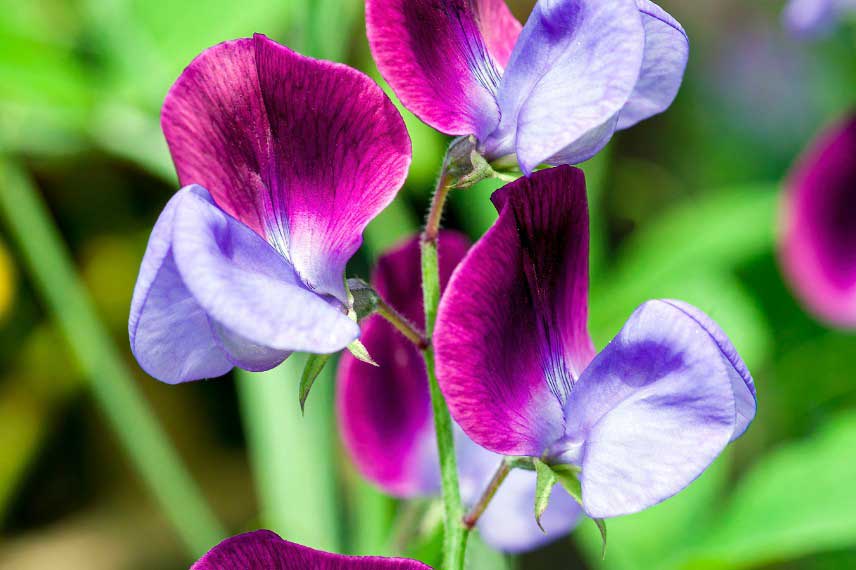
Sweet pea 'Matucana'
Originating from an ancient Peruvian variety, ‘Matucana’ is a Grandiflora-type sweet pea, regarded as one of the most fragrant sweet peas of all. Its scent, powerful, heady and inimitable, is also considered one of the genus’s most intense. It also charms with its small bi-coloured flowers in two deep shades of purple and violet, borne on long, slender stems, perfect for cut flower arrangements.
Bushy and vigorous, this climbing annual reaches about 2 m tall, clings easily to a trellis or runs along a fence, and can even trail in romantic garlands from a hanging basket. Easy to grow in fertile, well-drained soil and in full sun, this fragrant climbing flower flowers from June to August with steady regularity, offering a somewhat wild and authentic charm, typical of old-fashioned sweet peas.
To accompany its understated yet fragrant appearance, pair it with old-fashioned roses in pale pink or cream, such as ‘Cuisse de Nymphe’, with a soft, refined, powdery fragrance. For a deep colour harmony, pair it with a Cosmos atrosanguineus, with velvety red and a chocolate fragrance, or with a Clematis viticella ‘Étoile Violette’. The contrast with Gaura lindheimerii ‘Blanche’, light and airy, will bring freshness and movement to the overall effect.
Read also
Sweet peas: the most beautiful varietiesSweet pea 'King Edward VII'
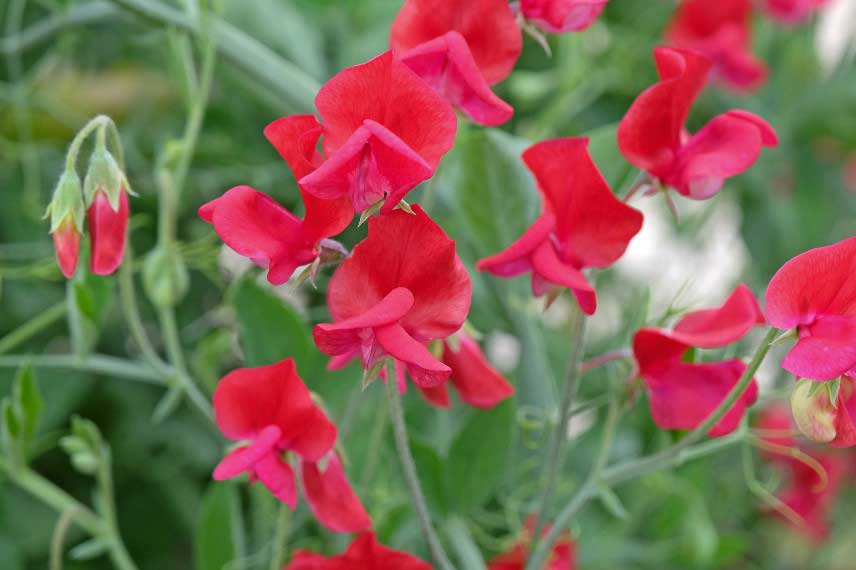
Introduced in 1903, the Lathyrus odoratus ‘King Edward VII’ is a Grandiflora-type sweet pea, which remains a benchmark in the fragrant world of sweet peas. It is one of the most renowned fragrant varieties of sweet peas. It embodies the elegance of old-fashioned varieties, with a charm that is both classic and powerful. Its flowers develop a generous, floral and very sweet fragrance, rich and enveloping, with warm notes reminiscent of honey and orange blossom. It flowers from June to August, producing an abundance of deep crimson velvety flowers borne on long stems ideal for cutting.
It reaches up to 2 m in height, and is ideal for forming a hedge in a scented, flowering garden or for creating pretty bouquets with vintage charm. Pair ‘King Edward VII’ with a Verbena bonariensis, whose tall stems and small purple flower heads will create an airy veil around the sweet pea. Annual poppies Papaver rhoeas ‘Shirley’ in white or pink tones will provide a delicate contrast, as will Ammi majus, with airy foliage and white umbels. With Coreopsis rosea ‘Limerock Ruby’ and the Canna ‘Red Wine’ with cherry-red flowers, it will form an exotic and unusual scene.
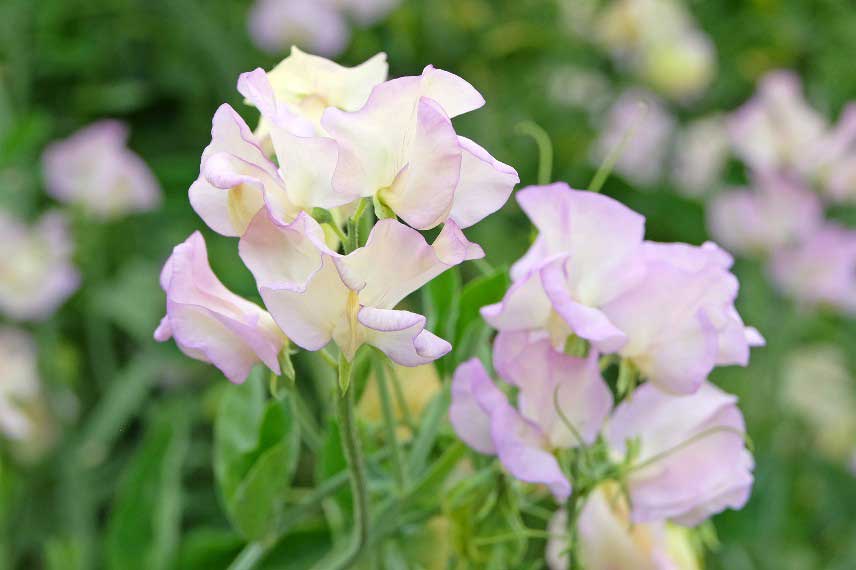
Sweet pea 'High Scent'
The sweet pea ‘High Scent’ lives up to its name: it is often regarded as the definitive benchmark among scented sweet peas. Its fragrance is suave, highly floral, and perfectly balanced. It is also noted for its delicacy. Its large, slightly undulating flowers blend soft cream tones, edged with pink or lavender depending on light and the opening of the corolla. This subtle nuance makes it one of the finest sweet peas, as refined in a cut flower arrangement as in the garden. It is a Spencer-type variety, vigorous, climbing up to 2 m on a trellis, arch or fence in fertile, well-drained soil, in full sun. It flowers abundantly all summer, from June to August.
Pair it with Phlox paniculata ‘Younique Bicolor’ for a soft, fragrant display, and with asters with white- or pink-flowered blooms, with which they will form an elegant pairing.
Sweet pea 'Blue Ripple (TM)'
‘Blue Ripple’ belongs to the Spencer series, renowned for its late-flowering, slightly undulate, and deeply fragrant flowers. Each corolla features a delicate cream shade marbled with blue-lavender markings. It is also recognised as one of the the most fragrant sweet peas. It exudes a lasting, subtle and refined fragrance: a soft, floral and slightly sweet scent. This generous summer flowering of sweet peas extends from June to August, producing long stems perfect for cutting.
It reaches 2 to 2.5 m in height when trained, but also adapts very well to trailing growth in pots. To be installed in hanging baskets, where its stems will trail gracefully, alongside the charming Felicia amelloides, a small blue daisy with a golden centre. In a summer border, sow Nigella damascena ‘Miss Jekyll Blue’, plant tall perennials that bloom in the same blue and white tones as the hollyhocks ‘Chater’s Double White’ and the Lupin ‘The Governor’. This combination evokes a light, airy, and soothing atmosphere, ideal for a flowering and fragrant cottage-style garden.
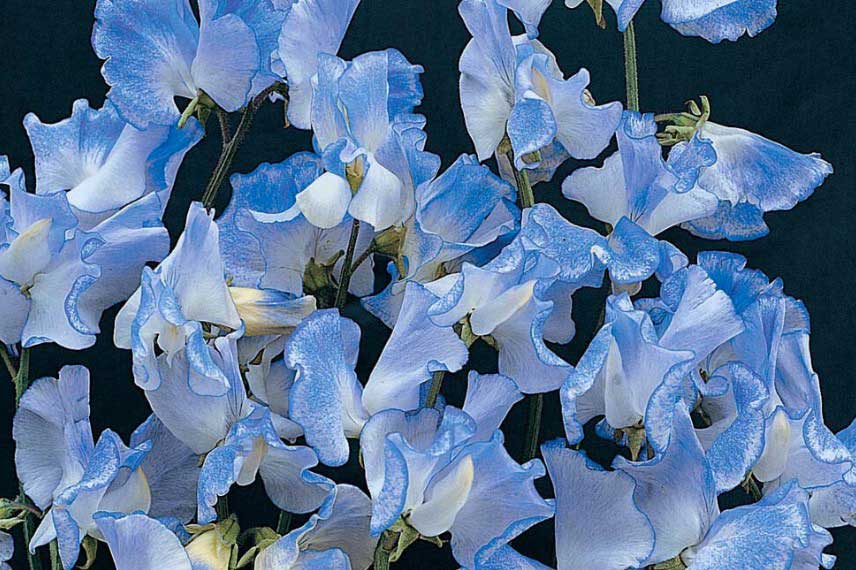
Sweet pea ‘Arthur Hellyer’
‘Arthur Hellyer’ is an elegant Spencer-type variety, captivating with its large fragrant flowers, slightly undulated, in pale lavender tones delicately tinged with white. Another beautiful fragrant sweet pea variety! Its fragrance, classic and intense, is typical of traditional sweet peas: floral, sweet, with that slightly powdery note that recalls gardens of old.
This fragrant climbing flower grows up to 2.5 m high on a light support, and provides airy, subtle and luminous flowering throughout the summer.
Pair this highly fragrant sweet pea for the garden with an old white or pale pink rose, such as ‘Blush Noisette’ and with a Cleome Senorita ‘Carolina’ to compose a romantically gentle and light scene. Mix it with flowers in the same pastel tones, such as a Knautia macedonica ‘Melton Pastels’ which bear charming little flowers blue, mauve, pink, peach and purple all summer long, or to a Lupin ‘Blossom’, with soft pink spikes.
- Subscribe!
- Contents
Comments