





























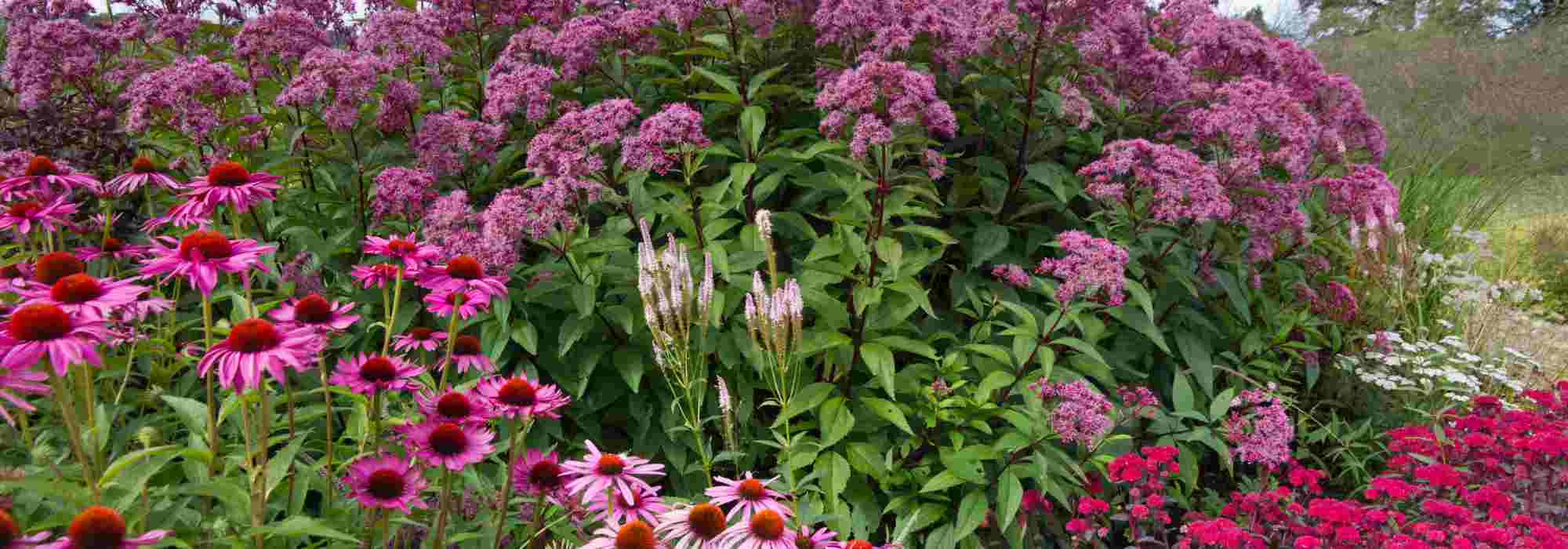
Inflorescences: all you need to know about the different forms of flowering
Learn to recognise the shape of flowers!
Contents
The flowers in our gardens are all different and contribute to the great richness of the flora. Beyond colour or fragrance, their differences are mainly due to distinct flower forms, which give them their unique appearance: at Promesse de Fleurs and in gardening books or magazines, the flowering of a variety, or species, is often described by the botanical term inflorescence.
This botanical vocabulary refers to the disposition of a group of flowers on an axis, as flowers are sometimes single, but more often grouped together to form the beauties that delight us so much.
Without going into a proper botany course, here are a few basics on the inflorescences most commonly encountered to better understand and appreciate the diversity of the flowers in our gardens.

Why is it useful to recognise the different inflorescences?
Recognising a flower’s inflorescence type is interesting for several reasons.
First, it helps to identify plants precisely, whether you’re out in the countryside or visiting a garden.
Just like leaves, the shape and arrangement of flowers are, in fact, among the keys to identifying plants, because each type of inflorescence has its own characteristics, indicating differences in family or genus, evolutionary adaptations and diverse reproductive strategies.
In floristry, the different inflorescences allow bouquets with a wide variety of shapes and enable you to work with their aesthetics.
Learning about them is, above all, for us, everyday gardeners, to learn how to use them well and to integrate them by combining them in borders, playing on their originality and diversity!
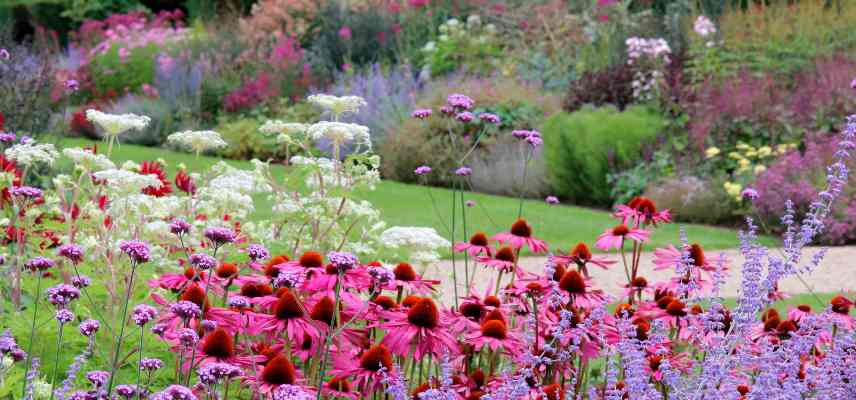
The variety of flower forms is immense: a boon to be explored in the garden!
Read also
Feathery inflorescencesHeads
Let’s start with the easiest of inflorescences, which is generally mistaken for a single flower!
I love you, a little, a lot, passionately… You’ll surely picture in your mind the flowers from which petals are plucked one by one to declare one’s love! It is actually heads, comprising flowers called sessile (without peduncle or petiole) grouped in a more or less dense arrangement on a central disc-shaped receptacle, itself surrounded by bracts, and ligules that are mistaken for petals and that are threshed little by little until… not at all!
They are most often flattened in shape, as with asters or daisies, a true landing pad for pollinators. This form of head-shaped flower is found in a characteristic family, the Asteraceae (or Compositae).
→ Examples: the daisy, the cornflower, Erigeron, the echinacea, the dandelion, the artichoke…
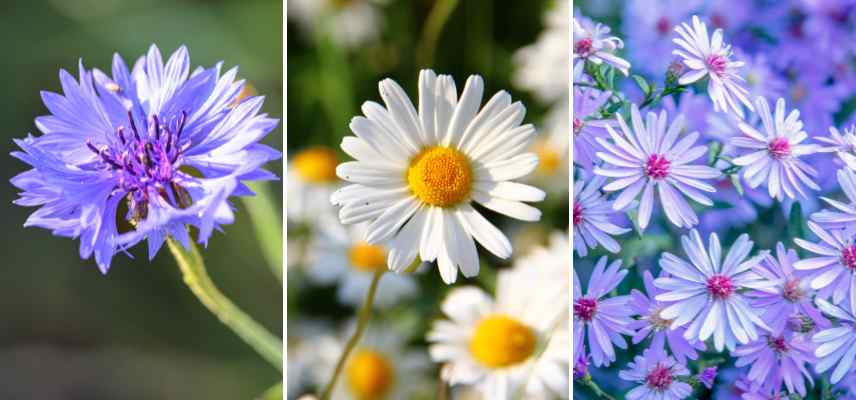
Cornflower, daisy and asters
Corymbs
The corymb is another inflorescence widely distributed among flowering plants. It forms a flat-topped bouquet of flowers whose peduncles (attachment stalks) are inserted in a tiered fashion at varying heights along the main axis, of differing lengths. As a result, the flowers are all on one plane and can form flat-topped inflorescences as in some hydrangeas (Hydrangea serrata), or more domed inflorescences in the Hydrangea aspera.
Sometimes some corymbs are mistaken for umbels: the difference being that the flowers of umbels are all attached at a single, radiating point. Corymbs occur notably in some Rosaceae (apple, pear, plum). They are compound in elder.
→ Examples: the elder, physocarpus, hawthorn, the yarrow, autumn stonecrop, the Iberis…
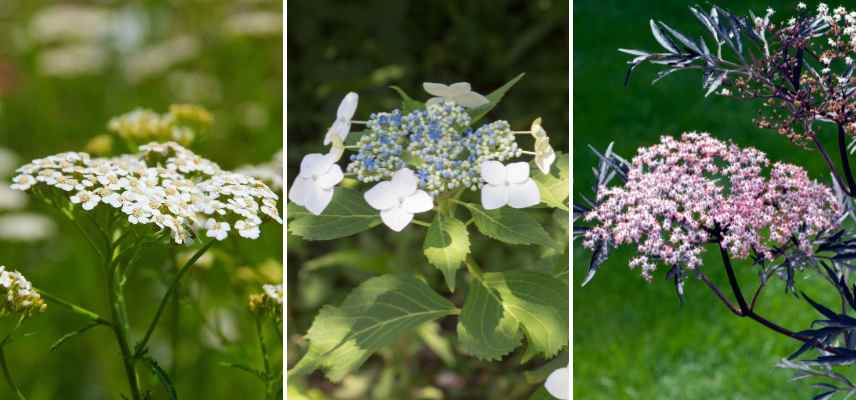
Yarrow, Hydrangea serrata and elder
Umbels
This inflorescence has peduncles almost of equal length (unlike the corymbs above) inserted at the same point on the stem.
The flowers are thus arranged evenly in a radiating pattern from a single point on the stem, like an umbrella.
The pedicels bearing the flowers vary in length, which means all the flowers lie largely on a single plane, more or less spherical. Umbels can be simple or compound, the latter formed by several simple umbels united into a larger structure, called a compound umbel. Thus there are relatively flat umbels in common fennel and compound (or double) umbels for the carrot flower, where the umbels reproduce a new nival zone with the umbellules.
Umbels are often grouped in the Apiaceae family, also known as the Umbelliferae. This family includes numerous aromatic and medicinal plants, such as carrot, parsley, celery, angelica and dill. They also form part of this inflorescence type of strikingly graphic flowers, forming a near-perfect sphere in agapanthus, lantana or ivy, and readily attract pollinators.
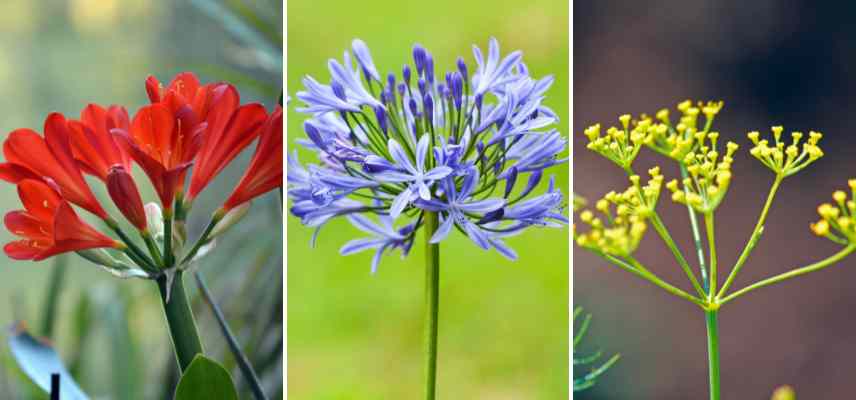
Clivia, Agapanthus and fennel
Cymes (or cimes)
Here, it starts to get a little more complex, as we are speaking in botanical terms about simple or compound cymes, uniparous, biparous or multiparous.
To keep it simple, let’s say that cymes are characterised by a main axis ending in a flower and that ramify by developing other flowers laterally from this axis. The flowers are often numerous and small and open in a staggered sequence, first the terminal flower, then the lateral flowers. It is sometimes confused with the raceme inflorescence (see below). Note that this type of flowering shows a great diversity in the shapes and sizes of cymes, which can vary from one species to another, as the lateral branches sometimes develop only on one side (this is then referred to as uniparous scorpioid cymes). The cyme flowering gives plants a particularly delicate and airy appearance.
→ Examples: Trachelospermum jasminoides (star jasmine) and Solanum jasminoides, forget-me-not, valerian, common borage, Ajuga reptans…
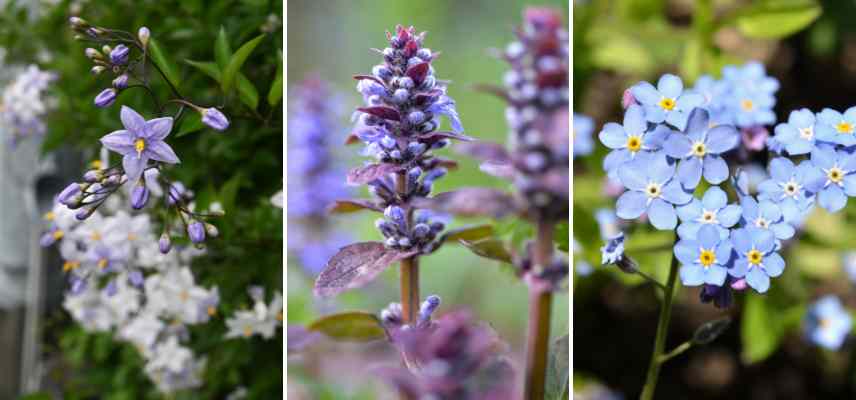
Solanum jasminoides, Ajuga reptans and forget-me-not
Racemes or clusters
Racemes, or clusters, are simple inflorescences in which the flowers are arranged along a single central axis, without branching, and attached by a short pedicel. They are fairly easy to identify thanks to their single floral axis. The raceme may be trailing or upright. This structure is common in many plants such as wisteria and lupins. Racemes allow for neat and elegant flowering, appreciated for its simplicity and charm. Racemes or clusters are found in a wide variety of flowering plants, with no particular dominant family.
→ Examples: wisteria, crocosmia, lily of the valley, Muscari, lupins, mimosa, Winter Jasmine…
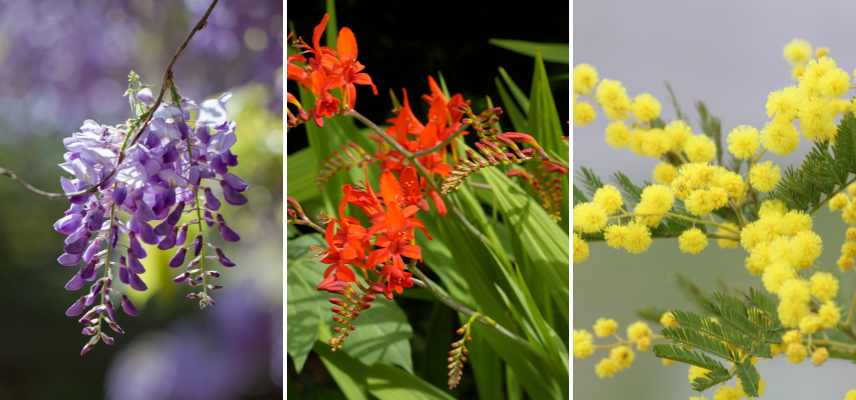
Wisteria, Crocosmia and Mimosa
Thyrses
Thyrses are complex inflorescences, characterised by a branched structure in which each secondary axis itself bears flowers in a cluster of cymes, thus forming a composite inflorescence. This arrangement takes a pyramidal form, sometimes referred to as a thyrsoid panicle, which generally helps to identify them. Thyrses produce abundant, often spectacular flowering, attracting numerous pollinators. Thyrses are not restricted to any single family of flowers, but occur across a variety of ornamental and wild species.
They are loved for their striking aesthetic effect and generous flowering. Thyrses are also valued for their ability to typically produce flowers over a long period, as with the butterfly bush (Buddleja davidii), providing prolonged visual interest in the garden.
→ Examples: horse chestnut, Ornithogalum, lilac, Buddleja, grapevine.
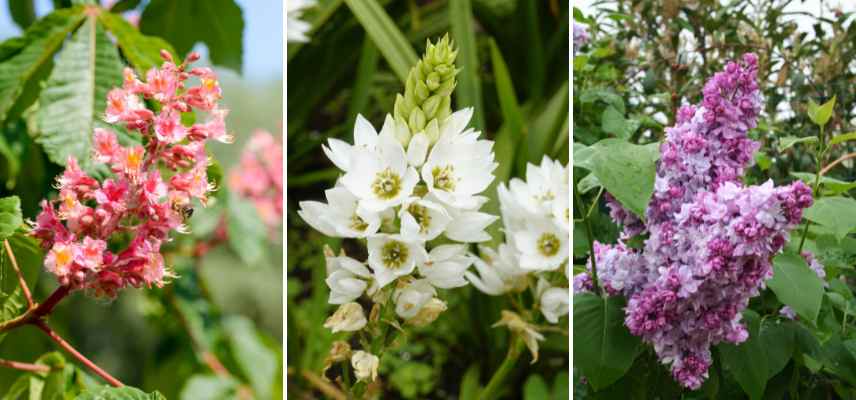
Flowers of horse chestnut, Ornithogalum and lilac
Panicles
Panicles are large, branched inflorescences composed of clusters of flowers, each flower petiolate: the flowers are arranged in a disorderly fashion and collectively form a pyramid or cone. The degree of branching decreases along the central axis, and the flowers are located on terminal meristems, creating an airy structure. This arrangement is common in plants such as Asian hydrangeas, aptly named Hydrangea paniculata. Panicles offer abundant, airy and misty flowering, adding volume and texture to borders, perfect for naturalistic gardens or the elegance of English gardens. Plant Latin names often bear this adjective “paniculata”, which helps us a little!
→ Examples: Hydrangea paniculata, Perovskia atriciplifolia, gypsophile, Phlox paniculata, Yucca gloriosa…
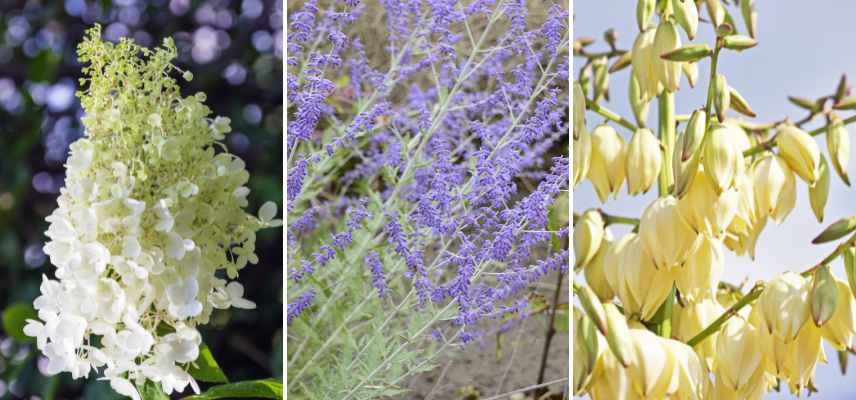
Hydrangea paniculata, Perovskia atriciplifolia et Yucca gloriosa
Glomerules
Glomerules form a very dense, roughly spherical cluster of numerous small sessile flowers, without a peduncle or with a shortened peduncle. The flowers take on the appearance of small, compact spheres, as they are all inserted at the same point on the stem, along a very short axis. Glomerules present a visually attractive appearance, with their globular shape. They are ideal for creating colourful displays in borders and often attract pollinators.
→ Examples: Monarda bee balm, clovers, and Echinops ritro.
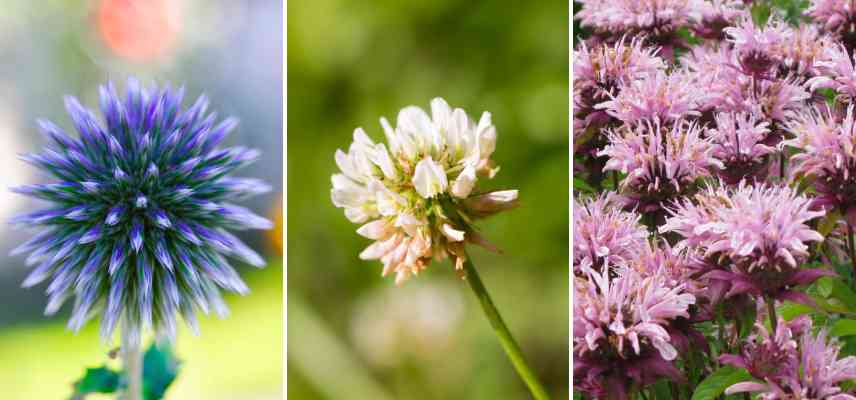
Echinops ritro, clover and Monarda
Cyathia
The cyathium is typical of the Euphorbiaceae, as the best-known in our gardens—the Garrigue spurge. We are indeed still dealing with an inflorescence, because there is a single female flower, but it is surrounded by several grouped male flowers, and the whole is surrounded by two bracts.
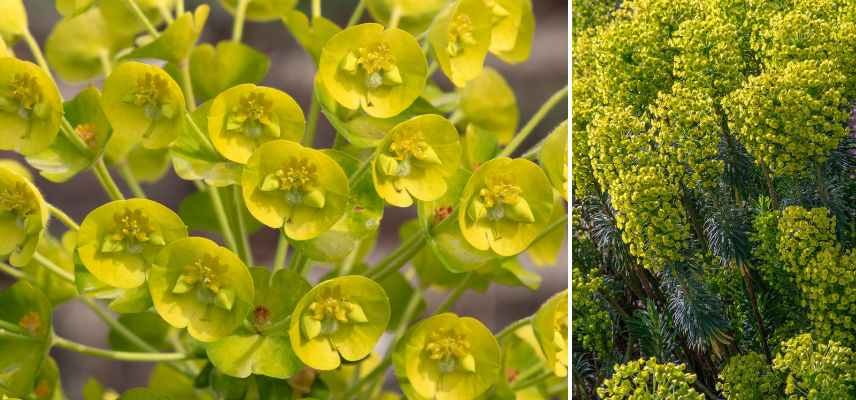
Euphorbia characias
Spikelets and spikes
Spikelets are a term typically reserved for the Poaceae family, i.e., the grasses (although the term épillets is also used). Wheat that forms part of it is composed of a terminal spike, itself subdivided into several spikelets. Spikelets are also the characteristic inflorescences of the Juncaceae (such as the woodrushes and rushes) and of the Cyperaceae (Carex, Cyperus papyrus, Cirpoides, etc.), although some may flower in the form of panicles or glomerules.
In our gardening practice, spikelets are encountered mainly in all ornamental grasses such as Miscanthus and Muhlenbergia, among others, and in Lagurus ovatus (though it is often incorrectly referred to as ‘bunny tails’).
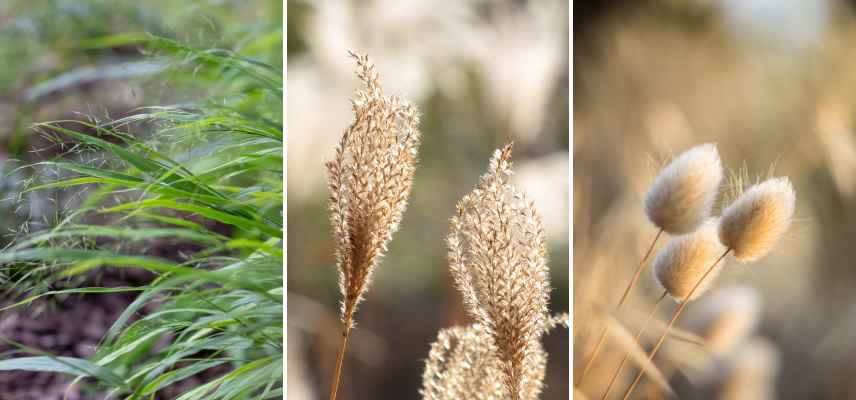
Hakonechloa macra, Miscanthus sinensis and Lagurus ovatus
As for the spikes, that is a term used for a very large number of perennials or shrubs presenting inflorescences characterised by a central stem with flowers arranged along their entire length, sessile flowers without a peduncle. The range of spike types is wide as they can be compact or loose, depending on the species.
Spike inflorescences provide vertical structure and height to the garden, essential in borders, creating an interesting contrast with airy plants.
→ Examples: lavender, viper’s bugloss, Callistemon, Celosia argentea, Verbena hastata, Liatris spicata, plantain…
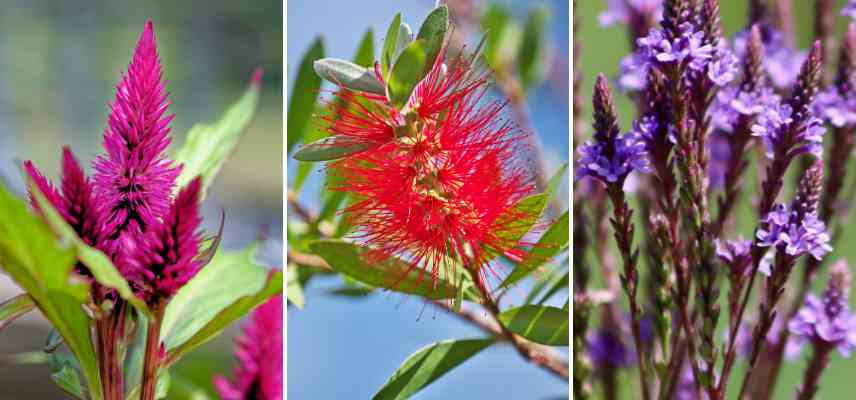
Celosia argentea, Callistemon and Verbena hastata
Aments
This term speaks to the child within us and does not resemble the idea we have of a flower. Yet it is indeed a flower, growing only on trees known as bearing catkins. This inflorescence is always soft and has neither petals nor sepals.
The most common catkins are those of willow, hazel, hornbeam or birch, but they are also seen on Garrya elliptica, on poplar and on holm oak (Quercus ilex). These are three major genera involved: the Salicaceae (willow, poplar), the Fagaceae (oak, chestnut and beech) and the Betulaceae (hornbeam, hazel and alder). These inflorescences have the peculiarity of appearing at the end of winter (except for chestnut) and become more noticeable in spring as they release their pollen.
This ament can be a male flower in oak or hazel, but it is a female flower in willow, alder and poplar.
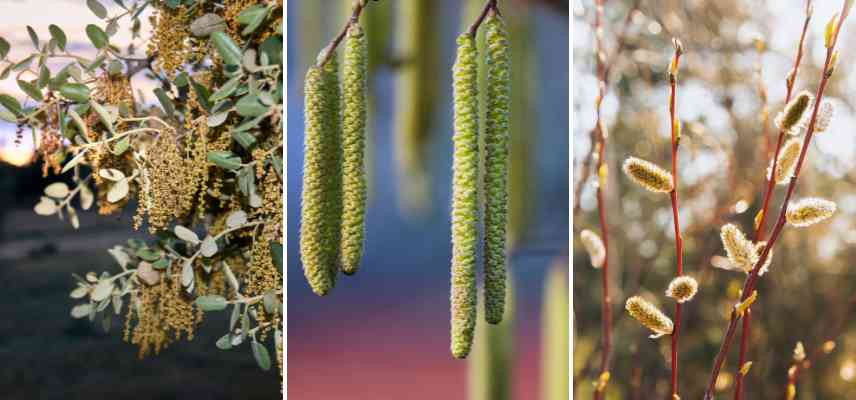
Garrya eliptica, hazel and willow
Spadix
To finish with this beautiful display, here is a truly original and atypical inflorescence. The spadix is the characteristic flower of plants in the Araceae family, such as the Arum (Zantedeschia aethiopica). The spadix takes the form of a a fleshy spike that gathers a multitude of tiny flowers, yellow, white or red depending on the flowers. In these flowers, there is a membranous envelope more or less large and leathery depending on the plants, a sort of large cone half-open in full bloom, which surrounds the spadix: this is the spathe, white in colour in the arum and in the spathiphyllum, a fairly common houseplant.
Spathes and spadices are characteristic of plants in the Araceae family, which include arums, but also palms.
→ Examples: the garden arum, the Calla palustris, the Anthurium, the Syngonium, the dragon arum Dracunculus vulgaris, the palms.
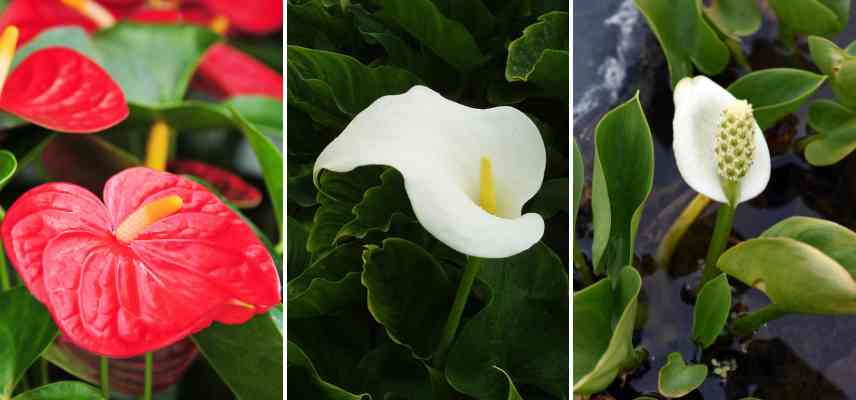
Anthurium, Zanthedeschia aethiopica and Calla palustris
- Subscribe!
- Contents
Comments