





























6 ideal plants to create a rain garden
Our selection of plants suited to the cool, damp conditions of riverbanks
Contents
The rain garden is an ecological, economical, and aesthetic arrangement. It allows for the collection and management of rainwater to limit the risk of flooding. However, this water retention also enables the valorisation of rainwater for reuse. These wet areas are also beneficial for biodiversity.
This arrangement is made possible, among other things, by using suitable plants that thrive in cool or moist conditions, near water points. These riverbank plants will be selected based on the size of the rain garden, as well as your growing constraints: soil type, exposure, and climate. Ideally, it is best to diversify the types of vegetation to achieve an aesthetic appearance in all seasons.
Here is our selection of 6 plants to grow in a rain garden.

Athyrium: a fern with decorative fronds
Athyrium ferns are valued for their elegant, finely divided foliage, which is particularly ornamental. We are well acquainted with the type species Athyrium filix-femina. This is a large perennial with green fronds that can easily be encountered during our walks in the forest, where it grows spontaneously.
However, other cultivars or species display originality, showcasing less conventional textures or colours:
- the small variety ‘Frizelliae’ produces light green foliage with a texture reminiscent of parsley;
- ‘Lady in Red’ reveals, after a few years, fronds with burgundy petioles, which are particularly aesthetic;
- ‘Victoriae’ offers very architectural foliage composed of cristate fronds;
- the Japanese fern Athyrium niponicum ‘Burgundy Lace’ delights us with fronds that blend green, silver, and purple;
- ‘Metallicum’ has green foliage with beautiful metallic reflections of blue, mauve, and grey.
These perennial plants will add a natural touch, as well as a graphic note, to the edges of a rain garden. Like most ferns, they indeed prefer cool or moist soils, which are essential for their reproduction via spores. They will thrive in soils rich in organic matter, preferably slightly acidic.
Hardy down to -20°C, or even beyond, they can be cultivated in most of our regions. Provide them with a shaded or partially shaded exposure.
For more information: Athyrium: planting, growing, and caring for
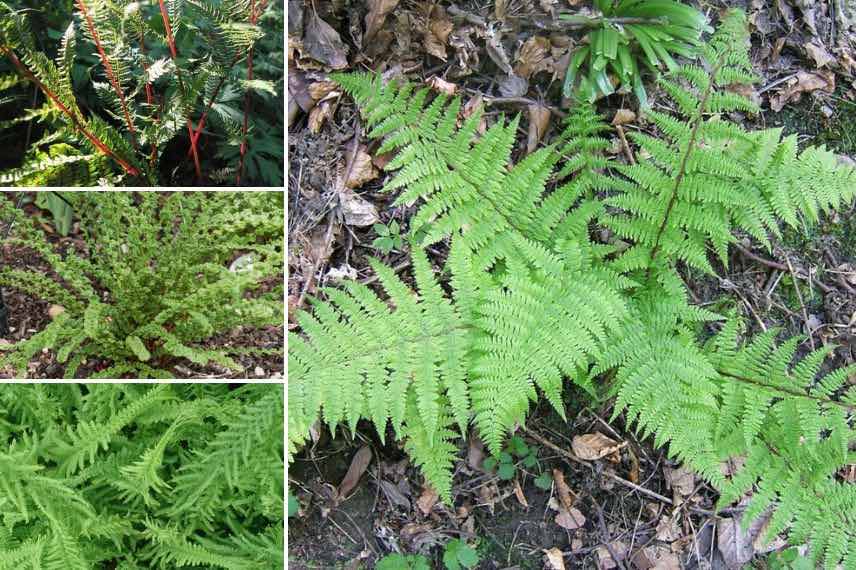
Clockwise: Athyrium ‘Lady in Red’, Athyrium filix femina, ‘Victoriae’, ‘Frizelliae’
Read also
How to save water in the garden?Hibiscus moscheutos: perfect for flowering a rain garden
These common Rose mallows are plants with spectacular summer flowering and an exotic appearance. They are widely used in water gardens because they thrive in moist, even waterlogged soils. Native to the marshy areas of the United States, these Hibiscus have a preference for waterlogged locations, as well as for long, mild summers that allow them to reveal their natural lushness.
Although they emerge late in spring, Hibiscus moscheutos will provide a generous display from summer to autumn, flowering around your rain garden. They produce large, single cup-shaped flowers that can reach nearly 25 cm in diameter. These flowers continuously renew on the plant until autumn.
Choose your Hibiscus based on the colour and size of the flowers:
- the Hibiscus moscheutos ‘Joli Cœur’ produces impressive bicoloured flowers, white with a bright red centre;
- ‘Fujin’ is a dwarf variety that reaches about 80 cm in all directions, with flowers blending pale pink, white, and purple;
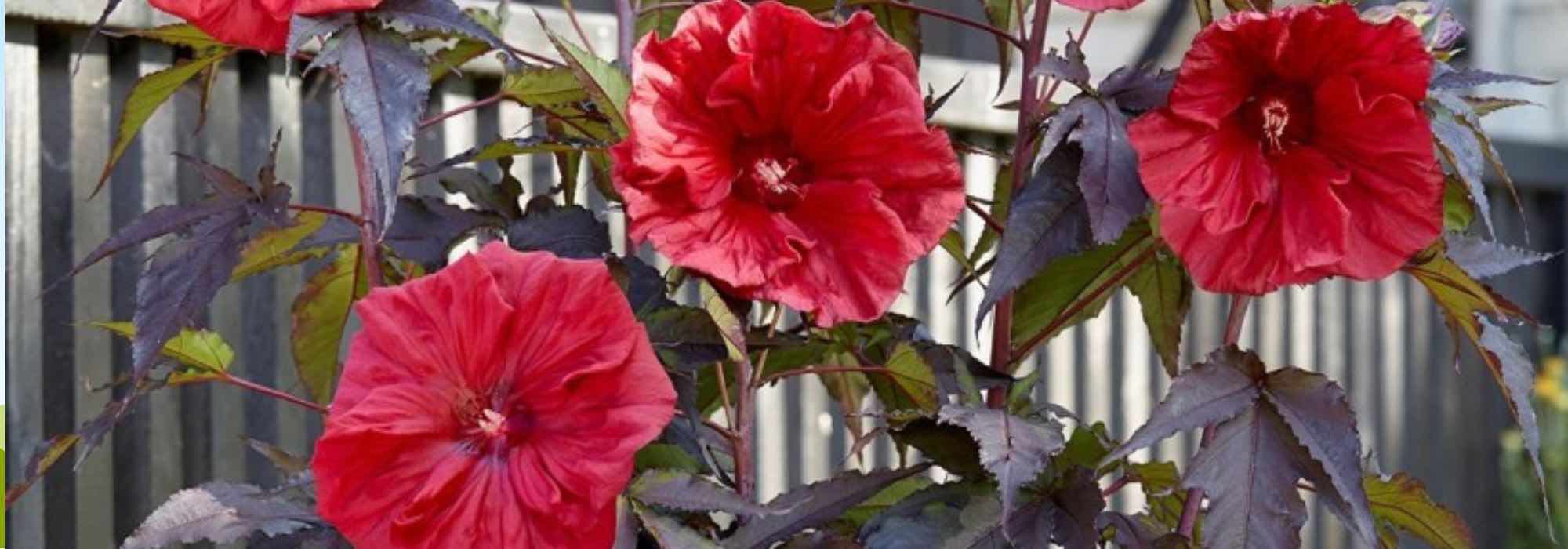
- ‘Red Wine’ graces us, as its name suggests, with bright red flowers, enhanced by beautiful purple foliage;
- the variety ‘Sweet Caroline’ offers a charming bright pink flowering.
Provide them with a sunny location, sheltered from prevailing winds that could damage their delicate flowers. In terms of soil, Hibiscus moscheutos can tolerate even heavy, calcareous soils.
Somewhat less hardy than other species of Hibiscus, they can withstand frosts down to -10°C. In regions north of the Loire and in areas with harsh winters, the stump can be protected with a thick mulch in autumn.
For more information: Hibiscus, althaea: planting, growing, and maintaining.
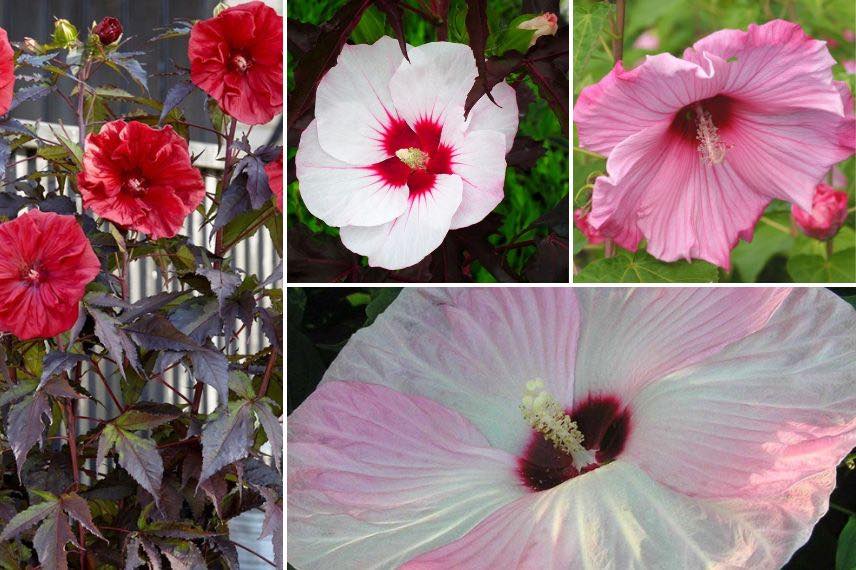
Hibiscus moscheutos ‘Red Wine’, ‘Joli cœur’, ‘Sweet Caroline’, ‘Fujin’
Gunnera manicata: an impressive plant for water's edge
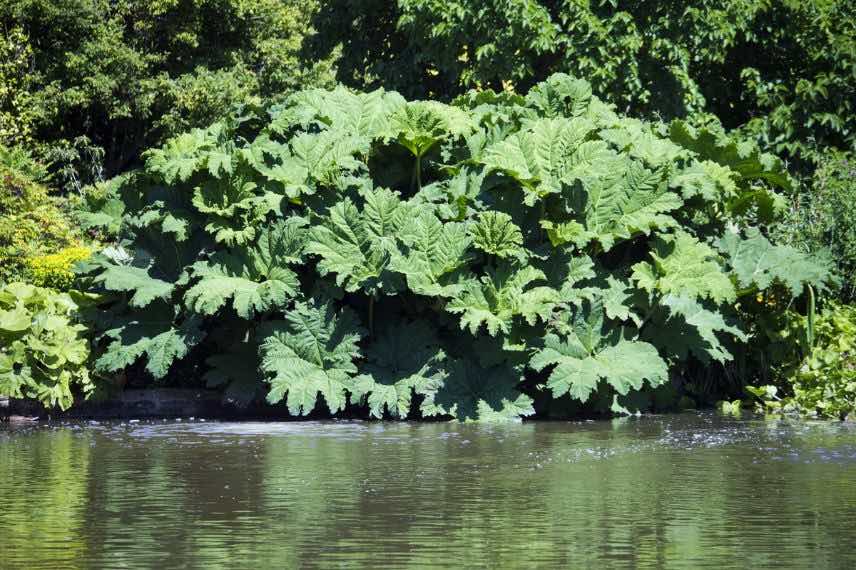
Gunnera manicata is also known as Brazilian giant rhubarb, referring to its foliage and impressive silhouette. At maturity, this perennial easily exceeds the height of a man, reaching around 2.5 metres in height and spread. It produces enormous, exotic-looking leaves, dark green in colour, gathered in a lush clump. This lobed foliage is dentate and has a crinkled texture. It disappears in autumn but re-emerges in spring, exhibiting rapid growth.
The summer flowering is equally impressive: the inflorescences with red or green spikes can indeed reach nearly 1 metre in height. They are followed by brown fruits, which remain ornamental until autumn. A plant that definitely cannot go unnoticed!
This plant enjoys damp, even waterlogged areas, making it a good candidate for rain garden borders.
Moderately hardy due to its origins (the mountain swamps of Brazil), it can withstand frosts of around -10°C, or even more if its stump is well protected by a thick mulch.
Grow this Gunnera in full sun or partial shade, in rich, deep soil. Prefer a location sheltered from prevailing winds and the scorching rays of the sun, which can damage its impressive foliage. Water during dry spells or add a waterproof liner at the bottom of the planting hole to better retain moisture, as this plant requires consistently moist soil, but not waterlogged.
For more information: Gunnera, Brazilian giant rhubarb: planting and care
The hard rush: an evergreen, ornamental foliage in all seasons
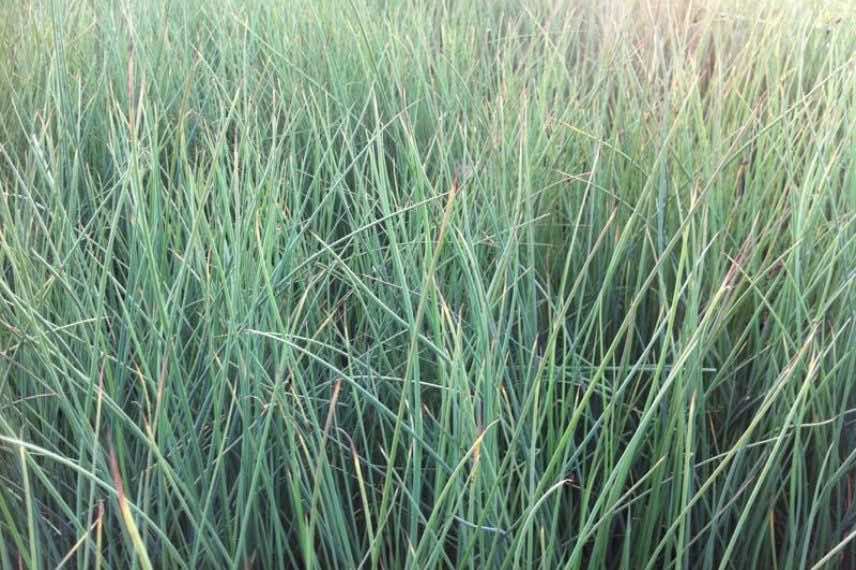
The hard rush (Juncus inflexus) is a perennial plant of wet environments often found alongside aquatic plants. It is also known as arching rush or glaucous rush.
This plant quickly forms a true clump of vegetation, consisting of stiff striate stems reminiscent of grasses. They display a silvery green colour. Evergreen, this foliage has the advantage of remaining decorative throughout the year, adding a lovely vertical graphic touch. Flowering occurs in summer, in the form of brownish-red spikelets.
Thanks to its rhizomes and stolons (aerial stems producing new plants), this perennial develops and spreads rapidly, potentially becoming invasive.
The gardener’s rush prefers heavy, moist, even marshy soils. It will thrive effortlessly in a rain garden of any size, thanks to its small stature measuring 50 cm in all directions. Its stump can even be submerged up to 10 cm.
Cultivate it in rich soil, even clayey, in partial shade or full sun.
Houttuynia cordata: an adorable heart-shaped aromatic foliage
Houttuynia cordata is also known as Chinese pepper or fish mint, referring to the aromatic scent of its edible leaves. It is a perennial groundcover with a wider than tall silhouette, native to the wet and marshy areas of China and Japan.
Its foliage is particularly ornamental: it consists of heart-shaped leaves. They display a dark green colour with bronze highlights in the typical species. The variety Chameleon, on the other hand, is much more exuberant: its leaves are randomly variegated with cream, yellow, green, and pink, making them particularly vibrant. This foliage can be evergreen in mild climates.
In summer, the decorative leaves are accompanied by a charming flowering, consisting of conical flowers with white bracts.
This perennial thrives in cool, moist, waterlogged soils, even occasionally submerged, such as at the edges of a rain garden. Plant it in a semi-shaded position, in rich soil, even heavy and clayey.
Quite hardy (down to about -15°C) and easy to care for, it requires no special attention to grow. It will easily colonise the space thanks to its underground rhizomes, potentially becoming invasive and transforming into a true green carpet.
For more information: Houttuynia cordata, Chinese pepper: planting, growing
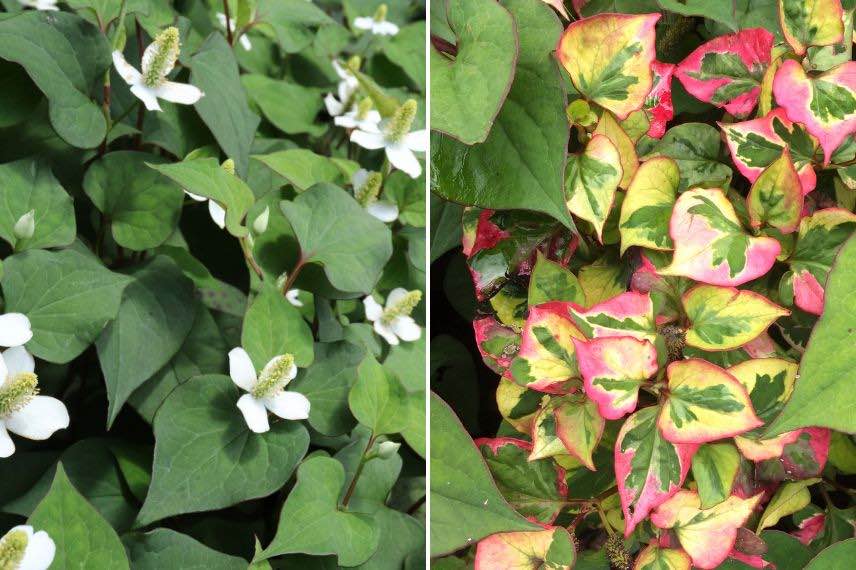
Houttuynia cordata and variety ‘Chameleon’
Marsh Irises: an elegant colourful blooming for wet banks
Iris pseudacorus or Yellow Flag Iris is a perennial plant with beautiful golden yellow spring flowering. There are different varieties, such as:
- ‘Variegata’, which has very bright variegated green and cream foliage;
- ‘Plena’, which rewards us with beautiful double flowers;
- ‘Crème de la Crème’, which offers, as its name suggests, a creamy white flowering tinged with yellow;
- the Iris pseudacorus bastardii, which produces original pale yellow flowers veined with brown.
Its silhouette, reaching about 1 metre in height, consists of slender, evergreen leaves, in a bright green.
A native perennial plant, growing naturally in ditches, the banks of freshwater and stagnant water, it will be perfect for a rain garden. Quite hardy, it will adapt to all our regions, in sunny or partially shaded locations. Plant Yellow Flag Iris in soil that is always cool to moist, even submerged up to 20 cm.
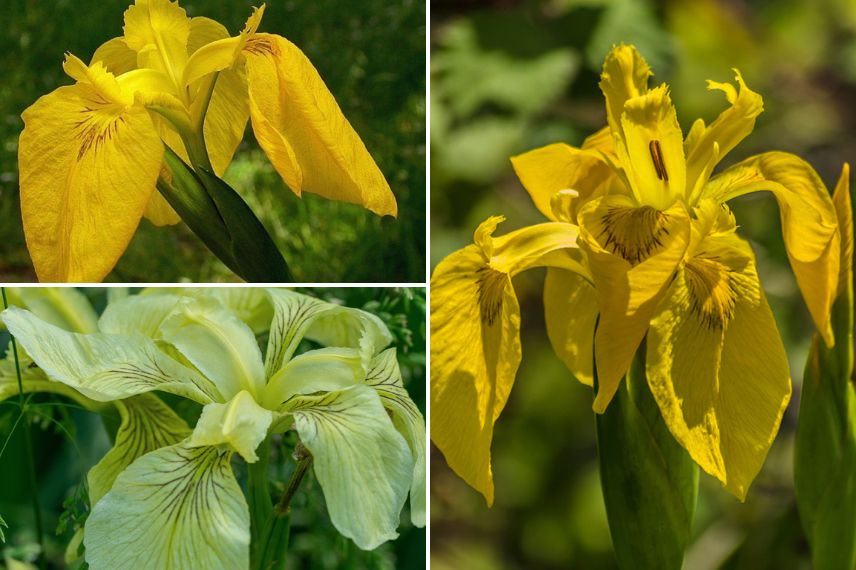
Iris pseudocarus ‘Variegata’, ‘Plena’ and pseudocarus bastardii
- Subscribe!
- Contents
Comments