


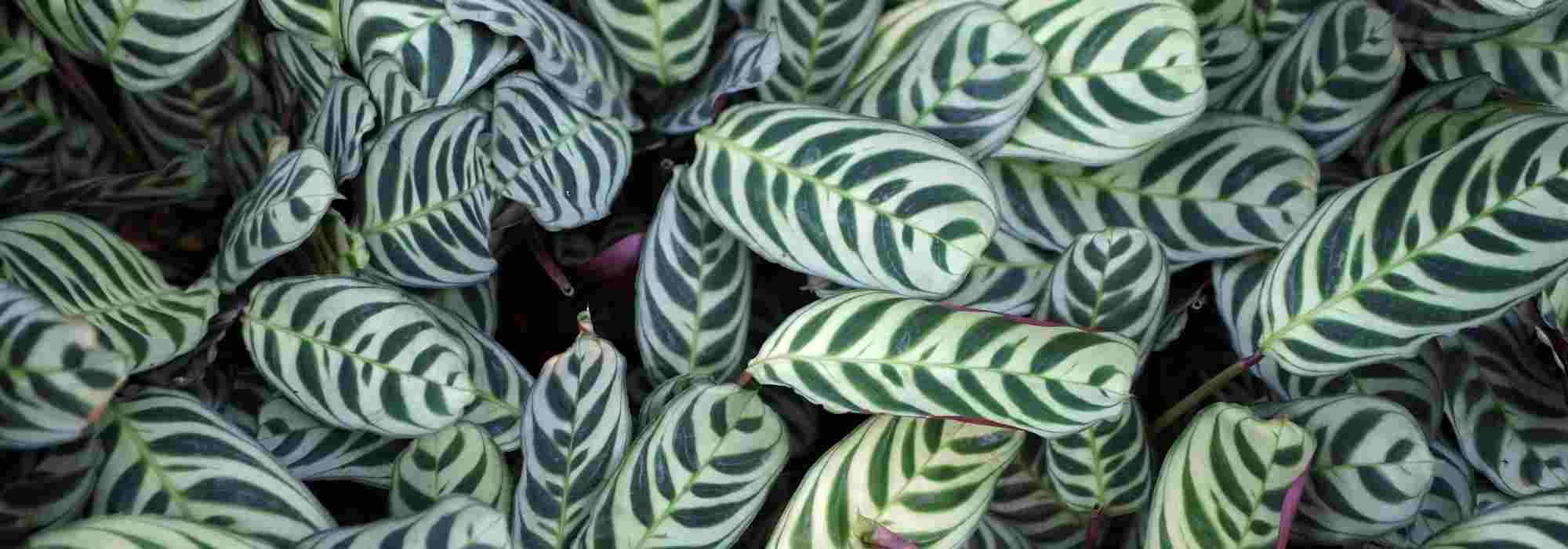
Diseases and parasitic problems of Ctenanthe: our tips
Diagnosis, treatment and prevention of diseases and pests affecting this houseplant
Contents
Ctenanthe, a member of the Marantaceae family, is an indoor plant that captivates with its exotic marbled leaves and its ability to follow daylight by slowly folding its foliage as night falls. Native to the tropical forests of South America, it evokes the luxuriance of a humid understorey, which makes it a highly appreciated indoor plant for its aesthetics. But like any tropical plant cultivated outside its natural habitat, the Ctenanthe can be a little temperamental, especially when its specific needs are not fully met. Poorly controlled humidity, inadequate ventilation or poorly calibrated watering can cause the appearance of parasitic pests and diseases that can quickly compromise the health and beauty of the plant.
Discover how to identify, treat and prevent the most common pests and diseases of Ctenanthe.
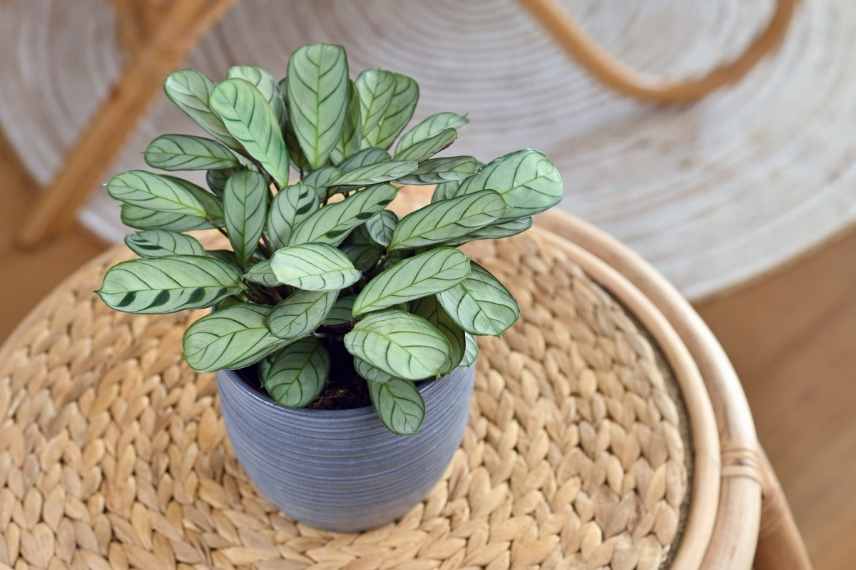
The Ctenanthe burle-marxii

The most common pests of Ctenanthe
Ctenanthe, an indoor plant prized for its graphic foliage, patterned with markings and contrasting colours, and its natural movement, can be vulnerable to a range of pests. This is all the more true since these plants are fairly demanding in terms of their growing conditions.
Red spider mites
Microscopic, red spider mites are sap-sucking mites. They thrive in warm, dry environments. Their webs are visible between the petioles and under leaves.
Signs of infestation
- Leaves are speckled with tiny pale dots, then discolour, turn brown and shed prematurely
- Presence of very fine silken webs, often visible in oblique light.
Treatments
- Douse the plant with a jet of water, as red spider mites dislike humidity
- Increase ambient humidity with regular foliar mists, but not excessively to avoid fungal diseases
- In case of severe infestation, spray a neem oil solution, renewing the treatment until all webs have disappeared.
Prevention : Increase ambient humidity with regular foliar mists, but not excessive to avoid fungal diseases. Wiping the foliage with a damp cloth is also advised.
Mealybugs and scale insects
Mealybugs feed by inserting a rostrum into plant tissues to suck sap. The fluffy species secrete a white waxy substance, while shield mealybugs are covered by a hard shell.
Signs of infestation
- Presence of small white cottony masses or brown plaques on stems and leaf veins, or on the underside of leaves
- Leaves are sticky due to honeydew, a substance secreted by mealybugs
- Secondary development of sooty mould, a black fungus that resembles soot.
Treatment
- Gently scrape off mealybugs with a cotton bud dipped in 70% alcohol or with black soap, followed by a light rinse of foliage with clean water
- In case of severe infestation, spray, on the undersides of leaves and on the stems, a mixture consisting of one tablespoon of black soap, one tablespoon of vegetable oil and one tablespoon of 70% alcohol added to one litre of water. The spray can be repeated one week after the first application.
Prevention : An overly dry atmosphere encourages their development. Maintaining humidity at 60% minimum reduces their presence.
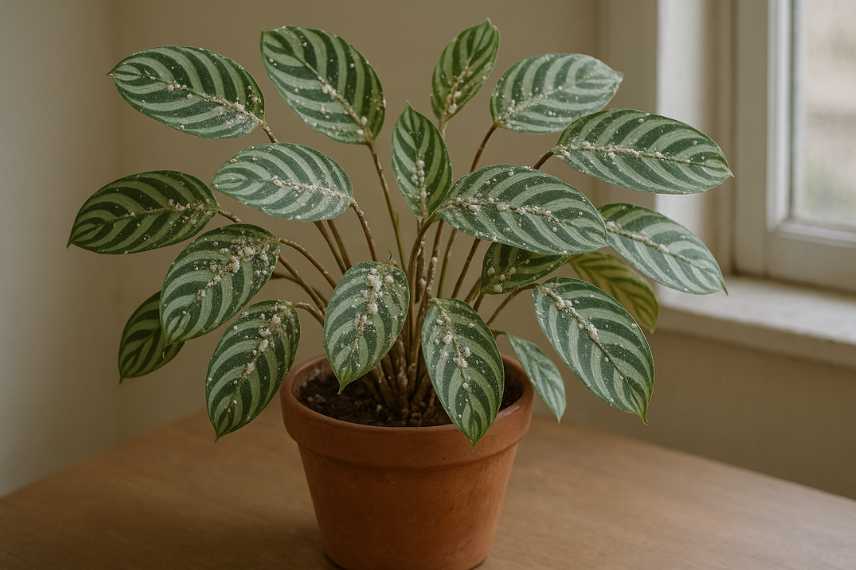
The most common pests of Ctenanthe are mealybugs (AI-generated image)
Thrips
The thrips are slender, elongated insects, very fast, that puncture leaf cells, creating a silvery effect.
Signs of infestation
- Silver stripes or patches on foliage, or irregular discolouration
- Distortion of young leaves
- Small black specks corresponding to thrips excrement visible on the undersides of leaves
Treatment : The blue chromatic traps help capture thrips.
Prevention : Regular monitoring of the foliage and removal of affected leaves helps eliminate thrips.
Read also
Ctenanthe: planting, growing and careMain diseases of Ctenanthe
Beyond pests and diseases, which are relatively common on houseplants when cultural conditions are not observed, can affect Ctenanthe.
Root rot
It is one of the most common problems in Ctenanthe, often caused by overwatering or a pot with poor drainage.
Signs of infestation
- General yellowing of the foliage, sometimes rapid
- Soft, drooping stems
- Dark, mushy roots that may emit an unpleasant odour
Treatment
- Unpot the plant immediately
- Cut away all affected roots with a clean tool
- Repot into a very well-draining mix (light potting compost + perlite or sand)
- Reduce watering and only water when the top of the substrate is dry
Prevention
- Always check that the pot has drainage holes
- Never leave water standing in the saucer
- Adjust watering to the season, reducing it in winter
Brown or black spots on the leaves of Ctenanthe
Brown or black spots on the leaves of Ctenanthe can be the symptom of a fungal attack, such as Alternaria or bacterial. Constant humidity on the leaves is often the trigger.
Signs of infestation
- Small brown spots with yellowish edges on the foliage
- Expansion of the lesions
- General weakening if many leaves are affected
Treatment
- Remove the affected leaves to limit spread
- Avoid any direct spraying on the leaves
- Apply an organic fungicide (sulphur or copper) or potassium bicarbonate-based on the foliage
Prevention
- Do not water with spray; always water at the base
- Ventilate the room regularly
- Space the plants apart to limit stagnant humid air
- Limit misting for a period
Leaves curling on the Ctenanthe
Leaves curling can indicate environmental stress or a response to unsuitable growing conditions. This phenomenon often precedes other, more serious symptoms.
Signs
- Gradual curling of the leaves towards the centre
- Loss of turgor (soft leaves)
- Leaves that pale or become brittle
Treatment :
- Increase ambient humidity to a minimum of 60%, via a humidifier or a water tray with clay pebbles
- Maintain regular watering, without excess: the substrate should remain slightly moist, but not waterlogged
- Place the plant in a location away from drafts, in a room between 18 and 24°C
- Filter the light if the exposure is too direct, using a sheer curtain
Prevention
- Install a hygrometer to monitor ambient humidity
- Never let the root ball dry out completely
- Avoid abrupt temperature fluctuations
- Adapt the watering frequency according to the seasons
Powdery mildew
Powdery mildew, also called “white,” is a well-known fungus among gardeners. It prefers warm and slightly dry conditions. It appears as a white powdery coating on the surface of the leaves, like flour.
Signs of infestation
- Leaves covered with a light white down
- Distortion of young leaves, slowed growth
- Leaves that yellow and drop prematurely
Treatment
- Remove the affected parts promptly
- Spray a mild fungicidal treatment such as horsetail decoction, nettle manure, baking soda or sulphur-based fungicide
- Ventilate the room and avoid excess stagnant heat
Prevention
- Avoid strong temperature differences
- Mist the surrounding air lightly, without soaking the plant
- Do not over-fertilize, especially with nitrogen
Care for Ctenanthe
It’s often said in gardening, and it’s even truer for tropical plants like the Ctenanthe: prevention is better than cure. Here are the habits to adopt to keep your Ctenanthe looking resplendent all year round.
Ideal growing conditions
Ctenanthe thrives in tropical conditions: gentle warmth, indirect light, high humidity.
- Light : place your Ctenanthe near an east- or north-facing window, or behind a sheer curtain if it is south-facing
- Temperature : between 18 and 25°C. Avoid draughts, radiators and sudden fluctuations
- Humidity : use a humidifier, place the plant on a bed of damp clay pebbles, or lightly mist the air around
- Watering : wait until the surface of the potting mix is dry before watering. Use soft water, such as rainwater or filtered water if possible, at room temperature. In spring and summer, watering 2–3 times a week is ideal; in autumn and winter, once a week. Never leave residual water in the saucer or the cache-pot.
Adequate air circulation
The Ctenanthe likes to be surrounded, but not crowded. Too much crowding between plants fosters disease transmission and stagnant humid air, conducive to fungi.
- Leave an space of at least 10 to 15 cm between each plant
- Ventilate regularly the room, even in winter, to refresh the air.
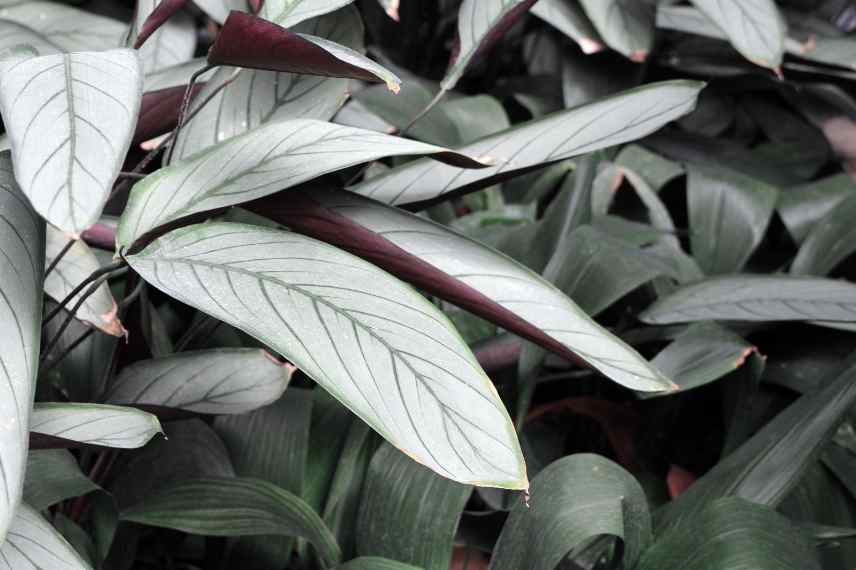
The ctenanthe requires high humidity and moderate light
A measured approach to fertilisation
Too much fertiliser, particularly rich in nitrogen, can promote fragile foliage that is highly attractive to insects. Conversely, an undernourished plant will be more vulnerable.
- Fertilise once a month in spring and summer, with a balanced fertiliser (such as 10-10-10 or a fertiliser for leafy houseplants)
- Do not fertilise in winter.
Impeccable hygiene
A clean plant and a well-kept environment greatly limit the proliferation of pathogens.
-
Regularly wipe the leaves with a soft, slightly damp cloth to remove dust and invisible spores
-
Disinfect your tools before each pruning, especially when moving from one plant to another (70% alcohol, diluted white vinegar).
A quarantine period after purchase
Any new plant introduced into your home may, unbeknownst to you, bring pests or diseases with it. It is therefore crucial to go through a quarantine period.
-
Isolate your Ctenanthe for 2 to 3 weeks
-
Use this time to check for the absence of spots, webs or small insects.
- Subscribe!
- Contents
Comments