


How to fence a garden on a budget?
Our tips and practical ideas
Contents
In most of our regions, when you have a garden, you typically surround it with a fence. This helps define the space, protect it, and even add a decorative touch to your outdoor space. But a fence can quickly become a significant investment, and not everyone wants to break the bank. Good news: there are many economical, clever and eco-friendly ideas for fencing your garden. In this article, discover our various ideas for fencing your garden, from the most eco-friendly to the most common, to choose the ideal solution for your needs.

Why fencing in your garden?
Fencing a garden helps address several needs. Firstly, it helps to materialise the boundaries of your property, an essential point in avoiding potential neighbour disputes or the unsolicited arrival of complete strangers.
Secondly, a fence can protect your privacy, particularly in residential areas where prying eyes are common. Not to mention that hedges are also used to reduce wind or noise!
The fence or hedge also plays a role in delimiting and protecting your spaces, for example by protecting children from outdoor hazards or by preventing your domestic animals from escaping. It also limits visits by animals coming from outside (wild or domestic) or from the neighbouring poultry, which would relish your precious vegetables or ornamental plants.
In addition, it also helps to organise your garden by delimiting different zones such as a vegetable patch, a poultry area or a seating area.
Finally, it also adds aesthetic value, becoming a decorative feature that contributes to the beautification of your outdoor space.
Note: as we will see below, some fencing solutions, such as hedges or vegetated structures, can provide shelter for birds, pollinating insects, or other useful species in your garden.

When should you install a fence?
The best time to install a fence is in spring or autumn. After spring or autumn rains, the soil is usually wet and easy to work. This makes driving in posts or digging holes for your fence easier.
The work will also be less arduous than doing it in the heat of summer or the cold of winter.
Additionally, if you opt for a living fence (such as a hedge), these seasons coincide with the best times to plant, helping plants establish.
A few tips before you start
- Before planting your first post or hedge, check with your local council for any restrictions on fences (height, materials, etc.). Also ensure you respect the boundaries of your land to avoid disputes with neighbours.
- Clear the area of stones, roots or unwanted weeds to facilitate installation.
- Use stakes and string to mark precisely where your fence will go. A well-defined plan will save you costly errors or time spent readjusting.
Hedges
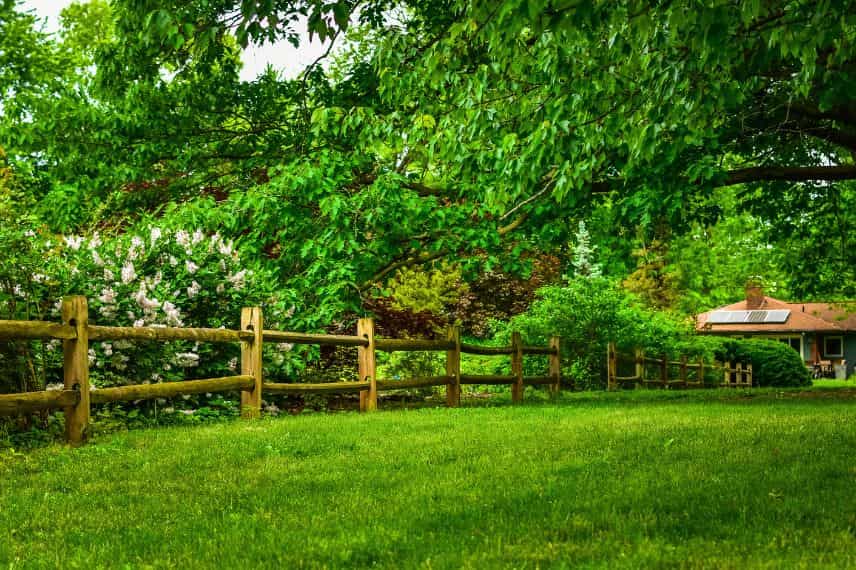
A living fence, besides being economical and eco-friendly, blends harmoniously with the surroundings of a garden. It promotes biodiversity, provides shelter for birds and insects, and can even evolve with the seasons. Here are several types of living fences, suited to different needs.
Shrub hedges
A shrub hedge is composed of several specimens aligned to form an aesthetically pleasing and dense natural barrier, ideal for shielding prying eyes, reducing wind, noise or structuring space.
A hedge can be created with a single species (privet, Portuguese laurel, etc.), but a varied composition is often more visually interesting. By pairing shrubs with deciduous and evergreen foliage, you obtain a garden that evolves through the seasons while reducing the risks linked to diseases or pests found in hedges of a single species. A diverse hedge (or cottage-style) also helps support local wildlife, by providing shelter and food for birds, insects and other small animals.
→ For guidance, read: “Which shrubs for which types of hedges?“.
Cost and durability
- €5 to €15 per shrub if you buy young plants. If you have time, it is possible to obtain these shrubs by propagation by cuttings, a simple and economical method for a dense hedge at a lower cost. For more, read our article: ” Propagation by cuttings: the different techniques and our advice“.
- A varied and well-maintained hedge can last several decades.
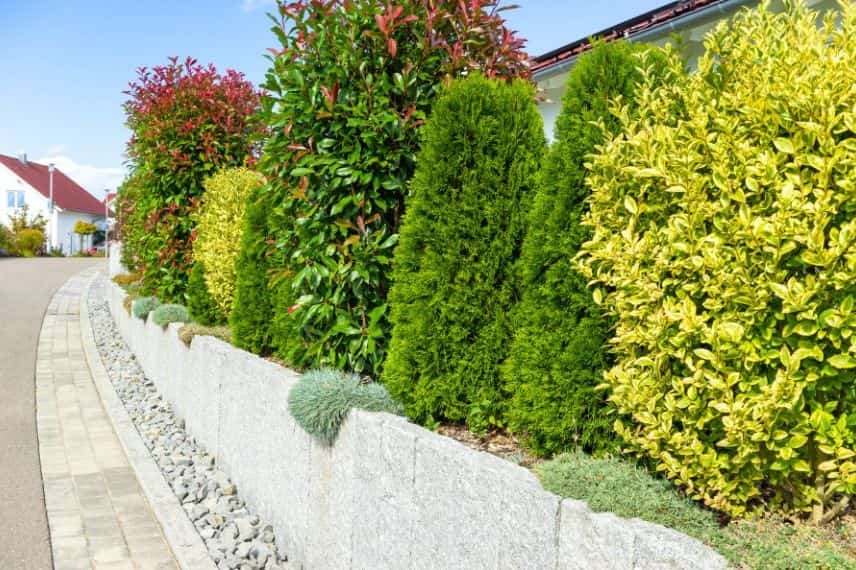
A varied shrub hedge
A climbing-plant hedge on a support
Climbing plants, grown on a support such as a mesh fence (which we will cover in the last chapter) or a trellis, allow you to quickly create an aesthetically pleasing and space-saving hedge.
They are particularly suited for small gardens or to dress up existing structures.
You can choose climbing flowering plants, such as Clematis, jasmine or honeysuckle, which add a touch of colour and fragrance to your fence. Evergreen species, such as ivy, are ideal for year-round green cover. Finally, fruiting varieties, such as grapevine or kiwi, allow you to combine practicality with pleasure.
This type of fence is quick to set up: some climbers, such as ivy, can cover a support in two years (if guided, of course). Maintenance is generally limited to an annual pruning to control their spread.
→ Find our climbing plants by variety.
Cost and durability
- Youth plants cost between €10 and €20 (excluding the support). Supports can be made at a lower cost from recycled materials (wire, mesh) or existing structures (fencing, etc).
- With good upkeep, a climbing-plant hedge remains effective and attractive for many years.
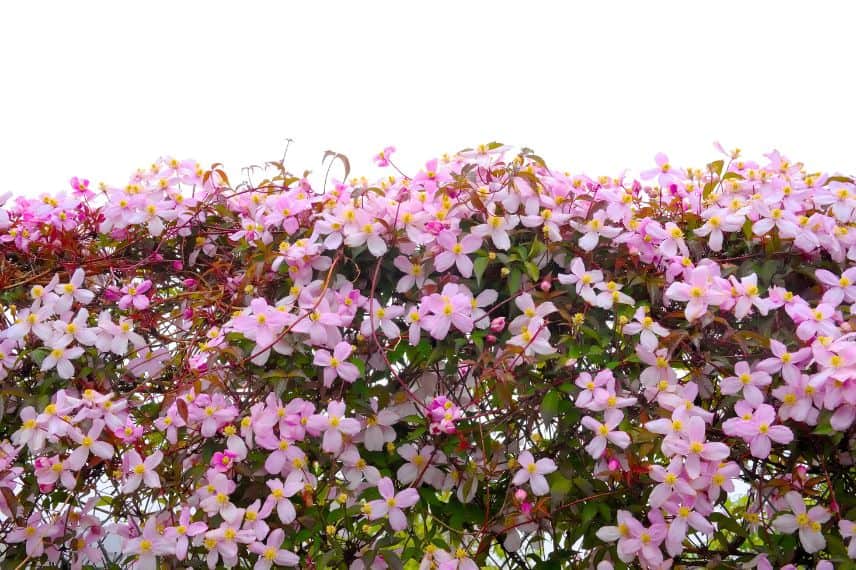
Clematis on a flexible mesh
The woven willow living hedge
This technique involves planting living willow branches (or willow cuttings) directly into the soil and intertwining them to form a dense and harmonious structure. Willows root quickly and grow vigorously, creating a green screen from the first season. This technique adds undeniable charm to your garden, while being easy to implement.
→ For more information, read our article: How to plant and maintain a living willow hedge?.
Cost and durability
- If you have access to willow branches, this method can be free—just take branches. Don’t hesitate to ask around (friends, neighbours, fellow gardeners) if you don’t have willow in your garden.
- With simple maintenance (pruning and watering), a living willow hedge can last several decades. Note, however, that the branches will thickening year by year and eventually form trunks.
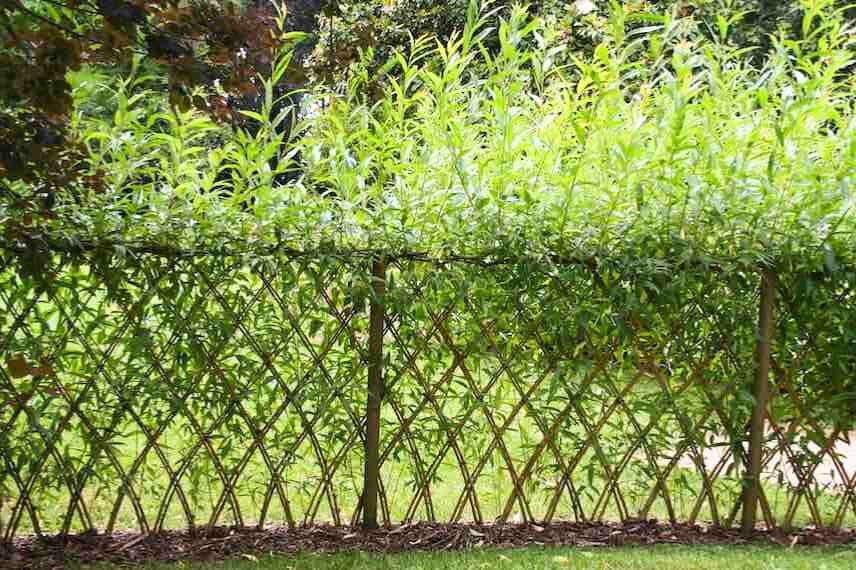
The pleached hedge
The pleached hedge (or pleissis) is an ancient technique once used in rural areas to delimit fields and pastures. This pleaching method is still used in Flanders. It involves bending (partially cutting the branches or young trunks) and weaving living shrubs to create a dense and solid barrier. Often practised with species such as hazel, hawthorn or blackthorn, this method is still transmitted and adds historic and rustic charm to a large garden.
Pleaching is durable. The shrubs continue to grow after being bent, which strengthens the structure over time. It also provides a refuge for wildlife: birds and insects find shelter and food there.
Cost and durability
- If you use shrubs already on your land, this method is free. Otherwise, budget €5 to €10 per young plant: you’ll have to wait several years to see results, as you need to let the shrubs grow a little before partially bending the branch to incline it.
- A well-maintained pleached hedge can last for several decades.
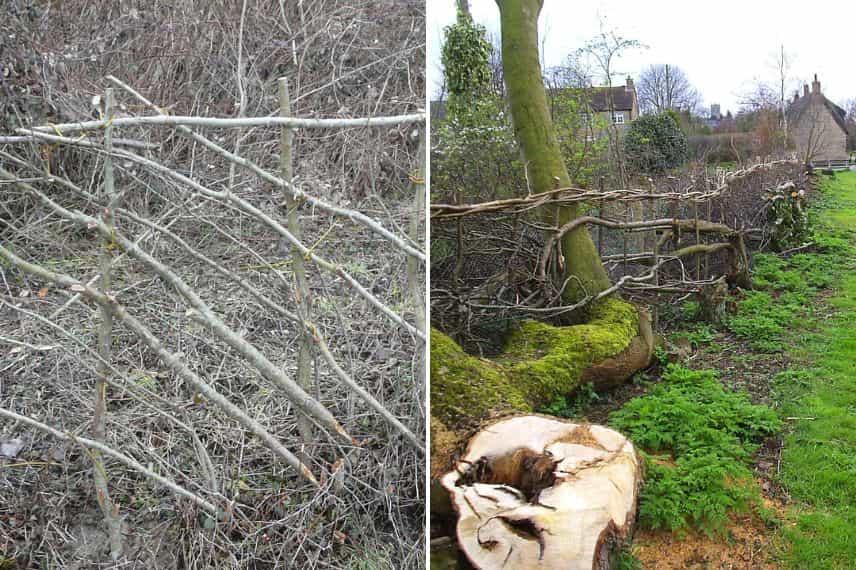
Examples of pleached hedges (source Wikipedia)
Read also
5 hedge bushes for stony soilWooden fences
Reclaimed wood fence
For a budget-friendly fence, you can reclaim timber such as pallets and put it to use. It’s both cost-effective and eco-friendly. Pallets are easy to obtain from traders or private individuals and can be assembled with minimal equipment (a crowbar for dismantling, a hammer and nails for fixings).
Cost and durability
- Free or low-cost (allow €10–€20 for a few tools or fixings). If you use stain or paint, you’ll need to add this extra cost. Also consider flour paint, also known as “Swedish paint”, used in Scandinavian countries.
- Well maintained and stained, a fence made from reclaimed timber can last 5 to 10 years.
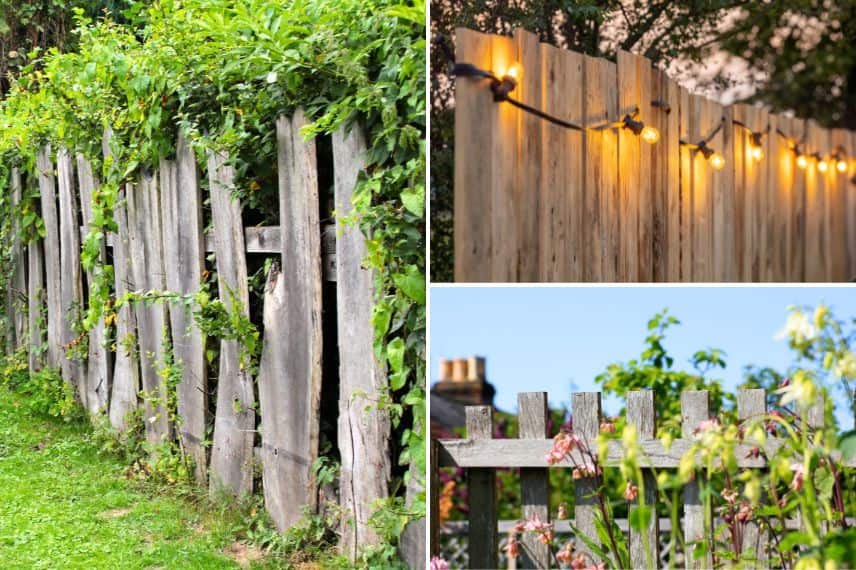
Examples of reclaimed wood fences
Woven-branch fence
Very close to the plessis technique (sometimes given the same name), this ancient practice consists of weaving flexible, cut branches (such as hazel or pollarded willow) around wooden posts to create a rustic barrier. This fence is especially suited for delimiting small spaces such as a vegetable patch or a path. Easy to make, it requires only a few tools (pruning shears and possibly screws). Economical: you can collect and use the branches when pruning your bushes.
Cost and durability
- If you have trees to prune, this option is free (apart from screws if required). Otherwise, budget €2–€5 per bundle of branches.
- A woven fence can last around five years, provided you replace the branches as they degrade. Tip: opt for hazel posts, of a good diameter, to extend its life.
- Note: there are woven hazel panels sold commercially, but they are relatively expensive.
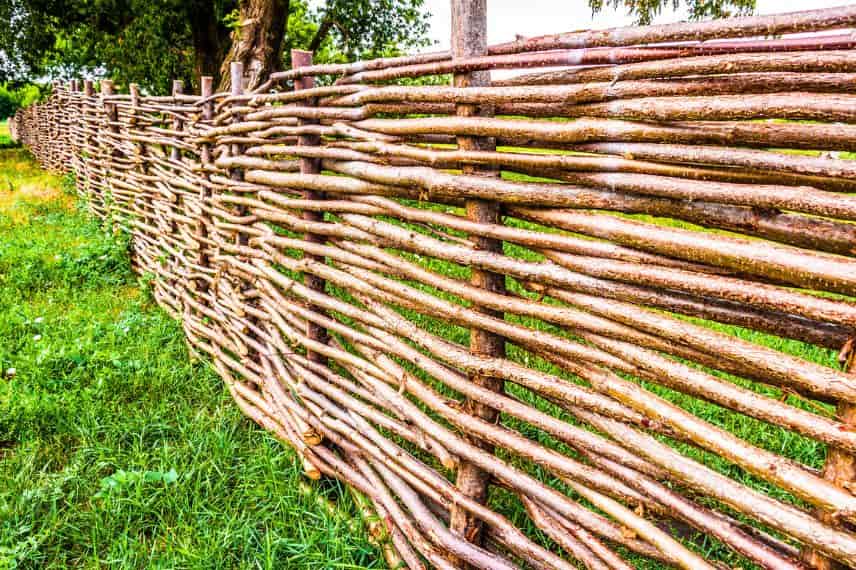
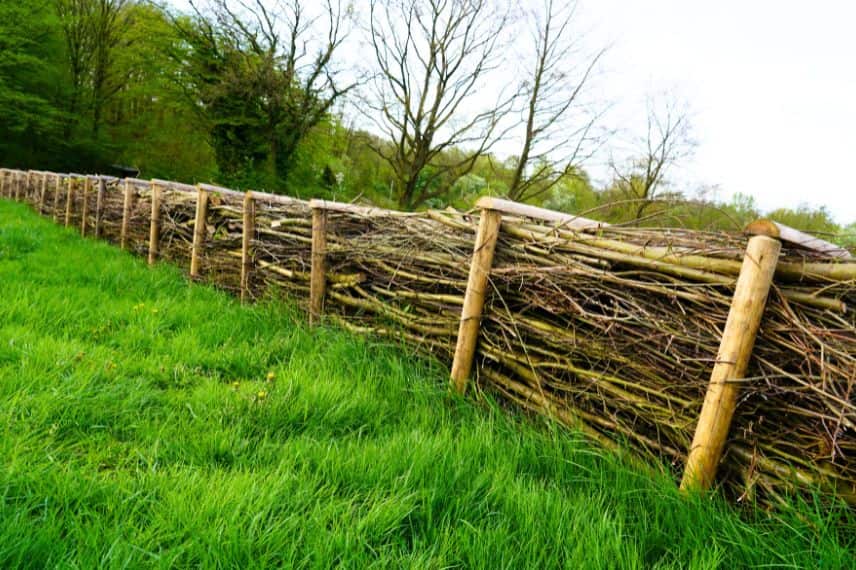
A dry hedge
A dry hedge is composed of dead branches stacked between two rows of posts (usually wooden). This simple solution allows you to transform pruning residues into a natural barrier. It also provides a refuge for small wildlife, such as insects, hedgehogs or birds. It is easy to install and allows both storing pruning wood and letting it decompose.
→ To learn more, read our article: How to create a dry hedge?
Cost and durability
- Free if you use your own pruning waste.
- The timber structure (stakes) can last 5 to 10 years depending on the wood species used. Stakes can be replaced as time passes.
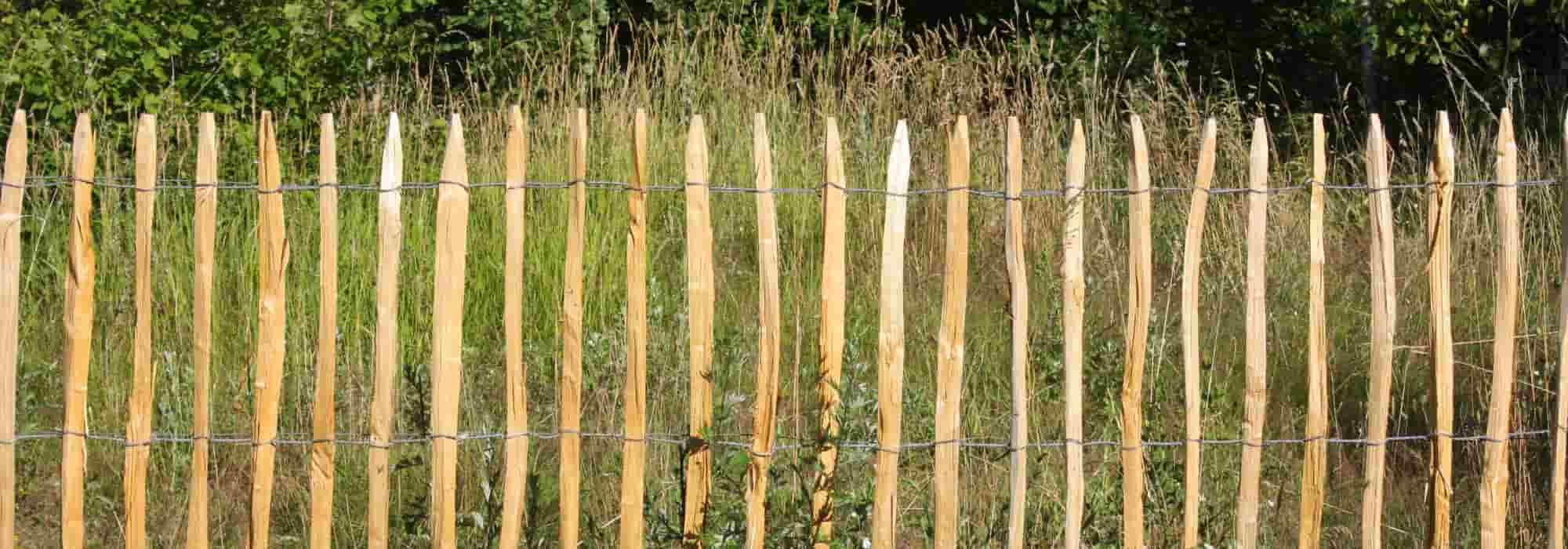
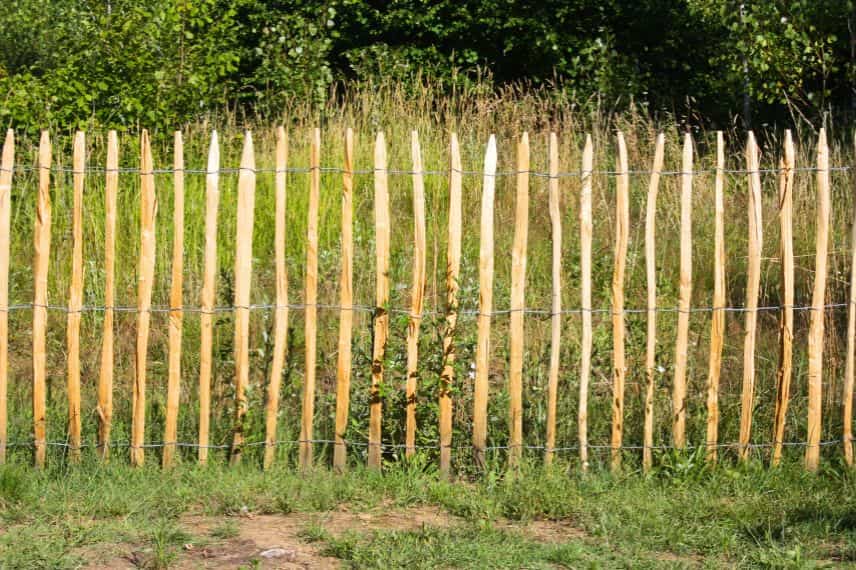
Ganivelle fence
The ganivelle is a fence made of vertical wooden slats linked by iron wires. Ganivelle is quick to install and requires little maintenance. Made from durable woods such as chestnut or black locust, it is durable and (almost) rot-proof. It sits particularly well in a garden with a natural or rustic style.
→ To learn more, read our article: How to install a ganivelle fence to enclose your garden?
Cost and durability
- Expect between €20 and €30 per linear metre, depending on height, the spacing of the slats and the wood species used.
- A ganivelle fence can last 10 to 20 years (depending on the wood), especially if well installed on well-drained soil and not too damp.
Flexible or rigid wire-mesh fencing
Admittedly less eco-friendly, wire-mesh fences, whether flexible or rigid, remain one of the most commonly used solutions for delineating a garden. They are straightforward to install and durable over time, without necessarily requiring a colossal budget.
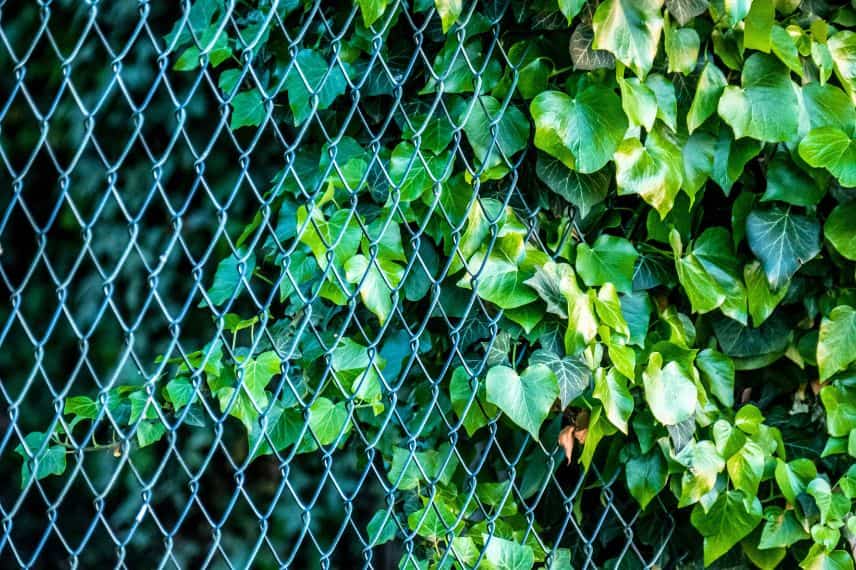
Flexible wire-mesh fencing
Flexible wire-mesh is made from woven metal wires forming the mesh openings. It is typically sold in rolls, which makes transport and installation over large areas easier. This type of fencing is quick to install, but you will need fixing posts and, if necessary, concrete footings for greater heights.
Cost and durability
- Expect between €15 and €25 per linear metre depending on the height and quality of the mesh, including stakes and various accessories (excluding masonry if necessary).
- A flexible wire-mesh fence can last for several decades.
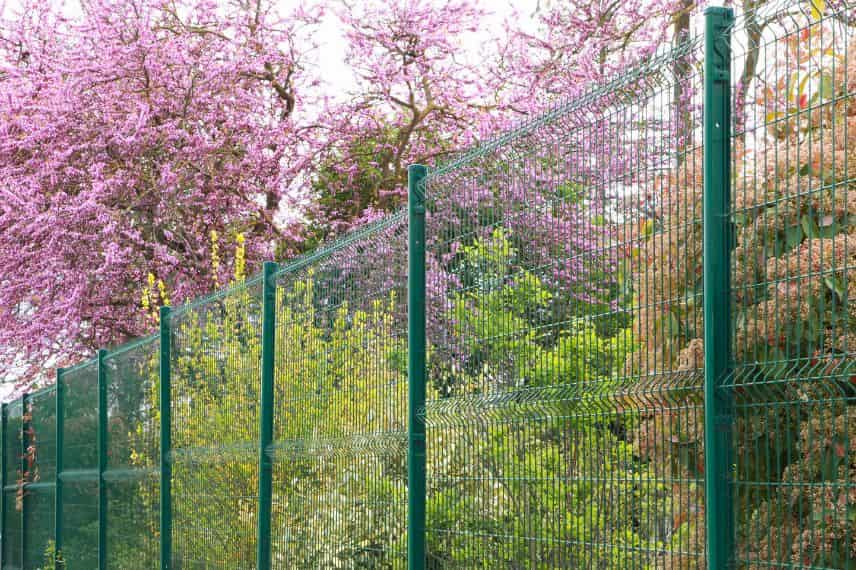
Rigid wire-mesh fencing
This type of fencing consists of rigid metal panels welded together. More robust than flexible wire mesh, it is also more durable. It is commonly used for gardens requiring enhanced security (around a housing estate, to contain large animals or to protect crops).
Its longevity and strength make it an excellent investment for a fence that is both aesthetically pleasing and practical… but the investment is higher as well. Note that you will also need to provide concrete footings to fix the posts.
Cost and durability
- Expect between €25 and €50 per linear metre depending on the chosen height.
- A well-installed rigid fence can last for several decades without moving.
Customisation with mesh fencing enhanced by climbing plants or screening
To transform a wire-mesh fence, whether flexible or rigid, into a decorative and intimate feature, here are a few ideas:
- Climbing plants : star jasmine, clematis and many other climbing plants will easily wrap around the mesh, bringing greenery and a natural green screen. These plants will also boost the garden’s biodiversity.
- Cane screens : in reed, bamboo or willow, they can be fixed directly to the mesh to create a screening barrier that is elegant, natural and quick.
- Privacy panels : made of wood or PVC, these elements integrate perfectly with the rigid panels for a modern and practical finish.
- Subscribe!
- Contents
Comments