


How to get rid of thrips on indoor plants?
Our tips and solutions for naturally defeating these pests
Contents
A nightmare! Just like scale insects, the appearance of thrips on our indoor plants can be described as a nightmare. These tiny insects, almost invisible to the naked eye, can ravage your collection of houseplants in record time if they are not treated promptly and thoroughly. It’s also a long-term battle that requires patience and perseverance. From then on, prevention takes precedence—inspect the leaves of your plants at each watering, and act as soon as the air becomes dry in winter.
Discover all our tips to get rid of thrips as naturally as possible.

What are thrips?
Thrips belong to the order Thysanoptera.
How to recognise them?
Thrips are very small insects, about 1 to 2 mm in length, with elongated bodies and feathery wings. What makes them particularly troublesome is their near invisibility, but also their feeding mode: they possess piercing-sucking mouthparts that they use to pierce leaf cells and suck out their contents. As for the larvae, they are wingless, rather elongated, and slow to move.
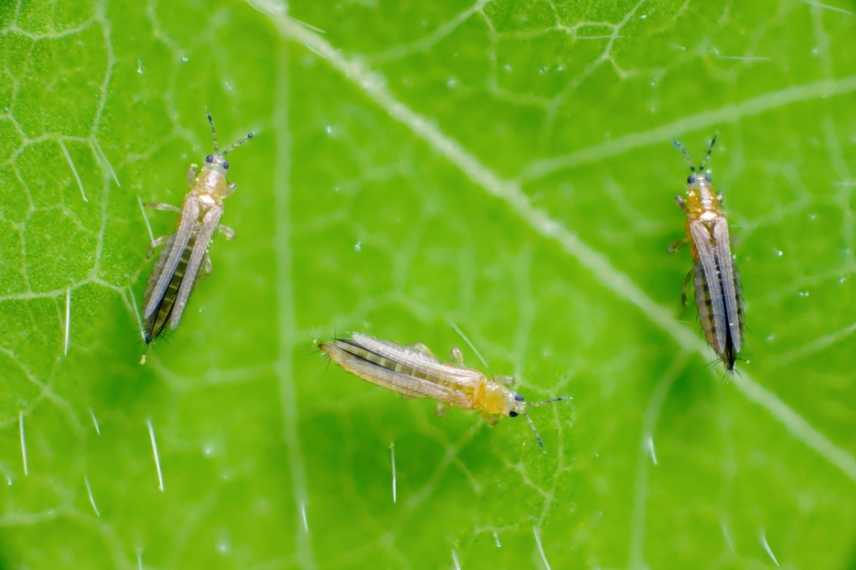
Thrips are virtually invisible to the naked eye
Life cycle
To eradicate thrips, it is crucial to understand their life cycle, as they are not always visible on the plant.
- The female lays her eggs directly in the plant tissues. They are therefore protected from surface treatments.
- After hatching, the larvae, often cream-coloured or pale green, immediately begin feeding.
- The nymphal stage is the critical stage for your plants. Most thrips species drop to the soil to develop into adults in the potting compost. A treatment that targets only the foliage will therefore be ineffective in the long term.
- Capable of flying or leaping, the adult colonises new plants and restarts the cycle.
The full life cycle can complete in as little as two weeks if indoor temperatures are warm, between 20°C and 25°C. Three generations can occur in a single summer!
How to identify a thrips infestation?
Because the insect is tiny, its presence is often detected by the damage it causes rather than by direct observation. Unless you use a magnifying glass…
Signs of a thrips attack
- Silver or discoloured spots: this is the most characteristic symptom. By draining the sap from the cells, thrips leave air pockets that create metallic or greyish reflections on the laminae of the leaves.
- Black specks: If you observe tiny black droppings, resembling grains of pepper, on or under the leaves, it is irrefutable evidence of their presence.
- Deformation of new shoots: Thrips love soft tissues. The new leaves often emerge curled, stunted or brown-stained.
- Premature wilting: A heavily attacked plant loses vigour, its leaves yellow and eventually drop.
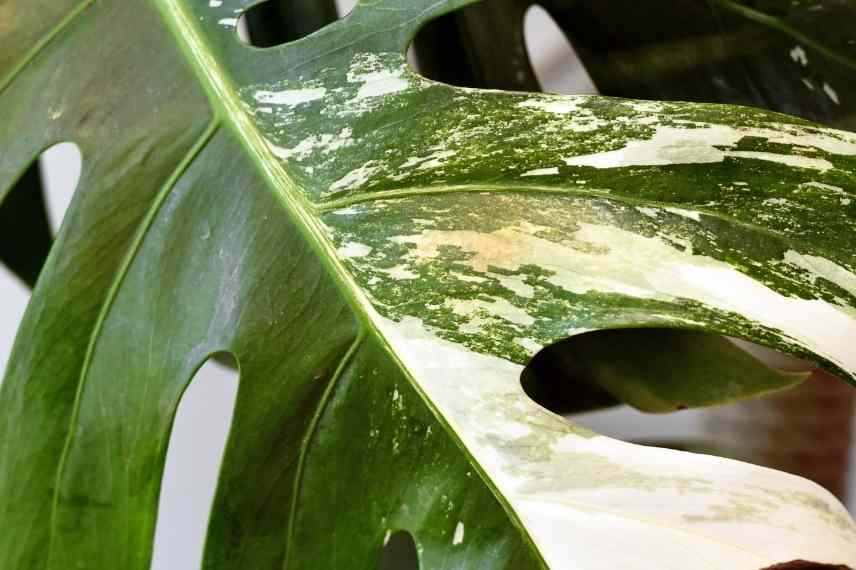
Silver spots on the foliage of a Monstera
How to differentiate thrips from other pests?
Thrips are easily distinguished by the silver spots and black specks (their droppings) on the foliage. Other pests show different signs.
- The Red spider mites are distinguished by fine webs between the stems and yellow spots on the foliage.
- The Mealybugs are characterised by cottony masses or brown shells on the foliage.
- The Aphids are recognised by the presence of sticky honeydew. They are also visible to the naked eye.
What are the first steps to take?
As soon as you suspect thrips, it’s urgent. You must act quickly to prevent infestation from spreading to other plants. Here are three emergency rescue steps:
Isolation
It’s the most neglected step, yet the most important. You must immediately move the infected plant into a separate room, far from any other vegetation. If you have outdoor space—garden, balcony or terrace—do not hesitate to place it well away, weather permitting. Inspect neighbouring plants carefully, as thrips move easily from pot to pot.
The shower
Take your plant to the bath or under the shower. Use a jet of lukewarm water, not hot, to thoroughly rinse the foliage, top and bottom. This helps physically remove a large portion of larvae and adults.
Our tip : Tilt the plant or shield the potting mix with a plastic bag to prevent displaced thrips from dropping directly into the substrate.
Cleaning the surroundings
Clean the area where the plant stood (shelf, saucer, window) with a mild disinfectant or soapy water to remove any individuals that may have fallen.
Natural treatments
If the infestation is moderate, natural solutions may be sufficient, provided you are persistent.
Black soap
The black soap is a contact insecticidal. It suffocates insects.
- Mix 2 tablespoons of liquid black soap into 1 litre of lukewarm water.
- Spray the entire plant, concentrating heavily on the undersides of the leaves and the gaps between the stems. Repeat the operation every 3–5 days for at least three weeks.
Neem oil
Neem oil contains azadirachtin, a substance that disrupts the hormonal system of insects and prevents them from feeding and reproducing. You should mix 1 teaspoon of Neem oil with a few drops of washing-up liquid as an emulsifier in 1 litre of water. Spray in the evening as Neem oil is photosensitive and can burn the leaves in bright sunlight.
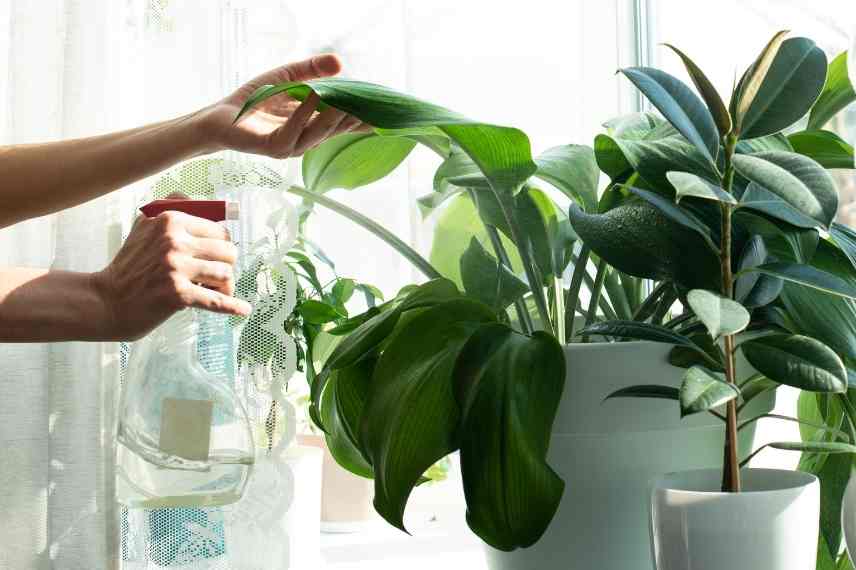
Black soap or Neem oil sprays should be renewed
Blue sticky traps
Unlike fungus gnats, which are attracted to yellow, thrips are irresistibly drawn to blue. Install blue sticky plates near your plants. This will not solve the infestation on its own, but it helps trap the flying adults and monitor the intensity of the attack.
Mistakes to avoid during processing
-
Stopping too early: it’s the number one mistake. Eggs laid on the leaf will hatch a few days after your first treatment. If you do not treat over several cycles (a minimum of three weeks), the infestation will return.
-
Forgetting the undersides of the leaves: thrips dislike direct light and hide almost exclusively under the leaves. A superficial treatment is useless.
-
Neglecting the potting compost: if you treat only the leaves, you ignore the generation that is developing in the soil. A top-dressing by replacing the first three centimetres of soil, or the use of nematodes is recommended.
And is biocontrol possible indoors?
If all of your plants are affected, or if you have tried all other treatments, biological control is possible:
-
Predatory mites (Amblyseius cucumeris) : these tiny mites feed mainly on thrips larvae. They are sold in sachets that are hung on the branches of the plant. They act continuously for several weeks.
-
Nematodes (Steinernema feltiae) : since thrips spend part of their life cycle in the soil, applying these microscopic worms to the watering water helps eliminate pupae hidden in the potting compost. It is the ideal complement to foliar sprays.
Prevention: never see thrips again
Rather than wasting energy (and money) fighting thrips, it’s better to prevent their appearance:
- Systematic quarantine: each new plant entering your home should be isolated for at least 15 days. Inspect it with a magnifying glass. Thrips are most often introduced by new purchases.
- Ambient humidity: thrips, like red spider mites, generally prefer dry atmospheres. Increasing the humidity in your room or regularly misting your plants can make the environment less welcoming for them. However, be careful not to promote mould if air circulation isn’t adequate.
- Strengthening plant health: a healthy plant is less attractive to parasitic pests. Ensure a balanced fertiliser application, without too much nitrogen. An excess of nitrogen can make plant tissues softer, attracting more pests.
- Subscribe!
- Contents
Comments