


Pachira: seasonal care
Watering, light, pruning and year-round care
Contents
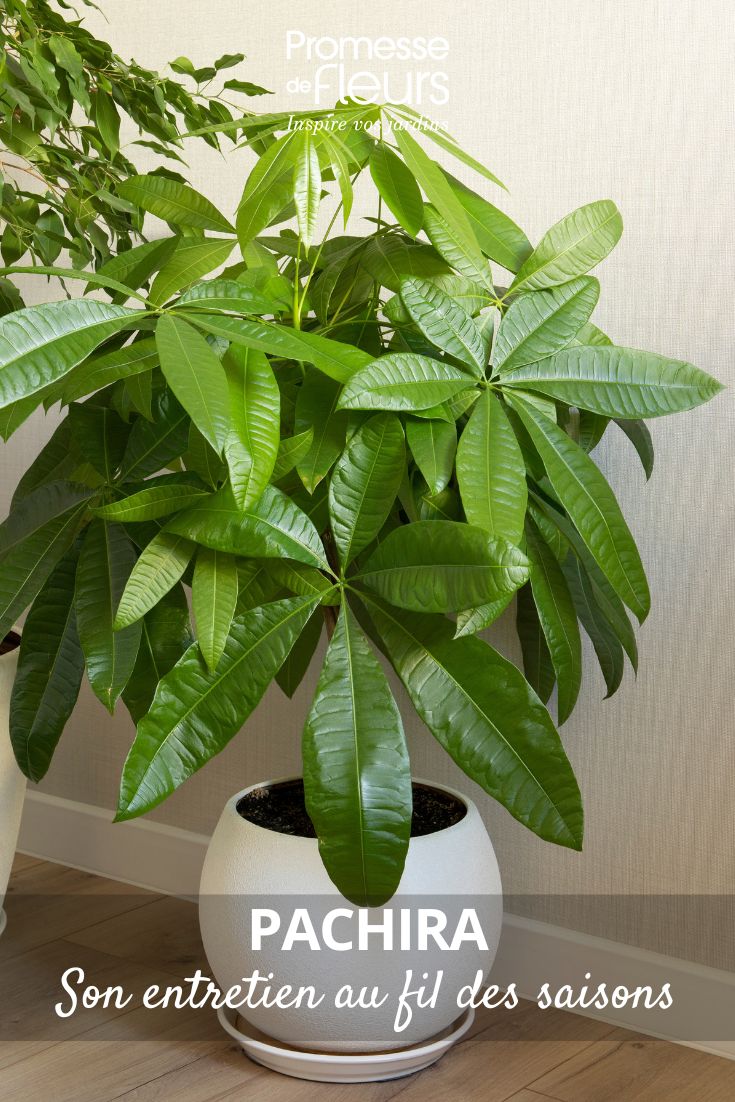
The Pachira or Pachira aquatica is one of those houseplants that form real miniature trees. It is valued for its lush, exotic-looking foliage, for its often braided trunk and for its handsome silhouette. But it is also a plant regarded as a real lucky charm that attracts luck and prosperity, which has earned it the nickname ‘money tree’.
Easy to care for and long-lasting, the Pachira will nevertheless require some care to thrive, to be adjusted according to the season. We invite you to discover which care steps to take season after season to keep a Pachira looking its best.

The seasons also influence indoor plants.
That may seem somewhat unnecessary to take the seasons into account when growing a plant indoors. Logically, it is indeed less subject to weather extremes and to large temperature fluctuations than a plant grown outdoors, in the garden, or in a pot.
However, indoors too, growing conditions and the environment will evolve and will not be the same in winter as in the height of summer. Light levels and ambient humidity can vary considerably in our homes.
In addition, The plant has its own rhythm, alternating between a growth period and a period of dormancy. Its needs will therefore be quite different.
Watering, fertilisation, pruning, exposure… all of which will benefit from being adjusted throughout the year.
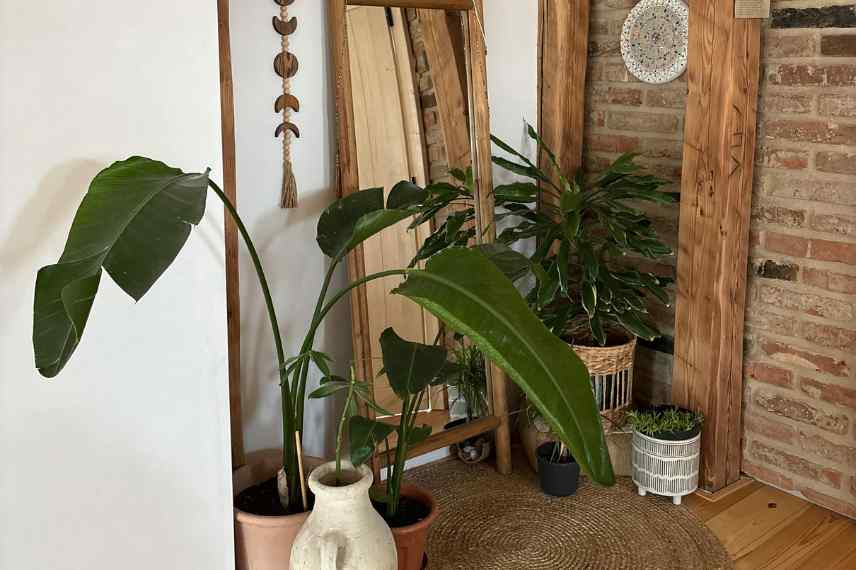
Indoor plants, too, require appropriate care according to the season
Read also
Pachira : planting, growing, and careSpring: a growth period for Pachira
Like many plants, Pachira will emerge from its dormancy in spring and restart its growth. With longer days and the return of brighter light, it will be able to start growing again.
This season, you can resume somewhat more regular watering. Water every 8 to 10 days on average, depending on the ambient temperature. Although native to the tropical regions of Central and South America, where it tends to grow in moist environments, Pachira appreciates moderate watering. Wait until the soil is dry on the top few centimetres. Don’t hesitate to feel the soil with your fingertips to check whether it is moist. But Pachira has the advantage of being tolerant: it can withstand occasional water shortages, thanks to its thick trunk which allows it to store reserves. This is precisely what makes it an ideal young plant for beginner gardeners. On the other hand, it will be more sensitive to excesses, which can cause its roots to rot. With it, it’s better to under-water than over-water. If you have placed a saucer or a cachepot, remember to empty it after about thirty minutes. If you prefer, apply the bottom-watering method for watering. It involves placing the plant in a sink or container with a bottom layer of water and letting it drink from below, just the amount needed to thoroughly rehydrate the soil. Then simply let it drain before returning it to its place.
Spring is also the right time to support growth of the plant by applying a fertiliser. You can add a handful of mature compost or well-rotted manure, which you incorporate gently into the substrate by scratching the surface. If not, plan an indoor plantsindoor plants, in solid or liquid form, which will support growth and enhance the foliage. Granules or sticks to mix into the soil have a slow-release action, but longer-lasting. Liquid fertilisers to mix with the watering water provide a boost, but short-lived. Choose the fertilisation that suits you best, always ensuring you do not exceed the dosages indicated by the manufacturers.
If you notice damaged leaves, weak or bare branches, prune them with a cleansécateur clean, which you should disinfect before and after to limit the risk of disease spread between plants. You can also shorten a few shoots that unbalance the silhouette. Cut just above a node (the starting point of a new leaf). This gesture will also help promote the development of new shoots and the density of the foliage.
This is also the ideal time to repot, which is done every 2 to 3 years. If Pachira can reach nearly 20 metres in its native habitat, it generally settles for 2 to 3 metres indoors. If its pot becomes too tight (roots coming out of the drainage holes or above the substrate), it is time to repot into a larger container. Always choose a model with drainage holes, so that excess water can drain away without stagnating around the roots. Use a well-drained, airy substrate: you can use special indoor plant potting mix or all-purpose potting mix mixed with draining elements (clay pellets, river sand, gravel, etc.). Also install a drainage layer at the bottom of the container. In years without repotting, simply top-dress, replacing the top 3 centimetres of soil with fresh potting mix.
Finally, with regard to light exposure, don’t hesitate to rotate the pot regularly during this period so that growth is more even: about a quarter turn every 2 to 3 weeks. However, ensure the plant is not subjected to drafts.
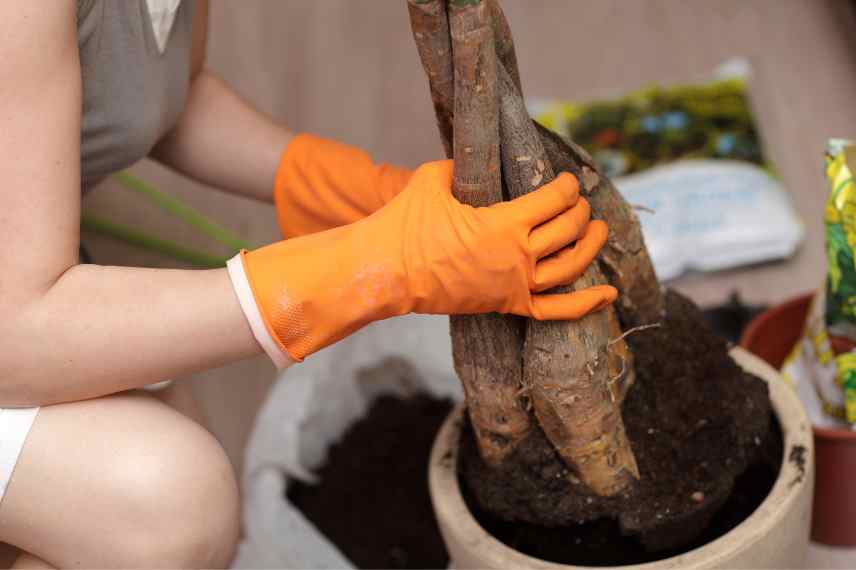
Spring is the ideal time to repot indoor plants
Summer: How to Manage Pachira's Watering and Light Exposure
This season, Pachira will require less care.
In summer, temperatures can rise indoors, so watering will be more frequent. Plan for about one watering per week. Use room-temperature water, ideally rainwater or filtered.
Pachira enjoys bright light exposure, but not direct sunlight. This will be all the more true in summer, when UV rays can be intense and scorching for its foliage. Prefer an east or west-facing exposure. If it is placed behind a very bright window, consider moving it a little away or adding a sheer curtain to filter the light. If you have outdoor space, you can take the Pachira outside when temperatures are around 20°C, but in a wind-protected location and still not scorching.
As it is a tropical plant, Pachira appreciates good humidity. You can mist the foliage in summer to provide ambient humidity, Also take the opportunity to dust the leaves with a slightly damp cloth to promote photosynthesis. This is also the time to check for the absence of parasites (aphids, scale insects, thrips…) or diseases (leaf spots).
Fertiliser applications will also be gradually reduced this season.
 Mist in addition to watering if it is very hot
Autumn: a transitional season for Pachira
In autumn, Pachira begins to prepare for its vegetative rest.
Watering can again be spaced more widely, about every 10 days.
Also consider stopping fertiliser applications, which are no longer needed for this season.
If you haven’t done this in spring, repotting in autumn is possible.
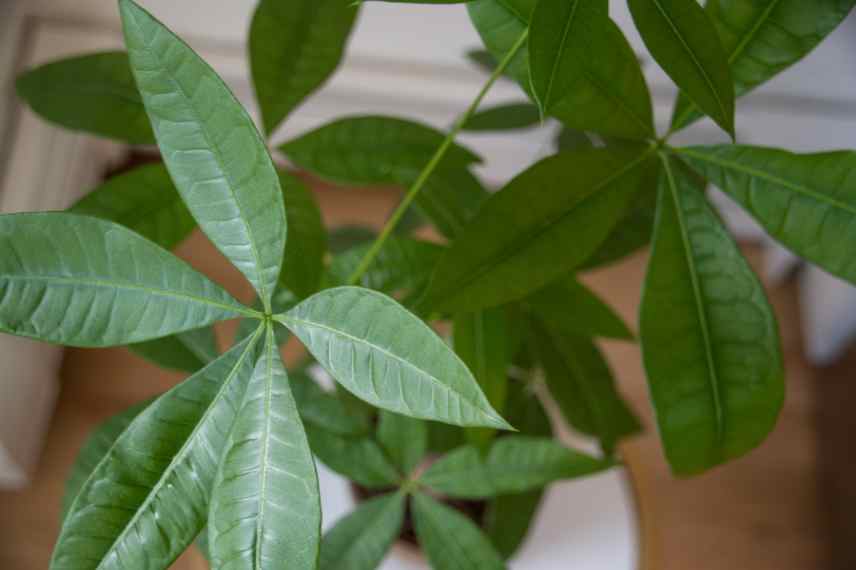
In autumn, Pachira requires little maintenance
Winter: a period of vegetative rest for Pachira plants.
The Pachira thrives in cultivation conditions around 20°C and will not tolerate temperatures below 10°C. However, it also dislikes proximity to an intense heat source. Keep it away from radiators, ovens, fireplaces or a wood-burning stove. If light levels become too low, move it closer to a well-exposed window.
In winter, watering should be reduced to a minimum, about every two weeks.
Stop all fertiliser applications immediately.
During this season, the Pachira will not require much care and invites you to wait until the return of warmer days in spring.
The Pachira is a long-lived plant: by following proper care throughout the seasons, you can enjoy it for around 10 to 15 years on average.
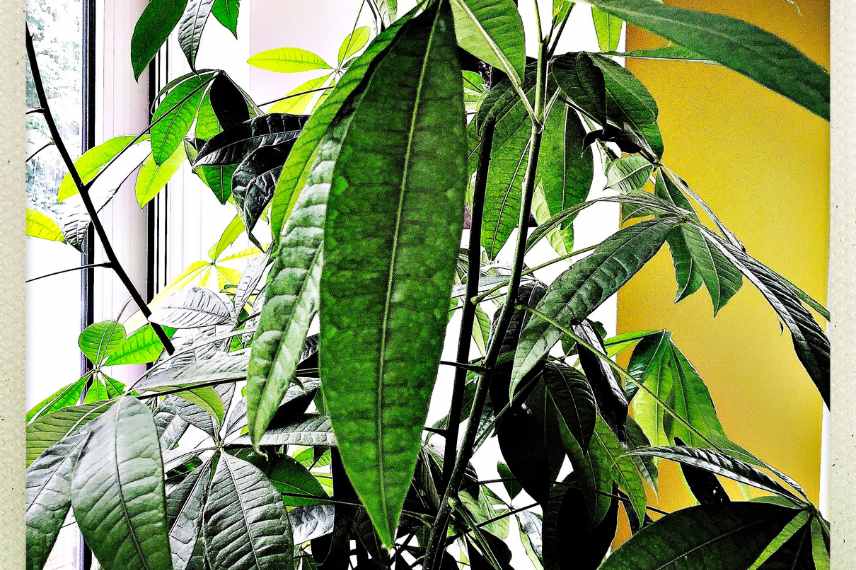
In winter, move the Pachira closer to windows
- Subscribe!
- Contents
Comments