


Perennials resistant to sea spray for coastal gardens
Plants that withstand sea winds and sun
Contents
Having a seaside garden is the dream for many people. Yet, the conditions are not necessarily ideal for growing plants. But that’s no reason to renounce having a beautiful, green outdoor space. All you need to do is choose plants that can cope with the particularities of these gardens, such as some perennials.
Let’s see which candidates are ideal and how to integrate them easily to create a beautiful seaside garden.

Oyat or Sand Reed, a grass endemic to seaside shores, to be planted in the garden

Coastal garden constraints
Coastal gardens remind us of holidays, lounging in the sun and warm weather. They are indeed privileged places, where the climate is generally mild and sunny. This makes it possible, in particular, to grow frost-tender plants that would not tolerate the rigours of winters inland.
But coastal gardens also have their drawbacks. These spaces between land and sea are subjected to sometimes challenging conditions:
– Salt air (spray), which burns foliage and dries out plants;
– Winds that can be very strong, storms, which can break branches or uproot roots and promote soil desiccation;
– Intense sun;
– Poor soil, often sandy and stony, which does not retain water or minerals well;
– Lack of water on the Mediterranean side, but heavy rainfall on the Atlantic coast;
– Acid soils on the Atlantic coast and more calcareous soils in Mediterranean gardens.
Depending on how close the garden is to the sea or ocean, it will be more or less subjected to these disturbances. Gardens closest to the sea are logically the most exposed.
At first glance, they may therefore seem difficult to cultivate. But the plant kingdom knows how to adapt, and there are in reality many plants that can withstand these conditions.
This is generally the case with all Mediterranean plants that are naturally designed to resist these hazards. They thus often have:
– smaller, tougher foliage to limit natural evaporation;
– greyish or blue-tinged colours;
– deep rooting, sometimes thanks to a taproot able to seek moisture deep in the soil and resist instability;
– a low, carpet-like habit, which is less prone to wind;
– a low nutrient requirement in the soil to develop.
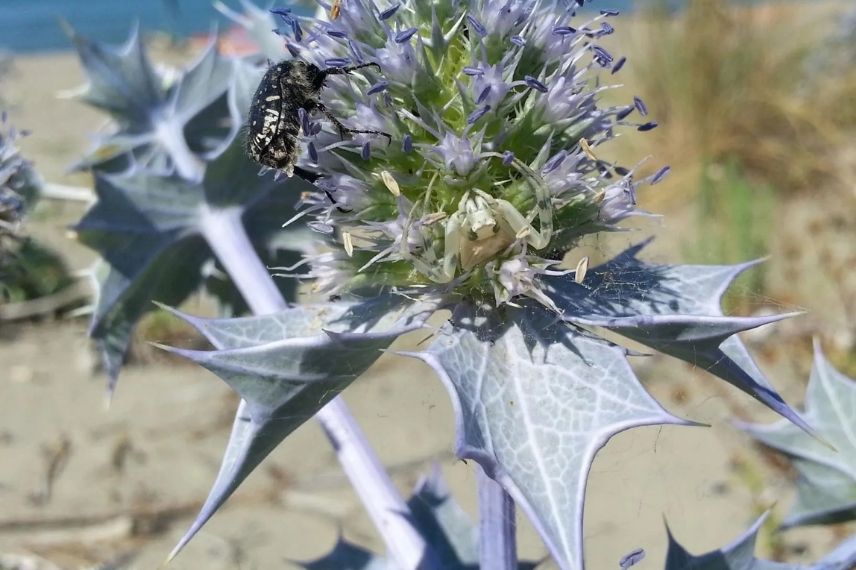
The sea holly or Eryngium maritimum, with tough bluish foliage, typical of coastlines and highly ornamental
Why choosing perennials for a coastal garden?
Perennial plants are essential in the garden, as they possess numerous qualities.
- They are perennials, able to stay in the garden for many years.
- There is something for every taste given their substantial diversity (flower shapes, colours, foliage, silhouettes, sizes, etc.). They adapt to all garden styles and spaces: beds, hedge fronts, borders, rockeries, slopes, pots, etc.
- They are generally easy to grow, provided you meet their growing requirements.
- Some propagate easily, by self-seeding, propagation by cuttings or layering.
Among plants suited to coastal gardens, the Mediterranean perennials are essential.
Many of them are, in fact, well suited to hot, dry and unfriendly soils, strong winds, and also to sea spray.
Also consider observing native vegetation, which grows naturally near the water: you can be sure it will withstand the coastal conditions.
Salt-tolerant perennials with ornamental foliage
They are perennials with coloured or architectural foliage, which will add volume and verticality to the garden.
Let’s start with Phormiums, these evergreen perennials with a grassy look. Originating from New Zealand, they are cousins of agaves. They are ideal for bringing a touch of exoticism to coastal gardens. Their linear foliage comes in many colours, often variegated, from the green of the type species Phormium tenax, to the more variegated forms such as ‘Jester’ or ‘Rainbow Sunrise’. Phormium tenax will thrive in Mediterranean gardens, while Phormium cookianum will be better suited to wetter Atlantic coast gardens.
Of course, let us also mention the grasses, whose linear foliage sways in the wind to create graceful, undulating movements and play with the sun’s rays. This is the case with Ammophila arenaria, marram grass, which forms large clumps over 1 metre tall. The Provence cane (Arundo donax) is also a grass, typical of Mediterranean regions, which produces tall stems resembling those of bamboo. It can reach nearly 2.5 m in height. However, beware of its invasive nature.
Let’s also mention Lagurus ovatus, hare’s-tail, adorable with its small ovoid, white and silky spikes at maturity. Don’t forget the Stipa with very fine foliage, widespread in the wild on coastal dunes.
For its part, the Corynephorus canescens ‘Spiky Blue’ or sand canes offer steel-blue evergreen foliage, forming small round tufts about 30 cm across. Koeleria glauca also has evergreen foliage in blue-green tones.
With its beautifully cut, silver-white foliage, Dusty Miller (Cineraria maritima) adds a great deal of delicacy to the garden. It also features pretty yellow umbels when in bloom.
Finally, let us mention sea holly (Eryngium maritimum), very common along the coast. It forms an upright clump composed of evergreen blue-green, leathery and very spiny foliage.
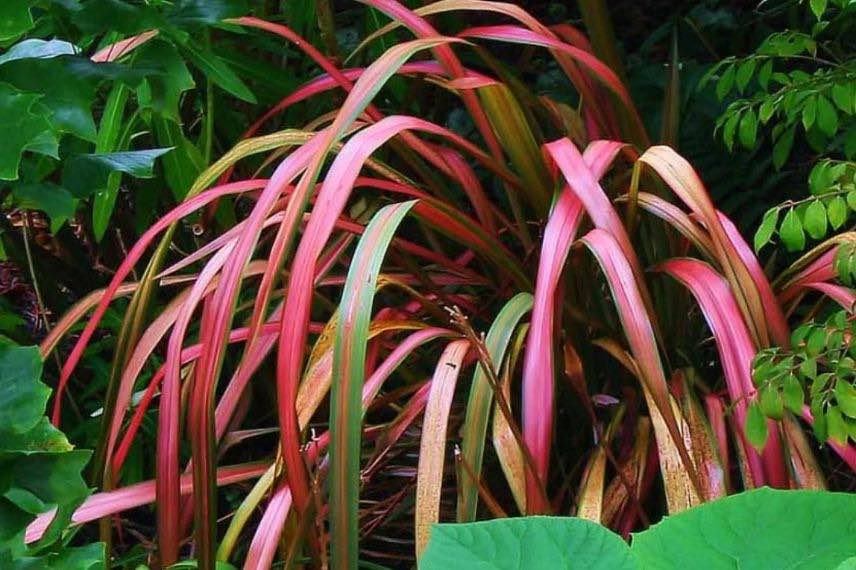
Coloured Phormium foliage (here ‘Jester’)
Read also
Plants resistant to sea spraySalt-tolerant perennials with beautiful flowering
It is perfectly possible to enjoy beautiful flowering displays in coastal gardens. Let’s start with the indispensable lavender, an evergreen undershrub that produces violet flowering spikes with its iconic scent in summer. There are also white-flowered varieties (Lavandula angustifolia ‘Hidcote White’) or pink ones (‘Rosea’).
Let’s move on with the Italian strawflower, Helichrysum italicum. This Mediterranean shrubby perennial features attractive evergreen, aromatic grey foliage, with the distinctive curry scent. But it is also prized for its beautiful pom-pom blooms.
Agapanthus are also among these magnificent perennials to grow by the sea, as they withstand wind and sea spray.
The blue blooms will obviously be perfect to evoke the maritime ambience, but you can also fall for white flowers (Agapanthus africanus ‘Albus’), pink ones (Agapanthus africanus ‘Strawberry Ice’) or almost black ones (‘Black Magic’).
Let’s also mention Limonium, with their long summer flowering and varied colours. These perennials are known for their resistance to sea spray and dry conditions.
The sea fennel crithmum maritimum is among these native coastal plants, which produce pale-yellow flowers resembling those of fennel. They delight pollinators and bring a rustic touch to the garden.
For an autumn flowering that will follow the others, opt for Sedums spectabile, with their lovely coloured umbels. They tolerate drought and sea spray very well.
As impressive as it is not very hardy (down to -4 °C), the Madeira viper’s-bugloss vipérine de Madère produces large conical inflorescences studded with small blue and pink flowers.
As a ground cover, consider Cooper’s ice plant, with its adorable little succulent leaves and vivid pink summer flowers.
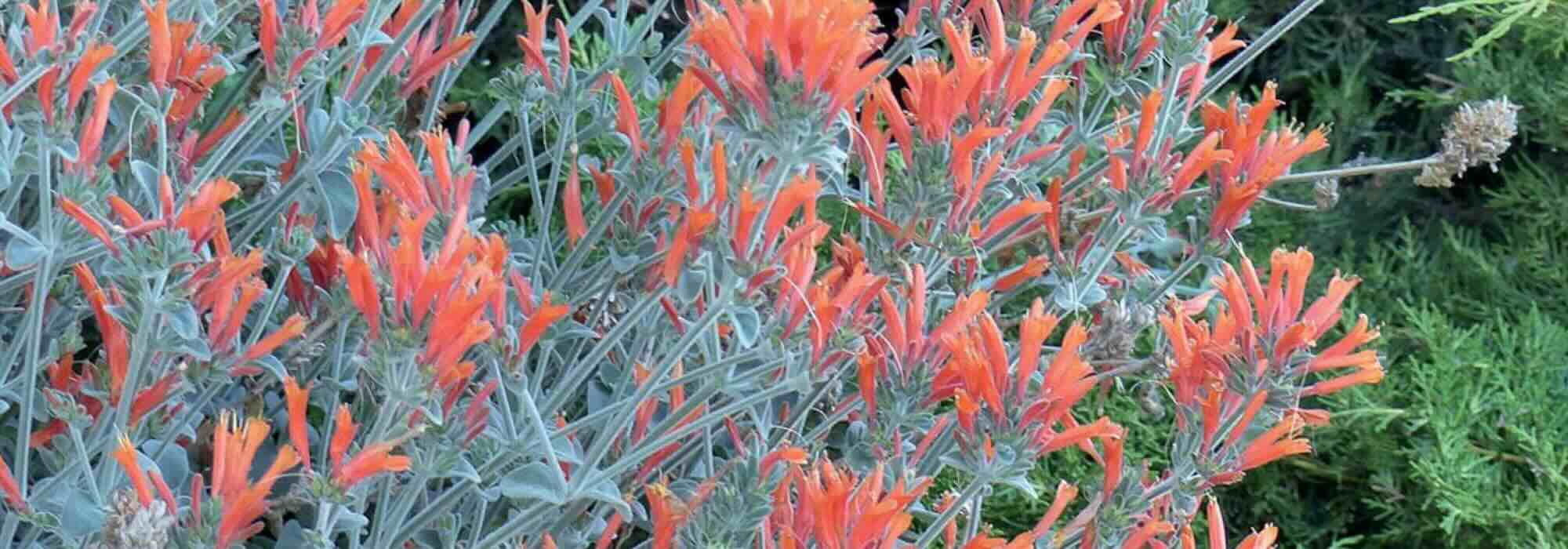
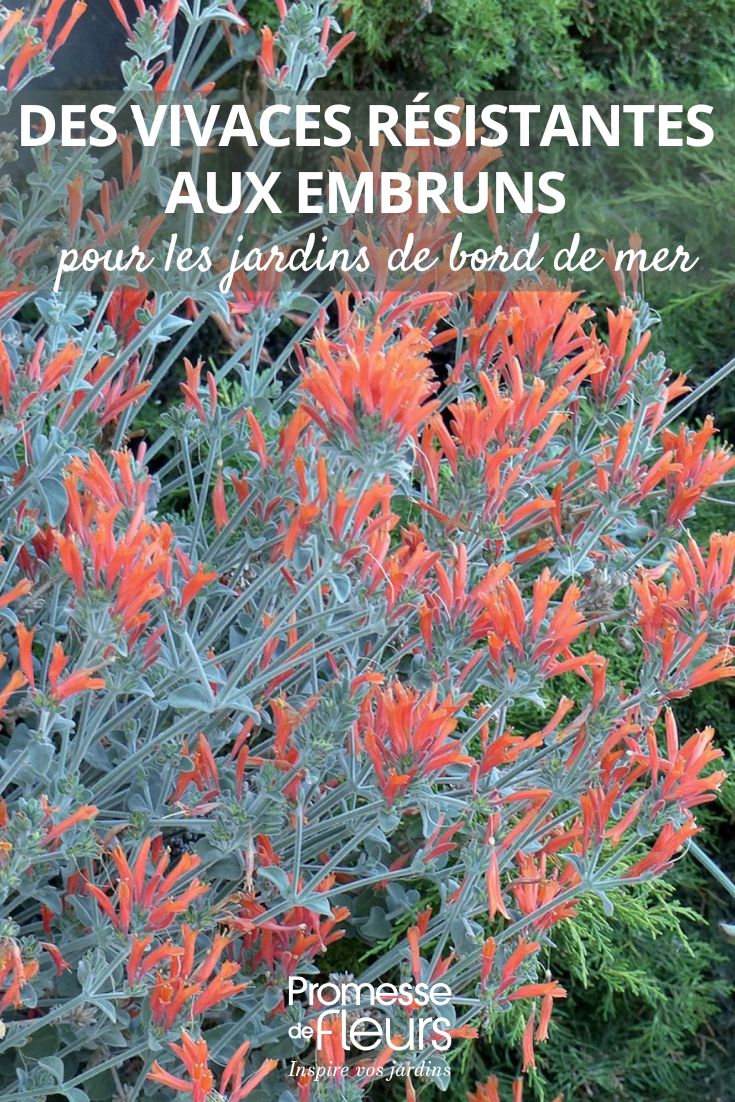
Finish this non-exhaustive list of salt-tolerant perennials with the lesser-known Dicliptera suberecta. It rewards with tubular flowers in a bright orange that last from summer to the first frosts. Its hardiness, however, is limited (down to -6 to -10 °C).
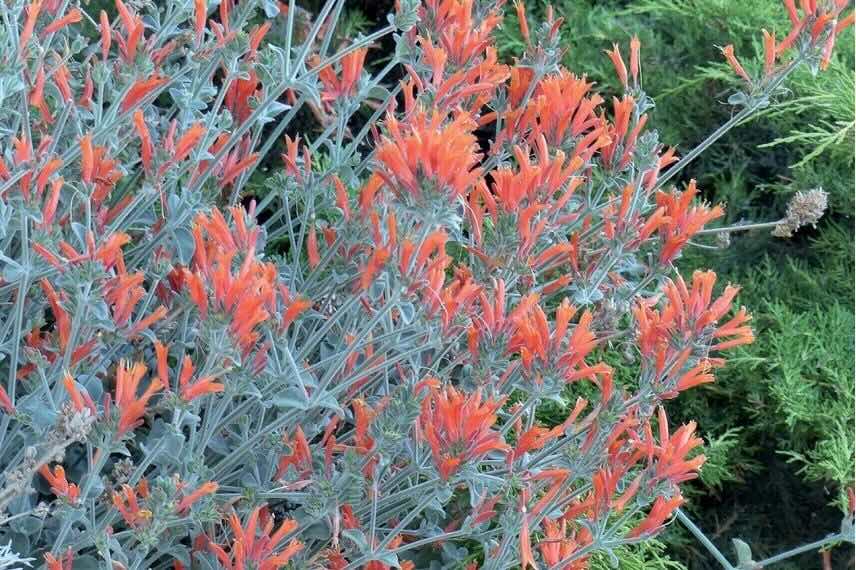
Stunning foliage and flowering of the little-known Dicliptera suberecta
How to grow salt-tolerant perennials?
- Install windbreaks that will help reduce wind speed and the impact of strong gusts. You can create a living barrier by choosing deciduous or evergreen bushes, but also opt for hard installations (reed screens, palisades, banks of heather…). In all cases, prefer filtering solutions that attenuate wind speed, rather than those too opaque, which risk creating eddies and/or causing damage by deflecting gusts.
- Plant densely, so that each plant protects the other.
- Plan to dig basins around the plants, to facilitate watering and prevent water from being drained away immediately in very well-drained soils.
- Water regularly during the first two years after planting, but perennials that don’t require much watering, to help them establish properly and develop their root system.
- In case of strong winds causing damage, promptly cut back the damaged shoots.
How to pair salt-tolerant perennials?
Coastal-hardy perennials will be paired with other plants that can tolerate the conditions of the coastal gardens.
- Trees, such as conifers (pines and Lambert’s Cypress in particular), palms, the Eucalyptus or the Holm oak, which are resistant to salty, desiccating winds.
- Shrubs such as the tamarisks, the Yuccas, the myrtles, the Elaeagnus, the evergreen euonymus, the gorses, the brooms, the rockroses, the oleanders, the Pittosporum, the Griselinia, the Escallonia, the Olearias or the Vitex.
- Aromatic shrubs such as the rosemary, the thyme, the Santolina.
- Fruit trees such as the fig, the olive, the jujubee, the arbousier or the sea buckthorn.
- Climbing plants such as the trumpet vine, the coral plant, the bougainvillea or the Ipomoea indica (Blue Dawn flower).
- Subscribe!
- Contents
Comments