



Propagation by cuttings on dry wood: when and how to do it?
Discover a very easy, highly successful propagation by cuttings technique
Contents
I take cuttings, you take cuttings, we take cuttings… Between the end of autumn and winter, there is a very easy technique for propagating trees and shrubs by cuttings that is especially reliable: hardwood cuttings. Not familiar? If I say “On Saint Catherine’s Day, all wood takes root“, does that sound a little more familiar? Indeed, 25 November marks the start of these famous hardwood cuttings, mentioned in this well-known proverb among gardeners.
Discover how to propagate by hardwood cuttings to multiply your favourite trees, shrubs and climbing plants and obtain vigorous new plants that are also very cost-effective.

What exactly is a hardwood cutting?
Dry-wood cuttings are a propagation by cuttings technique that lets you obtain, at no cost, new plants identical to the mother plant. And as the name suggests, this method uses sapless wood. Of course, it is not dead wood, but wood devoid of sap. Perhaps a few explanations are in order…
Dès la fin de l’automne, les végétaux entrent dans une phase de repos hivernal. Concrètement, les feuilles des végétaux caducs tombent et la sève ne circule plus dans les tissus du tronc et des rameaux. Les rameaux se rigidifient et se lignifient, ils deviennent cassants et prennent une couleur brune. On dit que les végétaux entrent en dormance, mais ils restent bien vivants. C’est donc la période idéale pour effectuer ces boutures.
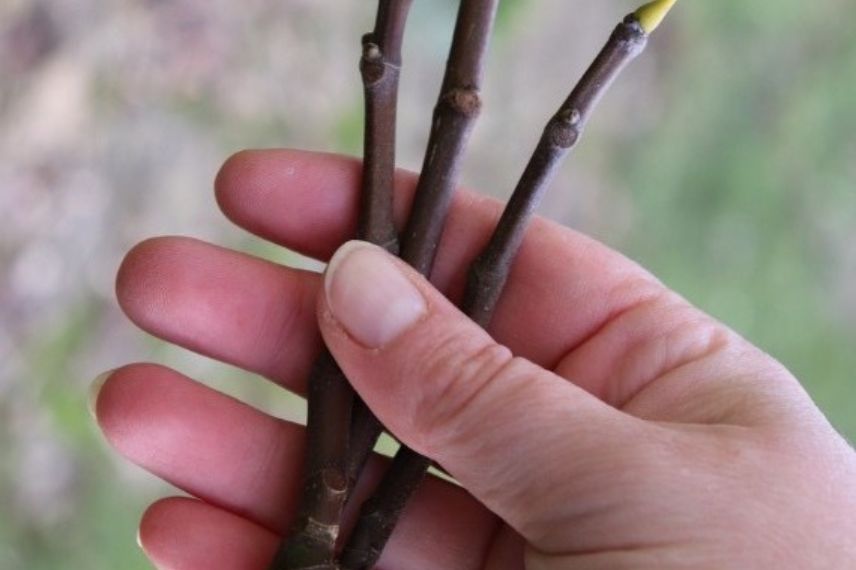
Fig tree dry wood cuttings
That is why dry-wood cuttings are also known as dormant-wood cuttings, woody cuttings, or cuttings from leafless shoots. It is a relatively simple method of plant propagation to carry out, in open ground or in pots, and, above all, highly successful.
It is mainly carried out on trees and woody shrubs with deciduous foliage, but also on evergreen plants, from which you simply remove the leaves. However, this propagation by cuttings technique applies only to woody plants and cannot be adapted for herbaceous plants.
When is the best time to take hardwood cuttings?
As this type of propagation by cuttings is carried out on dormant wood, logically it is done in winter. And more specifically between mid-November and early February. Thus, the months of December, or January at the latest, are perfect for taking these cuttings which will take you only a very short time and will require no special care.
If carried out in December, these cuttings will have time to develop a semblance of roots before spring. This cold period enhances the formation of this scar-like root callus, somewhat akin to seed stratification.
Step-by-step technique for hardwood propagation by cuttings.
How to make a hardwood cutting? That’s surely the question you’re asking now that I’ve sung its praises! And I can confirm that it’s a very easy method to apply, accessible to all gardeners, even beginners.
First step is to prepare the ground. Indeed, these hardwood cuttings are made in the ground, in a cold location with no direct sun. Therefore choose a north-facing space, well sheltered from winds and cold drafts, for example at the foot of a wall or a hedge.
- Dig a shallow trench 30 centimetres deep
- Place a little coarse sand at the bottom of the trench to ensure drainage
- Mix the excavated soil with sand, roughly in equal parts, to form a light substrate
Next comes the step of preparing the cuttings:
- Identify current-year shoots, perfectly healthy and vigorous, which have shed all their leaves
- Cut these shoots just above an eye to obtain cuttings 20–25 cm long with several nodes. Ensure to trim the cutting with a bevel, very cleanly, using a perfectly sharp, cleaned and disinfected pruning shear
- Plant these cuttings obliquely in the trench to half their length, making sure to keep the upper end of the stem at the top. It is also possible to make small bundles of five cuttings and plant them obliquely in the trench
- Refill the trench with the excavated soil mixed with sand
- Firm gently to remove air pockets
- Water lightly if it is not freezing and the trench is sheltered from the elements
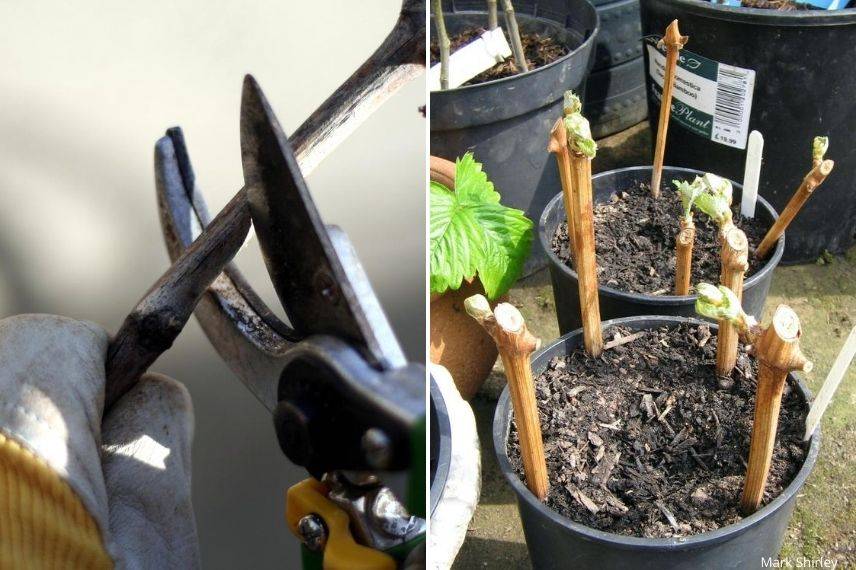
Grapevine stem cuttings
And that’s it! You can now attend to other tasks in the garden and leave your hardwood cuttings to rest until spring.
From March or April, depending on the plants and regions, these cuttings will be transplanted into individual pots filled with potting compost, still at half their height. The pots will be placed outside, in a sheltered and bright spot, but without direct sun. Leaves will appear very quickly. It is enough to keep the substrate evenly moist.
In autumn or the following spring, the cuttings can be replanted in the ground.
And in a pot, is it possible to practise propagation by cuttings from dormant wood?
If you don’t have any free space in open ground at the northern end of your garden, or simply a balcony or terrace, you can easily carry out this dry-wood propagation by cuttings in a pot or tub. The essential thing is that it is perforated to ensure drainage and filled with a substrate consisting of garden soil or potting compost and sand.
Then, we proceed exactly in the same way by planting the cuttings at an angle. And leave the pot outdoors in the shade. The cuttings must not be placed in direct sun, as they fear direct rays.
Which plants can be propagated by cuttings using this technique?
These are mainly trees, shrubs and woody climbers that can benefit from this cutting propagation technique. Not to mention the old-fashioned roses, the tea roses and wild roses.
- Among trees, alder, hazel, plane, elder, poplar and willow can be propagated from hardwood cuttings…
- Among shrubs, it is possible to propagate from hardwood cuttings dogwood, hibiscus, lilac, mock orange, tamarisk, viburnum, snowberry, Buddleja, Forsythia, Spiraea, Deutzia, Cotoneaster, Privet, Hydrangea, Abelia, Weigela…
- Among climbing plants, trumpet vine, honeysuckle, clematis, Virginia creeper…
- Among fruit trees, blackcurrant bush, redcurrant bush, raspberry plant, jostaberry, grapevine and fig tree are easily propagated.
- Subscribe!
- Contents
Comments