


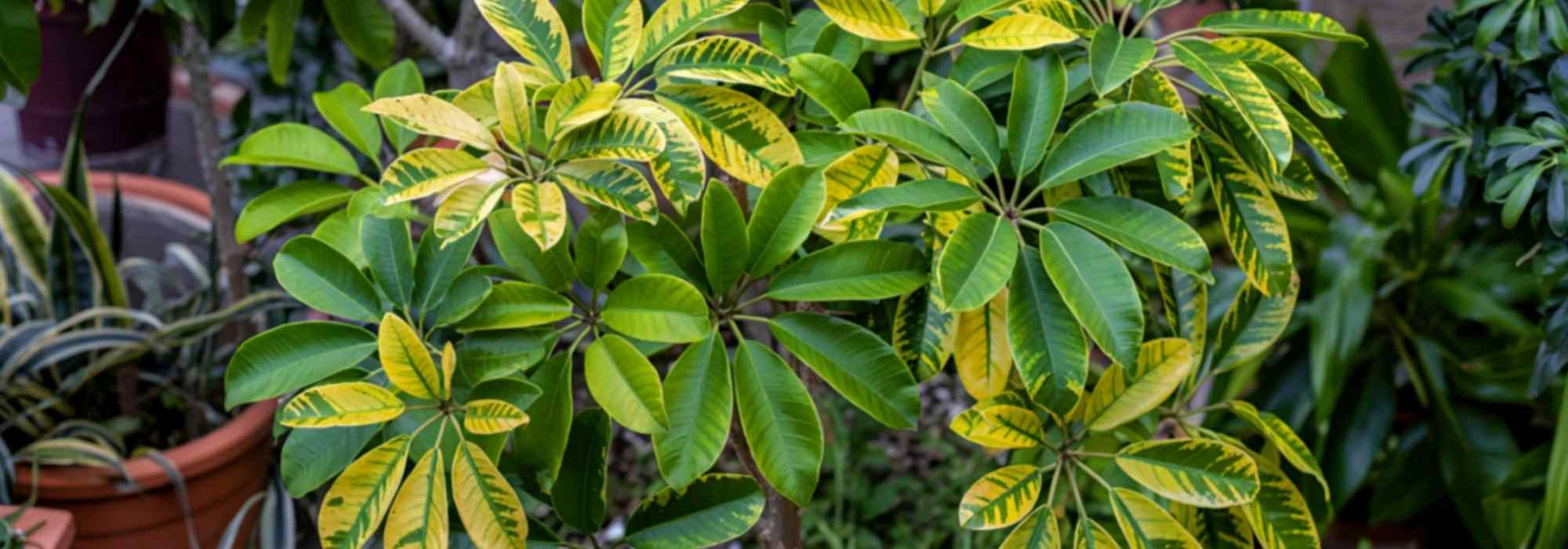
Schefflera: seasonal care
Easy indoor care for Schefflera
Contents
Schefflera, commonly known as the umbrella tree, parasol tree, or umbrella plant due to the arrangement of its foliage, is an indoor plant that enjoys a certain degree of popularity. Renowned for its luxuriant, palm-like, glossy foliage and its relative robustness, Schefflera grows in its natural habitat in montane forests of tropical and subtropical regions. Its ability to adapt to a wide range of indoor conditions makes it a popular choice, even for beginners. However, to help the dwarf Schefflera arboricola or the majestic Schefflera actinophylla reach their full potential, they require the best care, tailored to the seasonal cycle.
Watering the Schefflera, pruning, indoor Schefflera cutting, discover care rules and tips across the four seasons.

Spring, the awakening and the growth momentum of Schefflera
Spring marks the end of winter dormancy. With longer days and the increasing natural light, The Schefflera enters its most active growth phase. This is the most crucial season to kick-start the plant and provide it with the resources it will need for the coming months.
Watering the Schefflera
From early March, as new shoots appear, it is time to gradually increase the frequency of watering. The aim is to keep the potting mix evenly moist, but never waterlogged. Let the top layer of the substrate (about 3 to 5 cm) dry out between two waterings. Watering once a week should be sufficient.
Ideally, watering should be with rainwater at room temperature, or with demineralised water.
Water should drain freely through the drainage holes to prevent root asphyxiation. Never leave residual water in the saucer or the cache-pot.
Fertilisation
It is also the ideal moment to start fertilisation. The Schefflera is a heavy feeder during its growth phase. We use a balanced liquid fertiliser (type 10-10-10) for indoor plants, diluted to half strength, applied every three to four weeks. This nutritional input will support the formation of new leaves and sturdy stems.
Repotting the Schefflera
If the plant stagnates, if its roots start to emerge from the bottom of the pot, spring is the best time for the repotting. This repotting can take place in April or early May, every 2 to 3 years.
Choose a pot slightly larger (2 to 5 cm in diameter larger) and use a well-draining potting mix, ideally a blend of potting mix for indoor plants (60%) and perlite or coarse sand (40%). A small addition of compost is always possible to help the Schefflera settle into its new pot.
Of course, do not forget the drainage layer, made up of clay balls, at the bottom of the perforated pot.
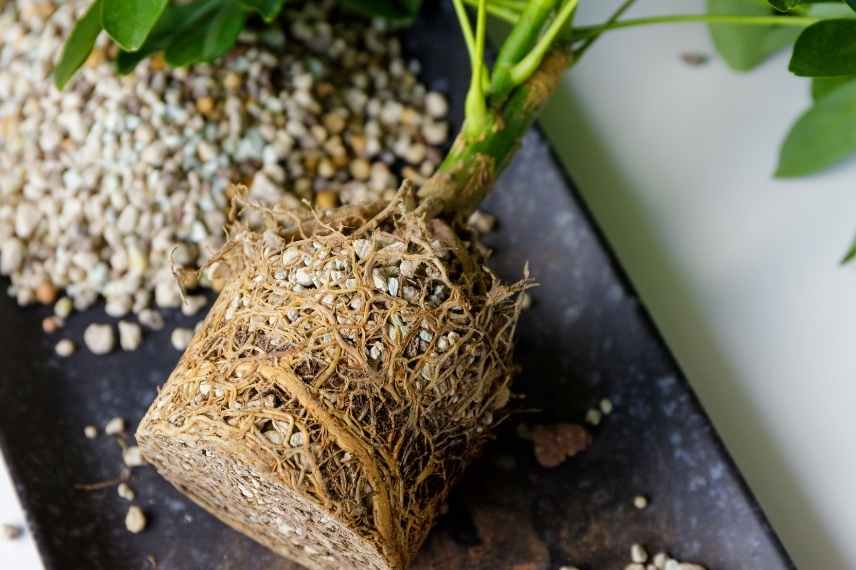
Spring is the best time for repotting the Schefflera
The pruning of the Schefflera
Spring is also the ideal time for the formative and rejuvenating pruning. The Schefflera tolerates pruning well and this is essential to maintain a bushy habit and prevent it from becoming etiolated. For this operation, it is recommended to wear gloves, as latex can be potentially allergenic to sensitive individuals.
Schefflera cuttings
Cut the long or leggy stems just above a node or an eye. Top-cuttings and stem cuttings can be rooted to propagate new plants. This propagation can be carried out in water or directly in the substrate.
Read also
Misting indoor plantsSummer, the season of full bloom for Schefflera
Summer marks the peak growing season. The days are long, the light is plentiful and the temperatures are ideal for this tropical plant. That said, a few precautions are needed.
Managing light and temperature
Indoors, the Schefflera appreciates bright indirect light during the summer. A spot near a window is suitable, provided it faces east or west. It should be protected from direct afternoon sun, or its foliage may burn. Variegated varieties generally require more light to maintain their colour patterns.
The ideal temperatures range from 18°C to 27°C. If night-time temperatures stay above 15°C, it may be placed outdoors, in a shaded spot sheltered from the wind, to give it a breath of fresh air and unfiltered natural light.
Watering and humidity
With the heat, evaporation and the plant’s transpiration increase significantly. Watering can become more frequent depending on the weather conditions. In very hot weather, you may need to water twice a week. The golden rule is to check the substrate: wait until the top layer is dry before watering again.
Air conditioning and heat can, however, dry the indoor air. The Schefflera thrives in relatively humid conditions. To compensate, you can mist the foliage regularly, early in the morning, or place the pot on a tray filled with clay balls or pebbles covered with water, without the bottom of the pot sitting in water. Maintaining a good level of humidity is crucial to prevent the appearance of red spider mites.
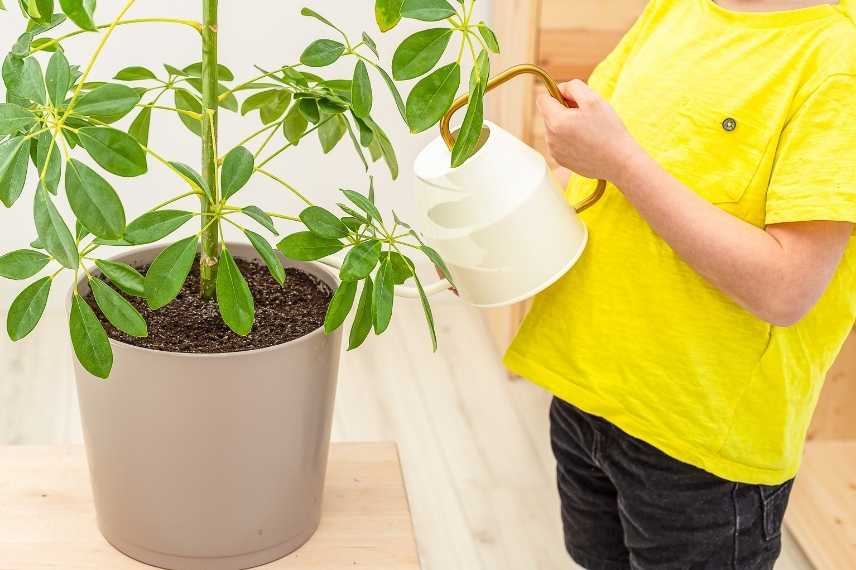
In summer, Schefflera watering should be increased
Fertilisation
Fertilisation continues at the same pace as in spring.
Autumn, the transition to dormancy for the Schefflera
Autumn is a transition period during which the plant begins to prepare for its winter dormancy. Growth slows, which requires a gradual reduction in care.
Watering
With reduced light levels and lower temperatures, the Schefflera uses less water. It is time to start spacing out watering. Let the potting mix dry more deeply than in summer, for example down to half the pot for large specimens. Thus, watering of the Schefflera every 10 days can be more than enough. The most common error in autumn and winter is overwatering, which inevitably leads to root rot.
Fertilisation
Towards the end of September or early October, it is time to stop fertilising completely. Applying fertiliser to a plant that slows its metabolism can lead to an accumulation of salts in the soil, harmful to the roots.
Pest prevention
If your Schefflera has spent the summer outdoors, it must be brought in before night-time temperatures drop below 10 °C. Before reintroducing it, a careful inspection is required. Check underneath the leaves and the stems for the presence of scale insects, whiteflies or red spider mites.
A thorough clean of the foliage with a damp cloth and, if desired, a preventive treatment (such as diluted black soap) is strongly recommended to avoid infesting the rest of the houseplants.
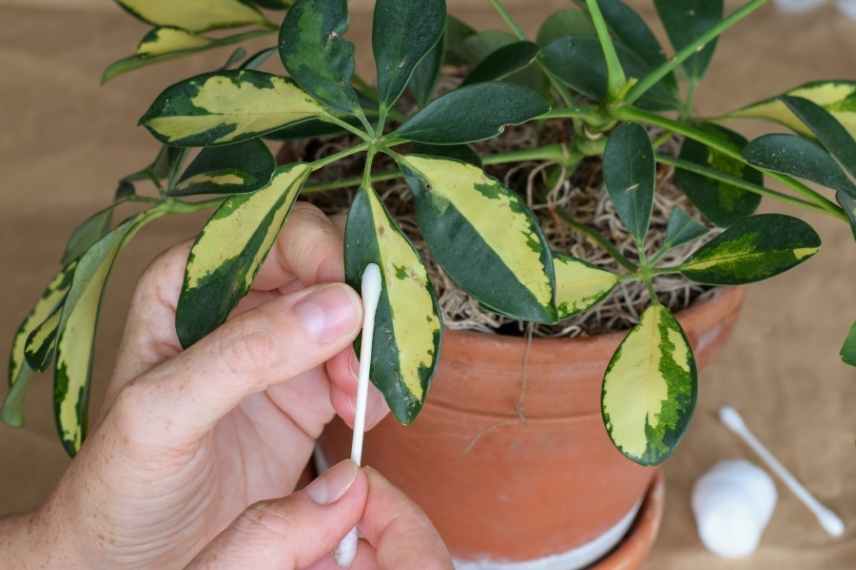
Pest surveillance is essential in autumn
Winter, the dormancy period for Schefflera
Winter is often the trickiest time for caring for indoor tropical plants. The low light levels, combined with heating that dries the air, create stressful conditions for Schefflera.
Light management
Even if Schefflera is in dormancy, it needs as much light as possible to maintain its vital functions. Place it in front of the brightest window, ideally facing south or west, where it can capture the maximum amount of direct filtered sunlight or intense indirect light.
It is vital to the plant to protect it from cold draughts from windows or doors, as well as from hot, dry air emanating from radiators or heat outlets. A sudden temperature change can trigger massive leaf drop.
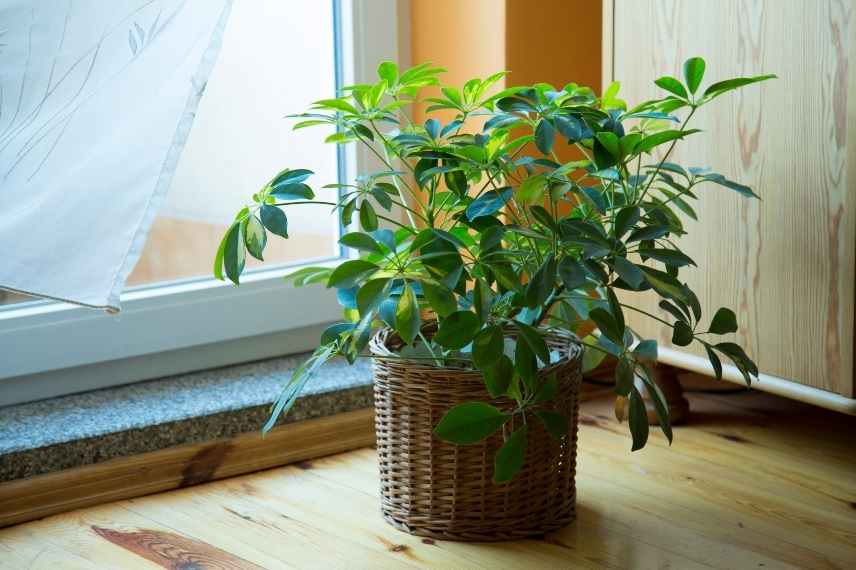
In winter, Schefflera should receive optimal light
Watering and humidity
During winter, Schefflera is in near-total dormancy. Care of Schefflera should be kept to a minimum. Water only when the potting mix is dry to two-thirds of the depth of the pot, or almost dry for large pots. Watering should occur only every two weeks, according to the room temperature. Overwatering in winter is the leading cause of death for Schefflera.
The dry air caused by heating can be offset by the same humidity-boosting method as in summer. However, this misting should be done sparingly due to the risk of fungal diseases in a cold, poorly ventilated environment.
Fertilisation
Stop fertilising altogether.
Year-round regular and systematic care
Some Schefflera care actions should be incorporated into the annual routine to ensure its long-term health:
- Cleaning the leaves with a damp cloth once a month
- Rotating the pot a quarter turn every week
- Monitoring the Schefflera leaves for any signs of disease or pests (yellowing or withered leaves, white spots, fine webs…).
- Subscribe!
- Contents
Comments