


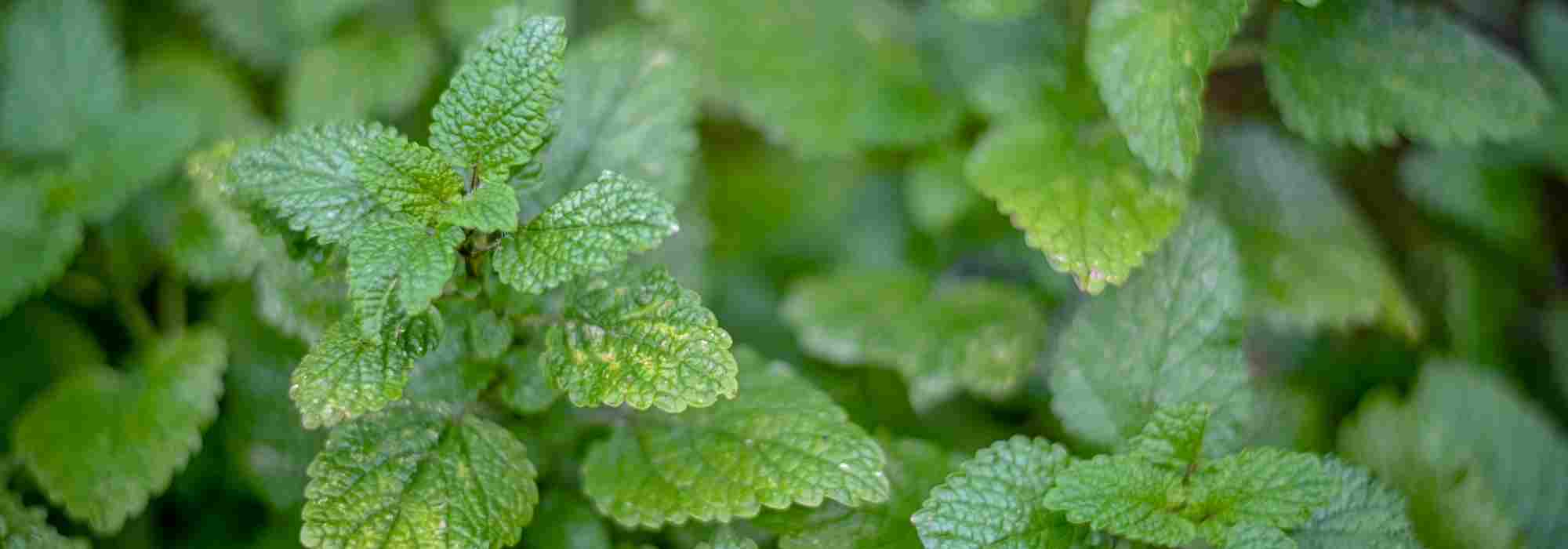
Stop the lemon balm invasion! Our solutions
Our solutions to control this lemon-scented aromatic herb
Contents
Whoever has lemon balm (Melissa officinalis) in their garden knows how useful and interesting it is, not only for its repellent properties but also for its medicinal and aromatic properties. It is also a pretty perennial with bright green foliage that exudes a very pleasant, fresh lemon scent. Very easy to grow, it will thrive anywhere, from the vegetable plot to an ornamental garden, in a flower bed or border. From May to October, its small leaves are harvested to make infusions or refreshing drinks such as lemon balm syrup, or to flavour desserts, marinades and vinegars… They can also be dried for winter use.
Nevertheless, lemon balm has a major flaw: it is very invasive. If you’re not careful, it will quickly take over every corner of the garden.
Discover our practical, easy-to-implement solutions to curb the vigour of lemon balm and enjoy its benefits.
Further reading : Lemon balm: sowing, planting and care.

Lemon balm, a plant with many benefits
Indeed, lemon balm (Melissa officinalis) is an aromatic perennial plant, endowed with a multitude of virtues. Used since Antiquity, lemon balm is known for easing digestive troubles, improving mood, relieving stress, and aiding sleep. In the Middle Ages, these virtues earned it a reputation and, from then on, lemon balm became the basis for liqueurs or the famous lemon balm water which Richelieu popularised. He even claimed that the lemon balm water had saved his life! One day, the unusual aroma of his favourite brew convinced him that someone was trying to poison him. He wasn’t wrong!
Today, people still use its leaves, fresh or dried, in infusions. Or in cooking.
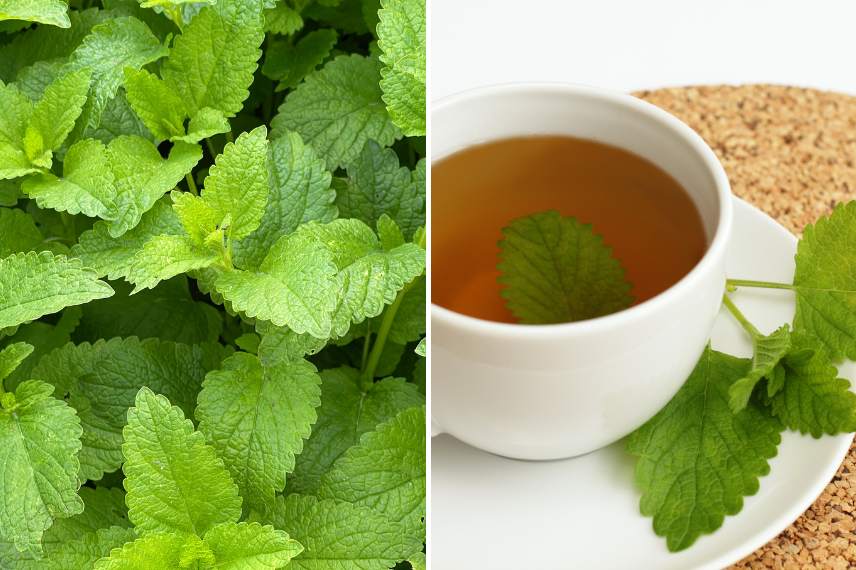 Lemon balm possesses medicinal, aromatic and repellent properties
But lemon balm has many other virtues as well. Notably for its repellent properties. The garden’s little pests such as aphids don’t care for it, and mosquitoes don’t either. Personally, I won’t set foot in the garden or on the terrace without rubbing the lemon balm leaves on my arms and legs. Unbeatable! And far more effective than any other solution, natural or otherwise, sold commercially.
Grown in the kitchen garden or in beds and borders, lemon balm has another advantage: extremely melliferous and nectariferous, it attracts swarms of pollinating insects, starting with bees. By the way, the term ‘mélisse’ comes from melissa, meaning ‘bee’ in Greek. That says it all!
With such virtues, it’s hard to be without a lemon balm young plant in your garden. But it’s not a foregone conclusion. There are solutions.
Read also
Growing lemon balm in potsDifferent ways to counter lemon balm invasion
To act effectively, one must first understand why lemon balm is so invasive. And it is doubly so! On the one hand, its root system consists of a network of long rhizomes that anchor themselves very easily and very quickly into the soil. On the other hand, the flowers are followed by tiny achenes that scatter seeds abundantly. That is why lemon balm readily self-seeds almost everywhere in the vegetable garden and beyond.
That said, it is fairly easy to curb the invasive exuberance of our aromatic herb. Moreover, with very simple, economical solutions that require little effort. But they will have to be combined due to lemon balm’s extraordinary capacity to multiply. A bit like mint.
Pot culture
Growing lemon balm in pots is certainly one of the most effective solutions to limit its invasiveness. It is enough to sow it or plant it in a substrate made up of universal potting compost, garden soil and sand in equal parts.
If you want to integrate your lemon balm more naturally into your borders or the vegetable patch, you simply need to bury the pot, ensuring that it remains 5 cm above the surface to prevent rhizome overflows. Likewise, remember to repot it regularly, as the rhizomes can insinuate themselves through the pot’s drainage holes.
This solution is effective against rhizome propagation, but not against spontaneous seedlings.
The removal of the flowering stems
To prevent the dispersion of lemon balm seeds (which reseed and germinate very easily within a perimeter of several metres around the mother plant), you simply need to prevent the formation of the achenes. And for that, you must cut all flowering stems, between June and August. A good pruning shear and you are free!
Personally, in June, I prune my lemon balm plant to about 20 to 30 cm from the ground, thus stopping any flowering. This pruning has the advantage of removing all spontaneous seedlings, but also of stimulating the appearance of new shoots, richer in essential oil.
As for the leaves, don’t throw them away! Dry them to use in winter, in infusions or in cooking. Patricia also explains how to dry lemon balm leaves.
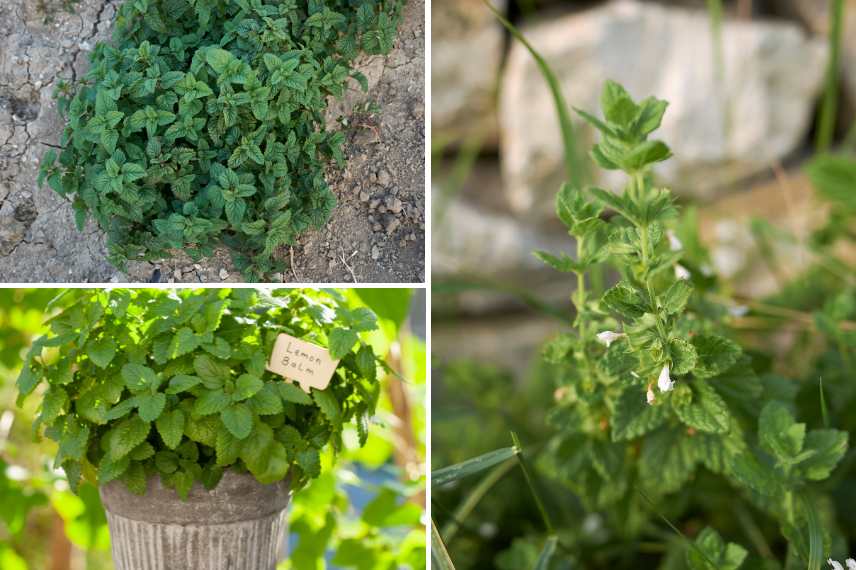
The removal of the flowering stems, the division of the clump or growing in pots are effective against invasion
Installing a thick mulch
A thick mulch of RCW (ramial chipped wood), fallen leaves or mulch such as the flax flakes, miscanthus or hemp, is fairly effective against spontaneous seedlings. It will also help limit weed proliferation and keep moisture to a minimum. Nevertheless, this solution is not 100% foolproof.
Manual weeding
Okay, you have let yourself be overwhelmed. And already, you see young seedlings appearing, fairly easy to recognise by their characteristic scent. At this stage, the only effective solution is manual weeding to remove all these young shoots. Weeding that must be careful and very regular, because every day, new seedlings will appear. But after a month, you will have removed them all.
The division of the clump
The division of the lemon balm clump is the ultimate solution to avoid too-excessive vigour. Indeed, simply uproot your lemon balm plant with a digging fork by circumventing it and share the rhizome stock into several segments. Then you replant simply one of the rhizome pieces which should quickly flourish.
Don’t hesitate to share the other rhizome fragments with friends and neighbours. Not forgetting to warn them of lemon balm’s propensity to spread elsewhere…
This clump division is carried out either in spring, around March or April, or in autumn, by October at the latest.
- Subscribe!
- Contents
Comments