


Tree peony and herbaceous peony: which should you choose for your garden?
Some fairly different flowering perennials.
Contents
Peonies peonies enchant us with their generous and colourful flowering. Long-lived, these perennials are true garden classics. There are several species, which can vary greatly. Shrub peonies, herbaceous peonies or Itoh peonies: discover their characteristics to help you choose the right one.
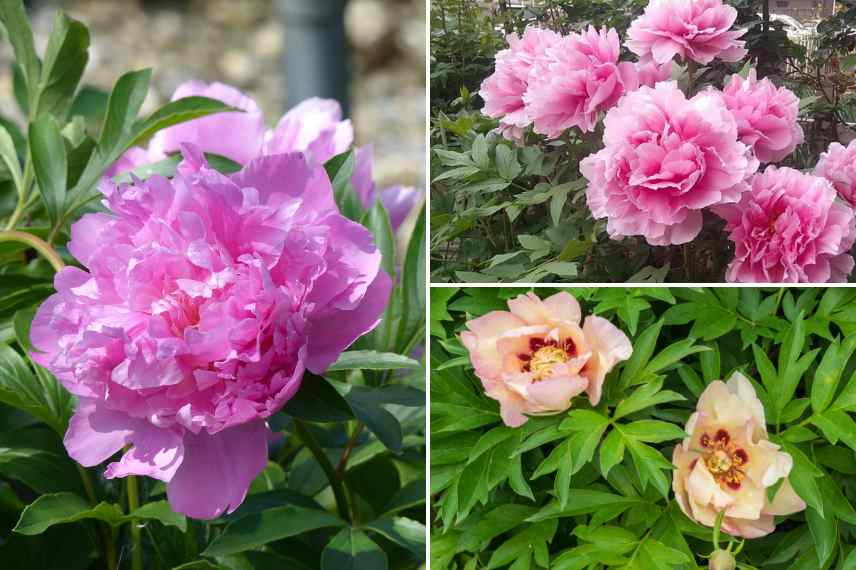
On the left, herbaceous peony ‘Monsieur Jules Elie’. On the right, shrub peony ‘Cotton Candy’ and Itoh peony ‘Pastel Splendor’

Herbaceous peonies: the easiest to grow.
These are the best known and most widespread. Also called the “Chinese peony” or the “Japanese peony”, they reward us with a beautiful palette of classic colours, often in shades of red, pink or white. There is the delicate pink, white-tinged from Paoenia lactiflora ‘Shirley Temple’, the bright red of ‘Command Performance’ or the white of the aptly named ‘Immaculée’.
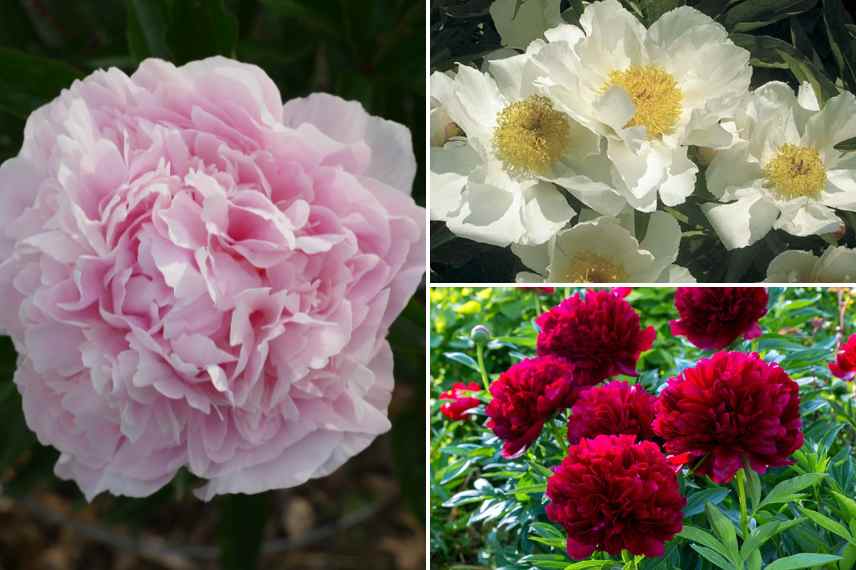 Peonies ‘Shirley Temple’, ‘White Wings’ and ‘Command Performance’
These peonies can produce single or semi-double flowers, revealing a clearly visible heart of stamens, as with ‘White Wings’. For its part, ‘Gay Paree’ offers anemone-centred flowers with a ruffled heart. Among herbaceous double peonies, there are pom-pom flowers that are very frilly, or very refined and rounded forms reminiscent of antique roses. For example, ‘Fringed Ivory’, a beautiful warm white.
Their flowers reach between 7 and 20 cm in diameter.
Finally, many varieties are quite fragrant, exhaling notes of lily of the valley or rose. This is the case of ‘Madame Calot’, of ‘Miss Eckhardt’ or of ‘Edulis Superba’.
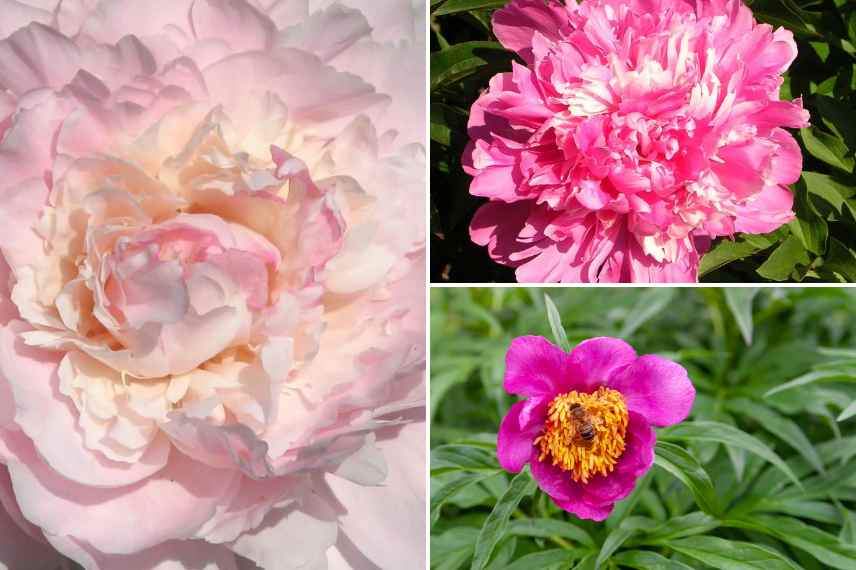 Peonies ‘Madame Calot’, ‘Edulis Superba’ and Paeonia anomala
In terms of habit, these peonies do not exceed one metre in height. In winter, they disappear completely, but return in spring by producing large flower buds from the ground. Flowering occurs from May to June.
Very hardy down to -50°C and robust, they tolerate a wide range of growing conditions. They can even thrive in slightly heavier, calcareous soil. They also tolerate sun that is not scorching as well as partial shade. They can even be grown in pots, provided you choose a sufficiently deep one. There are even dwarf varieties, such as the Patio Peony Kiev, with a height of 70 cm and a spread of 50 cm.
We should also mention the botanical peonies (not derived from hybridisation), such as Paeonia anomala, very easy to grow and magnificent with its bright pink flowers and yellow stamens. They prefer warm sites, for example at the top of a large rock garden, even on calcareous soil. Their lifespan, however, is shorter.
Herbaceous peonies are ideal for:
- beginner gardeners;
- cultivation conditions that are somewhat less ideal, notably with harsh winters and clay soils;
- growing in pots;
- a fairly classic colour range, easy to pair with other plants;
- fragrant flowering;
- a later flowering;
- beds or mixed borders;
- small budgets.
Shrub peonies: the most majestic
These are the most impressive, capable of forming a true bush reaching 2 to 3 metres in height or spread. Their flowers are very large, reaching up to 25 to 30 cm in diameter. They can be single as with Paeonia delavayi ‘Lutea’, or double as with Paeonia suffruticosa ‘Xue Ta’.
In terms of colours, they offer original hues, such as salmon (Paeonia suffruticosa ‘Jin Ge’) or green (Bush peony ‘10 Lu Mu Ying Yu’). There are a few scented varieties, such as ‘Hai Huang’.
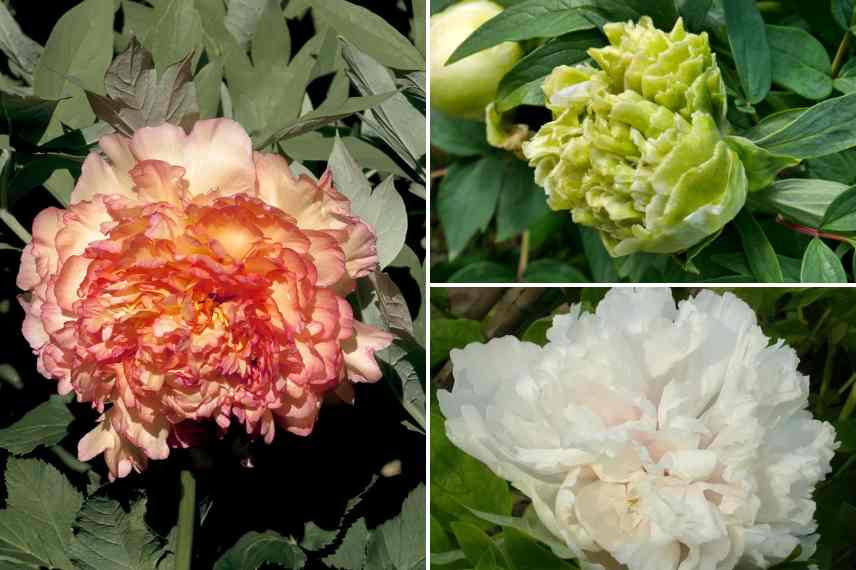
Bush peonies: ‘Jin Ge’ on the left, ‘Lu Mu Ying Yu’ and ‘Xue Ta’ on the right
Flowering takes place early in spring, as early as April, on the shoots.
These peonies have slow growth and take time to establish themselves. Indeed, they begin by developing their root system, before producing new branches. It takes at least 5 to 7 years before you can enjoy a first genuine flowering.
Because of their strong and deep root system, they require a large volume of soil to develop well. Pot culture is therefore not recommended, even if it can be tested by choosing a large container and the smaller varieties: Paeonia suffruticosa ‘Wu Long Peng Sheng’, ‘Xue Ta’, ‘Cai Hui’, ‘Ri Yue Jin’, or also Paeonia (x) lutea ‘Alice Harding’.
Unlike herbaceous peonies, which die back in autumn, these bush peonies behave like shrubs and keep their stems in winter (though the foliage still falls in autumn).
More exacting in their cultivation requirements, these delicate peonies require a shaded and wind-sheltered exposure, in a warm site (west-facing exposure preferred). They need 4 to 6 hours of sun per day, but will not tolerate scorching exposures. They fear late frosts, to which the flower buds do not resist. They require a light, fertile and well-drained soil (that does not retain water). Their stems may require staking to prevent bending under the weight of the flowers.
Bush peonies are ideal for:
- gardens with ample space;
- patient gardeners who are prepared to wait several years before enjoying a generous flowering;
- an early spring flowering;
- a wider colour palette;
- an isolated position or in a hedge.
Itoh peonies, or intersectional peonies: a wealth of qualities
These are hybrids, a cross between herbaceous peonies and shrub peonies. They combine the best of both. It was the Japanese horticulturist Toichi Itoh who originated them in the 1930s and 1940s. But it would be until the 1980s that they were introduced to the United States, and subsequently marketed,
These peonies are first and foremost hardy, tolerating frosts down to -29°C. They behave like herbaceous peonies.
But they produce large flowers, with colours sometimes quite unusual, as with shrub peonies: peach, cinnamon, apricot or Canary yellow. This is the case with the Paeonia Itoh ‘Callies Memory’, which features a gradient of cream yellow and peach, maculated with blood-red at the centre. Also note the sunny ‘Yellow Crown’, with bright semi-double flowers, satin-like in appearance, with a heart full of golden-yellow stamens. They have sturdy stems that do not require staking. Their flowering can be very long, lasting up to a month.
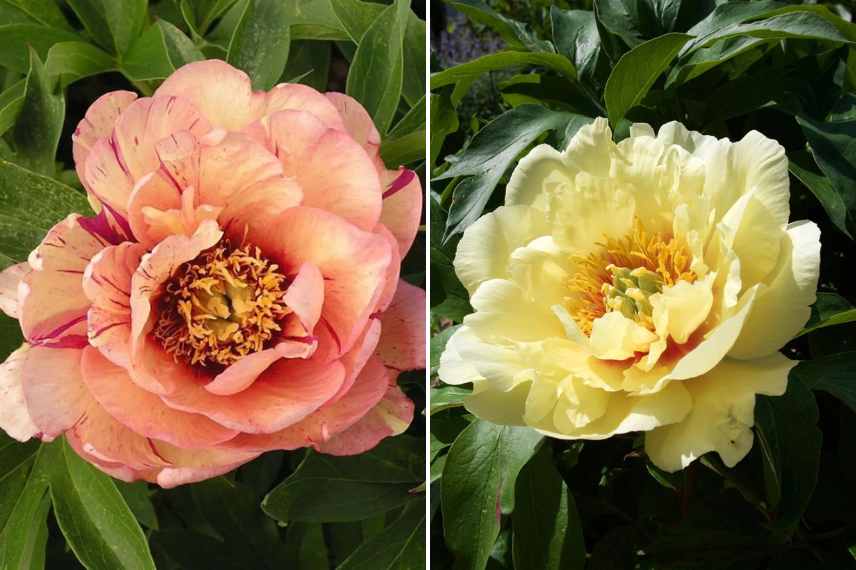
Itoh peonies ‘Callies Memory’ and ‘Yellow Crown’
In terms of culture, they prefer partial shade locations, for example on the edge of a grove or sheltered by a hedge. They require rich, cool, deep and well-drained soil.
Itoh or intersectional peonies are ideal for:
- beginner gardeners;
- a long flowering period;
- a broader colour palette;
- larger budgets.
- Subscribe!
- Contents
Comments