


What is marcescence?
These winter-hardy trees
Contents
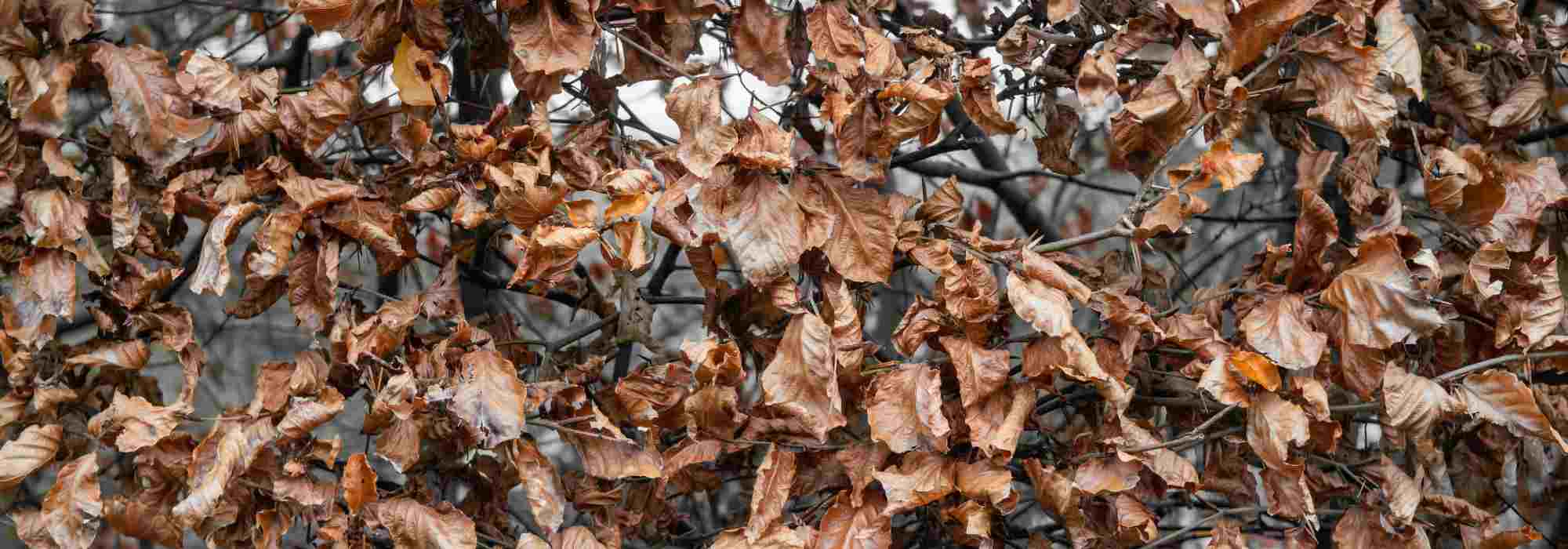
Winter is well and truly here, and in the landscape or our gardens, among the bare plants, a few trees that are a little out of the ordinary stand up to the cold! Their russet foliage remains curiously attached, seeming to defy the coldest season. These are trees or bushes that are described as marcescent.
Which ones are they, and why don’t they behave like all deciduous plants as winter approaches? We also explain in this article how to make the most of the beauty and originality of marcescent trees and shrubs in a garden.

A bit of botany...
The word marcescent appeared in France in the 18th century. Etymologically it derives from the Latin “marcescere” which means “to wither or to fade”. It is used to define the above‑ground parts of a plant, chiefly its leaves, but also the calyx and corollas, which do not detach from the plant once dead, in autumn, after they have become dry and withered. This dry foliage will remain attached to the plant until the bud burst period of the new leaves in the following spring, which will replace these dead leaves that fall away as they dry. Note that while the word marcescent is generally used in this sense, it is also employed to describe the crown of leaves on certain palms that remains desiccated under the new fronds, potentially staying in place for several years without falling from the tree.
Marcescence is, in reality, regarded as a variation of deciduity. One could thus say that these are late‑deciduous trees: indeed, the dry leaves with their brown to russet tint remaining attached to the tree all winter eventually fall, but only a few months after deciduous trees, which shed their leaves in autumn. This marcescent character may be complete or partial, and even temporary. The tree is left leafless for only a few weeks before the bud burst, which occurs later or earlier depending on the year.
The retention of desiccated and dead elements occurs on a healthy plant that is just entering its vegetative rest. The marcescence phenomenon is observed essentially on young trees and shrubs, notably oaks.
Biologically speaking, in marcescent trees, the enzymes and plant hormones responsible for the degradation of tissues at the base of the petiole (the leaf stalk) are less active or absent. These enzymes, such as cellulase and pectinase, are responsible — with the day length shortening — for the abscission phenomenon, which triggers the physiological process of shedding, allowing the leaf (fruit or flower) to detach. Due to the inactivity of the degradation enzymes or the slower formation of the abscission zone (especially in younger specimens), abscission is not total and the marcescent leaves remain attached to the ramure or stems by their petioles, even after drying and colour change.
Concretely, this phenomenon allows the tree to better protect its future buds and its new shoots during winter and to reabsorb some of the nutrients from the dead leaves before they fall in spring. This process is also often linked to a symbiotic relationship that the tree would establish with animals such as deer and herbivores: they would turn away from its foliage, which is not very nutritious, instead of attacking its buds or its bark. According to some ecologists, this is also a genuine survival strategy in the face of the cold.
Marcescence varies with climate and temperatures, but it should not be confused with semi-persistent foliage: the latter do not desiccate their foliage. In milder climates, they simply retain all or part of their foliage, often turning colour, becoming almost evergreen, and thus referred to as semi‑persistent (some roses, Lonicera fragrantissima, shrubby fuchsias, deciduous euonymus, etc.).
Olivier explains in images the differences between deciduous, persistent or marcescent foliage in his video.
→ Read also: How do plants resist the cold?
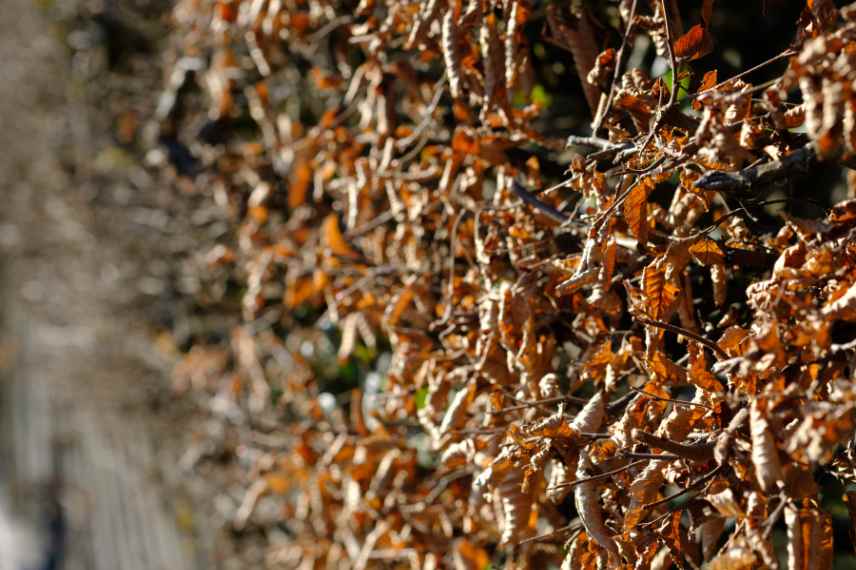
The presence of a marcescent hedge in the garden: warm colours and a unique texture!
Plants with marcescent leaves
When we talk about marcescence, it mainly applies to trees and shrubs, three main ones commonly found here (all belonging to the same order, that of the Fagales), all native to European forests:
- Common beech (Fagus sylvatica) and its numerous cultivars (purple with the Fagus sylvatica ‘Atropurpurea’, ‘Franken’ variegated with white and dwarf, ‘Dawyck‘ fastigiate, etc.)
- Hornbeam and the hornbeam hedge (Carpinus betulus) and their varieties (Carpinus ‘Fastigiata’ with an oval form, ‘Orange Retz’ with black bark, weeping as in the ‘Carpinus betulus ‘Pendula’, etc.)
- Many oaks are highly ornamental, such as the Pyrenean oak (Quercus pyrenaica), the sessile oak (Quercus petraea) and its varieties, the truffle oak (Quercus pubescens), several pedunculate oaks (Quercus robur and its many cultivars such as the Quercus robur ‘Salicifolia’ with elongated leaves, the Quercus robur ‘Pectinata’, the superb Quercus robur ‘Crimson Spire’ and ‘Fastigiata Koster’ with a columnar habit, or with a fastigiate habit like the Quercus robur ‘Zeland fastigiata’. There are also less well-known and remarkable oaks such as the Quercus petraea ‘Insecata’ with laciniate foliage, the Quercus imbricaria (laurel-leaved oak), the Quercus alba ‘Longigemma’, the Macedonian oak (Quercus trojana), the Quercus acutissima, some Quercus dentata, the Quercus falcata, the Quercus lanuginosa, another pubescent oak… the list goes on.
- In some young trees such as chestnuts (Castanea sativa) and willows or in Ostrya (\Ostrya carpinifolia), but also in milder climates with the bald cypress (Taxodium distichum), the larch or the Pseudolarix, marcescence can also be discussed.
N.B. : fruits or flowers can, themselves, also remain attached as they dry, as seen on Paulownia, honesty, cardoon, sedums and some hydrangeas.
→ Read also Decorative dried flowers in winter.
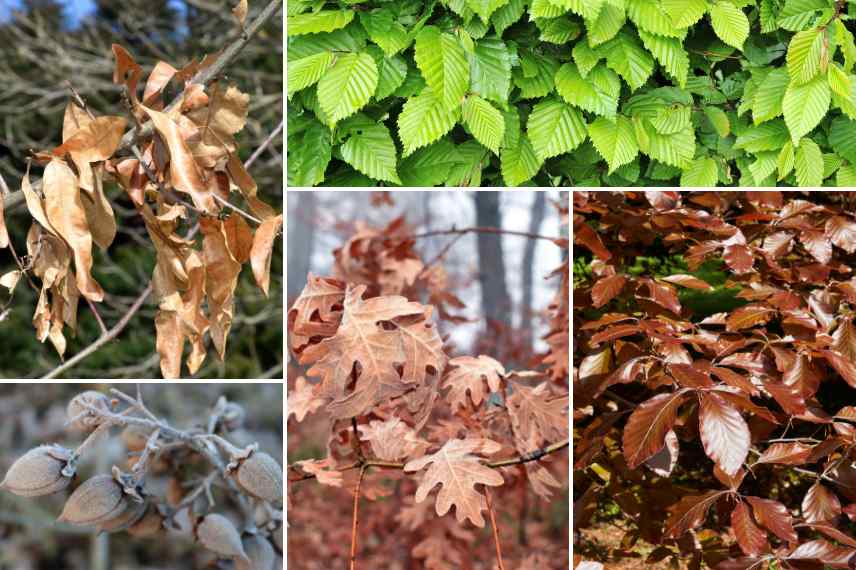 Quercus imbricaria, Carpinus betulus (summer foliage), fruits of Paulownia tomentosa, Quercus pyrenaica and Fagus sylvatica ‘Atropurpurea’
How to use marcescent trees in the garden?
Marcescent trees remain particularly decorative for the colour they bring to the garden, in honeyed to rust tones and for their texture that is very different from deciduous trees and shrubs. It is an undeniable charm asset during the winter months. Oaks are often used as specimen trees to enjoy this exceptional character.
To create evolving screening hedges
This is one of the main uses, because these screening hedges provide a very good privacy screen all year round. Hornbeam is renowned for this function, and has been successfully used since the 17th century in European gardens.
These hedges are sometimes low, clipped to a straight line, imagined as a dotted line as in Stéphane Marie’s Jardin de la Maubrairie in the Cotentin, and often taller in many château-style French gardens, sometimes clipped into a screen, but also in countryside gardens where they can remain free. The marcescent hedge is indeed adaptable to almost all garden styles, with height adjustable to suit the need.
Read also: Why and how to design different spaces in the garden?
To create mazes
When deciding to create a maze at home, one often relies on hornbeams, which are among the finest choices for this project, because repeated pruning stimulates its branching. Thus, you retain a visually dense maze thanks to the persistence of the leaves all winter.
→ Read also: Creating a maze in the garden.
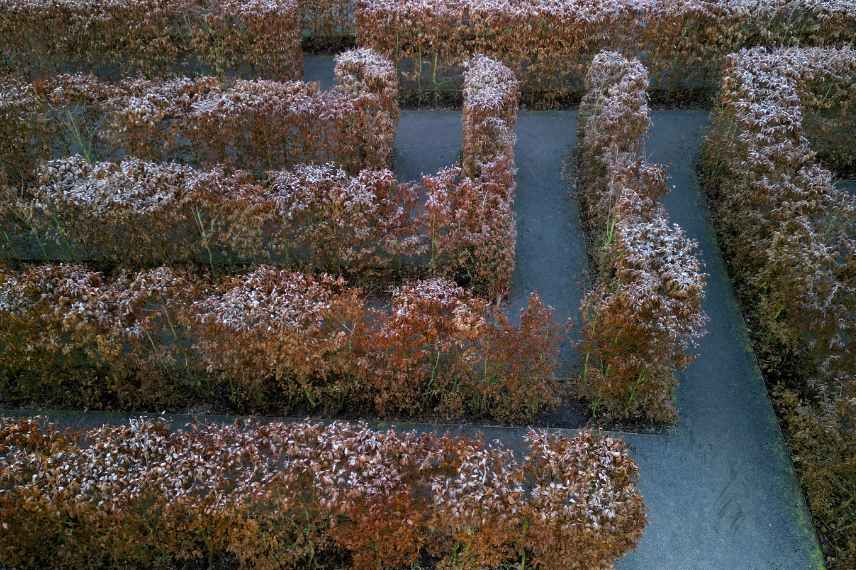
The hornbeam labyrinth keeps its neat outline and interest all year round
In topiary art
The hornbeam — again! — not fearing pruning, is perfectly suited to forming topiaries, shrubs that one can shape at will according to one’s inspiration into figurative art. It is frequently seen in alignments with a repeated motif in French-style gardens.
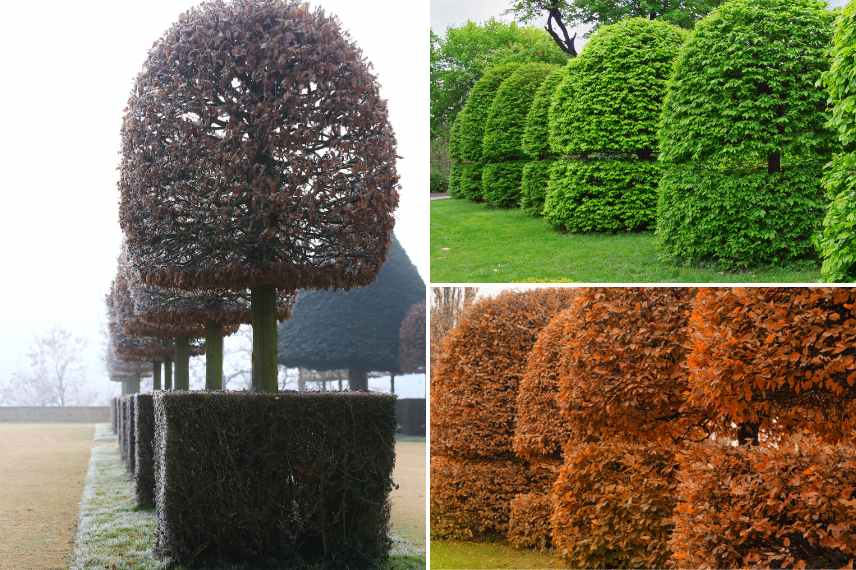
To the right, hornbeams formed into topiaries in summer and in winter.
To create arches or green cradles
Hornbeam is also valued in creating structures such as plant arches, tunnels or green cradles, sorts of trellised gloriettes allowing one to sit underneath.
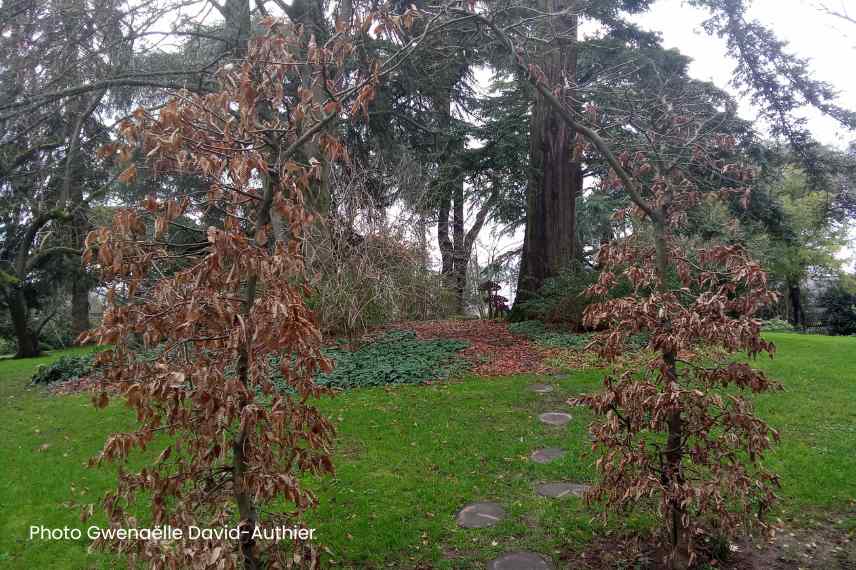
A pretty hornbeam arch at the Jardin des plantes d’Angers (© Gwenaëlle David Authier)
In autumn scenes
Marcescent trees pair easily with the tawny colours of grasses at their peak and with all autumn-colour bushes, from yellow to orange to red.
In a winter garden
The marcescent leaves filter light with a beautiful translucence: in a sunny position in a winter garden, the effect is particularly effective and magical during the cold season.
- Subscribe!
- Contents
Comments